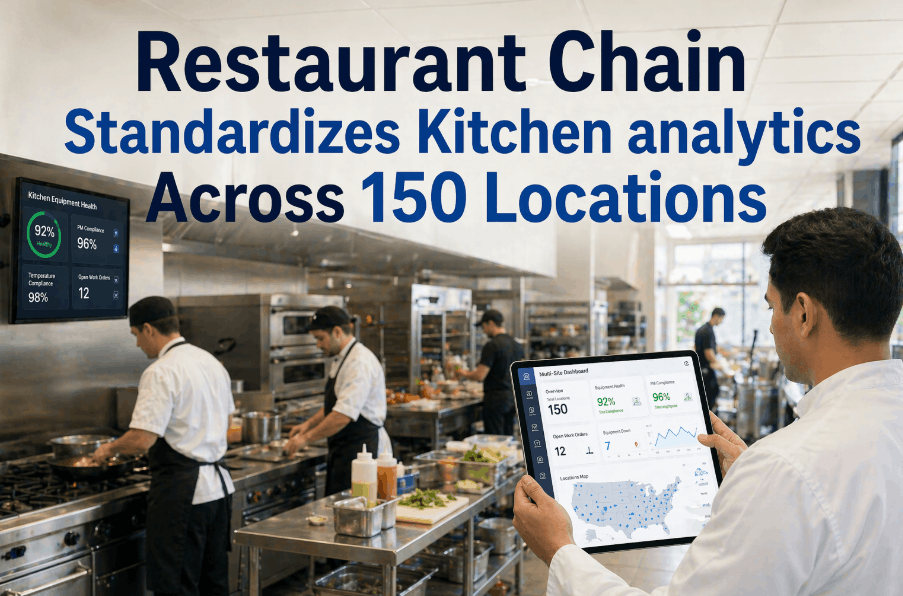
A multi-location restaurant chain operating 150 high-volume kitchen production sites was absorbing an estimated $3.2 million annually in losses tied to unplanned equipment failures, recurring health inspection violations, and inconsistent kitchen operations across its distributed footprint. Operating on paper-based checklists and reactive maintenance schedules, the chain's operations managers had zero standardized visibility into kitchen equipment health across locations. Following a structured pilot across eight locations, the chain deployed ifactory's Multi-Site Dashboard across all 150 sites — reducing equipment failures by 45%, cutting health inspection violations by 80%, and achieving kitchen equipment uptime of 96.8% within twelve months of full rollout. To see how ifactory structures similar deployments for multi-location restaurant operations, book a demo with the engineering team.
A 150-Location Restaurant Chain with No Unified Kitchen Visibility
The Compounding Cost of Fragmented Kitchen Operations Across 150 Locations
Multi-location restaurant chains face a kitchen analytics challenge fundamentally different from single-facility food service operations: equipment failures do not merely disrupt one site — they create service gaps that cascade across dining commitments, delivery SLAs, and peak-hour production schedules that cannot be rescheduled. This chain's 150 locations each managed kitchen maintenance independently, with no standardized inspection framework and no mechanism for sharing fault pattern data across sites. When a commercial fryer began degrading or a refrigeration compressor showed early signs of failure, there was no early warning signal. The failure only became visible when the unit stopped functioning during service. Across 150 locations operating under this reactive model, the chain was absorbing $3.2 million annually in avoidable breakdown costs, emergency labor, health inspection penalties, and lost service capacity. To understand how ifactory closes this visibility gap for distributed restaurant networks, book a demo with the engineering team.
ifactory Multi-Site Dashboard: Unified Kitchen Intelligence Across All 150 Locations
Following a competitive evaluation and an eight-location pilot, the chain's operations leadership selected ifactory's Multi-Site Dashboard for its ability to standardize inspection workflows across distributed restaurant operations, deliver real-time fault visibility to regional and corporate maintenance teams, and generate AI-driven fault prediction from inspection data without requiring full IoT sensor infrastructure at every location. The platform was deployed to standardize fryer and cooking equipment PM scheduling, refrigeration temperature analytics, and ventilation condition inspections across all 150 sites under a single operations interface accessible from any device in the field. To see how ifactory configures this for multi-location restaurant operations, book a demo with the team.
Full Network Deployment Across 150 Locations in 74 Days
All 1,200+ assets across 150 locations inventoried and classified into criticality tiers based on service consequence, failure frequency, and health compliance exposure. Mobile inspection templates designed per asset class — fryers, refrigeration, HVAC, and dishwashing systems — with field-validated condition criteria and structured fault escalation logic.
ifactory Multi-Site Dashboard deployed across the chain's eight highest-volume locations. Kitchen staff and maintenance technicians trained on mobile inspection workflows within two days per site. AI engine initialized with historical fault records and incoming inspection data. First predictive fault alert issued on Day 21 — identifying abnormal temperature variance in a walk-in refrigeration unit consistent with early-stage compressor degradation. Planned intervention completed with zero health compliance risk and no service disruption.
Platform deployed to all remaining 142 locations in six regional cohorts. Regional maintenance coordinators onboarded to multi-site dashboard views. Cross-location fault pattern benchmarking activated, surfacing that fryer heating element failures were occurring at a 3.1x higher rate at coastal humidity locations — a pattern entirely invisible under the prior paper-based model. Book a demo to learn how ifactory surfaces similar cross-network fault patterns for your restaurant locations.
Full network inspection workflows validated across all 150 sites. Corporate operations and maintenance leadership dashboards activated with network-wide breakdown frequency, open work order status, and kitchen condition heatmaps by location. Individual asset condition baselines confirmed for all 1,200+ assets within 18 days of first data ingestion per location.
12 Months of Measured Reliability Improvement Across the Full Network
The transition from isolated paper-based kitchen management to a standardized AI-driven multi-site platform produced measurable, sustained improvement across every tracked reliability, compliance, and financial dimension within the first 90 days of full network deployment. Equipment failures fell across all three primary kitchen asset categories as the AI prediction engine intercepted developing faults before they reached service-disrupting thresholds. Mean time to resolution dropped sharply as pre-fault condition data eliminated diagnostic discovery time from every field dispatch. Kitchen equipment uptime across the network reached 96.8% — the highest recorded availability in the chain's operating history. Health inspection violations fell by 80% within the first two quarters. To explore what these results would look like across your restaurant network, book a demo with ifactory's food service team.
| Metric | Before ifactory | After ifactory | Change |
|---|---|---|---|
| Unplanned equipment failures | 112 incidents / month | 62 incidents / month | −45% failure reduction |
| Total annual maintenance spend | ~$4.1M | ~$2.2M | −46% cost reduction |
| Emergency labor as % of budget | 48% | 17% | −65% emergency labor share |
| Health inspection violations | 34 / quarter | 7 / quarter | −80% violation reduction |
| Mean time to resolution (MTTR) | 5.3 hours | 1.9 hours | −64% resolution time |
| Avg. fault prediction lead time | 0 days (reactive) | 7.2 days advance | 7.2-day early warning |
| Refrigeration failures across network | 38 / month | 19 / month | −50% refrigeration failures |
| Fryer and cooking equipment faults | 51 / month | 29 / month | −43% fryer faults |
| HVAC and ventilation breakdowns | 23 / month | 14 / month | −39% HVAC breakdowns |
| Kitchen equipment availability (avg.) | 84.2% | 96.8% | +12.6 pts availability gain |
| Locations with standardized digital inspection | 0 | 150 / 150 | Full network coverage |
| Full network deployment timeline | N/A | 74 days | Fully live in 74 days |
Why the Results Were This Significant
Refrigeration fault prediction eliminated the chain's highest health compliance risk category. The 50% reduction in refrigeration failures was the platform's most compliance-critical outcome. ifactory's AI engine detected compressor load anomalies, temperature drift patterns, and condenser degradation an average of 7.2 days before anticipated failure — converting events that would have triggered health violations and food safety incidents into scheduled maintenance interventions with zero compliance exposure.
Cross-location benchmarking exposed systemic failure patterns invisible to individual sites. By aggregating inspection data across all 150 locations, ifactory identified that fryer heating element failures were occurring at a 3.1x higher rate in high-humidity coastal sites — attributable to accelerated oxidation under sustained moisture exposure. A targeted component specification change deployed network-wide reduced the excess failure rate by 71% within eight weeks of identification.
Pre-fault mobile data compressed resolution time by 64%. Prior to deployment, technicians arrived at fault sites with no inspection history, no fault context, and no pre-diagnosis data. ifactory's automated work orders pre-populated each dispatch with the specific condition fault signature, probable failure mode, recommended parts, and full asset service history — reducing MTTR from 5.3 hours to 1.9 hours per incident and directly reducing service interruption risk per failure event.
Standardized inspection data enabled evidence-based capital planning across the network. With consistent asset condition records across all 150 locations, the chain's operations team identified 58 kitchen assets whose repair cost trajectories indicated replacement within 18 months — enabling proactive capital allocation and avoiding an estimated $720,000 in projected emergency replacement and service disruption costs over the subsequent two years. To see how ifactory's condition-based planning applies to your kitchen asset portfolio, book a demo with the engineering team.
Operational, Financial, and Compliance Outcomes Across the Full Restaurant Network
Standardized AI-Driven Kitchen Analytics Across a Distributed Restaurant Network
This restaurant chain's 45% reduction in equipment failures and 80% reduction in health inspection violations were achieved by closing the information gap that made reactive kitchen management the only available operating model across 150 independent locations. ifactory's Multi-Site Dashboard gave the chain's maintenance and operations teams standardized, real-time kitchen condition visibility across all 1,200+ tracked assets — and converted that visibility into advance fault warnings actionable an average of 7.2 days before failures reached service-disrupting thresholds. Kitchen equipment uptime reached 96.8% across the network, health compliance violations fell by 80%, and the maintenance budget's emergency response share dropped from 48% to 17% within the first twelve months.
The compounding value extends well beyond the first year's $1.9 million in direct savings. Every inspection cycle enriches the asset condition history that improves AI fault prediction accuracy across fryer, refrigeration, and HVAC equipment classes. Every avoided breakdown reduces the operational strain and compliance risk that accumulates in a distributed network operating without condition intelligence. To assess what a deployment of this model would look like for your restaurant operation, book a demo with ifactory's food service engineering team.