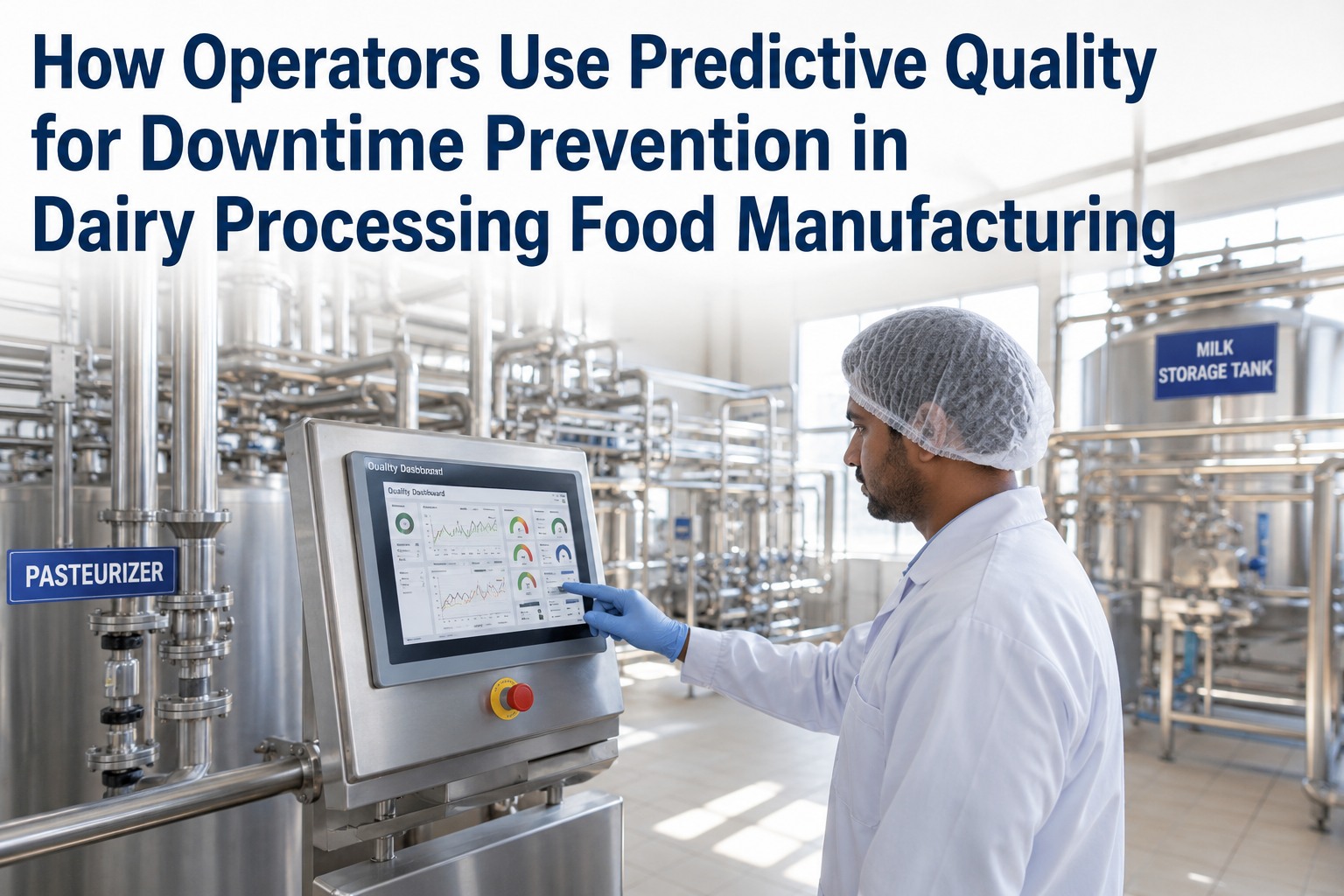
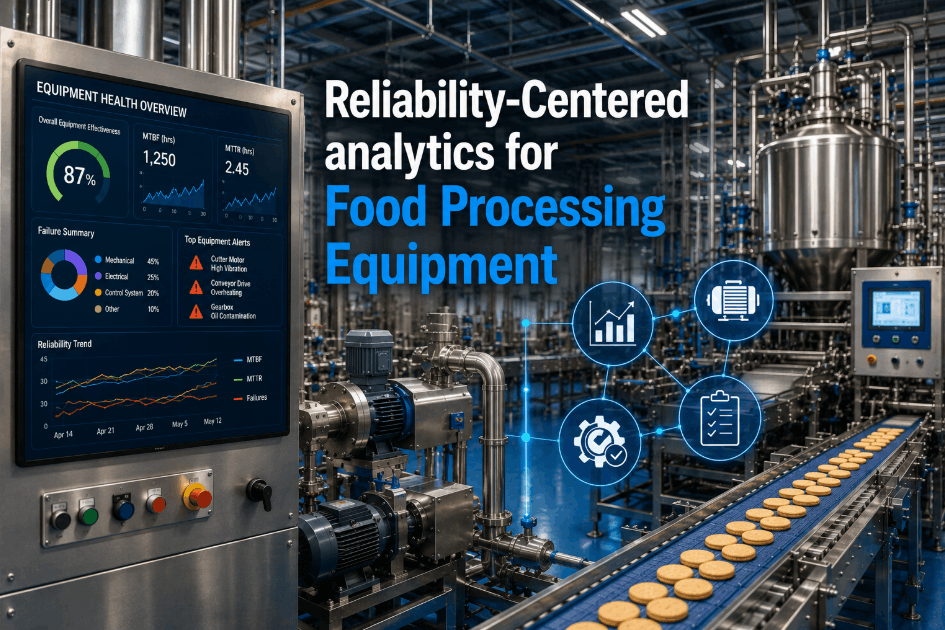
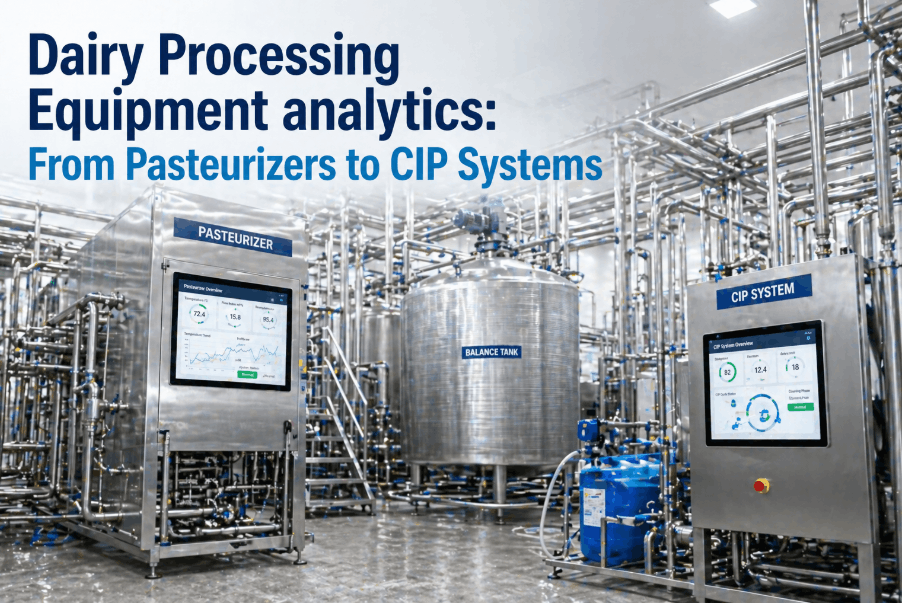
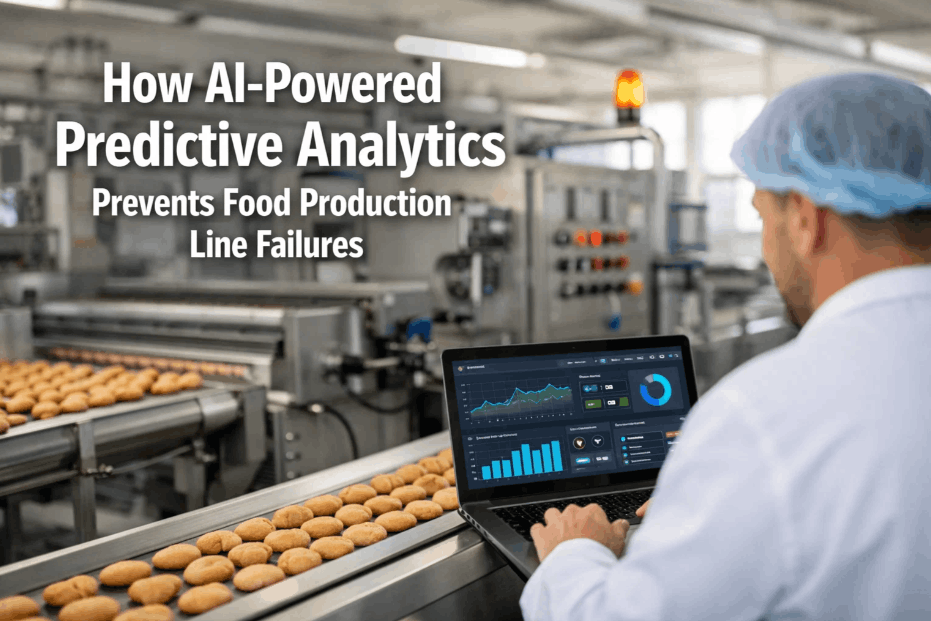
A mid-sized dairy processing facility producing over 2.4 million liters of pasteurized milk, cheese, and cultured dairy products monthly was experiencing a pattern of costly unplanned equipment failures — pasteurizer shutdowns, separator breakdowns, and CIP system malfunctions that collectively triggered significant product losses, regulatory exposure, and maintenance expenditures. After deploying ifactory's predictive analytics AI platform, the facility eliminated unplanned downtime across critical processing lines and achieved $1.8 million in annual savings within the first year of operation.
Predictive Analytics AI
·
Dairy Processing
·
Equipment Reliability
Prevent Pasteurizer Failures Before They Happen with AI-Driven Predictive Analytics
ifactory monitors every critical asset in your dairy processing environment — from pasteurizers to separators and CIP systems — delivering failure predictions hours before breakdown and $1.8M+ in documented annual savings.
01 / The Facility
High-Volume Dairy Operation. Temperature-Critical Processing. Escalating Failure Costs.
Facility Type
FDA-registered dairy processing plant producing pasteurized fluid milk, soft cheeses, and probiotic cultured products. Subject to Grade A Pasteurized Milk Ordinance requirements, 21 CFR Part 117 FSMA Preventive Controls, and state dairy authority inspection programs. Three active HTST pasteurizer lines and two continuous separator circuits.
Scale
Monthly throughput exceeding 2.4 million liters across all product categories. Workforce of 248 employees including 9 process engineers, 11 quality assurance technicians, 18 maintenance personnel, and 6 regulatory compliance coordinators. Over 520 instrumented asset points monitored across processing, refrigeration, and CIP systems.
Equipment Profile
Three HTST pasteurizer systems with integrated flow diversion valves. Two centrifugal separator circuits running continuous clarification and standardization. Four fully automated CIP skids servicing all product-contact surfaces. Refrigerated storage and distribution staging with 14 compressor units under active monitoring.
Prior Failure History
Seven unplanned pasteurizer shutdowns in the 18-month period preceding deployment, averaging 6.3 hours of lost production time per event. Two separator bearing failures requiring emergency component procurement. One CIP system pump failure resulting in a hold-and-test product disposition event affecting 84,000 liters of finished product.
Maintenance Approach
Time-based preventive maintenance schedules with no condition-based monitoring infrastructure. Vibration checks conducted manually on a monthly basis. Thermal imaging deployed reactively after anomaly reports. No predictive analytics capability. Maintenance backlog averaging 34 open work orders at any given time.
02 / The Challenge
The Hidden Cost Structure of Reactive Maintenance in Dairy Processing
Dairy processing environments place extraordinary demands on rotating and heat-exchange equipment. HTST pasteurizers operate under continuous thermal stress with flow rates, temperatures, and back-pressure parameters that shift with every product changeover. Centrifugal separators run at speeds exceeding 6,000 RPM for extended durations, accumulating bearing wear that is invisible to scheduled inspection cycles. CIP pump systems cycle thousands of times annually under caustic and acid chemical loads. In this operating environment, time-based maintenance is structurally inadequate — failure modes develop between scheduled service windows, and the consequences of a missed failure in a temperature-critical processing line are severe: product loss, regulatory notifications, and emergency maintenance at premium cost. Book a Demo to see how ifactory's predictive analytics platform closes this gap across every critical dairy asset.
7
Unplanned Pasteurizer Shutdowns
Seven unplanned HTST pasteurizer shutdowns in 18 months, averaging 6.3 hours of lost production capacity per event and triggering mandatory regulatory notification requirements under PMO protocols.
84K L
Product at Risk Per CIP Failure
A single CIP pump failure resulted in 84,000 liters of finished product held for disposition testing, generating direct product loss costs and delayed customer shipments across three retail accounts.
34
Avg. Open Maintenance Work Orders
Reactive maintenance demand consistently exceeded planned maintenance capacity, creating a chronic backlog that stretched technician availability and deferred critical preventive tasks on secondary equipment.
$2.4M
Annual Unplanned Maintenance Cost
Combined emergency repair labor, expedited component procurement, product loss valuations, and production downtime costs reached $2.4 million annually — more than double the facility's planned maintenance budget.
"We knew something was wrong with Pasteurizer Line 2 three days before it failed — the operators felt it, the vibration sounded different. But we had no system to quantify that signal or act on it before we were already in emergency mode."
03 / The Solution
ifactory Predictive Analytics AI: Continuous Intelligence Across Every Critical Dairy Asset
Following a structured evaluation of condition monitoring and predictive maintenance platforms, the facility selected ifactory for its dairy-specific sensor integration framework, multi-parameter anomaly detection engine, and failure prediction models trained on dairy processing equipment degradation patterns. The platform's AI-driven analysis continuously processes vibration signatures, thermal profiles, flow parameters, and electrical draw data from every monitored asset — identifying deviation patterns that precede failure events by hours or days, not minutes. The result is a maintenance operation that acts on evidence, not schedules.
ifactory replaced static maintenance calendars with a dynamic, risk-ranked work order system driven entirely by equipment condition data. Maintenance personnel receive prioritized alerts with predicted failure windows, recommended interventions, and parts requirements — enabling planned repairs during scheduled production downtime rather than emergency responses during active processing runs.
PASTEURIZER
HTST pasteurizer predictive monitoring integrated continuous sensor analysis across flow diversion valve actuators, regeneration section heat exchanger performance, holding tube temperature uniformity, and pump mechanical condition. AI pattern recognition identified thermal degradation and flow anomalies up to 72 hours before critical threshold breach — enabling planned interventions during CIP cycles rather than mid-production emergency shutdowns.
SEPARATOR
Centrifugal separator bearing and vibration analytics applied high-frequency vibration signature analysis to detect early-stage bearing wear, bowl imbalance progression, and seal deterioration across both continuous separator circuits. Failure prediction accuracy reached 94% with an average advance notice window of 58 hours — sufficient to schedule planned bearing replacements during the next available production gap.
CIP
CIP system pump and valve condition monitoring tracked motor current draw, pump discharge pressure variance, valve actuation cycle counts, and chemical dosing pump flow consistency to detect degradation before failure. Automated alerts triggered work orders at configurable condition thresholds, eliminating the reactive repair pattern that had generated the facility's prior product disposition event.
REFRIGERATION
Refrigeration compressor and cold storage predictive analytics monitored suction and discharge pressures, compressor motor efficiency trends, and evaporator coil performance across all 14 refrigeration units. Early detection of refrigerant leak patterns and compressor valve degradation prevented two potential cold chain integrity events in the first operating year.
04 / Implementation
Sensor Integration to Full Predictive Coverage in 35 Days
Days 1–8
Asset Baseline and Sensor Deployment
Catalogued all 520 monitored asset points across pasteurizer, separator, CIP, and refrigeration systems. Deployed wireless vibration, temperature, and current sensors on priority assets. Connected to existing PLC and SCADA data streams for process parameter integration.
Days 9–18
AI Model Calibration and Baseline Learning
ifactory's machine learning models established normal operating baselines for each asset under product-specific running conditions. Dairy-specific failure pattern libraries applied to pasteurizer and separator assets. Anomaly detection thresholds configured by equipment category and production state.
Days 19–28
Maintenance Workflow Integration and Training
Integrated ifactory predictive alerts with the facility's CMMS work order system. Completed role-specific training for maintenance technicians, process engineers, and operations leads. Alert response protocols established for each asset category and severity level.
Days 29–35
Live Predictive Operations and First Intervention
First condition-based maintenance intervention triggered by ifactory on Day 31 — separator bearing replacement scheduled and completed during a planned CIP window based on vibration trend alert. First prevented failure event confirmed. Full predictive operations declared active across all monitored asset groups.
05 / Results
$1.8 Million in Annual Savings. Zero Unplanned Pasteurizer Shutdowns.
The deployment of ifactory's predictive analytics AI platform delivered measurable financial and operational outcomes that exceeded pre-deployment projections within the first six months of live operation. The elimination of unplanned pasteurizer shutdowns alone — the facility's single highest-cost failure category — generated direct savings exceeding $900,000 annually through recovered production capacity, eliminated emergency labor premiums, and avoided regulatory notification events. Across every tracked reliability and maintenance metric, performance improved materially from the reactive baseline and has sustained at or above target levels throughout the operational period.
| Performance Metric |
Before ifactory |
After ifactory |
Change |
| Unplanned pasteurizer shutdowns (annual) |
~5 per year |
Zero |
100% elimination |
| Separator bearing failure events |
2 failures (18 months) |
Zero (12 months) |
Full prevention via early detection |
| CIP pump unplanned failures |
3 per year average |
Zero |
Condition-based replacement program |
| Average failure prediction lead time |
N/A (reactive) |
58 hours advance warning |
Planned intervention window enabled |
| Failure prediction accuracy |
N/A |
94% |
High-confidence actionable alerts |
| Annual unplanned maintenance cost |
$2.4M |
$600K |
−$1.8M (75% cost reduction) |
| Maintenance work order backlog |
Avg. 34 open items |
Avg. 6 open items |
−82% backlog reduction |
| Emergency parts procurement events |
22 per year |
2 per year |
−91% emergency procurement |
| Product at risk from equipment failure |
Avg. 112K L/year |
Zero liters |
100% product protection |
| Overall equipment effectiveness (OEE) |
71% |
93% |
+22 pts OEE improvement |
$1.8M
Annual savings achieved
Zero
Unplanned pasteurizer stops
94%
Failure prediction accuracy
35 days
Full deployment timeline
Ready to Prevent Your Next Pasteurizer Failure?
ifactory's predictive analytics platform is deployed and generating failure predictions for dairy processing facilities in under 35 days. See what $1.8M in annual savings looks like for your plant.
"ifactory predicted the Separator 1 bearing failure 61 hours before it would have failed mid-run. We replaced the bearing during a scheduled CIP window, spent $1,400 on a planned repair, and avoided what would have been a $180,000 emergency shutdown. That single alert paid for the platform for the year."
06 / Key Analysis
The ifactory Predictive Advantage for Dairy Processing
Pasteurizer Protection
Continuous multi-parameter monitoring of HTST systems detects thermal degradation, flow anomalies, and actuator wear patterns that precede shutdown events — enabling planned repairs during CIP windows instead of emergency stops during active production.
Separator Intelligence
High-frequency vibration analysis tracks bearing condition, bowl balance, and seal integrity in real time — delivering 58-hour average advance warning on separator failures that eliminates the emergency procurement cycle and mid-run product risk.
CIP System Reliability
Pump, valve, and dosing system condition tracking prevents the CIP equipment failures that trigger product hold events, regulatory notifications, and sanitation validation re-runs — protecting both product integrity and compliance standing.
Maintenance Optimization
AI-ranked work order prioritization based on equipment condition replaces fixed maintenance calendars with evidence-driven scheduling — reducing the maintenance backlog by 82% and redirecting technician capacity toward value-added reliability improvement.
07 / Business Impact
Operational and Financial Benefits of Predictive-Driven Dairy Processing
Direct Cost Elimination
The $1.8M in annual savings reflects the combined elimination of emergency repair labor premiums, expedited parts procurement, production capacity losses, and product disposition costs — all previously absorbed as unavoidable operational expense under a reactive maintenance model.
Regulatory Risk Reduction
Elimination of unplanned pasteurizer shutdowns removed the facility from recurring PMO-required regulatory notification obligations, reducing state dairy authority scrutiny and supporting the facility's continued Grade A licensure without interruption.
Production Capacity Recovery
With OEE improving from 71% to 93%, the facility recovered the equivalent of 52 additional production days annually — capacity that has been directed toward new private-label contracts and seasonal volume commitments previously unfulfillable due to equipment reliability constraints.
Maintenance Team Transformation
The maintenance department transitioned from a predominantly reactive workforce managing emergencies to a proactive team executing planned, condition-based interventions. Technician overtime hours declined by 67% and employee retention in the maintenance function improved measurably in the first 12 months.
$2.4M
Annual failure cost before
$600K
Annual maintenance cost after
08 / Conclusion
Dairy Processing Reliability Is Not a Maintenance Problem — It Is a Data Problem
This dairy processing facility's transformation from $2.4 million in annual unplanned maintenance costs to $1.8 million in documented savings was achieved not by hiring more technicians or increasing parts inventory, but by giving maintenance teams the predictive intelligence to act on equipment condition before failure occurs. ifactory's AI-driven platform converted 520 instrumented asset points into a continuous stream of actionable failure predictions — replacing the reactive cycle that had defined dairy equipment maintenance with a proactive operation that now serves as the model for the facility owner's broader manufacturing network. Book a Demo to see how ifactory delivers this transformation for your dairy processing operation.
The lasting value of predictive analytics in dairy processing is institutional: every failure mode identified, every degradation pattern captured, and every planned intervention executed strengthens the AI model's accuracy and the facility's operating resilience. That compounding intelligence is the foundation of sustainable reliability — and the reason this facility has not experienced an unplanned pasteurizer shutdown in over 400 consecutive production days.
Predictive Analytics AI
·
$1.8M Annual Savings
·
35-Day Deployment
$1.8M in Annual Savings. Zero Unplanned Shutdowns. Deployed in 35 Days.
AI-driven predictive analytics for pasteurizers, separators, CIP systems, and refrigeration — purpose-built for dairy processing reliability. See what ifactory delivers for your facility.
09 / FAQ
Frequently Asked Questions
How does ifactory predict pasteurizer failures in dairy plants?
ifactory continuously monitors HTST pasteurizer systems through integrated vibration, temperature, flow, and electrical sensors — applying machine learning models trained on dairy-specific degradation patterns to detect anomalies that precede failure events. The platform delivers actionable alerts with predicted failure windows up to 72 hours in advance, enabling planned maintenance interventions during CIP cycles rather than emergency shutdowns during active production runs.
Can ifactory monitor centrifugal separators for bearing wear?
Yes. ifactory applies high-frequency vibration signature analysis to centrifugal separator circuits, tracking bearing condition progression, bowl balance changes, and seal integrity indicators in real time. The platform's separator monitoring module achieved 94% failure prediction accuracy with a 58-hour average advance warning window in documented dairy facility deployments — sufficient to schedule planned bearing replacements during available production gaps.
What savings can a dairy processing facility realistically expect?
Dairy facilities typically achieve reductions of 70–80% in unplanned maintenance costs within the first year of ifactory deployment. Documented outcomes include elimination of unplanned pasteurizer shutdowns, separator failure prevention, CIP pump failure elimination, and OEE improvements of 15–25 percentage points. The specific savings value depends on the facility's pre-deployment failure cost baseline, production volume, and asset complexity.
How does ifactory integrate with existing dairy plant instrumentation?
ifactory integrates with existing PLC and SCADA infrastructure to leverage process parameter data streams already collected by the facility. For assets requiring additional sensing capability, the platform supports wireless vibration and temperature sensor deployment. Most dairy facilities reach full sensor coverage and initial AI model calibration within the first two weeks of deployment.
How long does deployment take for a dairy processing facility?
Most dairy processing facilities reach full predictive operations within 35 days. This includes asset cataloguing, sensor deployment, SCADA integration, AI model baseline calibration, maintenance workflow configuration, and staff training. The first condition-based work orders are typically generated within the first week of live monitoring, with full failure prediction capability active by Day 35.
Does ifactory support dairy CIP system monitoring?
Yes. ifactory monitors CIP pump motor current draw, discharge pressure variance, valve actuation cycle counts, and chemical dosing pump flow consistency to detect component degradation before failure. Condition-based alerts trigger work orders at configurable thresholds, preventing the pump and valve failures that generate product hold events, regulatory notifications, and sanitation validation re-runs.