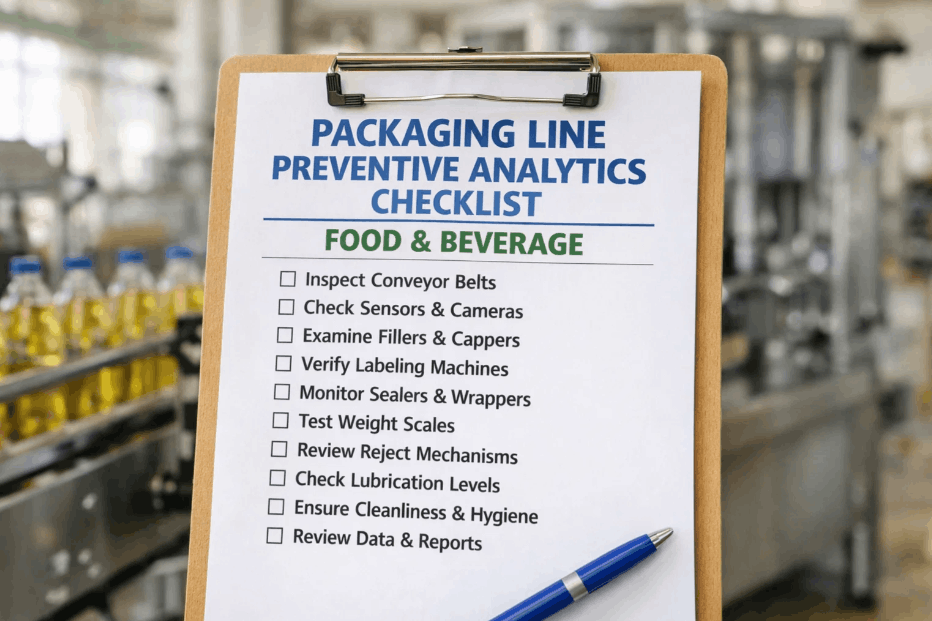
.png)
Beverage production equipment analytics is no longer a competitive advantage reserved for large-scale manufacturers — it is the baseline standard for any plant running fillers, carbonators, pasteurizers, or bottle washers at commercial throughput. In 2026, unplanned downtime on a single filling line costs an average beverage facility $18,000–$45,000 per hour in lost output, rework, and compliance risk. AI-driven preventive maintenance platforms are changing how beverage plants track equipment health, calibrate critical process parameters, and document CIP cycles — transforming reactive maintenance into precision-scheduled reliability.
See iFactory's AI Copilot for Beverage Plant Equipment Analytics
iFactory connects fillers, carbonators, pasteurizers, and bottle washers into a single AI-driven platform — with real-time PM scheduling, CIP tracking, and calibration management built in.
Why Beverage Equipment Analytics Is Critical in 2026
The beverage industry faces a convergence of pressures: rising energy costs, stricter FDA and FSMA 204 traceability mandates, labor shortages, and consumer demand for consistent product quality across every SKU. Beverage production analytics — the systematic collection, analysis, and action on equipment performance data — directly addresses all four. Plants that have deployed AI-driven maintenance platforms report 30–50% reductions in unplanned downtime and significant improvements in overall equipment effectiveness (OEE) within the first year of deployment.
The competitive differentiator is not simply having sensors on equipment — it is closing the loop between sensor data, maintenance scheduling, calibration records, and food safety compliance. Book a demo with iFactory to see how AI Copilot connects beverage equipment analytics to your HACCP and compliance infrastructure.
Beverage facilities using AI-driven preventive maintenance platforms report up to 47% reduction in emergency work orders and 38% improvement in line changeover efficiency compared to reactive maintenance programs.
Filler Analytics: Maximizing Fill Accuracy and Line Uptime
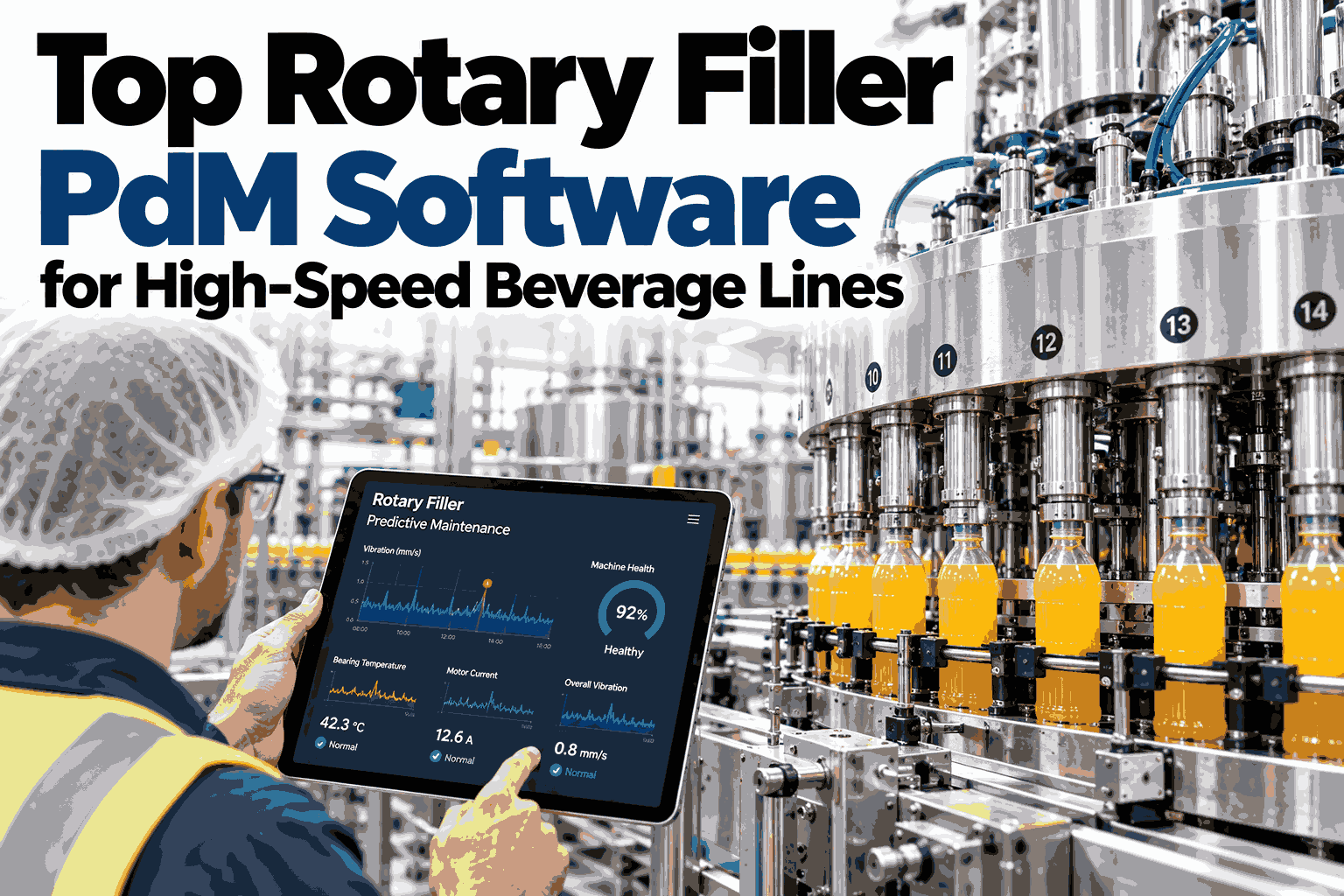
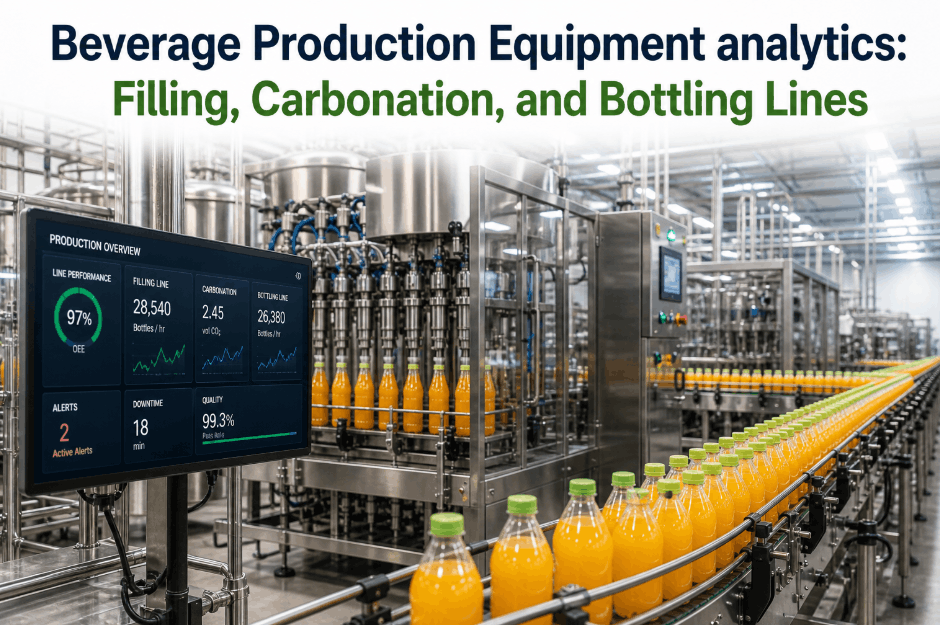
Beverage fillers are the highest-throughput, highest-consequence assets on any production line. A single filler running at 1,200 containers per minute with even a 0.5% overfill rate generates substantial annual product giveaway — while underfill creates regulatory risk and consumer complaints. AI-powered filler analytics continuously monitor fill level accuracy, valve response times, nozzle seal integrity, and bottle seating precision.
Fill Level Accuracy Monitoring
Real-time weight and vision-based fill verification across every nozzle — detecting drift before product goes out of specification and triggering automatic valve recalibration alerts.
Valve and Nozzle Health Tracking
Predictive models detect valve seal degradation and nozzle wear through flow rate anomalies and pressure differential trending — scheduling replacement during planned downtime.
Filler CIP Cycle Verification
Machine-verified CIP parameters — temperature, chemical concentration, contact time, and flow rate — recorded at every phase with automatic linkage to production run records.
Changeover Time Optimization
AI analytics identify bottlenecks in SKU changeover sequences — reducing average filler changeover time by 25–40% through optimized work order routing and pre-staged tooling alerts.
Carbonator Analytics: Maintaining CO₂ Consistency and Pressure Integrity
Carbonation consistency is a defining quality attribute for carbonated soft drinks, sparkling water, and beer. Carbonator analytics track CO₂ injection pressure, gas-to-liquid ratios, temperature stability, and carbonation retention across the filling process. Deviations in carbonator performance directly impact consumer-perceived quality and shelf life. Proactive carbonator maintenance — guided by AI predictive models — prevents the most common failure modes: seal degradation, pressure regulator drift, and heat exchanger fouling.
Plants using iFactory's beverage production analytics platform can book a demo to see how carbonator sensor data flows directly into PM work orders and calibration records — eliminating manual data collection.
Pasteurizer Analytics: Temperature Control, HTST Compliance, and Energy Optimization
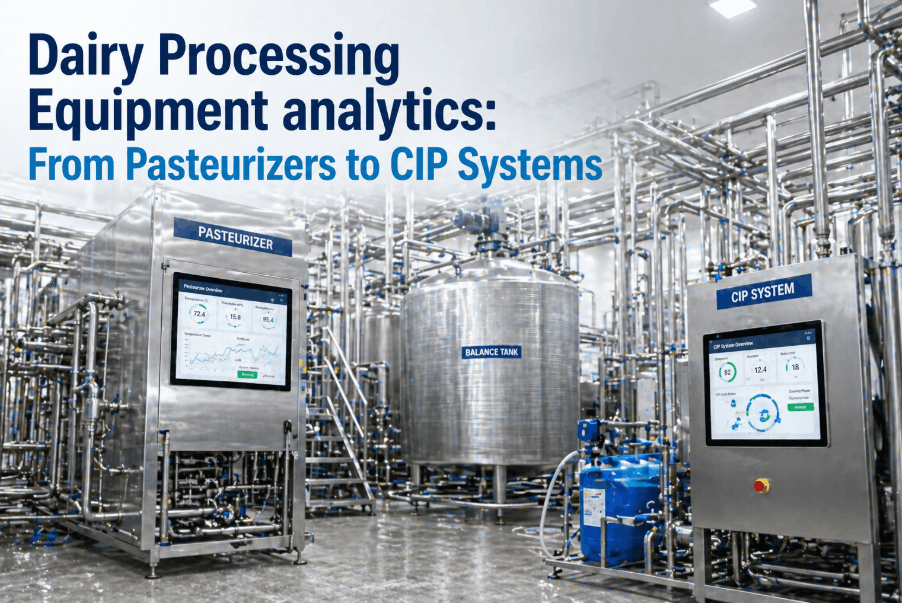
Pasteurizers are the most food-safety-critical assets in juice, dairy beverage, and ready-to-drink tea production lines. HTST and tunnel pasteurizers must maintain precise time-temperature profiles to achieve legal pathogen reduction while avoiding overcooking that degrades product quality. AI-driven pasteurizer analytics monitor holding tube temperatures, flow diversion valve response, regeneration efficiency, and fouling accumulation — providing continuous CCP verification that far exceeds manual chart recording.
HTST and Tunnel Pasteurizer Monitoring
Continuous temperature and flow monitoring across all pasteurizer zones with automatic CCP deviation alerts and digital record generation — satisfying FDA 21 CFR Part 113 requirements without manual log compilation.
- Automatic CCP deviation records
- Flow diversion valve performance tracking
- Fouling detection via thermal efficiency trending
Pasteurizer Energy and Efficiency Analytics
AI models track heat regeneration efficiency and steam consumption patterns — identifying fouling buildup weeks before it impacts product quality or causes an unplanned CIP. Energy waste reduction of 12–18% is typical in the first 90 days.
- Heat regeneration efficiency trending
- Steam and energy consumption benchmarking
- Predictive CIP scheduling based on fouling models
Bottle Washer Analytics: Sanitation Verification and Mechanical Reliability
Bottle washers in returnable glass and reusable container operations are high-volume, chemically intensive assets that require precise caustic concentration, temperature, and contact time to meet microbiological standards. Bottle washer analytics track chemical dosing accuracy, spray nozzle coverage integrity, conveyor speed consistency, and rinse water quality — generating the machine-executed sanitation records that BRCGS and SQF auditors increasingly require.
When connected to iFactory's AI Copilot platform, bottle washer performance data automatically triggers PM work orders when nozzle pressure drops indicate blockage, and chemical consumption anomalies flag dosing system calibration needs. Schedule a demo to see bottle washer analytics in action.
| Equipment Type | Key Analytics Parameters | Food Safety Impact | PM Trigger Events | ROI Timeline |
|---|---|---|---|---|
| Beverage Fillers | Fill accuracy, valve health, nozzle wear, CIP cycles | Product integrity, seal verification, contamination prevention | Fill drift, pressure anomaly, valve response delay | 12–18 months |
| Carbonators | CO₂ pressure, gas-liquid ratio, temperature, seal integrity | Product consistency, shelf life protection | Pressure drift, temperature variance, seal wear | 18–24 months |
| Pasteurizers (HTST) | Time-temperature profiles, flow diversion, fouling index | CCP compliance, pathogen control, 21 CFR 113 | Temperature deviation, flow rate change, fouling buildup | 12–20 months |
| Bottle Washers | Caustic concentration, spray coverage, rinse quality | Microbiological sanitation, BRCGS/SQF compliance | Nozzle pressure drop, chemical dosing anomaly | 14–22 months |
| Tunnel Pasteurizers | Zone temperatures, conveyor speed, steam consumption | Label integrity, thermal process verification | Zone temp variance, belt speed inconsistency | 18–30 months |
AI-Driven Preventive Maintenance for Beverage Production Lines
Standard calendar-based PM schedules for beverage equipment systematically fail because they ignore actual utilization, product type, cleaning chemical exposure, and environmental conditions. A filler running three shifts on acidic juice requires fundamentally different seal replacement intervals than the same unit running one shift on still water. AI-driven beverage production PM platforms build dynamic maintenance models from actual sensor data — adjusting PM intervals based on real equipment condition rather than fixed calendar dates.
iFactory's AI Copilot applies predictive models to every asset in your beverage plant — from high-speed fillers to tunnel pasteurizers — learning from vibration signatures, motor current patterns, and thermal data to schedule maintenance before failure occurs. Book a demo to explore how AI-driven PM scheduling works for your specific beverage line configuration.
Connect Your Beverage Equipment to iFactory's Analytics Platform
iFactory integrates filler, carbonator, pasteurizer, and bottle washer data into a single AI-driven platform — with automatic PM work orders, CIP tracking, and HACCP compliance documentation.
Beverage Equipment Calibration Management
Calibration management for beverage production equipment is a compliance-critical function that most plants manage through fragmented spreadsheets, paper records, and manual reminders — creating audit gaps and the constant risk of operating out-of-calibration instrumentation. Critical calibration points include filler valve flow meters, pasteurizer temperature sensors and recording devices, carbonator pressure transducers, and bottle washer chemical dosing probes.
AI-driven calibration management platforms maintain a complete digital calibration register for every instrument — tracking calibration frequency, tolerance limits, out-of-calibration events, and certificate storage in a single system. Calibration due dates auto-generate work orders, and out-of-tolerance findings automatically trigger CAPA workflows. Book a demo with iFactory to see how calibration management integrates with your beverage production compliance program.
CIP Tracking and Documentation for Beverage Plants
Clean-in-place (CIP) documentation is one of the most audit-sensitive areas in any beverage facility. Manual CIP logs — paper or spreadsheet — are inherently prone to omission, transcription error, and retrospective completion. AI-driven CIP tracking systems capture every parameter in real time: chemical concentration, temperature, flow rate, contact time, and conductivity at rinse — generating a machine-verified digital record that closes the most common BRCGS and SQF audit findings.
When CIP records are connected to production run data in iFactory, every batch is automatically linked to the verified sanitation event that preceded it — providing the traceability chain required by FSMA 204 and eliminating the manual record-matching that audit preparation currently demands.
Brewing Equipment Analytics: Fermenters, Bright Beer Tanks, and Canning Lines
Craft and commercial breweries operate some of the most analytically complex beverage production environments — combining fermentation biology with precision packaging equipment. Brewing equipment analytics spans fermenter temperature and pressure profiles, bright beer tank conditioning data, yeast health monitoring, and canning line DO (dissolved oxygen) pickup tracking. AI-driven brewing analytics platforms detect fermentation deviations early, optimize conditioning schedules, and prevent the dissolved oxygen pickup that destroys shelf life on packaged beer.
Fermenter Temperature Profiling
Continuous glycol cooling performance monitoring with automatic alerts when fermentation temperature drifts outside profile — preventing off-flavor development and batch loss.
DO Pickup Monitoring on Canning Lines
Real-time dissolved oxygen tracking at every transfer point — purge station, filler bowl, and seamer — identifying oxygen ingress before it impacts packaged product shelf life.
Seamer and Canning Line PM
AI-driven seamer chuck and roller wear detection via statistical seam dimension trending — predicting tooling replacement needs before seam failures impact production.
Bright Beer Tank Conditioning Analytics
Carbonation stability and pressure holding performance tracking across BBT fleet — identifying tanks with seal or pressure relief issues before conditioning failures affect packaging schedules.
Soft Drink Production Analytics: Syrup Room, Blending, and High-Speed Filling
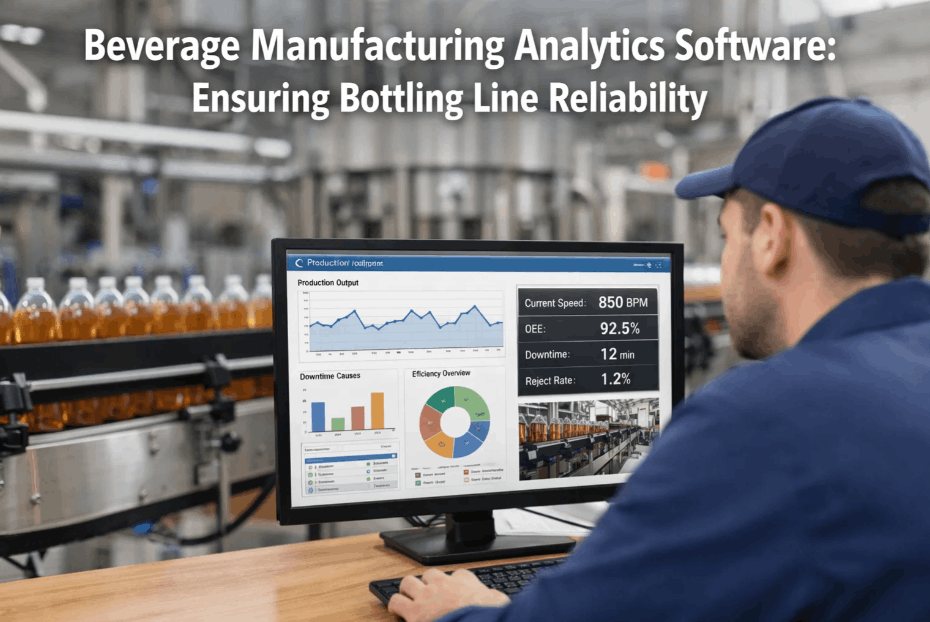
Soft drink production analytics spans the entire process from syrup room blending through high-speed PET or glass filling. Critical analytics parameters include syrup concentration consistency, Brix and pH control at the blending stage, carbonation levels in the filling bowl, torque and seal integrity at the capper, and label application accuracy at the labeler. AI-driven platforms connect all these data streams into a unified OEE and quality dashboard — enabling shift supervisors and maintenance teams to act on real-time performance data rather than end-of-shift summaries.
Juice Processing Equipment Analytics: Extractors, UHT Systems, and Aseptic Fillers
Juice processing equipment operates in the most chemically aggressive and microbiologically demanding beverage production environment. Extractor yield analytics, UHT system time-temperature profiles, aseptic filler sterile barrier integrity, and cold chain monitoring from fill to distribution are all analytically tracked in modern juice facilities. Aseptic filler analytics are particularly critical — any breach in sterile zone integrity requires documented investigation and requalification before production resumes. AI-driven aseptic filler monitoring provides continuous sterile barrier verification with automatic deviation logging and CAPA integration.
iFactory's beverage production analytics platform is deployed across juice, soft drink, brewing, and dairy beverage operations globally. Book a demo to see the full platform capability for your specific beverage category and equipment mix.
Implementation Roadmap: Deploying Beverage Equipment Analytics
Equipment Registry and Analytics Baseline
Full asset registry build for all critical beverage equipment — fillers, carbonators, pasteurizers, bottle washers, and ancillary systems. Existing PM schedules, calibration records, and CIP documentation migrated into iFactory. Analytics KPI baseline established for OEE, downtime, and CIP compliance rate.
Sensor Integration and AI Model Initialization
Sensor data streams from fillers, pasteurizers, and carbonators connected to iFactory AI Copilot. Predictive maintenance models initialized with historical failure data and equipment specifications. CIP parameter tracking activated for all applicable assets.
Compliance Integration and Calibration Management
HACCP plan linkage activated for CCP monitoring points on pasteurizers and aseptic fillers. Full calibration register digitized with automatic work order generation. FSMA 204 traceability data flowing from packaging equipment into digital batch records.
Full Analytics Intelligence and Continuous Optimization
All beverage production equipment operating under AI Copilot analytics with live dashboards tracking OEE, predictive maintenance alerts, CIP compliance, and calibration status. Continuous model refinement using operational data from the full beverage line fleet. BRCGS and SQF audit packages auto-generated from platform data.
Frequently Asked Questions: Beverage Production Equipment Analytics
Conclusion: Building the Intelligent Beverage Plant with Analytics
Beverage production equipment analytics — spanning fillers, carbonators, pasteurizers, bottle washers, and the full line — is the foundation of the high-reliability, high-compliance beverage plant in 2026. Plants that have moved beyond reactive maintenance and manual compliance documentation are delivering measurably better OEE, lower audit risk, and more consistent product quality. The facilities pulling ahead are those where every critical equipment asset is connected to an AI-driven operations platform that links equipment health, CIP compliance, calibration status, and food safety documentation into a single actionable system. iFactory's AI Copilot is purpose-built for exactly this architecture across every beverage category. Book a personalized demo to see how iFactory connects your beverage production equipment to AI-driven analytics, predictive maintenance, and compliance documentation in a single platform.
Fillers. Carbonators. Pasteurizers. One Analytics Platform.
iFactory's AI Copilot integrates every critical beverage production asset into your maintenance, calibration, CIP, and compliance workflows — live in 10–14 weeks.