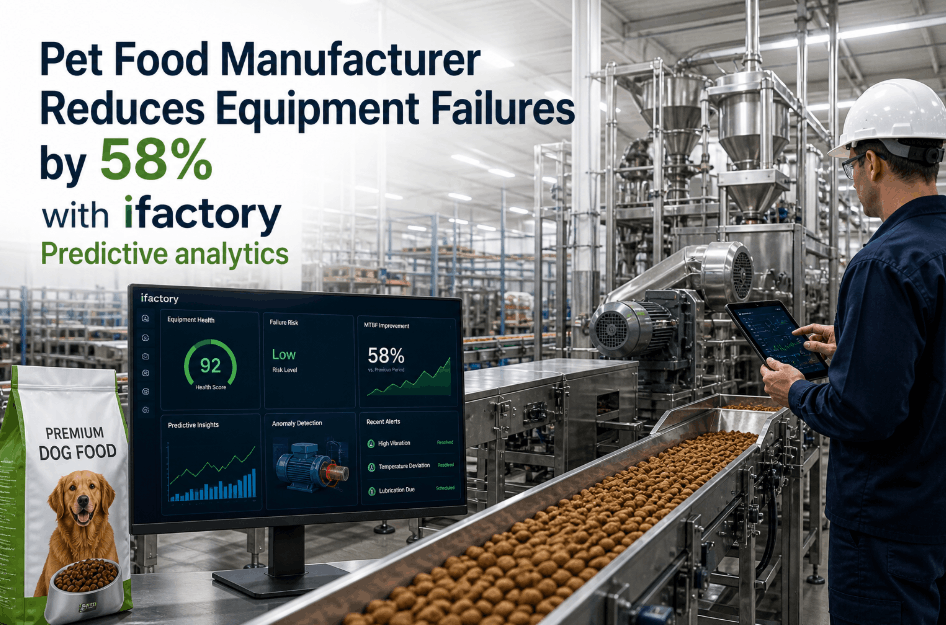
Food production line failures don't announce themselves — they build silently in motor vibration signatures, thermal drift patterns, and torque fluctuations weeks before a conveyor belt seizes or a filler valve fails at full-capacity throughput. AI predictive analytics for food manufacturing intercepts these failure signals 2 to 8 weeks before breakdown, protecting batch integrity, preventing unplanned downtime, and keeping your HACCP compliance records uninterrupted. iFactory's production line AI monitoring platform connects directly to your processing equipment, scores asset health in real time, and surfaces actionable maintenance intelligence that eliminates the guesswork from food plant operations. Book a demo to see how AI-driven food analytics transforms your maintenance strategy from reactive firefighting to precision-scheduled intervention.
Stop Production Line Failures Before They Cost You
iFactory's AI predictive analytics detects equipment deterioration 2–8 weeks early — preventing downtime, protecting product quality, and maintaining continuous HACCP compliance documentation.
Why Food Production Lines Are Uniquely Vulnerable to Cascading Failures
Modern food and beverage manufacturing faces a unique pressure combination: continuous high-speed throughput, strict hygiene constraints, regulatory obligations, and zero tolerance for contamination. A single seized bearing doesn't just halt one line — it backs up packaging, triggers allergen cross-contamination risk, and can invalidate an entire batch. Traditional time-based maintenance schedules were designed when sensors were expensive and data processing was slow. In today's smart food factory, IoT sensors, edge computing, and cloud analytics have eliminated those constraints — shifting the question from whether to deploy food equipment failure prediction technology to how quickly your team can capture the advantage.
How AI Predictive Analytics Works on the Food Production Line
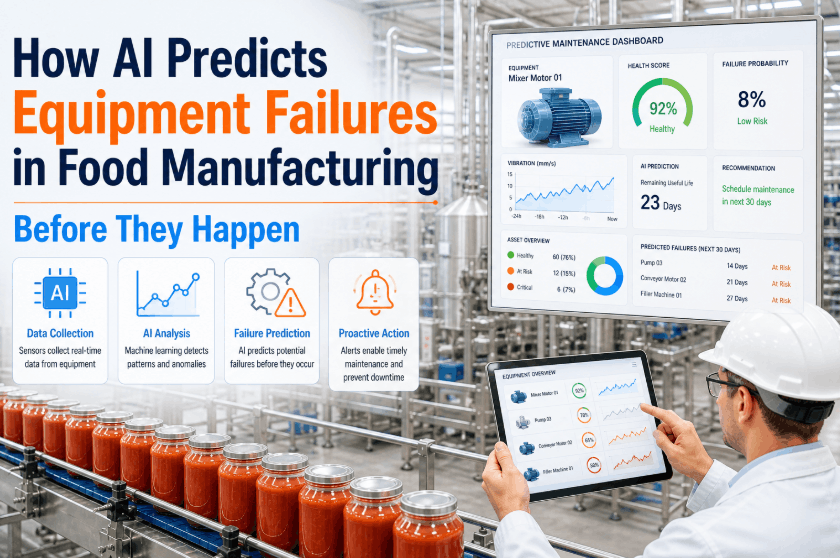
iFactory's AI predictive analytics transforms raw sensor streams into scheduled maintenance actions through four integrated layers — no production stoppages or manual data collection required.
Continuous IoT Sensor Data Collection
Vibration, current, temperature, and pressure sensors installed on mixers, fillers, conveyors, and pasteurizers stream real-time data continuously. Non-invasive clamp-on installation means zero production disruption during deployment.
Edge AI Feature Extraction
On-premise edge processors apply FFT vibration analysis, thermal gradient tracking, and motor current signature analysis — extracting fault-relevant features locally and ensuring monitoring continuity even during network outages.
Machine Learning Failure Prediction Models
Cloud ML models trained on food industry failure datasets detect anomalies and predict remaining useful life from day one — no months of site-specific baseline collection needed. Book a demo to see accuracy benchmarks for your equipment.
Automated Work Order and Compliance Integration
Predicted failure events auto-generate structured work orders — with fault classification, parts list, and response procedure — weeks before failure. Each completed order feeds back into the model and produces tamper-resistant audit records.
Critical Food Processing Equipment Monitored by AI Analytics
Effective food manufacturing downtime prevention requires monitoring the highest-consequence equipment in your facility — the assets where unplanned failure triggers batch loss, contamination risk, or regulatory notification obligations. The following equipment categories represent the highest predictive analytics ROI in food and beverage production environments.
| Equipment Type | Key Monitored Parameters | Failure Modes Detected | Typical Detection Lead Time |
|---|---|---|---|
| Mixing and Blending Equipment | Motor current, vibration, torque, temperature | Bearing degradation, blade wear, shaft imbalance | 3–6 weeks |
| Filling and Dosing Machines | Actuator cycle time, pressure deviation, flow rate | Valve wear, seal failure, pump degradation | 2–4 weeks |
| Conveyor and Transfer Systems | Drive motor current, belt tension, speed variation | Belt stretch, drive chain wear, motor overload | 4–8 weeks |
| Pasteurizers and Heat Exchangers | Temperature differentials, flow rate, pressure drop | Fouling buildup, gasket failure, pump cavitation | 3–5 weeks |
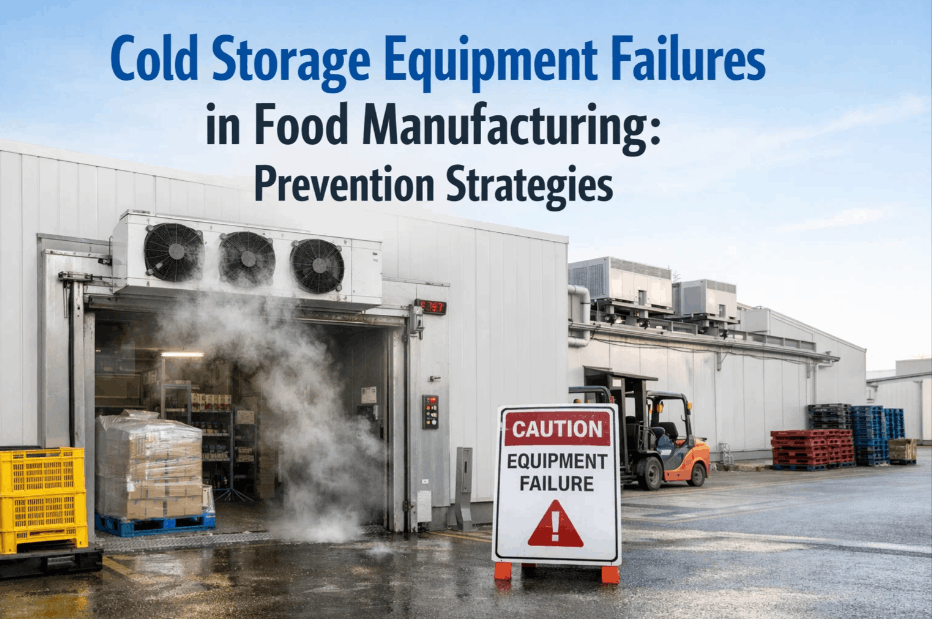
| Refrigeration and Cooling Systems | Compressor current, suction/discharge pressure, superheat | Compressor wear, refrigerant leak, condenser fouling | 2–6 weeks |
| Packaging and Sealing Equipment | Seal temperature, cycle time, servo torque | Heating element failure, film feed tension, jaw misalignment | 1–3 weeks |
| CIP/Sanitation Systems | Pump pressure, flow rate, chemical dosing accuracy | Pump degradation, nozzle blockage, valve leakage | 2–4 weeks |
Food Equipment Health Scoring: Moving Beyond Binary Fault Detection
The most advanced food plant IoT sensor deployments have moved beyond binary alert logic — where equipment is either "running" or "faulted" — toward continuous health scoring models that express asset condition as a percentage of optimal operational state. Food equipment health scoring gives maintenance planners a quantitative basis for prioritizing interventions across a facility with dozens of monitored assets, enabling smarter resource allocation than alarm-count-based dispatching.
iFactory's health scoring engine calculates composite equipment health indices from weighted sensor inputs — weighting vibration severity more heavily than temperature deviation for rotating equipment, for example, while emphasizing pressure drop and flow rate anomalies for heat transfer assets. Health scores update continuously and trend over time, giving maintenance engineers visibility into deterioration rate as well as current condition. An asset scoring 88% with a 2-point-per-week decline trajectory demands different scheduling urgency than one at 82% with a stable trend — and iFactory surfaces this distinction clearly on every asset dashboard. Book a demo to explore the health scoring framework applied to your equipment inventory.
Predictive Analytics and HACCP Compliance: The Overlooked Connection
Food safety management systems built around HACCP principles depend on documented proof that critical control points operated within validated parameters throughout every production run. Equipment failures at CCPs — a pasteurizer temperature controller fault, a CIP pump delivering insufficient flow pressure — don't just cause downtime. They trigger mandatory product holds, regulatory notification timelines, and detailed corrective action documentation requirements that consume significant management bandwidth and carry license-at-risk consequences.
AI-driven food analytics prevents CCP equipment failures before they occur, but it also generates the continuous sensor log records that HACCP compliance documentation requires. When an iFactory-monitored pasteurizer approaches a thermal deviation threshold, the system generates a maintenance alert and simultaneously logs the sensor data sequence, the alert generation timestamp, the work order created, and the corrective action completed — creating an unbroken chain of documented equipment oversight that satisfies FDA, USDA, and BRC audit requirements. The compliance documentation that previously required manual logbook entries and technician sign-offs is produced automatically as a byproduct of the predictive maintenance workflow. Book a demo to see the compliance documentation output format for your applicable regulatory framework.
Reducing Food Production Waste Through Upstream Equipment Intelligence
The financial case for production line AI monitoring in food manufacturing extends well beyond avoided repair costs. Product waste from equipment-related quality deviations — fill weight variation from a worn dosing valve, seal integrity failures from a degraded jaw heater, temperature excursions from a struggling refrigeration compressor — often exceeds the direct maintenance savings by a significant multiple.
Dosing and Fill Accuracy Protection
Filling machine actuator wear causes progressive dosing deviation that accumulates product giveaway long before mechanical failure becomes obvious. AI monitoring detects the fill weight drift signature weeks before the filler requires emergency shutdown, enabling scheduled maintenance during a planned changeover window rather than a mid-run crisis that wastes an entire product batch.
Seal and Packaging Integrity Monitoring
Packaging seal failures generate consumer complaints, retail returns, and potential food safety recalls. Servo torque deviation analysis on sealing jaws identifies heating element degradation and jaw alignment drift before seal integrity falls below specification — catching the failure mode that quality inspection sampling often misses until defect rates become statistically significant.
Refrigeration and HVAC Performance Optimization
Refrigeration compressor degradation and condenser fouling increase energy consumption by 15–30% before equipment failure. Predictive analytics identifies the efficiency degradation curve and triggers cleaning or maintenance intervention that restores rated efficiency — reducing utility costs while preventing the catastrophic compressor failure that would compromise temperature-controlled storage product safety.
Deploying AI Food Plant Analytics: A Phased Implementation Roadmap
Successful predictive analytics food manufacturing deployments follow a phased approach that delivers measurable ROI at each stage while building the sensor network and data infrastructure required for full-facility coverage. The following roadmap reflects deployment prioritization based on downtime consequence and regulatory risk.
Critical CCP and High-Consequence Equipment
Deploy sensors on pasteurizers, CIP systems, and primary production line equipment where failure triggers regulatory notification or batch destruction obligations. Configure critical alert tiers and establish CMMS integration for automated work order generation. This phase delivers immediate compliance documentation value and eliminates the highest-consequence downtime risk scenarios from the unplanned failure pool.
Packaging, Filling, and High-Trip-Count Assets
Expand monitoring to filling machines, packaging lines, and conveyor systems that accumulate high cycle counts and generate the majority of unplanned maintenance interventions. Enable ML-based remaining useful life predictions on assets with sufficient baseline data, and configure condition-warning work order routing for scheduled maintenance responses during planned production changeovers.
Utilities, Refrigeration, and HVAC Systems
Extend monitoring to compressed air systems, refrigeration, and facility HVAC — assets where degradation causes energy waste and product quality risk before obvious equipment failure. Activate energy efficiency benchmarking and utility cost optimization analytics that feed ESG and sustainability reporting requirements increasingly demanded by major retail customers.
Facility-Wide Digital Twin and Lifecycle Planning
Integrate full-facility sensor data with capital planning, equipment lifecycle management, and supplier performance benchmarking. Digital twin models for every monitored asset incorporate failure history, component age data, and ML-predicted remaining useful life to generate multi-year capital expenditure forecasts and equipment replacement schedules that eliminate end-of-budget-year surprise capital requests. Book a demo to see the Phase 4 lifecycle planning dashboard in action.
Frequently Asked Questions: AI Predictive Analytics for Food Manufacturing
How early can AI predictive analytics detect food production line failures?
iFactory detects developing failures 2 to 8 weeks before breakdown — bearing degradation surfaces 4–6 weeks early via vibration analysis, actuator wear shows 2–4 weeks before quality impact, and refrigeration issues offer up to 8 weeks of lead time. Book a demo to see detection benchmarks for your equipment type.
Does AI food plant analytics integrate with existing HACCP documentation systems?
Yes. iFactory generates timestamped, tamper-resistant sensor logs that satisfy HACCP CCP monitoring requirements and connects via REST API to major food safety management platforms. Every maintenance event is automatically documented — alert timestamp, work order, and corrective action — ready for FDA, USDA, or BRC audit.
What sensors are required for food production line IoT monitoring?
Core sensors include vibration transducers, current transformers, RTD temperature probes, pressure transmitters, and encoder signals for speed and cycle time. Most use non-invasive clamp-on installation — no equipment disassembly and no production interruption during deployment.
How does machine learning improve food plant analytics over time?
iFactory's models improve through site-specific baseline refinement as equipment history accumulates, and cross-facility pattern transfer as failure events from any connected facility enrich the shared training dataset — giving new installations the benefit of network-wide failure intelligence from day one.
What is the typical ROI timeline for AI predictive analytics in food manufacturing?
Most iFactory customers achieve full cost recovery within 8–14 months, driven by avoided batch loss and eliminated emergency maintenance premiums. For high-consequence refrigeration or CCP equipment, a single prevented failure event often exceeds the full annual platform cost.
Ready to Eliminate Unplanned Downtime from Your Food Production Line?
iFactory's AI predictive analytics platform gives your maintenance team 2–8 weeks of advance warning on equipment failures — protecting product quality, maintaining HACCP compliance, and delivering measurable cost savings from the first detected failure event.