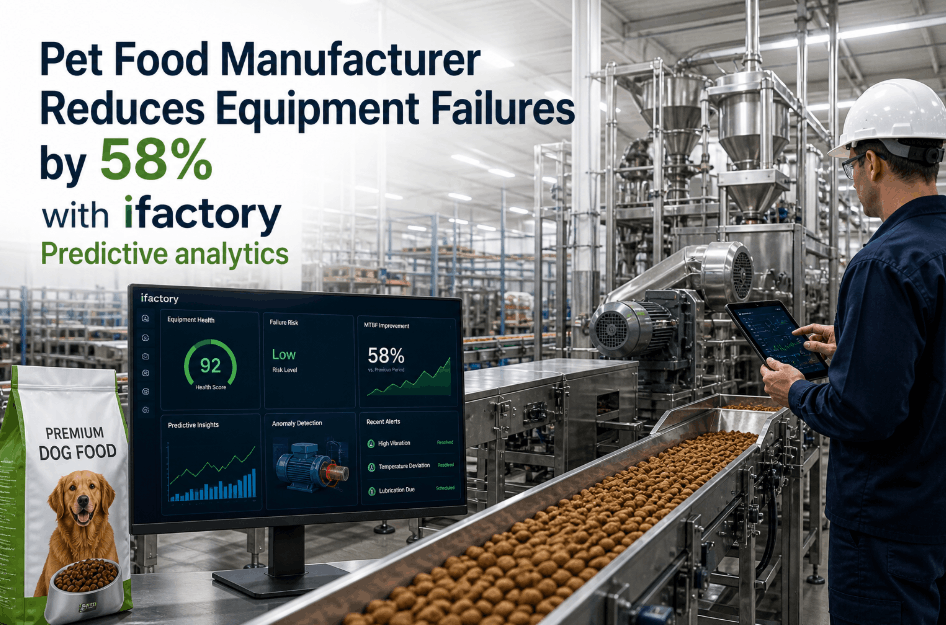
A mid-sized pet food manufacturer operating three production lines — each anchored by high-capacity extruders, continuous-feed dryers, and automated coating systems — was absorbing more than $1.1 million annually in maintenance costs driven almost entirely by reactive equipment failures. Forty-one unplanned downtime events in a single operating year disrupted batch consistency, triggered waste disposal of in-process product, and eroded throughput capacity by an estimated 19%. The deployment of ifactory's predictive analytics AI platform — monitoring real-time vibration signatures, thermal drift, motor load variance, and process parameter deviations across all three lines — reduced equipment failures by 58%, cut unplanned downtime by 63%, and delivered $847,000 in documented first-year maintenance and production impact. Book a Demo to see how this outcome maps to your production environment.
Client Background
The manufacturer produces dry kibble, semi-moist, and coated treat formats across three fully integrated production lines at a single processing facility. Each line runs 20 hours per day across two shifts, with a scheduled four-hour maintenance window per 24-hour cycle. Core processing equipment includes twin-screw extruders, belt and drum dryers, and precision coating drums — all operating under continuous thermal and mechanical stress that accelerates wear on critical components. Prior to the ifactory deployment, the facility had no sensor-based condition monitoring infrastructure. Maintenance decisions were calendar-driven, failure diagnostics were reactive, and equipment health data existed only as post-failure repair records in a work order management system. Book a demo to see how this platform applies to your production line configuration.
The Challenge
Pet food processing equipment operates under conditions that accelerate failure mechanisms invisible to calendar-based maintenance schedules. Extruder screws and barrels accumulate wear from abrasive formulations. Dryer fan bearings develop fatigue signatures weeks before audible failure. Coating drum drive assemblies generate thermal and load deviation patterns that precede mechanical breakdown by days. Without continuous monitoring and early-warning analytics, none of these failure progressions were detectable until the equipment stopped — or until product quality degraded enough to trigger a line hold.
The Solution: ifactory Predictive Analytics AI Platform
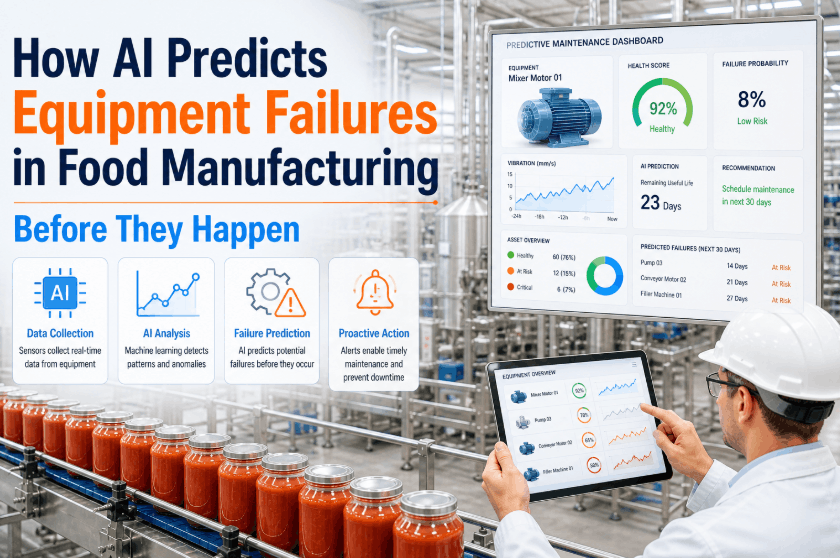
The facility deployed ifactory's predictive analytics AI platform across all three production lines — establishing continuous condition monitoring on extruders, dryers, and coating systems through a non-invasive sensor network integrated with existing control infrastructure. The platform ingested real-time vibration signatures, thermal profiles, motor current and load data, pressure readings, and process parameter streams — feeding machine learning models trained on normal operating baselines to detect anomalous patterns indicative of developing fault conditions. Alerts were generated with sufficient lead time for planned intervention before failure risk materialized, transforming maintenance from reactive response to condition-driven precision scheduling.
- Real-time vibration analysis on screw bearing assemblies detecting wear signatures before mechanical failure
- Motor current draw monitoring identifying blockage conditions, formulation viscosity deviation, and drive train stress
- Barrel temperature profile tracking flagging thermal inconsistencies linked to screw wear or heater degradation
- Fan bearing vibration and thermal monitoring providing 14+ day advance warning of bearing failure risk
- Airflow and temperature uniformity tracking identifying burner or heat exchanger degradation patterns
- Drive belt tension and motor load trending enabling planned belt replacement before unexpected failure
- Drum drive motor load variance trending detecting bearing wear, imbalance, and drive chain fatigue
- Spray nozzle performance monitoring identifying partial blockages before coating uniformity degrades
- Thermal signature analysis on drum shells detecting hot spots linked to product adherence issues
- Machine learning models trained on facility-specific operating baselines eliminating false-positive alert noise
- Multi-sensor fusion correlating vibration, thermal, and load signals for compound fault signature detection
- Fault severity scoring providing maintenance teams prioritized work queues ranked by failure probability and impact
- Automated work order generation triggered by condition thresholds — not calendar intervals
- Maintenance window scheduling aligned to planned production breaks, minimizing intervention impact on throughput
- Component replacement history integrated with degradation models for continuously improving prediction accuracy
- Real-time OEE tracking per line and per equipment category with availability, performance, and quality decomposition
- Downtime root cause attribution linking failure events to specific equipment fault signatures and operating conditions
- Production capacity forecasting based on current equipment health state across all three lines
Implementation Approach
Deployment followed a structured eight-week integration sequence designed to maintain continuous production across all three lines throughout sensor installation and platform activation. ifactory engineers completed sensor installation during scheduled maintenance windows — requiring zero production line downtime for deployment. Baseline condition modeling was established within the first three weeks of continuous data collection, enabling the AI fault detection models to begin generating actionable alerts from week four onward.
Vibration sensors, thermal imaging units, and motor current monitors were installed across all critical equipment on all three lines during scheduled four-hour maintenance windows — with no production interruption required. API connections were established between the ifactory platform and existing PLC and SCADA infrastructure, enabling process parameter data ingestion alongside sensor telemetry. Historical maintenance records and repair logs were migrated to establish component age, replacement history, and prior failure context for each monitored asset.
AI condition models were calibrated against three weeks of continuous sensor data spanning full production cycles, formulation changeovers, and both shift patterns. Normal operating envelopes were established per equipment type and per line, allowing the fault detection models to distinguish genuine anomalies from expected operational variation. During this phase, the platform identified eight equipment assets showing early-stage degradation signatures — providing the maintenance team with its first condition-based work prioritization list before a single platform-driven alert had been formally issued.
Predictive alert thresholds were activated across all monitored assets, with alert routing configured to maintenance team mobile devices and the facility's existing work order management system. Maintenance supervisors and technicians completed platform training covering alert interpretation, severity triage, and condition-based work order scheduling. The eight assets identified during baseline calibration were addressed through planned interventions during the final two weeks of the deployment phase — with zero unplanned failures occurring among monitored equipment from week six onward.
By month three, the facility had transitioned entirely to condition-based maintenance scheduling across all three lines. The AI models had accumulated sufficient fault progression data to begin generating 18–21 day advance warning windows on bearing and drive component degradation — consistently exceeding the initial 14-day lead time target. OEE tracking confirmed line availability improvements across all three production lines within the first quarter of full platform operation.
Results After Full Deployment
The transition from calendar-based reactive maintenance to AI-driven predictive analytics delivered measurable improvements across equipment reliability, production uptime, maintenance cost, and product yield — totaling $847,000 in documented first-year financial impact across three distinct value streams.
Performance Summary
| Metric | Before | After | Improvement |
|---|---|---|---|
| Annual Equipment Failures | 41 events | 17 events | -58% Reduction |
| Unplanned Downtime (Hours) | 193 hours | 71 hours | -63% (-122 hrs) |
| Annual Maintenance Cost | $1.1M | $643K | -42% ($457K Saved) |
| Mid-Process Failure Events | 14 events | 2 events | -86% Reduction |
| Product Waste from Failures | $112K annually | ~$15K | -86% ($97K Recovered) |
| Predictive Alert Lead Time | None — reactive | 18–21 days avg. | From 0 to 21 Days |
| OEE — Line Availability | Baseline | +8–11% capacity | Across 3 Lines |
| Total First-Year Financial Impact | Baseline | $847K+ | Across 3 Value Streams |
Key Benefits and Business Impact
The deployment delivered value that extended beyond direct maintenance cost reduction — fundamentally transforming how the facility manages equipment risk, production capacity, product quality, and capital planning across its three production lines.
Continuous vibration, thermal, and motor load monitoring converted 24 annual failure events from reactive breakdowns into planned maintenance interventions — eliminating emergency repair costs, production disruption, and the compounding damage that occurs when equipment runs to failure rather than being serviced at the optimal maintenance window.
Recovering 63% of prior unplanned downtime added throughput capacity equivalent to 10–14 additional full production shifts annually — without capital investment in additional equipment. During peak seasonal demand periods, this recovered capacity directly supported order fulfillment commitments that would otherwise have required production rescheduling or outsourcing.
Consistent early-warning windows gave maintenance teams sufficient lead time to source components at standard procurement cost, schedule technician labor on regular shifts, and time interventions during planned production breaks — eliminating the premium costs and production impact associated with emergency response maintenance.
Near-elimination of equipment failures during active processing runs protected batch integrity across extruded, dried, and coated product lines — recovering $97,000 in annual product yield value and reducing the quality hold and disposal events that create downstream supply chain disruption.
Replacing fixed-interval preventive maintenance with condition-driven scheduling eliminated the systematic waste of replacing serviceable components on calendar timelines while simultaneously missing components approaching actual failure. Component utilization increased and maintenance spend became correlated with actual equipment condition rather than elapsed time.
Maintenance cost reduction ($457K), production capacity recovery value ($293K), and product yield improvement ($97K) combined to deliver $847,000 in documented first-year financial impact — without modifying any existing production equipment, replacing any control systems, or adding operational headcount to the maintenance or production management teams.