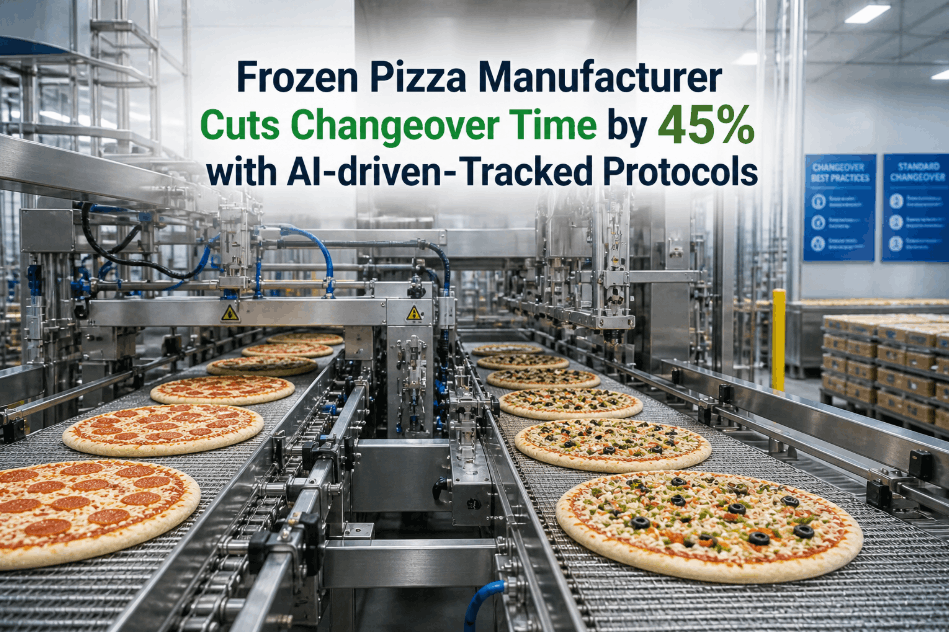
A high-volume frozen pizza manufacturer producing over 8,500 tonnes annually across multiple SKUs faced a critical operational bottleneck: slow, inconsistent production changeovers that were costing hours of productive uptime every single week. With allergen cleaning protocols tracked on paper, quick-change tooling steps left to individual operator memory, and no standardized digital checklist enforcing sequence compliance, changeover durations varied by as much as 38% between shifts — an unacceptable inconsistency for a facility running 24-hour production cycles. Deploying ifactory's AI-driven Work Order Automation platform delivered a 45% reduction in average changeover time within seven months, while simultaneously eliminating allergen cleaning documentation gaps that had created recurring audit risk. Book a Demo to see how ifactory transforms frozen food production efficiency at scale.
Client Background
The manufacturer operates an integrated production facility running three continuous shifts across six pizza lines, producing retail-branded and private-label frozen pizzas in more than 40 active SKU configurations. Product variety spans allergen-differentiated lines — dairy, gluten, tree nuts, and soy — requiring full allergen changeover protocols between product families on shared equipment. With over 120 scheduled changeover events per month across sauce, topping, crust format, and packaging variants, the facility's operational throughput was directly constrained by changeover speed and consistency. Prior to ifactory deployment, changeover management relied on laminated paper checklists, verbal handover between operators, and supervisor spot-checks — with no digital enforcement of step sequence, no real-time visibility into changeover progress, and no analytics identifying which steps were driving the most time loss. If you manage a similar operation, Book a Demo to see how ifactory maps to frozen food production environments.
The Challenge: Why Frozen Pizza Changeover Optimization Is So Complex
Pizza line changeover optimization presents a compound operational challenge that most frozen food manufacturers underestimate. Each changeover is not a single task — it is a sequenced workflow spanning equipment teardown, allergen-specific cleaning verification, tooling swap and torque validation, recipe parameter entry, first-article quality checks, and production release sign-off. When any of these steps is executed out of sequence, performed inconsistently, or documented incompletely, the consequences range from extended line downtime to allergen cross-contact risk to failed quality audits.
The Solution: AI-Driven Work Order Automation for Pizza Line Changeover
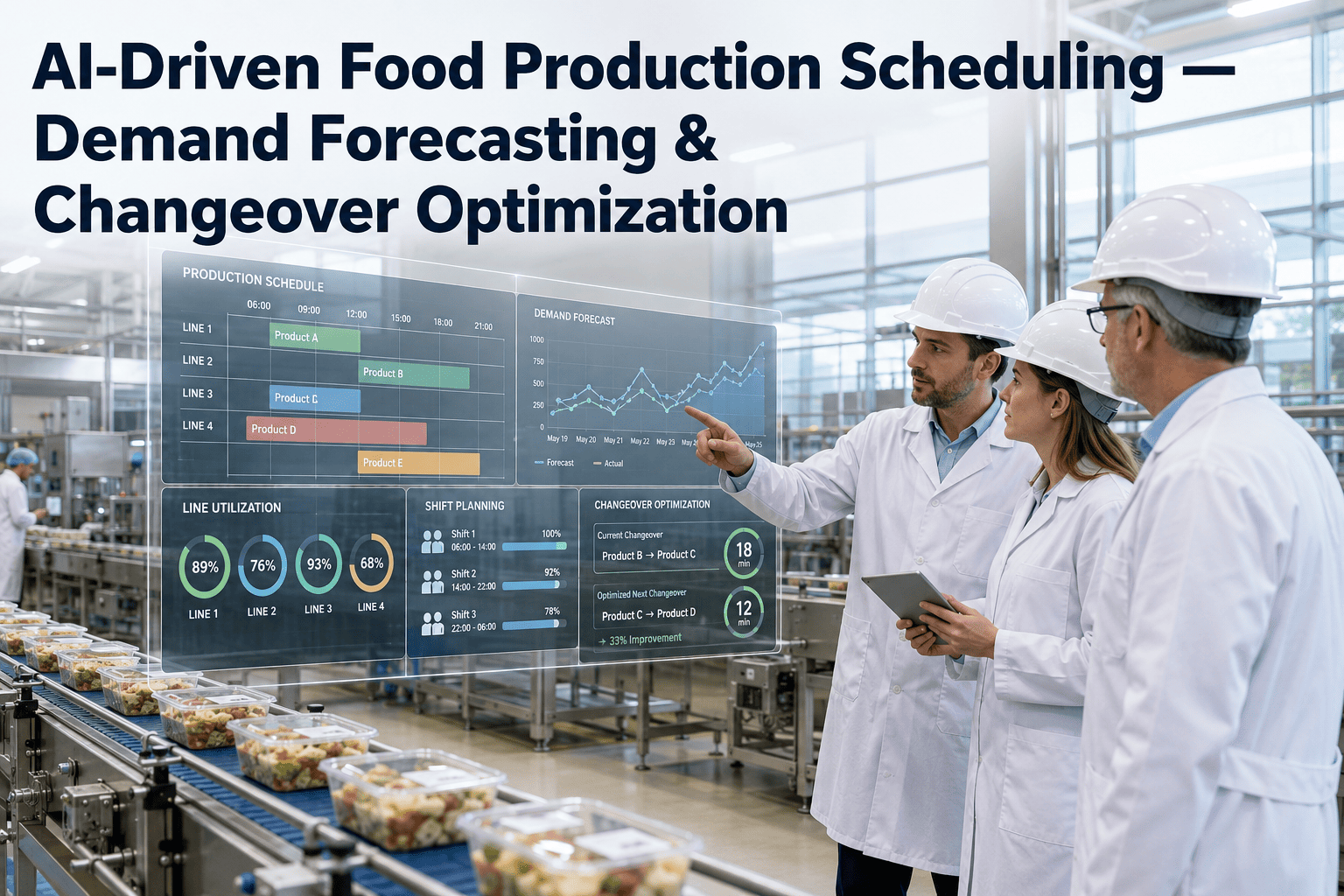
The manufacturer deployed ifactory's Work Order Automation platform to digitize, standardize, and analytically optimize every dimension of its pizza line changeover process. The platform replaced paper checklists with enforced digital workflows, introduced step-level timing analytics to identify bottleneck tasks, and integrated allergen cleaning verification into a mandatory hold-and-release protocol that made incomplete documentation structurally impossible. Quick-change tooling management was brought under the same digital layer — providing location tracking, condition logging, and pre-retrieval staging notifications that eliminated the hidden 17-minute retrieval burden from each changeover event. To explore how this maps to your production environment, Book a Demo with the ifactory team.
- Enforced step-sequencing workflows for all 40+ SKU changeover types across 6 production lines
- Mandatory completion logic preventing production release until all checklist steps are verified
- Role-based task assignment routing supervisor sign-off steps to authorized personnel only
- Integrated allergen changeover workflows with mandatory cleaning verification, swab logging, and supervisor e-sign-off
- Automated hold-and-release controls blocking production start until allergen clearance is fully documented
- Time-stamped, immutable allergen cleaning records available for instant audit retrieval
- Digital tooling register with location tracking, condition status, and last-verified calibration dates
- Pre-changeover staging notifications alerting tool room staff 30 minutes before scheduled changeover start
- Tooling retrieval time eliminated from changeover critical path via pre-staged kits at line-side storage
- Automatic time-stamping of every checklist step across all changeover events and all shifts
- Bottleneck identification dashboards ranking changeover steps by average duration and shift-to-shift variance
- Trend analytics comparing changeover performance by line, shift, product family, and operator cohort
- Fastest-observed changeover sequences automatically flagged for review and workflow incorporation
- Parallel task scheduling logic enabled for eligible changeover steps, reducing total critical path duration
- Institutional knowledge encoded into platform workflows, available to all operators across all shifts
- Automated work order creation triggered from production schedule, pre-populated with line-specific changeover requirements
- Real-time work order status visible to supervisors, quality managers, and production planners simultaneously
- Deviation alerts escalated when changeover steps exceed configurable time thresholds
Implementation Approach: From Paper Checklists to AI-Driven Changeover Control
Deployment followed a six-week structured onboarding program designed to digitize all changeover workflows without interrupting live production. The implementation team worked from the facility's existing paper checklists, internal audit findings, and changeover time records to configure the platform against actual operational requirements. All six production lines were live on the digital changeover platform within 41 days of project initiation, with allergen changeover workflows fully tested and allergen cleaning verification integrated into mandatory hold-and-release logic before the first allergen-adjacent product transition on the new system.
The ifactory team catalogued all 40+ SKU changeover types across six lines, mapping each to a structured digital checklist with step-level role assignments and sequence enforcement logic. All allergen changeover procedure types were identified and flagged for mandatory cleaning verification integration. Quick-change tooling inventories were registered in the platform with location, condition, and calibration data imported from existing tool room records.
Allergen cleaning workflows were configured with mandatory swab logging, pass/fail threshold validation, and hold-and-release controls. Pre-changeover tooling staging notifications were activated with 30-minute advance alerts to the tool room team. Operators across all three shifts completed platform onboarding sessions, with line supervisors trained on work order monitoring dashboards and deviation escalation workflows.
After two weeks of live data collection across all lines and shifts, the analytics layer identified the three highest-duration changeover steps: allergen line flush verification (averaging 14.2 minutes), oven zone temperature reset confirmation (averaging 11.8 minutes), and topping hopper changeout on lines 4 and 5 (averaging 9.6 minutes). Parallel task scheduling logic was configured to allow oven zone pre-heating to proceed concurrently with allergen cleaning, immediately reducing the critical path by an average of 8.4 minutes per allergen-adjacent changeover.
From month three, the platform's best-practice capture feature began surfacing the fastest-observed sequences for each changeover type. These were reviewed by production engineering, validated, and incorporated into updated workflow templates — progressively encoding institutional knowledge into the platform. By month seven, average changeover duration had declined 45% from baseline, shift-to-shift variability had been reduced from 38% to under 6%, and all 120+ monthly allergen changeover events were being completed with 100% documentation integrity.
Results: Frozen Pizza Production Changeover Performance After Deployment
ifactory's Work Order Automation platform delivered measurable, compounding performance improvement across every dimension of the facility's changeover operations — with results that translated directly into recoverable production capacity, eliminated audit risk, and a fundamentally more consistent operational baseline across all shifts and all lines.
Performance Summary
| Metric | Before | After | Improvement |
|---|---|---|---|
| Average Changeover Duration | 63 min baseline | 34.6 minutes | 45% Reduction |
| Shift-to-Shift Variability | 38% variance | Under 6% | 84% Variance Reduction |
| Allergen Doc Completeness | Gaps in 4 consecutive audits | 100% Complete | Zero Gaps — Platform Enforced |
| Tooling Retrieval Time | 17 min avg per changeover | Under 3 minutes | 82% Reduction |
| Changeover Knowledge Standardization | Operator-dependent — no capture | Encoded in platform workflows | Fully Standardized Across Shifts |
| Work Order Automation | Manual — paper-based, no analytics | AI-generated, real-time tracked | From Manual to Predictive |
| Time to Full Results | No improvement trajectory | 45% reduction by month 7 | Achieved Within 7 Months |
Key Benefits: What AI-Driven Changeover Automation Delivers for Frozen Food Manufacturers
The operational impact of deploying ifactory's Work Order Automation platform extended well beyond the headline changeover time reduction. The deployment changed the fundamental way the facility manages, measures, and improves its production changeover process — replacing an operator-dependent, paper-based system with a data-driven, continuously improving operational framework. Manufacturers considering similar deployments can Book a Demo to explore how the platform applies to their specific line configurations and changeover profiles.
A 45% reduction in average changeover duration from 63 minutes to 34.6 minutes across 120+ monthly events translates to more than 3,400 minutes of recovered productive line capacity per month — capacity that can be converted directly into incremental production volume, additional SKU flexibility, or reduced overtime dependency.
Encoding best-practice changeover sequences into enforced digital workflows eliminated the dependency on individual operator knowledge and experience. Production planners gained a reliable, consistent changeover duration they could schedule against — reducing buffer-time overruns, improving schedule adherence, and enabling tighter customer order commitments across export markets.
Mandatory hold-and-release logic made allergen documentation gaps structurally impossible — eliminating the recurring non-conformity pattern that had appeared across four consecutive internal audits. The facility now maintains complete, time-stamped, auditor-ready allergen changeover records for every event, available for immediate retrieval during announced and unannounced inspections.
Pre-changeover staging notifications reduced tooling retrieval time from 17 minutes to under 3 minutes per changeover — removing what had been an invisible but consistently recurring time loss from every changeover event across all six lines. The tooling register also reduced instances of damaged or uncalibrated tools reaching the production floor.
For the first time, the facility's production engineering team had access to step-level duration data for every changeover event — enabling evidence-based improvement decisions rather than anecdote-driven changes. Parallel task scheduling, pre-staging protocols, and best-practice capture are all now driven by actual performance data rather than supervisor intuition.
The fastest-observed changeover sequences — previously known only to individual high-performing operators — are now identified automatically by the platform, reviewed by production engineering, and incorporated into updated workflow templates. Operator turnover no longer results in knowledge loss. Every new operator starts with the facility's best-known changeover sequence from day one.
Conclusion: How Frozen Pizza Manufacturers Can Achieve Measurable Changeover Optimization
For frozen pizza and frozen food manufacturers, production changeover efficiency is one of the highest-leverage operational variables available without capital investment in new equipment. A 45% reduction in changeover time does not require faster machinery — it requires standardized workflows, allergen cleaning protocols that enforce documentation integrity, quick-change tooling processes that eliminate retrieval bottlenecks, and analytics that identify where time is actually being lost. This case study demonstrates exactly what becomes possible when AI-driven Work Order Automation replaces paper-based changeover management: a facility that had accepted 38% shift variability and recurring allergen documentation gaps as operational constants achieved measurable, sustained improvement across all six production lines within seven months. To explore how ifactory applies to your frozen food production environment, Book a Demo with the ifactory team.
Any frozen pizza manufacturer managing changeover workflows through paper checklists, verbal operator handovers, or disconnected spreadsheets is carrying avoidable time loss, scheduling risk, and allergen documentation liability that AI-driven work order automation can systematically eliminate — and quantify from the first weeks of deployment.