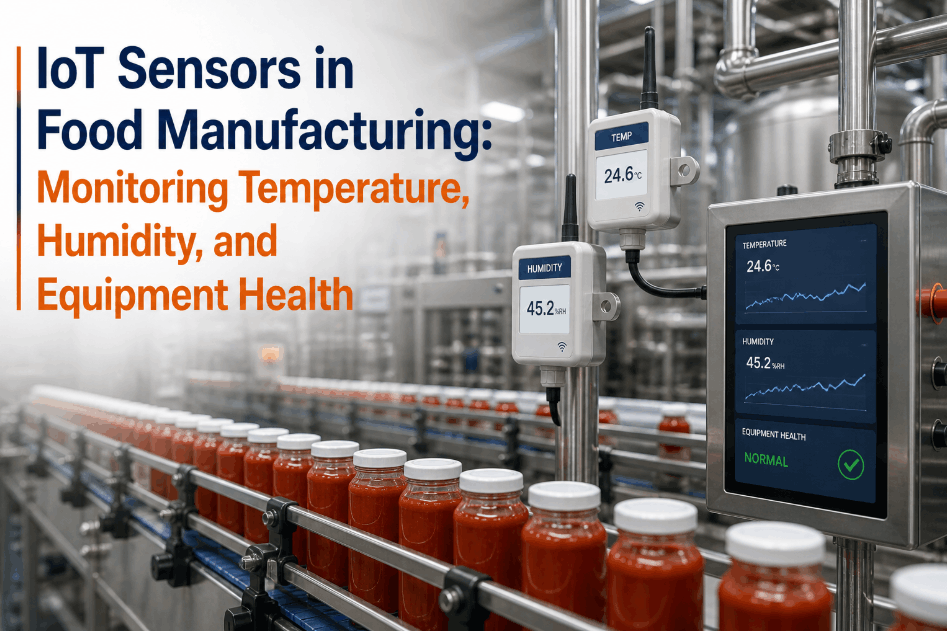
IoT sensors in food manufacturing are redefining how plant engineers monitor temperature, humidity, equipment health, and environmental conditions across every stage of production. As food safety regulations tighten and operational margins shrink, deploying a connected food plant IoT monitoring network is no longer optional — it is the core infrastructure that separates efficient, compliant facilities from those reacting to problems after costly failures have already occurred. Real-time sensor data, when integrated with AI-driven analytics, gives plant engineers the visibility to prevent spoilage, reduce energy waste, extend equipment lifespan, and maintain uninterrupted production continuity. Book a Demo to see how iFactory's IoT sensor integration platform delivers actionable environmental and equipment intelligence across your food manufacturing operations.
Real-Time IoT Monitoring Built for Food Manufacturing
iFactory connects temperature sensors, humidity monitors, vibration detectors, and flow meters into a unified intelligence platform — giving plant engineers instant visibility into every critical production variable.
Why IoT Sensors Are Essential Infrastructure in Modern Food Manufacturing
The fundamental challenge in food and beverage production is that critical conditions — cold chain temperature, cleanroom humidity, compressor pressure, conveyor motor vibration — change faster than any manual inspection cycle can capture. A temperature excursion that begins at 2:00 AM in a blast freezer may not be detected until the morning shift arrives, by which point significant product loss or food safety risk has already materialized. IoT sensors for food manufacturing eliminate these detection gaps by creating a continuous, automated monitoring layer across every environmental zone and equipment asset in the facility. When paired with AI-driven alert management, these sensor networks move plant engineers from reactive problem-solving to proactive condition management — transforming production reliability and food safety performance simultaneously.
The Five Core IoT Sensor Categories Every Food Plant Should Deploy
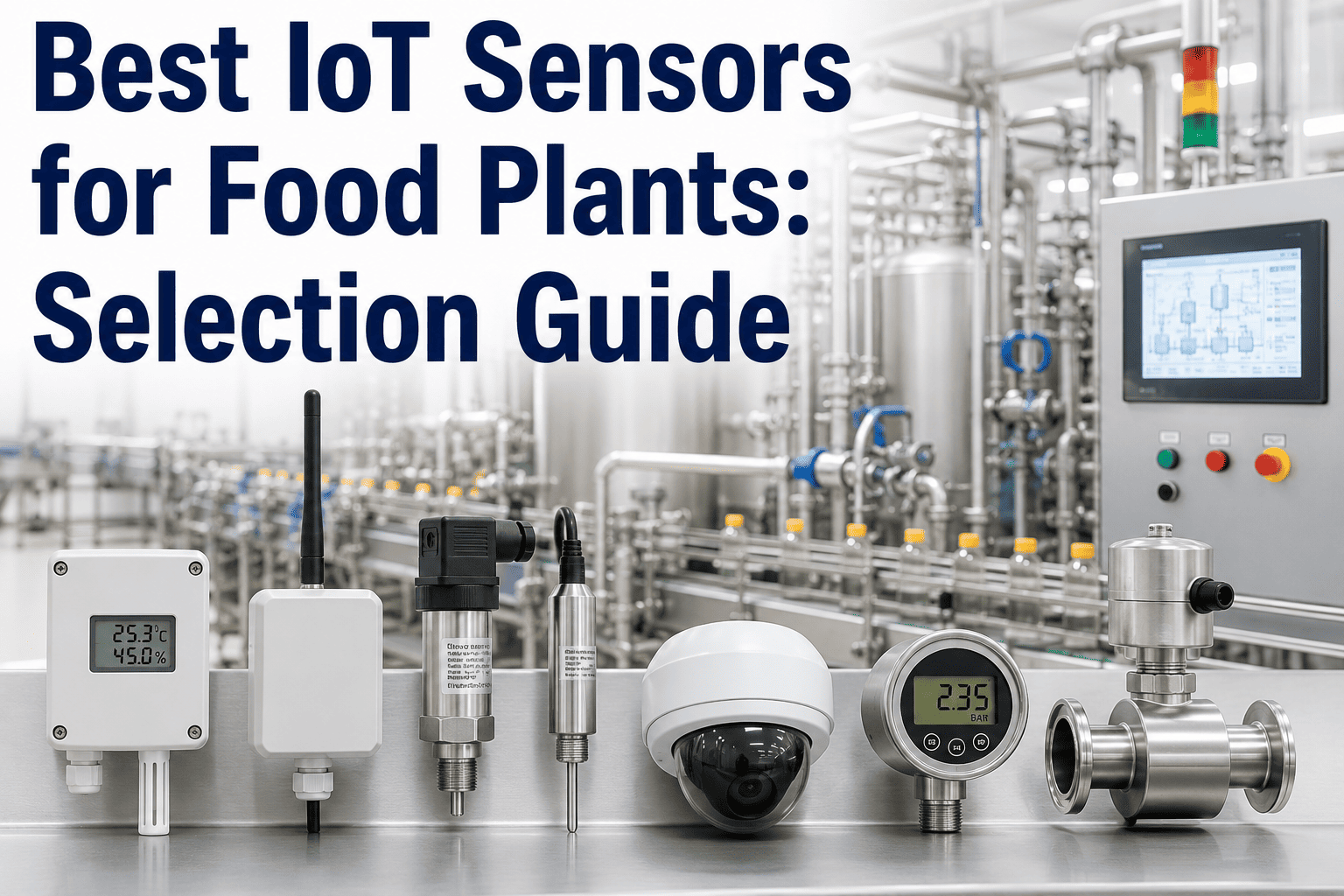
Selecting the right sensor types for a food manufacturing environment requires matching measurement capability to the specific process variables that most directly affect product quality, food safety compliance, and equipment reliability. Each sensor category solves a distinct monitoring problem that manual inspection or aggregate measurement cannot address with adequate resolution or frequency.
Temperature Sensors for Cold Chain and Process Monitoring
Temperature is the single most regulated variable in food manufacturing, governing everything from cold storage compliance to pasteurization validation and cooking process control. Wireless RTD and thermocouple sensors deployed across refrigerated storage zones, processing lines, and distribution staging areas provide continuous temperature logs that satisfy FSMA, HACCP, and retail audit requirements without manual data entry. Sub-second sampling intervals capture temperature spikes that hourly manual checks would miss entirely.
Humidity Monitoring for Cleanrooms and Ingredient Storage
Humidity monitoring in food plants protects against microbial growth in processing environments, prevents caking and degradation of hygroscopic dry ingredients, and maintains packaging seal integrity in humid climates. Capacitive humidity sensors with wireless connectivity deliver real-time relative humidity data across multiple monitoring points — alerting plant engineers when conditions approach limits before product quality or safety is compromised. Continuous humidity logs also support cleanroom certification and GMP compliance documentation.
Vibration Sensors for Equipment Health and Predictive Maintenance
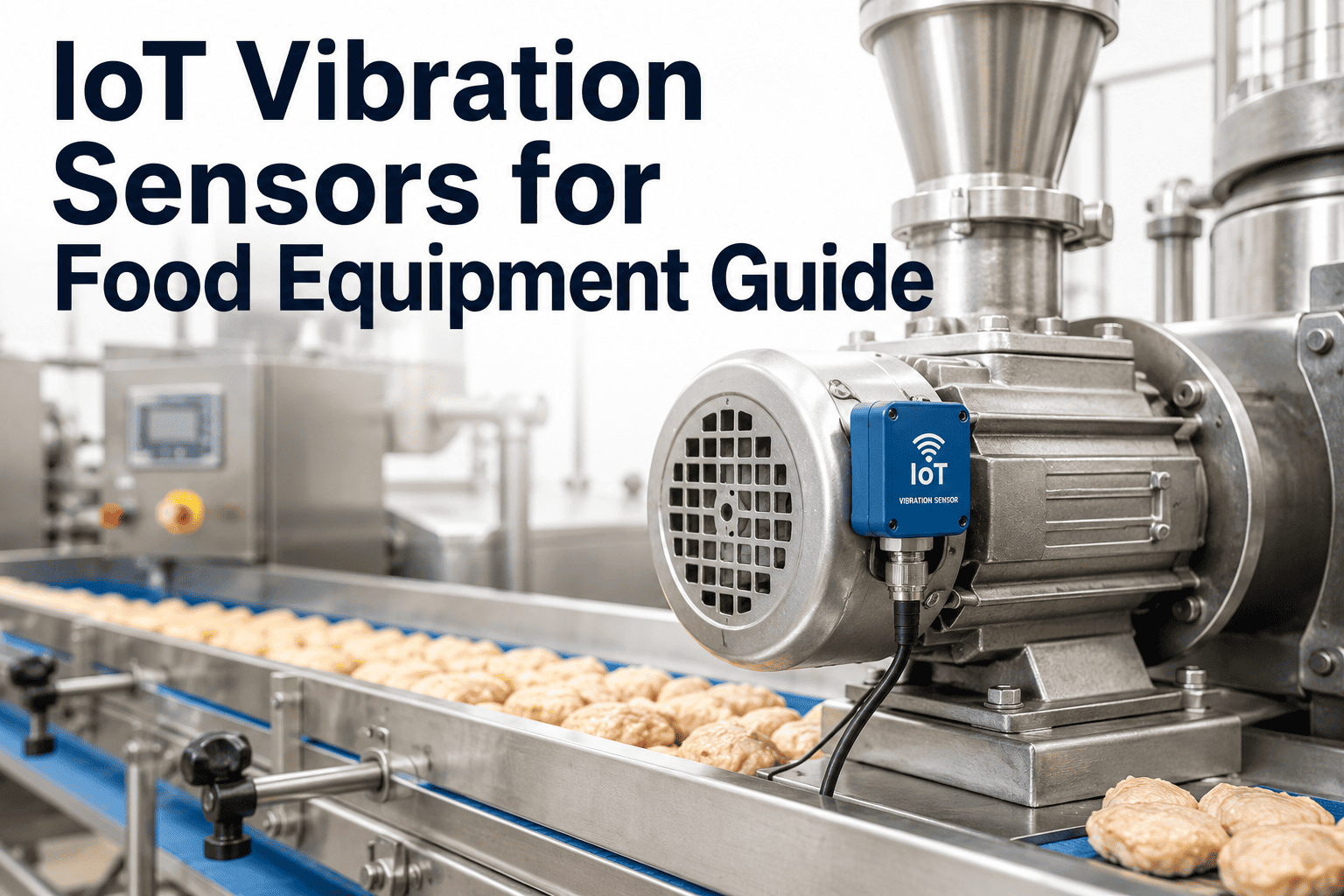
Vibration sensors mounted on motors, pumps, conveyors, mixers, and compressors provide the earliest available signal of mechanical degradation — detecting bearing wear, misalignment, imbalance, and lubrication failure weeks before the fault produces audible noise or performance loss. IoT equipment health monitoring through triaxial accelerometers connected to AI-driven baseline comparison algorithms generates maintenance work orders automatically when vibration signatures deviate from established healthy equipment profiles, preventing both unplanned downtime and the collateral product contamination risk that sudden mechanical failures create.
Pressure Monitoring for CIP Systems and Compressed Air Networks
Pressure monitoring sensors deployed on clean-in-place circuits, compressed air distribution headers, steam lines, and hydraulic systems confirm that cleaning processes are executing within validated parameters and that utility systems are delivering required operating pressures to production equipment. Deviations from target pressure ranges during CIP cycles can invalidate sanitation validation — a food safety and regulatory risk that real-time pressure IoT monitoring catches in the moment rather than during post-process review of paper records.
Flow Rate Sensors for Water, Product, and Chemical Dosing
Flow rate sensors on water supply lines, product transfer pipelines, and chemical dosing systems provide the measurement precision required to optimize ingredient utilization, validate cleaning chemical concentrations, and quantify water consumption at the process level. Ultrasonic and electromagnetic flow meters integrated into a food plant sensor network enable plant engineers to detect pipe leaks, dosing system malfunctions, and overconsumption patterns that aggregate utility metering cannot localize to specific process areas or equipment assets.
Gas and Air Quality Sensors for Controlled Atmosphere and Safety Compliance
Modified atmosphere packaging lines, fermentation vessels, and ammonia refrigeration systems require continuous gas concentration monitoring that manual sampling cannot provide at adequate frequency. Electrochemical and infrared gas sensors monitoring CO₂, O₂, NH₃, and volatile organic compounds deliver both product quality protection in controlled-atmosphere applications and worker safety compliance in facilities where refrigerant leak detection is a regulatory obligation. Integrating gas sensor data with building management systems enables automated ventilation responses that protect both personnel and production environments.
AI-Driven IoT Integration: Turning Sensor Data Into Production Intelligence
Raw sensor readings from a food plant IoT monitoring network generate enormous data volumes that manual analysis cannot process at the speed required for operational decision-making. The true value of AI-driven IoT integration in food manufacturing emerges when machine learning models trained on production-specific sensor patterns detect anomalies, predict failures, and correlate environmental conditions with quality outcomes in real time. Plant engineers who Book a Demo with iFactory see how the platform's AI layer converts raw temperature, vibration, pressure, and flow data into prioritized alerts, predictive maintenance schedules, and process optimization recommendations — reducing alert fatigue while ensuring that every critical condition receives immediate attention.
Machine Learning Baseline Modeling for Process Variables
AI models trained on weeks of historical sensor data establish dynamic baselines for normal operating conditions across each production line, storage zone, and equipment asset. Deviations from these learned baselines — rather than fixed threshold violations — trigger early warning alerts that capture developing problems before they cross critical limits. This approach dramatically reduces both false positives from expected process variation and false negatives from gradual drift that never crosses a static alarm threshold.
Failure Prediction and Maintenance Window Optimization
Vibration sensor data analyzed through remaining useful life prediction models gives maintenance teams actionable lead time — scheduling bearing replacements, seal inspections, and lubrication services during planned production gaps rather than responding to emergency failures during peak operating periods. Plants deploying predictive maintenance IoT analytics consistently report 30–50% reductions in unplanned downtime, with the highest-impact applications on refrigeration compressors, high-speed packaging lines, and continuous mixing equipment where failure consequences include product loss as well as mechanical repair cost.
Multi-Sensor Correlation for Root Cause Analysis
Individual sensor readings rarely tell the complete story of a process deviation. AI-driven correlation engines that simultaneously analyze temperature, humidity, pressure, flow, and vibration data across interconnected systems identify root causes that single-sensor analysis misses — distinguishing between a refrigeration compressor fault, a heat exchanger fouling event, and an upstream process change as the true driver of a cold storage temperature excursion, enabling targeted corrective action rather than broad investigative responses that consume maintenance resources without resolving the underlying problem.
Context-Aware Alert Management and Escalation Routing
Alert fatigue is the primary reason food plant IoT deployments fail to deliver on their monitoring promise — when every sensor threshold violation generates an equal-priority notification, engineers learn to filter alerts rather than respond to them. Smart alert management platforms apply production context — scheduled CIP cycles, planned line startups, seasonal ambient temperature ranges — to suppress expected condition deviations while ensuring that genuine anomalies reach the right personnel through mobile notifications, shift supervisor escalation, and maintenance system integration within seconds of detection.
IoT Sensor Network Architecture: From Plant Floor to Cloud Analytics
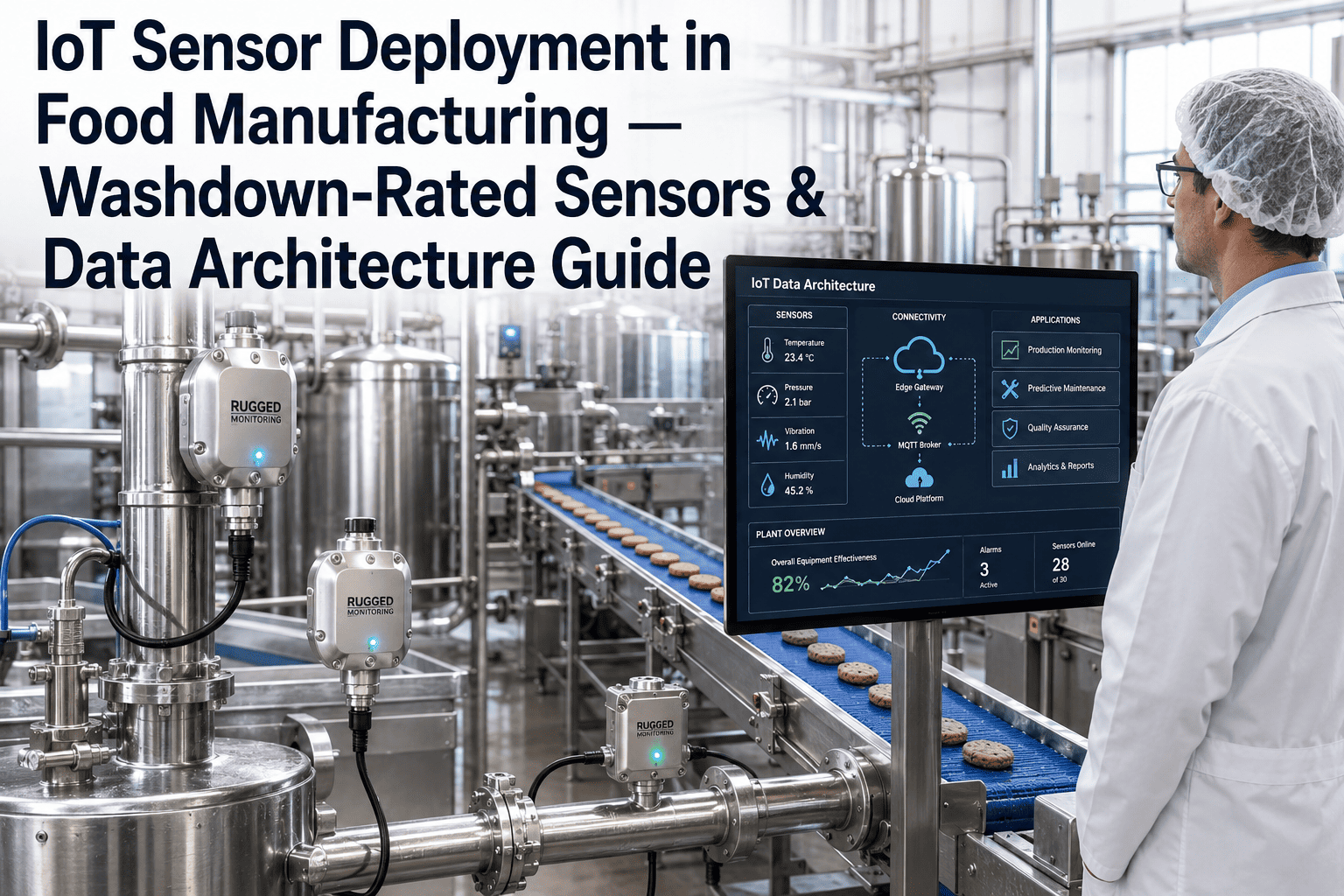
Designing a robust food plant sensor network requires understanding the three-tier architecture that transforms distributed physical measurements into centralized operational intelligence. Plant engineers evaluating IoT monitoring deployments should assess each layer's performance characteristics against their specific facility requirements — wireless coverage, sensor density, data latency tolerance, and cybersecurity requirements all influence architectural decisions that determine long-term platform reliability and scalability. Platforms like iFactory enable plant engineers to Book a Demo using live data from their own facility to validate network architecture decisions before committing to deployment.
Sensor Hardware and Wireless Protocols
Physical sensors, transmitters, and gateways on the plant floor form the edge layer. Food-grade sensors must meet IP ratings for wash-down zones and handle freezer-to-oven temperature ranges. Wireless protocols — LoRaWAN for long range, Zigbee for dense deployments, industrial WiFi for high-speed data — are selected based on facility layout and sensor density.
Edge Gateways for Local Real-Time Processing
Edge gateways process time-critical alerts — vibration spikes, temperature excursions, pressure deviations — locally in sub-seconds, without waiting for cloud response. They also buffer data during network outages, keeping food safety monitoring continuous even when internet connectivity drops.
Multi-Site Analytics and Long-Term Intelligence
The cloud layer aggregates sensor data from all facilities for benchmarking, trend analysis, and compliance documentation. Integrations with ERP, MES, and CMMS systems trigger automated workflows — from spare parts ordering to HACCP record updates — directly from sensor events.
IoT Food Safety Compliance: Meeting HACCP, FSMA, and Retailer Audit Requirements
IoT food safety monitoring systems are increasingly recognized by regulatory bodies and retail audit frameworks as superior to manual monitoring programs — not only for detection speed but for the data integrity and traceability that automated sensor logging provides. FSMA Preventive Controls regulations require food manufacturers to implement, monitor, and document controls for hazard points identified in food safety plans; IoT sensors provide continuous, tamper-evident monitoring records that satisfy these documentation requirements with far greater reliability than paper-based manual logs. Plant engineers responsible for HACCP program management who Book a Demo consistently identify significant reductions in audit preparation time when automated sensor logs replace manual temperature recording sheets, CIP process records, and equipment inspection checklists.
Smart Sensors vs. Traditional Monitoring: A Comparison for Plant Engineers
| Monitoring Category | Traditional Approach | IoT Smart Sensor Approach | Operational Benefit |
|---|---|---|---|
| Cold Storage Temperature | Hourly manual checks with paper logs | Continuous wireless sensors with automated alerts and tamper-evident cloud logs | Eliminates excursion detection gaps; 40% fewer product loss events |
| Equipment Vibration | Quarterly route-based vibration surveys by technicians | Continuous triaxial accelerometers with AI baseline comparison | Detects bearing faults 3–6 weeks earlier; prevents unplanned failures |
| Processing Humidity | Manual hygrometer readings at shift start | Wireless capacitive humidity sensors with real-time dashboards | Prevents microbial risk zones; supports cleanroom certification |
| CIP Pressure Validation | Operator observation with manual pressure gauge records | Inline pressure transducers with automated CIP validation reports | Eliminates invalid CIP cycles; reduces re-cleaning events by 60% |
| Water Flow Metering | Monthly utility invoice review at aggregate facility level | Process-level ultrasonic flow meters with real-time consumption analytics | Identifies 15–25% water reduction opportunities; detects pipe leaks immediately |
| Gas Concentration | Scheduled manual sampling with laboratory analysis | Continuous electrochemical sensors with instant alarm capability | Provides real-time worker safety protection; meets refrigerant compliance mandates |
| Audit Documentation | Manual record compilation from paper logs for each audit | Automated sensor data export with time-stamped, auditor-ready reports | 3× faster audit response; eliminates data integrity disputes |
Deploying IoT Monitoring in Legacy Food Plants: Retrofit Strategies for Existing Equipment
Most food plants were built before industrial IoT existed — but that doesn't block a retrofit deployment. Modern wireless sensors attach to legacy equipment without pipe cuts, rewiring, or asset decommissioning. The key is following a structured rollout that minimizes disruption while maximizing coverage. Plants evaluating retrofit IoT strategies can Book a Demo to assess compatibility between iFactory's sensor integration layer and their existing equipment portfolio.
Audit Critical Monitoring Gaps
Walk every production zone and identify where temperature, vibration, pressure, or flow currently goes unmonitored. Prioritize assets with the highest failure impact — refrigeration compressors, CIP circuits, and high-speed conveyors first.
Select Retrofit-Compatible Sensors
Choose non-invasive hardware: magnetic vibration sensors for motors, clamp-on ultrasonic flow meters for pipelines, and wireless RTDs that tap existing thermocouple conduits. No production stoppage required for installation.
Connect Legacy Protocols
Many older PLCs and controllers expose data via Modbus or OPC-UA. IoT gateways bridge these protocols to the cloud platform — pulling existing sensor outputs into the analytics layer without replacing any control hardware.
Deploy Gateways and Establish Network
Install industrial edge gateways across the facility to aggregate wireless sensor data. Map gateway placement to eliminate dead zones in cold storage, processing halls, and utility rooms where monitoring coverage is most critical.
Configure Baselines and Alert Rules
Run the platform for 2–4 weeks to collect baseline data before enabling alerts. AI models learn normal operating ranges per shift, season, and product run — so alerts fire on genuine anomalies, not routine process variation.
Integrate with MES, CMMS, and ERP
Connect sensor events to existing plant systems so alerts automatically generate maintenance work orders, update food safety logs, and feed production dashboards — closing the loop between sensor data and operational action.
Frequently Asked Questions: IoT Sensors in Food Manufacturing
What wireless protocol is best for temperature sensors in food plant cold storage environments?
LoRaWAN is generally preferred for cold storage IoT temperature monitoring due to its long range, low power consumption, and strong penetration through the insulated panels and metal shelving that characterize refrigerated warehouse environments. For applications requiring faster data rates or integration with existing WiFi infrastructure, industrial-grade WiFi sensors with dedicated SSID channels provide reliable performance. The optimal protocol depends on facility layout, gateway placement feasibility, and the number of sensors required — multi-protocol gateway deployments often provide the best coverage across mixed facility environments.
How do vibration sensors detect bearing failures before they cause equipment breakdowns?
Vibration sensors measure acceleration in multiple axes at high sampling frequencies, capturing the distinctive frequency signatures that characterize specific mechanical failure modes. Bearing defects generate characteristic frequency patterns — outer race defects, inner race defects, and rolling element defects each produce identifiable spectral peaks that AI algorithms recognize against the baseline vibration signature of healthy equipment. As the defect progresses, these frequencies increase in amplitude before the bearing reaches catastrophic failure, providing a predictable detection window of days to weeks during which maintenance can be scheduled without production interruption.
What IP rating do IoT sensors require for food manufacturing wash-down environments?
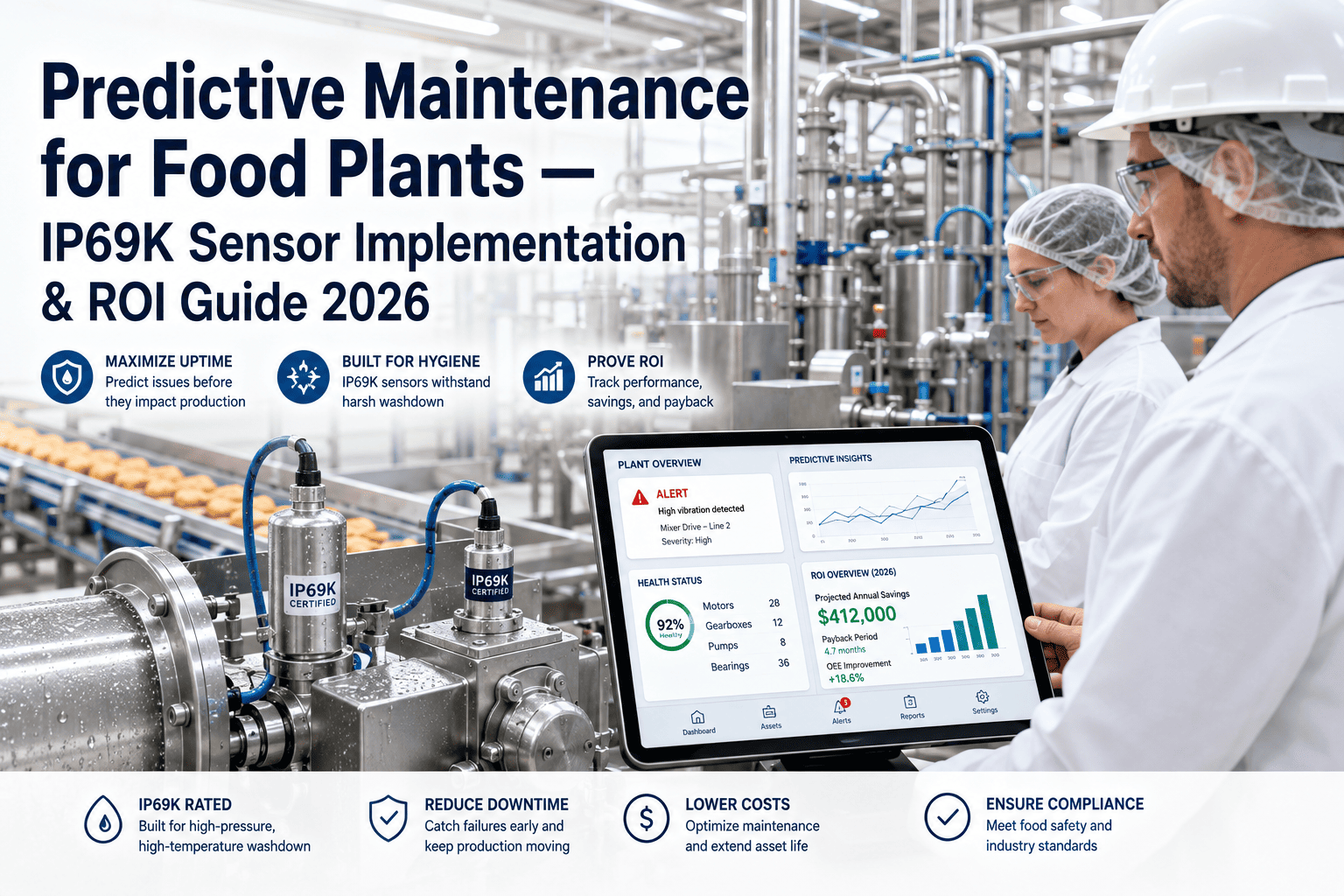
IoT sensors deployed in food manufacturing wet zones, processing areas, and anywhere subject to high-pressure cleaning require a minimum IP69K rating — the highest standard for protection against high-pressure, high-temperature water jets. For general food processing environments with moderate cleaning exposure, IP67 or IP68 ratings provide adequate protection. Sensors in dry ingredient handling or packaging areas may use IP65-rated devices. Food-grade stainless steel enclosures are recommended for direct product contact zones or areas where chemical cleaning agents are routinely applied.
Can IoT sensor data be used to support FSMA Preventive Controls documentation requirements?
Yes. Continuous IoT sensor logs provide the monitoring records, corrective action triggers, and verification documentation that FSMA Preventive Controls regulations require for temperature, process parameters, and sanitation monitoring activities. Automated sensor platforms that generate time-stamped, tamper-evident records with exception reports and corrective action documentation satisfy FDA expectations for monitoring frequency, documentation integrity, and traceability. Platforms integrated with food safety management systems can link sensor deviations directly to corrective action workflows, creating a complete audit trail that demonstrates both the effectiveness of monitoring programs and the responsiveness of corrective action procedures.
How long does it take to deploy an IoT sensor network across a food manufacturing facility?
A focused IoT sensor deployment covering critical monitoring points — cold storage, key process equipment, compressed air, and CIP systems — can be completed in four to eight weeks for a typical mid-size food plant. Comprehensive deployments covering all production lines, utilities, and environmental monitoring zones typically require twelve to sixteen weeks. The primary deployment timeline variables are network infrastructure readiness, the proportion of wireless versus wired sensors, integration complexity with existing plant systems, and the number of custom data integrations required to connect sensor data with ERP, MES, or CMMS platforms.
Connect Every Sensor in Your Food Plant to a Unified Intelligence Platform
iFactory's IoT integration platform connects temperature sensors, humidity monitors, vibration detectors, pressure transducers, and flow meters into a single real-time monitoring and analytics environment — giving plant engineers complete visibility into every process variable and equipment health indicator that drives food safety, production reliability, and operational efficiency.