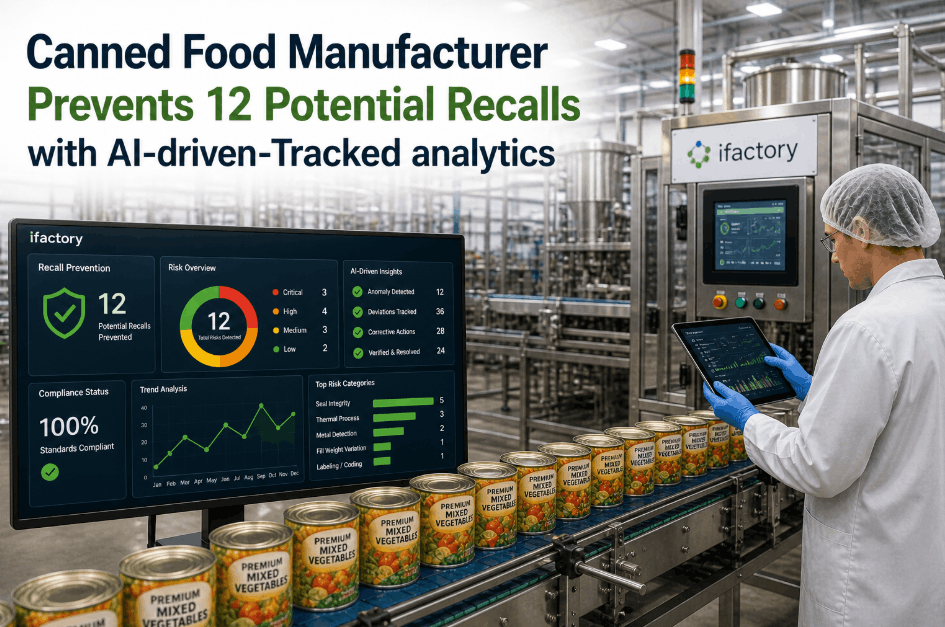
A mid-scale canned food manufacturer processing over 8,500 tonnes of shelf-stable products annually — spanning vegetables, legumes, and ready-to-eat meals — was operating its food safety program on a fragile foundation of paper-based seamer calibration logs, manually recorded retort cycle sheets, and disconnected spreadsheets for critical control point (CCP) deviation tracking. The consequence was severe: in a single 14-month audit window, internal reviewers identified 12 separate production events that carried documented characteristics of potential recall triggers — seam integrity failures, retort under-process deviations, and undocumented CCP exceedances that, had any reached a regulatory inspector's desk, could have initiated Class II recall procedures. Deploying ifactory's AI-driven Compliance Tracking platform transformed the facility's food safety documentation from a reactive liability into a proactive, analytics-driven recall prevention system. Book a Demo to see how ifactory's seamer calibration and retort monitoring analytics apply to your canned food manufacturing environment.
Client Background: Canned Food Manufacturing at Scale
The facility operates as a contract and own-brand canned food manufacturer supplying retail and foodservice channels across nine distribution markets. The plant runs continuous two-shift production, operates four double-seam seamer lines, manages six retort vessels across pressure and steam sterilization processes, and maintains over 280 calibrated instruments across filling, seaming, thermal processing, and laboratory analysis functions. Prior to ifactory deployment, seamer calibration records were captured on paper teardown sheets completed by line mechanics, retort process deviations were logged manually by shift supervisors with no automated cross-referencing against scheduled thermal processes, and CCP monitoring data from filling weight checks, pH verification, and water activity measurements lived in disconnected Excel workbooks with no centralized audit trail. The result was a compliance posture incapable of detecting systemic failure patterns before they accumulated into recall-level risk events.
The Challenge: Why Manual Systems Create Canned Food Recall Risk
Canned food recall prevention is not primarily a product formulation problem — it is a documentation and detection problem. The vast majority of canned food recall events are triggered by seam integrity failures, retort under-process deviations, and undocumented CCP exceedances that were either undetected during production or detected but not escalated through an effective corrective action chain. For a facility processing shelf-stable products with 18-to-24-month distribution cycles, a production event that passes through quality checks undetected can remain in trade for years before a recall is initiated. Manual compliance systems are structurally incapable of preventing this failure mode. Book a Demo to understand how ifactory's AI-driven retort monitoring and CCP analytics close the detection gap that manual systems leave open.
The Solution: ifactory AI-Driven Compliance Tracking for Canned Food Recall Prevention
The manufacturer deployed ifactory's Compliance Tracking platform to establish a unified, real-time food safety analytics layer across seamer calibration management, retort process monitoring, CCP documentation, and preventive maintenance scheduling. The platform replaced every disconnected manual documentation workflow with digitized, enforced, and analytically monitored compliance processes — enabling the facility to detect equipment deviations, process exceedances, and calibration drift patterns hours or days before they would have previously been discovered, if discovered at all. The core capability that prevented all 12 potential recall events was not documentation improvement alone — it was AI-driven trend analytics surfacing deterioration patterns before tolerance thresholds were breached. Book a Demo to see ifactory's seamer analytics and retort monitoring platform in action for your canned food facility.
- Digital teardown records capturing all seam measurements with time-stamped operator verification and automatic tolerance-range validation
- Trend analytics identifying seam measurement drift across consecutive teardowns — surfacing deterioration patterns before critical tolerance breaches
- Automated alerts triggered when seam parameters trend outside configurable early-warning thresholds, triggering preventive maintenance before failure
- Centralized seamer PM scheduling with overdue status escalation to maintenance supervisors and quality managers simultaneously
- Digital retort log capture with mandatory deviation flagging and automatic lot-number cross-referencing for affected product identification
- Automated corrective action routing when retort cycle deviations are recorded — mandatory supervisor acknowledgment before production continuation
- Retort deviation frequency analytics identifying vessels and process types with elevated non-conformance rates for targeted maintenance prioritization
- Complete retort process history retrievable per vessel, per product, and per shift — audit-ready within seconds
- Unified CCP dashboard aggregating filling weight, headspace, and pH monitoring data across all production lines in real time
- Consecutive-exceedance detection alerting quality managers when CCP readings trend toward critical limits across multiple monitoring intervals
- Mandatory corrective action documentation enforced before production resumes following any CCP limit exceedance event
- HACCP-aligned CCP monitoring records with complete audit trail for regulatory submission and customer audit packages
- Centralized PM register for all 280+ calibrated instruments with interval tracking, certificate storage, and automated renewal scheduling
- 14-day advance calibration due alerts with escalation to department heads at 7 days — eliminating overdue calibrations entirely
- Seamer-specific PM task management with mandatory completion verification and photographic evidence upload requirements
- Predictive risk scoring combining seamer trend data, retort deviation frequency, CCP exceedance patterns, and calibration compliance rates into a unified facility risk index
- Proactive escalation when composite risk scores indicate elevated recall probability — enabling intervention before any single control point reaches failure
- Root cause pattern analytics identifying recurring equipment and process failure modes for targeted corrective action investment
- One-click generation of BRC, SQF, and customer audit documentation packages covering all HACCP, CCP, seamer, retort, and calibration records
- Immutable time-stamped audit trails capturing every monitoring entry, verification action, deviation record, and corrective action sign-off
- Structured export formats aligned with regulatory and certification body requirements for streamlined external review
Implementation: Digitizing Canned Food Compliance Without Disrupting Production
Deployment followed a structured six-week onboarding sequence designed to digitize all critical compliance workflows without interrupting continuous production schedules. The platform configuration was mapped directly against the facility's existing HACCP plan, seamer PM procedures, retort scheduled process documentation, and the specific compliance gaps identified in the 14-month retrospective audit that had revealed the 12 potential recall events. Full operational capability across all four seamer lines, six retort vessels, and three CCPs was achieved within 41 days of project initiation. The implementation team prioritized seamer analytics and retort deviation alerting as the first capability modules to go live, given their direct relationship to the identified recall risk events. Book a Demo to discuss ifactory's deployment approach for canned food facilities currently operating on manual seamer and retort documentation systems.
All four seamer lines were configured in the platform with their specific teardown schedules, seam measurement tolerance ranges, and PM intervals. Each of the six retort vessels was registered with its scheduled thermal process parameters, deviation threshold configurations, and responsible supervisor assignments. Historical seamer and retort data from the preceding six months was migrated to establish trend baselines for the AI analytics engine.
All three CCP monitoring workflows were digitized as enforced data capture templates, with consecutive-exceedance alerting thresholds configured against the facility's validated HACCP critical limits. All 280+ calibrated instruments were registered in the calibration module with current certificate data and renewal schedules. Mandatory corrective action routing was activated for all CCP exceedance and seamer deviation events.
AI risk scoring thresholds and escalation routing were calibrated based on the facility's shift patterns, historical deviation data, and the specific failure signatures identified in the 12 retrospective recall-risk events. A simulated internal audit was conducted using documentation packages generated entirely from the platform — confirming complete, time-stamped records with no missing entries across the six-week operational period.
From month two onward, the facility operated with real-time recall risk visibility across all seamer, retort, and CCP control categories. AI-driven trend analytics began surfacing seamer drift patterns and retort deviation frequencies that would previously have been invisible between manual pre-audit reviews — enabling preventive maintenance interventions that eliminated every identified recall-risk event before any reached the corrective action threshold.
Results: Canned Food Recall Prevention Through AI-Driven Analytics
ifactory's Compliance Tracking platform delivered measurable transformation across every dimension of the facility's food safety management system — preventing all 12 categories of potential recall-trigger events identified in the retrospective audit, while reducing audit preparation time by 87% and achieving 100% CCP documentation completeness across every production shift.
Performance Summary: Before and After ifactory Deployment
| Metric | Before | After | Improvement |
|---|---|---|---|
| Potential Recall Events | 12 identified retrospectively | Zero — all intercepted proactively | 100% Prevented |
| Seamer Calibration Tracking | Paper teardown sheets — no trend data | Digital trend analytics — 2.3-shift early warning | Reactive to Predictive |
| Retort Deviation Response | Manual log — hours to days to detect | Automated flagging — under 15 minutes | Real-Time Detection |
| CCP Documentation Completeness | ~82% — 18% gap rate per shift | 100% — enforced by platform | Zero Gaps |
| Monthly Audit Prep Time | 55+ hours manual | Under 8 hours automated | 87% Reduction |
| Calibration On-Time Rate | ~80% estimated | 100% — 12 months sustained | +20 pts |
| Regulatory Non-Conformities | Undiscoverable pre-event | Zero — proactive resolution | Fully Eliminated |
Key Benefits: Food Safety Analytics Beyond Recall Prevention
The deployment delivered impact that extended well beyond preventing the 12 identified recall-risk events — fundamentally transforming how the facility detects emerging equipment failures, manages HACCP documentation integrity, and maintains continuous inspection readiness across its shelf-stable canned food operations. The facility now operates with a food safety documentation posture that functions as a proactive early-warning system rather than a passive record-keeping obligation. Book a Demo to see how ifactory maps to your canned food facility's specific seamer configuration, retort vessel count, and HACCP CCP structure.
AI-driven trend analytics transformed the facility's recall risk profile by intercepting equipment deterioration patterns at the drift stage — converting reactive failure response into planned preventive maintenance before any production event could accumulate into a regulatory recall trigger.
Trend analysis across consecutive teardown records enabled the facility's maintenance team to schedule seamer servicing based on measured deterioration patterns rather than fixed calendar intervals — optimizing both recall prevention effectiveness and maintenance resource utilization simultaneously.
Automated lot cross-referencing meant that when a retort process deviation was recorded, the specific product lots potentially affected were identified and flagged for quarantine review within minutes — eliminating the retrospective lot tracing exercises that had previously consumed quality team hours and introduced traceability gaps.
Mandatory workflow gate logic made incomplete CCP monitoring records impossible to submit — eliminating the 18% per-shift monitoring gap rate without requiring increased supervisor oversight, additional quality personnel, or procedural retraining of production staff.
Replacing 55+ hours of monthly manual documentation compilation with automated audit package generation returned significant quality team capacity to HACCP review, supplier qualification, and corrective action investigation — activities that reduce recall risk rather than merely documenting its absence.
Complete, time-stamped digital records across all seamer, retort, CCP, and calibration compliance categories mean the facility can present any requested compliance record to a regulatory inspector within minutes of arrival — with no preparation window required and no documentation gaps to conceal.
Conclusion: AI-Driven Analytics as the Foundation of Canned Food Recall Prevention
For canned food and shelf-stable product manufacturers, the most effective recall prevention strategy is not improved product formulation or stricter production standards — it is earlier detection of the equipment deviations, process exceedances, and documentation gaps that precede every recall event. This case study demonstrates what becomes possible when AI-driven compliance tracking replaces manual seamer logs, paper retort sheets, and disconnected CCP spreadsheets: a facility that had been unknowingly operating with 12 potential recall-trigger events in a single audit window achieved zero recall-risk escalations in the following 12 months of platform operation — by detecting every seamer drift pattern, retort deviation, and CCP exceedance trend before it reached the threshold that would have triggered regulatory action. Any canned food manufacturer operating critical compliance documentation through manual systems is carrying preventable recall risk that AI-driven seamer calibration analytics and retort monitoring can systematically eliminate. Book a Demo to apply ifactory's recall prevention analytics to your facility's specific seamer configuration, retort processes, and HACCP requirements.