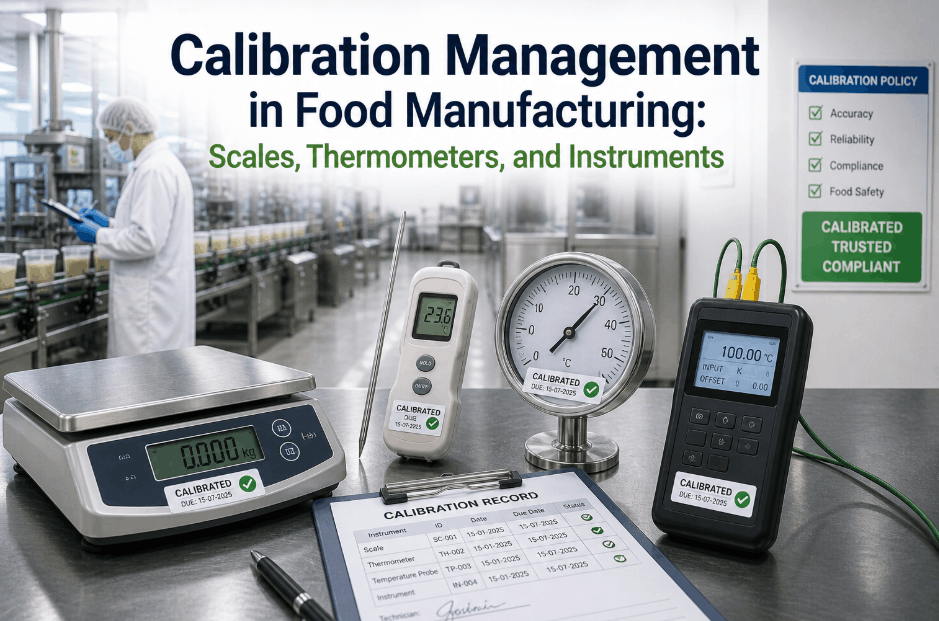
Calibration management in food manufacturing is one of the most compliance-critical yet chronically underestimated operational disciplines in the industry. Every weighing scale, every thermometer, every pH meter, and every metal detector on your production floor produces data that drives safety decisions — and if those instruments drift out of tolerance, every decision downstream becomes unreliable. For QA managers responsible for FSMA compliance, BRC certification, and audit readiness, a structured calibration program is not a regulatory checkbox. It is the foundation that makes every other quality system trustworthy. If your facility is still managing calibration schedules through spreadsheets and paper logs, Book a Demo to see how AI-driven calibration tracking transforms instrument management across your entire production environment.
Why Calibration Programs Break Down in Food Manufacturing Facilities
Most food manufacturers have a calibration program on paper. What they often lack is a calibration program that actually works under the operational pressures of a live production environment. Instruments get missed during high-volume periods, paper calibration logs get completed retroactively, and due date tracking relies on individual memory rather than automated scheduling — leaving QA managers exposed during third-party audits and FDA inspections without realizing it until it is too late.
Missed Calibration Intervals
Instruments cycle out of their required calibration window during busy production shifts, with no automated alert to notify QA personnel. Manual due date tracking in spreadsheets creates systemic blind spots that only surface during external audits.
Inadequate Documentation Trails
Calibration documentation for food manufacturing must capture instrument ID, calibration standard used, as-found and as-left readings, technician signature, and corrective action taken — paper-based systems rarely capture all required fields consistently across every instrument.
Out-of-Tolerance Events Without Impact Assessment
When a thermometer or checkweigher is found out of tolerance during calibration, the corrective action must include assessing all product measured since the last confirmed in-tolerance calibration — a step that paper-based systems structurally cannot trigger or track.
No Cross-Instrument Risk Visibility
QA managers operating across multiple production lines have no consolidated view of which instruments are approaching their calibration due date, which have open corrective actions, and which have recurring out-of-tolerance histories that suggest equipment replacement rather than recalibration.
Critical Instruments Requiring Calibration Management in Food Production
A complete food manufacturing calibration program must address every instrument category that generates data used in safety or quality decisions — from the floor scales used for incoming ingredient verification to the metal detectors protecting finished product release. Each instrument type has distinct calibration frequency requirements, tolerance specifications, and regulatory references that must be reflected in the calibration management system. QA managers evaluating how to structure their instrument master list can Book a Demo to see how iFactory organizes multi-instrument calibration programs by risk level and regulatory requirement.
Scale and Checkweigher Calibration
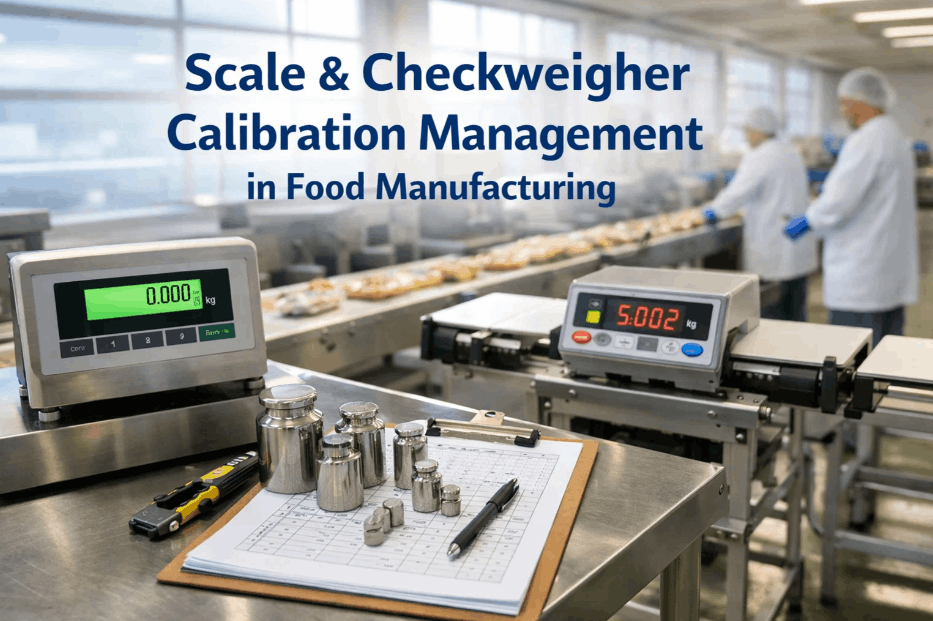
Scales and checkweighers must be calibrated against NIST-traceable reference weights. Any out-of-tolerance result triggers an immediate hold on all product weighed since the last verified calibration.
Thermometer and Temperature Sensor Calibration
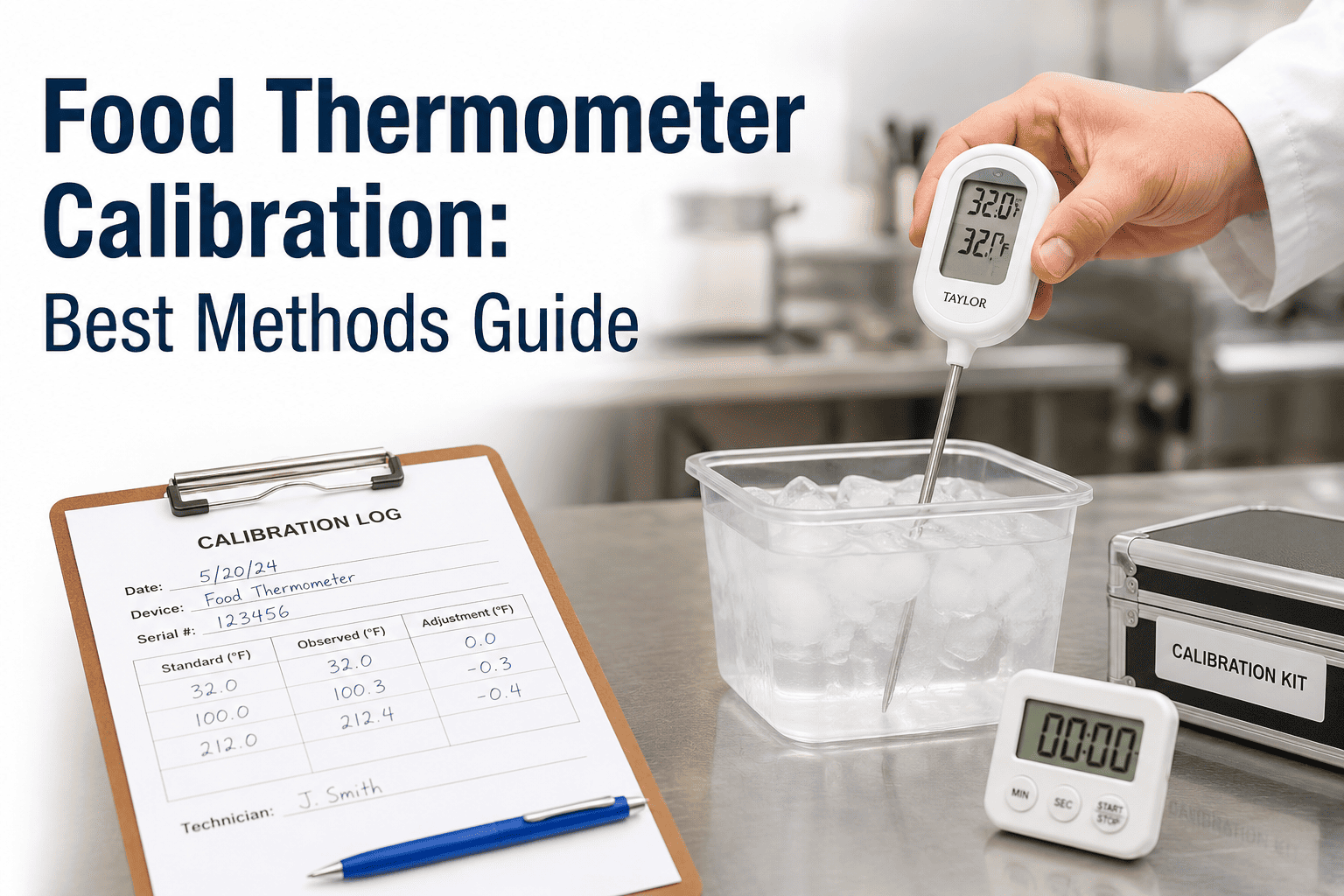
Thermometers at cooking, pasteurization, and cold storage CCPs require daily ice-point verification and monthly full calibration to a tolerance of ±1°F / ±0.5°C.
pH Meter Calibration in Food Manufacturing
pH meters used at food safety CCPs must be calibrated with certified buffer solutions before every use. Electrode response time is monitored as an early indicator of degradation requiring replacement.
Metal Detector and X-Ray Calibration
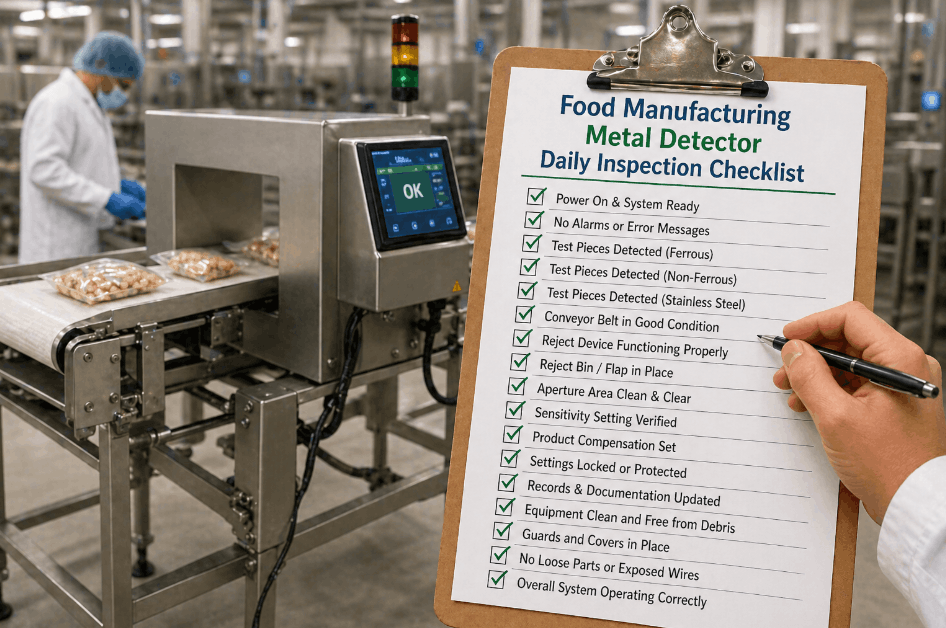
Metal detectors and X-ray systems must be verified with certified test pieces at the start, middle, and end of each production run. Any failure requires an immediate line stop and product hold.
Pressure Gauges and Flow Meters
Pressure gauges and flow meters on pasteurization and CIP systems require semi-annual calibration. Flow rate accuracy is especially critical as it directly determines hold time in heat exchangers.
Water Activity Meter Calibration
Water activity meters must be calibrated with certified salt solution standards before each batch. The tolerance is tight at ±0.005 aw, making precise reference standards and stable temperature conditions essential.
Calibration Frequency in Food Manufacturing: How to Set the Right Interval for Every Instrument
Calibration frequency in food manufacturing is not a single standard applied uniformly — it is a risk-based determination that accounts for instrument criticality, use intensity, historical stability performance, and applicable regulatory or customer requirements. A QA manager who sets calibration intervals based solely on convention rather than documented risk rationale is exposed both to over-servicing low-risk instruments and, more dangerously, under-servicing critical control point instruments that carry food safety implications. Facilities ready to build a defensible, risk-based calibration frequency matrix can Book a Demo and see how AI-driven calibration management generates interval recommendations based on instrument history and regulatory context.
| Instrument Type | Regulatory Reference | Minimum Frequency | Risk Factor Triggering Increased Frequency | Tolerance Specification |
|---|---|---|---|---|
| Checkweighers | NIST Handbook 44 / EU 76/211/EEC | Per production run start | High-volume SKU, retailer code of practice requirement | ±0.1% of nominal weight |
| Thermometers (CCP) | 21 CFR Part 110 / HACCP plan | Daily + monthly full calibration | Pasteurization, cook CCP application | ±1°F / ±0.5°C |
| pH Meters (CCP) | 21 CFR Part 114 / FDA acidified food | Before each use in CCP context | Low-acid / acidified food production | ±0.05 pH units |
| Metal Detectors | BRCGS / SQF / Customer CoP | Start, mid-run, end of production | Retailer CoP, BRCGS clause 4.11 | Per certified test piece specification |
| Water Activity Meters | FDA guidance / HACCP plan | Before each batch of measurements | Shelf-stability validation applications | ±0.005 aw |
| Pressure Gauges | 21 CFR Part 113 / HTST regulations | Semi-annual | HTST pasteurizer hold tube pressure | ±2% full scale |
| Floor Scales | NIST Handbook 44 | Annual + periodic verification | High-value ingredient weighing, catch-weight labeling | ±0.1% of capacity |
Out-of-Tolerance Calibration Events: What QA Managers Must Do When Instruments Fail
An out-of-tolerance calibration finding is not the end of a calibration event — it is the beginning of a structured corrective action process that can have significant implications for product safety, release decisions, and regulatory standing. Food manufacturers who treat an out-of-tolerance result as simply "recalibrate and move on" are exposed to serious audit findings and potential product liability. The correct response requires a documented, time-bounded investigation that is often where calibration documentation requirements in food manufacturing are most critically tested.
Immediate Instrument Quarantine and Line Notification
The out-of-tolerance instrument must be immediately removed from service, tagged with a clear "Do Not Use — Calibration Failure" indicator, and the production supervisor must be notified so that any ongoing measurements using that instrument are suspended. Continuing to use a known out-of-tolerance instrument after discovery compounds both the product risk and the regulatory exposure.
Determine the "Since When" Window for Product Impact Assessment
Identify the date and time of the last confirmed in-tolerance calibration for the failed instrument. All product measured, weighed, or tested by that instrument between that date and the discovery of the out-of-tolerance condition must be identified, placed on hold pending assessment, and evaluated against the magnitude of the calibration deviation to determine whether disposition as non-conforming is required.
Root Cause Investigation and Corrective Action
Document the probable cause of the calibration failure — mechanical shock, environmental contamination, electrode aging, or natural drift — and implement corrective action appropriate to the cause. A single calibration failure within historical norms may require only recalibration. Recurring out-of-tolerance patterns require escalation to instrument replacement or increased calibration frequency with documented rationale.
Document Everything to Audit-Ready Standard
The complete out-of-tolerance event record — as-found reading, product impact assessment, hold and disposition decisions, corrective action taken, and effectiveness verification — must be captured in the calibration management system with timestamped entries and authorized sign-off. This documentation is the primary evidence an auditor will examine when evaluating the maturity of your calibration program under BRCGS Clause 6.4 or SQF Code Element 2.4.
Calibration Documentation Requirements for Food Manufacturing Audits
Calibration documentation in food manufacturing is audited against specific completeness requirements under every major food safety standard. The question is not simply whether calibration was performed — it is whether the records demonstrate that calibration was performed correctly, using traceable standards, by a qualified technician, with results reviewed and approved, and with corrective action taken when tolerance limits were exceeded. Incomplete calibration records are among the most common major non-conformances cited during BRCGS, SQF, and FDA inspections. QA managers looking to build audit-proof calibration documentation systems can Book a Demo to see how digital calibration management generates complete, retrievable records for every instrument in the facility.
Instrument Master Record
Each instrument needs a master record with its ID, location, measurement range, calibration method, tolerance limits, and assigned technician. Auditors check this before reviewing individual calibration results.
Calibration Event Records
Every calibration must log the date, reference standard used, as-found and as-left readings, technician sign-off, and next due date. Any missing field puts the record at risk during audit scrutiny.
Reference Standard Traceability
All in-house reference standards must trace back to NIST or an equivalent national body. Certificates must be current and the full traceability chain must be available for auditor review on demand.
Corrective Action Records
Out-of-tolerance events require a documented corrective action covering product scope, hold decisions, root cause, and effectiveness verification. These records must be retrievable by instrument ID during inspections.
AI-Driven Calibration Tracking: How Digital Systems Transform Instrument Management
AI-driven calibration tracking systems replace the fragmented combination of spreadsheets, paper logs, and calendar reminders that characterizes most food manufacturing calibration programs with a centralized, automated platform that proactively manages every instrument in the facility. The operational improvement over paper-based systems is not incremental — it is categorical, eliminating the structural failure modes that cause calibration programs to break down under production pressure. Facilities evaluating AI-driven calibration management can Book a Demo for a live demonstration of automated scheduling, out-of-tolerance alerts, and audit report generation across a complete instrument inventory.
Automated Due Date Management
The system tracks every instrument's calibration due date and sends alerts at 30, 14, and 7 days in advance. When calibration is completed, the next due date resets automatically — no manual tracking required.
Instrument Drift Trend Analysis
AI monitors as-found calibration results over time to flag instruments drifting toward out-of-tolerance status before a failure occurs. This supports risk-based frequency adjustments with documented performance evidence.
Real-Time Audit Readiness Dashboard
QA managers see a live view of instruments in-tolerance, approaching due dates, open corrective actions, and traceability certificate status — all updated automatically without manual report compilation.
Automatic Certificate Generation
Calibration records are generated automatically on data entry, capturing all required fields in a consistent audit-ready format. Out-of-tolerance events trigger corrective action workflows without any manual intervention.
Calibration Requirements Under BRCGS, SQF, FSSC 22000, and FSMA
Food safety standards and regulatory frameworks each address calibration management with varying specificity, but all share a common requirement: monitoring and measuring equipment used to verify food safety and quality must be calibrated at defined intervals using traceable standards, with results documented and reviewed. QA managers operating under multiple schemes — a common scenario for food manufacturers supplying retail, foodservice, and export markets simultaneously — must ensure their calibration program satisfies the most demanding requirement applicable, which typically means aligning to BRCGS Global Standard for Food Safety Issue 9 or SQF Food Safety Code Edition 9.
Clause 6.4 — Calibration and Control of Measuring Equipment
Requires all CCP monitoring equipment to be calibrated at defined intervals against traceable standards. Out-of-tolerance events must trigger documented corrective action and product impact assessment, with records available for announced and unannounced audits.
Element 2.4 — Calibration and Verification of Measuring Equipment
Mandates a written calibration schedule, documented procedures, and current records for all monitoring equipment. Any out-of-tolerance finding must include an assessment of the product scope potentially affected, with documented disposition decisions.
21 CFR Part 117 — Calibration of Monitoring Instruments
Preventive Controls rule requires calibration of all instruments monitoring food safety controls — temperature, pH, and water activity. FDA inspectors specifically review CCP instrument calibration records and expect documented corrective action for out-of-tolerance events.
ISO 22000 Clause 8.7 — Control of Monitoring and Measuring Resources
Requires calibration at defined intervals with identifiable calibration status on each instrument. Documented procedures for out-of-tolerance handling must include validity assessment of previous measurements and appropriate product action.
Building a Best-Practice Calibration Program: A Practical Guide for QA Managers
Transforming a calibration program from compliance exercise to operational asset requires a structured approach that aligns instrument scope, frequency, documentation, and corrective action systems into a coherent framework that functions reliably under production pressure. The following implementation structure represents current best practice for food manufacturers operating under major food safety certification schemes.
Build a Complete Instrument Scope Document
List every instrument that generates food safety or quality data. Assign each a unique ID, log its location and measurement type, and flag CCP instruments for the highest priority tier. This inventory is the foundation every other calibration process builds on.
Assign Calibration Frequencies Based on Documented Risk Rationale
Set each instrument's calibration interval based on regulatory requirements, customer codes of practice, or historical drift data — and document the reason. Auditors cannot challenge a frequency that is backed by evidence; they can challenge one that isn't.
Establish a Traceable Reference Standard Program
Maintain a register of all in-house reference standards with current traceability certificates and recalibration due dates. Letting a reference standard certificate lapse breaks the traceability chain for every instrument calibrated against it.
Replace Paper Logs with AI-Driven Calibration Tracking Software
Deploy a digital platform that automates scheduling alerts, captures structured calibration records, and triggers corrective action workflows on out-of-tolerance findings. Facilities ready to see this in action can Book a Demo for a live walkthrough of the complete workflow.
Calibration Management in Food Manufacturing — Frequently Asked Questions
What is the difference between calibration and verification in food manufacturing?
Calibration compares an instrument against a traceable standard and adjusts it to bring it within tolerance. Verification confirms the instrument is still within its calibrated state without making any adjustments — and is typically performed more frequently than full calibration.
How long must calibration records be retained in food manufacturing?
FSMA and SQF both require a minimum of two years. BRCGS requires records be kept at least one year beyond the product's use-by date. Apply the most demanding requirement that applies to your facility's certification scheme.
Can in-house technicians perform calibration, or must it be done by accredited laboratories?
Most calibrations can be performed in-house by trained technicians using certified reference standards with current traceability certificates. High-precision instruments — such as HTST pressure transmitters — are typically sent to accredited laboratories to meet measurement uncertainty requirements.
What constitutes a calibration tolerance specification for food manufacturing instruments?
A tolerance specification defines the maximum permissible deviation before an instrument is considered out of tolerance. Tolerances are drawn from regulatory requirements, manufacturer specifications, or the measurement precision required to support the specific food safety decision the instrument serves.
How does AI-driven calibration management software reduce audit risk?
AI systems eliminate missed calibration intervals, incomplete records, and delayed corrective actions — the three most common audit failure points. Automated scheduling, structured digital records, and instant out-of-tolerance workflows ensure the facility's response is always timely and fully documented.