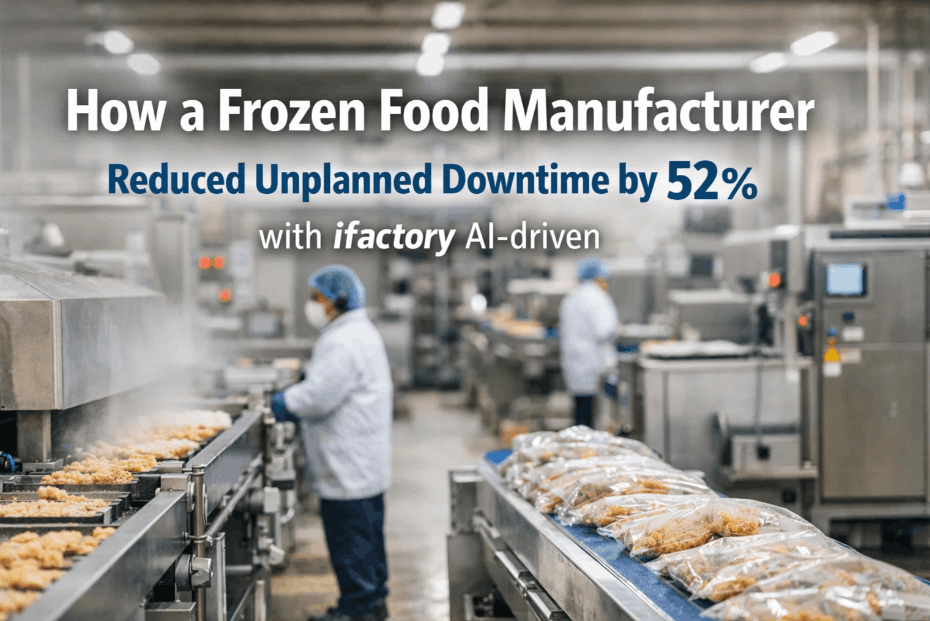
A mid-sized frozen food manufacturer operating two high-throughput processing and packaging facilities was losing an estimated $2.4 million annually to unplanned equipment downtime — the majority of it traceable to refrigeration system failures, conveyor breakdowns, and missed sanitation compliance windows. With over 1,200 production-critical assets running on calendar-based preventive maintenance and manual inspection logs, the plant's engineering team had no visibility into developing failures until they had already disrupted output. Following a structured evaluation and a 60-day pilot, the manufacturer deployed ifactory's AI-driven predictive analytics platform across both facilities — reducing total unplanned downtime by 52%, cutting emergency maintenance spend by 34%, and bringing refrigeration system availability to 98.1% within the first full year of deployment. To see how ifactory structures similar deployments for food manufacturing environments, book a demo with the engineering team.
ELIMINATE UNPLANNED DOWNTIME IN YOUR PLANT
52% Less Downtime. $1.3M Recovered. Refrigeration Uptime at 98.1%.
ifactory's AI-driven predictive analytics platform gives food manufacturers real-time condition visibility across refrigeration, conveyance, and sanitation systems — with fault prediction averaging 9.8 days in advance.
98.1%
Refrigeration Uptime
9.8 Days
Avg Fault Lead Time
01 / The Facility
A High-Output Frozen Food Operation with a Fragile Maintenance Model
Facility Type
Two integrated frozen food manufacturing and packaging facilities. Primary product lines include ready-to-cook meals, frozen proteins, and packaged vegetables. Combined floor area of 410,000 sq ft across both sites.
Scale
1,200+ production-critical assets. 18 refrigeration compressor units. 34 conveyor and packaging line drives. 9 blast freezing tunnels. 220,000 sq ft of temperature-controlled production and cold storage space.
Engineering Team
24-person maintenance and reliability team across both facilities. Three shift supervisors, 14 field technicians, seven maintenance planners and procurement coordinators. Specializations: refrigeration, mechanical conveyance, electrical systems, food-grade sanitation.
Failure Volume
Averaging 54 unplanned asset failures per month pre-deployment. Refrigeration failures: 19/month. Conveyor and packaging line faults: 23/month. Blast freezer and cold storage disruptions: 12/month.
Prior Maintenance System
Calendar-driven PM scheduling, paper-based fault logging, and manual technician rounds. No continuous sensor monitoring. No real-time telemetry on any refrigeration or production asset. Sanitation scheduling managed manually against regulatory calendar.
Annual Maintenance Budget
Pre-deployment annual maintenance spend of approximately $3.8 million — 27% above benchmark for comparable frozen food manufacturing operations. Emergency response labor and expedited parts procurement accounted for 41% of total spend.
02 / The Challenge
The Compounding Cost of Reactive Maintenance in Temperature-Critical Production
Frozen food manufacturing operates under conditions where equipment failures carry consequences far beyond the immediate production loss. An unplanned refrigeration compressor failure during a full-capacity shift does not just pause output — it risks product quality, triggers regulatory exposure under food safety frameworks, and initiates costly disposal and re-certification processes. Yet this manufacturer's maintenance model was entirely reactive: failures surfaced only after they had disrupted operations, and field technicians arrived at fault sites with no advance telemetry, no pre-diagnosis, and no asset condition history. The gap between what the plant's maintenance model could detect and what its equipment was communicating through vibration, temperature drift, and current draw anomalies was costing the business $2.4 million per year in avoidable losses.
54
Unplanned failures per month
Monthly unplanned failures across refrigeration, conveyance, and freezer systems generated an average of $112,000 in emergency labor, expedited parts, and product loss costs per month — $1.34M annually from failures alone.
41%
Budget consumed by emergency response
After-hours call-outs, emergency contractor dispatch, and expedited cold-chain parts sourcing consumed 41% of the plant's total annual maintenance budget — expenditure that no calendar-based PM schedule had any mechanism to intercept.
5.1 hrs
Mean time to resolution
Without fault telemetry or pre-dispatch diagnosis, field technicians averaged 5.1 hours to resolve unplanned failures — a resolution window that in refrigeration environments directly translates to product temperature risk and potential write-off events.
0
Assets with real-time condition monitoring
Not a single refrigeration unit, conveyor drive, or blast freezer in either facility had live sensor telemetry. Condition data was gathered exclusively through manual inspection rounds — a model structurally incapable of detecting developing faults between scheduled visits.
"We had skilled technicians and a capable team — but we were always responding, never anticipating. Every refrigeration failure during a production run was a worst-case scenario we had no way to prevent."
03 / The Solution
ifactory Predictive Analytics AI: Condition Intelligence Across Refrigeration, Conveyance, and Sanitation
Following a competitive evaluation of four industrial IoT and analytics platforms, the manufacturer's reliability engineering leadership selected ifactory for its food-grade sensor integration architecture, AI fault prediction engine validated in cold-chain environments, and demonstrated ability to operate under the moisture, temperature cycling, and washdown conditions characteristic of frozen food production floors. The platform was deployed to instrument all three primary asset categories — refrigeration compressor systems, conveyor and packaging line drives, and blast freezer infrastructure — under a unified sensor network managed through a single operations interface.
DETECT
IoT sensor deployment across all 1,200+ production-critical assets — vibration, temperature, current draw, suction and discharge pressure, and motor load sensors installed on every refrigeration compressor, conveyor drive, and blast freezer motor. Sensors rated for food-grade washdown environments and extreme temperature cycling from −40°C blast freeze to ambient packaging zones.
PREDICT
AI-driven fault prediction analyzed continuous sensor streams against failure signature libraries specific to refrigeration and food production asset classes — identifying developing faults an average of 9.8 days before anticipated failure and generating probabilistic fault scores per asset across every production shift.
AUTOMATE
Automated PM and sanitation scheduling replaced the manufacturer's manual calendar-based maintenance plan with condition-triggered work orders — pre-populated with asset fault signature, recommended intervention, parts requirements, and food safety documentation fields, ensuring both equipment reliability and regulatory compliance records were maintained simultaneously.
ANALYZE
Production and reliability dashboards delivered live condition visibility into refrigeration system health, conveyor fault probability scores, open work orders, and asset lifecycle cost accumulation — giving plant management the data required for evidence-based capital planning and annual maintenance budget forecasting.
04 / Implementation
Full Sensor Coverage Across Both Facilities in 64 Days
Days 1–10
Asset Criticality Classification and Sensor Specification
All 1,200+ assets classified into three criticality tiers based on production consequence of failure, product safety exposure, and historical failure frequency. Sensor type and food-grade enclosure rating specified per asset class. Network topology designed to support reliable data transmission through both facilities' metallic cold-room and blast freezer enclosures.
Days 11–32
Refrigeration and Blast Freezer Instrumentation — Priority Phase
Refrigeration compressor systems and blast freezer infrastructure instrumented first across both facilities — 18 compressor units, 9 blast freeze tunnels, and 47 associated cold-chain support assets. All installation conducted during scheduled sanitation and changeover windows with zero production interruption. First live refrigeration telemetry confirmed on Day 13.
Days 33–54
Conveyor, Packaging Line, and Ancillary Asset Instrumentation
Conveyor and packaging line drives instrumented across all 34 production lines in both facilities. Remaining ancillary production assets — compressor fans, pump motors, and HVAC — completed across the same phase. AI engine trained simultaneously on historical failure records and incoming live telemetry, establishing individualized normal operating baselines per asset within 16 days of first data ingestion.
Days 55–64
Full Network Validation, Dashboard Activation, and First Predictive Alert
Complete sensor network validated across both facilities. Production reliability and maintenance dashboards activated across all 24 team devices and plant management interfaces. First AI-generated predictive fault alert issued on Day 57 — identifying abnormal discharge pressure and suction temperature patterns in Facility 1's primary refrigeration compressor consistent with early-stage valve wear. Planned intervention completed 8 days later with no cold-chain disruption.
05 / Results
12 Months of Measured Production Reliability Improvement
The transition from calendar-based maintenance to continuous condition monitoring produced measurable, sustained improvements across every tracked reliability and financial dimension within the first 90 days of full deployment. Unplanned failures fell across all three asset categories as the AI prediction engine intercepted developing faults before they reached production-disrupting thresholds. Mean time to resolution compressed dramatically as pre-fault telemetry eliminated the diagnostic discovery phase from every technician dispatch. Refrigeration system availability reached 98.1% — the highest recorded uptime in either facility's operating history.
| Metric |
Before ifactory |
After ifactory |
Change |
| Unplanned equipment downtime |
54 incidents / month |
26 incidents / month |
−52% downtime reduction |
| Total annual maintenance spend |
~$3.8M |
~$2.5M |
−34% cost reduction |
| Emergency labor as % of budget |
41% |
15% |
−63% emergency labor share |
| Mean time to resolution (MTTR) |
5.1 hours |
1.9 hours |
−63% resolution time |
| Avg. fault prediction lead time |
0 days (reactive) |
9.8 days advance |
9.8-day early warning |
| Refrigeration compressor failures |
19 / month |
7 / month |
−63% refrigeration failures |
| Conveyor and packaging line faults |
23 / month |
12 / month |
−48% conveyor faults |
| Blast freezer and cold storage disruptions |
12 / month |
7 / month |
−42% cold storage disruptions |
| Refrigeration system availability |
91.4% |
98.1% |
+6.7 pts availability gain |
| Assets with live condition monitoring |
0 |
1,200+ |
Full portfolio coverage |
| Sensor network deployment timeline |
N/A |
64 days |
Fully live in 64 days |
98.1%
Refrigeration uptime
9.8 days
Avg fault lead time
"Within three months, ifactory had intercepted 11 refrigeration faults that would have caused cold-chain disruptions during active production shifts. The platform paid for itself before the first quarter was complete."
06 / Key Analysis
Why the Downtime Reduction Was This Significant
01
Refrigeration fault prediction prevented the highest-consequence failure category. The 63% reduction in refrigeration compressor failures was the platform's most operationally significant outcome. ifactory's AI engine detected discharge pressure anomalies, suction temperature drift, and current draw irregularities an average of 9.8 days before anticipated compressor failure — converting events that would have disrupted cold chains and triggered product safety reviews into scheduled maintenance interventions with zero production impact.
02
Pre-fault telemetry compressed resolution time by 63%. Prior to deployment, technicians arrived at fault sites with no sensor context, no pre-diagnosis, and no fault history. ifactory's automated work orders pre-populated each dispatch with the specific sensor fault signature, probable failure mode, recommended parts, and full asset service history — reducing MTTR from 5.1 hours to 1.9 hours per incident. In refrigeration environments, this 3.2-hour reduction per event directly reduces product temperature exposure risk per unplanned failure.
03
Automated sanitation scheduling closed a regulatory documentation gap. Before deployment, sanitation compliance windows were tracked manually against regulatory calendars — an approach that created documentation gaps and required manual reconciliation during audit cycles. ifactory's condition-triggered PM automation integrated sanitation scheduling directly into the maintenance workflow, generating timestamped compliance records automatically and reducing audit preparation time by an estimated 68% per cycle.
04
Condition-based capital planning identified $480,000 in deferred replacement risk. With live sensor condition data across the full 1,200+ asset portfolio, the plant's reliability team identified 14 refrigeration and conveyor assets whose repair cost trajectories indicated replacement within 18 months — enabling proactive budget allocation and avoiding $480,000 in projected emergency replacement and operational disruption costs over the subsequent two years.
07 / Business Impact
Operational, Financial, and Compliance Outcomes Beyond Downtime Reduction
Product Safety and Quality
Cold-chain temperature excursion events linked to refrigeration failure fell to zero following full platform deployment. Product write-off incidents attributable to equipment failure declined by 91% in the first 12 months — recovering approximately $310,000 in product value annually.
Regulatory Compliance
Continuous sensor logging across all 1,200+ assets now provides timestamped, unbroken condition and sanitation records — satisfying food safety authority documentation requirements that manual inspection logs had only partially met in prior audit cycles, with audit preparation time reduced by 68%.
Budget Predictability
Monthly maintenance cost variance dropped from ±44% to ±13%, enabling reliable 12-month budget planning across both facilities for the first time. Emergency labor as a share of total maintenance spend fell from 41% to 15% — reallocating over $988,000 annually from reactive response to planned investment.
Engineering Team Capacity
Eliminating 28 unplanned emergency dispatches per month recovered an estimated 142 field technician hours monthly — redeployed toward condition-based inspection quality improvement, cross-facility reliability projects, and capital asset lifecycle planning support.
$3.8M
Annual spend before
$1.3M
Annual savings achieved
08 / Conclusion
Predictive Intelligence at Scale: The Compounding Value of AI-Driven Reliability in Frozen Food Manufacturing
This manufacturer's 52% reduction in unplanned downtime was achieved by closing the information gap that made reactive maintenance the only available operating model. ifactory's AI-driven predictive analytics platform gave the plant's reliability team continuous, asset-level condition visibility across all 1,200+ tracked assets — and converted that visibility into advance fault warnings actionable an average of 9.8 days before failures reached production-disrupting thresholds. Refrigeration availability reached 98.1%, cold-chain temperature excursion events fell to zero, and the maintenance budget's emergency response share dropped from 41% to 15% within the first 12 months.
The compounding value extends well beyond the first year's $1.3 million in direct savings. Every day of sensor operation adds to the asset condition history that improves AI fault prediction accuracy across refrigeration, conveyance, and sanitation systems. Every avoided emergency dispatch reduces the organizational strain that degrades plant reliability team performance over time. To assess what a deployment of this model would look like for your food manufacturing facility, book a demo with ifactory's food manufacturing engineering team.
READY TO ELIMINATE UNPLANNED DOWNTIME?
See How ifactory Predictive Analytics Transforms Frozen Food Plant Reliability
Get 9.8 days of advance warning on developing faults across your refrigeration systems, conveyor drives, and blast freezer infrastructure — before the next production disruption.
09 / FAQ
Frequently Asked Questions
How does ifactory's predictive analytics AI reduce downtime in frozen food manufacturing?
ifactory replaces periodic manual inspection with continuous condition monitoring across all production-critical assets. Sensors transmitting vibration, temperature, current draw, and pressure data allow the AI engine to detect refrigeration fault signatures, conveyor motor degradation, and blast freezer anomalies days or weeks before assets reach failure thresholds — enabling planned interventions that prevent production disruptions entirely.
What asset categories does ifactory cover in frozen food manufacturing environments?
ifactory instruments any electromechanical asset category with food-grade sensor types. In frozen food manufacturing, primary applications include refrigeration compressor systems, blast freeze tunnels and cold storage infrastructure, conveyor and packaging line drives, and ancillary production assets including pump motors and HVAC. The platform also supports automated sanitation scheduling integration and food safety regulatory compliance documentation.
Can ifactory sensors operate in frozen food production environments with washdown and temperature cycling?
ifactory's sensor hardware is specified for food-grade production environments — including IP-rated washdown enclosures, extreme cold-zone ratings for blast freezer and cold storage operation, and materials compliant with food manufacturing sanitation standards. This manufacturer's sensor network operated reliably through production environments ranging from −40°C blast freeze tunnels to ambient packaging zones across both facilities.
How quickly can ROI be achieved from predictive maintenance AI in food manufacturing?
Facilities with high unplanned failure rates and significant emergency labor spend typically recover platform investment costs within the first two to three quarters of full operation. This manufacturer recovered its full first-year platform cost within three months of complete sensor network activation — primarily through emergency labor savings and eliminated product loss events. The ongoing annual savings of $1.3 million represent a sustained return from a single infrastructure deployment cycle.
How does ifactory support food safety regulatory compliance alongside equipment reliability?
ifactory's condition-triggered PM automation integrates sanitation scheduling directly into the maintenance work order workflow, generating timestamped compliance documentation automatically at the point of scheduled intervention. Continuous sensor logging across all assets also provides unbroken, audit-ready condition records that satisfy food authority documentation requirements — a capability this manufacturer's prior manual log system was only partially able to meet during regulatory audit cycles.
How long does a full ifactory sensor deployment take across a frozen food manufacturing facility?
Deployment timelines depend on facility scale, asset count, and production schedule constraints. This manufacturer achieved full sensor coverage across 1,200+ assets in two facilities within 64 days — with zero production interruptions. All installations were scheduled during production changeover and sanitation windows. ifactory's phased deployment model prioritizes highest-criticality refrigeration and cold-chain assets first, ensuring predictive value begins accruing before full network completion.