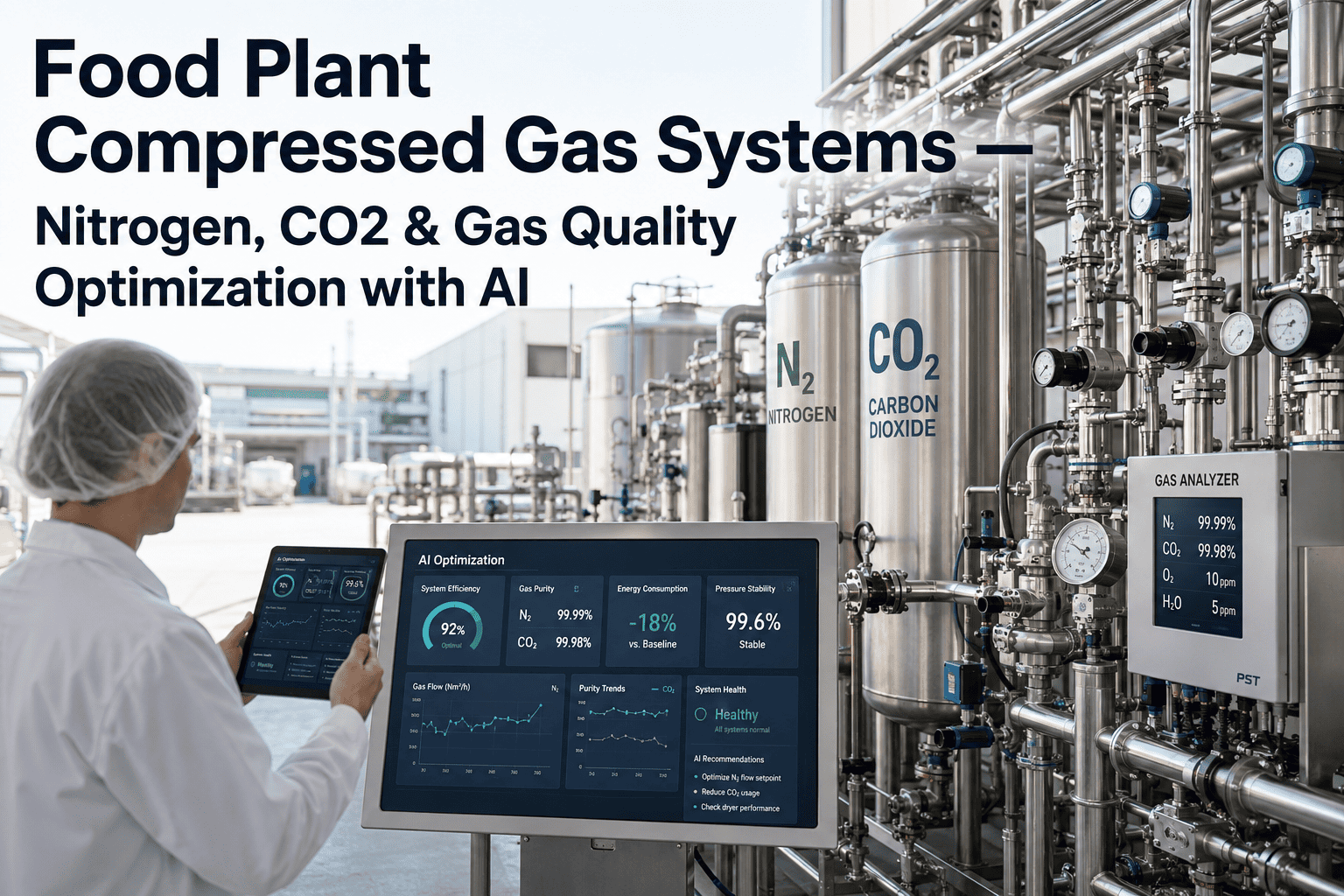
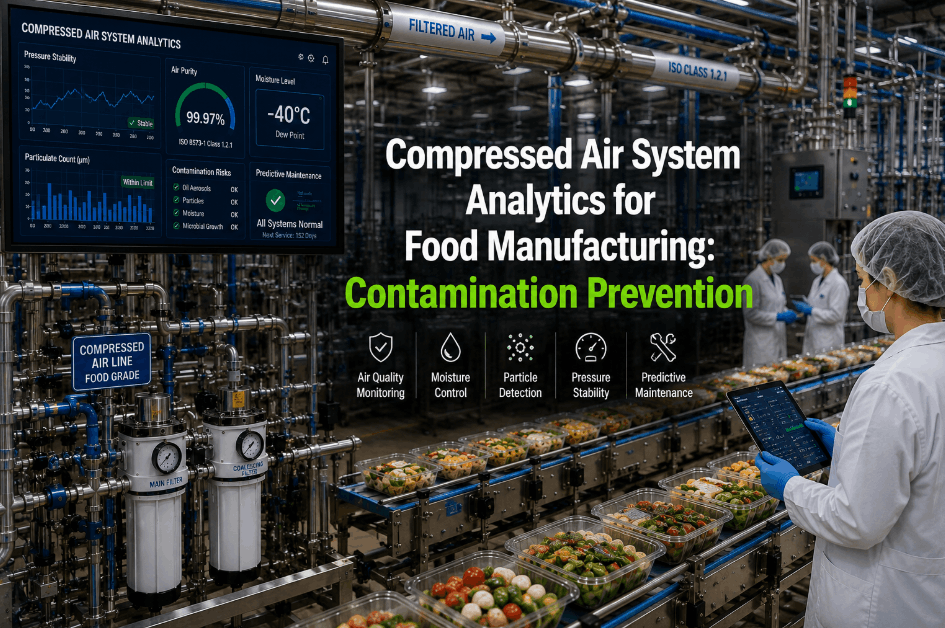
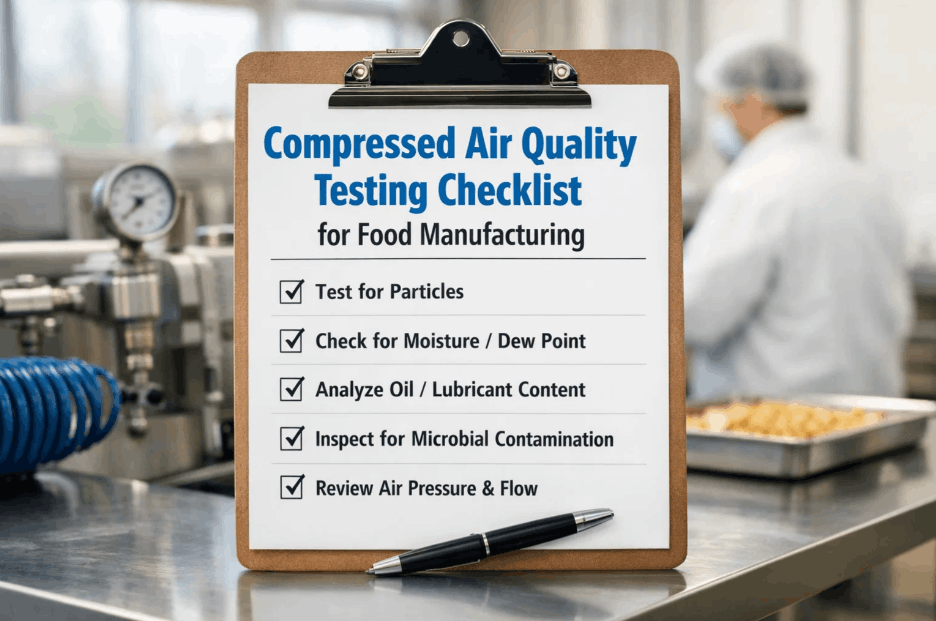
Compressed gas and nitrogen systems are the silent backbone of modern food manufacturing — yet most plants operate them with reactive maintenance and manual compliance tracking. In beverage filling, modified atmosphere packaging (MAP), and blanketing operations, a single nitrogen purity deviation can trigger batch rejection, product spoilage, or regulatory audit findings worth six figures. This article reveals how AI-driven analytics for compressed gas systems transforms nitrogen monitoring from a cost center into a measurable profit driver, with payback timelines as short as 4-6 weeks.
Monitor Compressed Gas & Nitrogen Purity in Real Time
Detect nitrogen contamination, pressure drift, and gas quality failures before they impact production — with automated compliance documentation.
Why Compressed Gas System Analytics Matters in Food Manufacturing
Food-grade nitrogen and compressed gas systems power three critical operations: modified atmosphere packaging (MAP), inert gas blanking, and instrument purging. Yet most plants rely on manual pressure gauges, periodic lab testing, and reactive maintenance — missing early warning signs of purity loss, moisture contamination, or equipment degradation. Book a Demo to see how continuous nitrogen monitoring prevents costly failures.
A single nitrogen purity excursion — dropping from 99.995% to 99.9% — can render an entire MAP batch non-compliant, force product recalls, or trigger FDA warning letters. Modern food plants cannot afford reactive gas system management. Real-time analytics for compressed gas quality, coupled with predictive insights on nitrogen generator maintenance, compress payback from 12+ months to under 6 weeks.
Four Critical Compressed Gas Failure Modes in Food Plants
Nitrogen system failures follow predictable patterns. Understanding each failure mode is the foundation for effective gas quality analytics and preventive maintenance strategy.
Nitrogen Purity Degradation
PSA (pressure swing adsorption) and membrane nitrogen generators gradually lose separation efficiency due to membrane fouling or adsorbent saturation. Purity drops from 99.995% to 99.5%–99.8% over weeks — imperceptible to manual testing but invisible to end-line oxygen analyzers. Book a Demo to model your nitrogen generator maintenance intervals.
Moisture Contamination & Water Ingress
Compressed air dryers fail silently. Water vapor enters the gas distribution system, corroding valves, fouling oxygen analyzers, and triggering product defects in sensitive applications like powder packaging or oxygen-free headspace requirements. Manual dew point testing catches problems days after onset.
Pressure Decay & Leakage
Microleaks in distribution lines, regulator seals, and connection fittings cause slow pressure loss — forcing the nitrogen generator to run continuously at higher load. Undetected leaks consume $40K–$80K in extra energy annually while increasing equipment stress. Book a Demo to quantify your gas system leakage cost.
Particulate & Oil Carryover
Compressor oil carryover and particle contamination in food-grade nitrogen systems violate food contact regulations and trigger organoleptic defects. Filter saturation and coalescent separator degradation go unmonitored until end-of-line quality failures emerge — often after product ships.
Nitrogen System Analytics ROI: Real-World Savings by Plant Type
Compressed gas system monitoring ROI scales with plant complexity and regulatory exposure. The table below shows validated savings across four food manufacturing categories.
| Plant Type | Primary Failure Risk | Annual Cost at Risk | Prevention Savings | Payback Period | Year-1 ROI |
|---|---|---|---|---|---|
| Beverage & MAP Packaging | Purity degradation, MAP compliance | $200K–$400K | $150K–$320K | 4–6 weeks | 8.2× |
| Dairy & Aseptic Processing | Moisture contamination, sensor drift | $180K–$350K | $140K–$280K | 5–7 weeks | 7.1× |
| Powder & Dry Foods | Leakage, energy waste, purity loss | $120K–$250K | $90K–$200K | 6–9 weeks | 5.8× |
| Meat & Poultry (Gas-Flushed Packaging) | Purity control, batch compliance | $250K–$500K | $200K–$400K | 3–5 weeks | 9.6× |
Even in conservative scenarios, nitrogen system analytics deliver 5.8× first-year ROI. For MAP and protein packaging operations, the payback is almost immediate — compressed gas failure prevention pays for itself in weeks, not months.
Five Key Metrics for Food-Grade Nitrogen System Monitoring
Effective nitrogen analytics requires real-time visibility into five interconnected parameters. Book a Demo to see how automated tracking eliminates manual testing burden.
1. Nitrogen Purity & Oxygen Content (ppm)
Continuous oxygen analyzer integration tracks real-time purity. Alerts trigger at 99.95% (warning threshold) and 99.9% (critical limit) — preventing out-of-spec gas from reaching packaging lines. Historical trending reveals generator membrane degradation weeks before catastrophic failure.
2. Dew Point & Moisture Content
Inline dew point sensors detect moisture ingress from failing air dryers, compressor seal leakage, or atmospheric contamination. Automated alerts at -20°C threshold prevent corrosion and sensor fouling before they trigger false readings or equipment damage.
3. System Pressure & Decay Rate
Real-time pressure trending with automated leak detection quantifies system leakage in CFM. Night-time decay analysis identifies micro-leaks ($40K–$80K annual energy waste per 1% pressure loss) and triggers precision maintenance.
4. Generator Load & Energy Efficiency
Nitrogen generator power consumption trending reveals adsorbent saturation, membrane fouling, and inefficient operation. Predictive alerts signal maintenance 2–3 weeks before purity loss — enabling planned generator optimization instead of emergency replacement.
5. Filter & Separator Differential Pressure
Coalescent separator and particulate filter pressure monitoring predicts saturation and oil carryover risk. Alerts trigger filter replacement before food contact violations occur — ensuring compliance with FDA 21 CFR Part 11 and GFSI audit documentation.
Compliance Automation: Nitrogen System Documentation for FDA & GFSI Audits
Food-grade gas system compliance requires documented evidence of continuous monitoring — dew point testing, oxygen purity verification, and corrective action records. Manual logging consumes 40–60 hours annually per site and is prone to transcription errors that trigger audit non-conformances. Book a Demo to see automated audit documentation in action.
AI-driven nitrogen analytics auto-generate GFSI-compliant logbooks with timestamp-locked records, audit trails, and corrective action workflows. Every purity deviation, moisture alert, and maintenance action is logged with digital signatures — meeting 21 CFR Part 11 requirements while eliminating manual data entry. This ensures your facility remains "audit-ready" 24/7, reducing the stress of unannounced inspections.
Digital Chain of Custody & Deliverables
The platform establishes a secure digital chain of custody, mapping gas quality data directly to production batches and packaging runs.
- Automated Logbooks: Daily nitrogen purity & dew point logs in audit-ready PDF formats.
- Corrective Action (CAPA): Automated workflows with timestamped closures for every deviation.
- GFSI/SQF Alignment: Pre-formatted reports tailored for SQF, BRC, and FSSC 22000 requirements.
- HACCP Integration: Real-time validation of Critical Control Points (CCPs) for gas systems.
- Predictive Compliance: Alerts for upcoming sensor calibrations and filter replacements.
- Cloud Archiving: Secure, searchable storage for up to 10 years of historical compliance data.
By integrating nitrogen systems directly into your digital quality management strategy, you transform compliance from a reactive burden into a strategic asset. Automated reporting not only saves labor but provides the high-fidelity data needed for deep-dive root cause analysis of quality excursions.
Implementation Strategy: 60-Day Nitrogen System Analytics Deployment
Compressed gas system monitoring does not require plant shutdown or capital equipment replacement. Real-time nitrogen analytics deploy in 60 days with minimal operational disruption and immediate ROI visibility.
Oxygen analyzers, dew point sensors, and pressure transmitters integrate into the nitrogen distribution system. No line shutdown required — sensors tap into existing monitoring points. Historical baseline data (30-day retrospective) establishes normal purity, leakage, and moisture profiles.
Machine learning models train on live purity, pressure, and dew point data — learning facility-specific gas system behavior. Threshold alerts calibrate to your equipment, packaging line demands, and regulatory requirements. Mobile alerts notify technicians of developing failures 24–48 hours before impact.
Auto-generated audit logs go live. Every purity reading, maintenance action, and corrective response is captured with regulatory timestamps. A formal 60-day ROI report documents prevented failures, leakage quantification, and energy savings — showing measurable payback before project closure.
Detect Compressed Gas Failures Before They Impact Production
Real-time nitrogen purity, moisture, and pressure monitoring with automated GFSI compliance documentation — deployed in 60 days with measurable ROI.
Predictive Maintenance for Nitrogen Generators & Compressors
Nitrogen generators (PSA, membrane, or liquid systems) degrade predictably. Most plants replace generators on calendar schedules — disposing of 6–12 months of remaining service life. Analytics-driven predictive maintenance extends generator lifespan 15–25% while eliminating unplanned failures.
Adsorbent saturation, membrane fouling, and seal degradation all precede purity collapse by measurable performance signatures. Book a Demo to see generator performance trending that predicts maintenance 2–3 weeks in advance.
Generator Health Indicators Tracked in Real Time
| Purity Trend (pppm O₂) | Linear decline = predictable membrane degradation; step loss = adsorbent saturation or bypass |
| Power Consumption Ratio | Rising kW per CFM output = fouling, seal friction, or inefficient cycling |
| Dew Point Margin | Narrowing margin between operating point & failure threshold = dryer performance loss |
| Purge Gas Efficiency | Increasing waste gas volume = adsorbent loss of capacity or membrane micro-tears |
Energy & Cost Savings: Quantifying Nitrogen System Efficiency Gains
Most food plants operate nitrogen systems 10–25% above optimal efficiency due to undetected leaks, over-pressurization, and poor load matching. Real-time analytics identify efficiency losses in weeks — not years.
Leakage Detection & Repair
Micro-leaks costing $40K–$80K annually become visible within 2–3 weeks of analytics deployment. Precision maintenance targeting identified leaks reduces generator runtime 12–18% and cuts annual compressed gas energy spend by $50K–$120K.
Pressure Optimization
Running nitrogen 5–10 PSI above requirement is common — consuming 6–12% extra energy. Optimized pressure setpoints validated by real-time monitoring reduce compressor load and extend service intervals by 18–24 months.
Generator Lifespan Extension
Predictive maintenance extends PSA and membrane generator life 15–25% — deferring $150K–$250K replacement CapEx by 18–36 months. Planned maintenance during scheduled downtime eliminates emergency service calls (2–3× standard cost).
Batch Loss Prevention
Preventing even two nitrogen-related batch rejections annually (MAP contamination, purity failure, moisture defect) saves $200K–$400K in scrap, rework, and lost revenue.
The Nitrogen System Analytics Maturity Curve
Compressed gas system monitoring ROI scales with operational sophistication. Early-stage plants capture 25–35% of available savings; fully integrated analytics operations capture 80–95%.
| Maturity Level | Capability | Savings Capture | Typical Facility |
|---|---|---|---|
| Level 1 — Manual Testing | Weekly lab nitrogen tests, pressure gauges | 0–10% | Small facility, single nitrogen generator |
| Level 2 — Periodic Monitoring | Monthly oxygen analyzers, manual dew point checks | 15–30% | Mid-size plant, basic instrumentation |
| Level 3 — Real-Time Sensors | Continuous O₂ analyzers, dew point transmitters, pressure logs | 35–55% | Multi-line facility, integrated sensors |
| Level 4 — Predictive Analytics | Machine learning failure prediction, automated alerts, compliance logs | 65–80% | Advanced food plant, AI-driven ops |
| Level 5 — Autonomous Optimization | Closed-loop generator control, self-healing alerts, predictive PM automation | 80–95% | Industry leader, full automation |
Key Takeaways: Why Compressed Gas Analytics Matter Now
Regulatory tightening (FDA 21 CFR Part 11, GFSI updates, traceability mandates) has transformed nitrogen system monitoring from a "nice to have" to a competitive necessity. Book a Demo to build your facility-specific business case.
Payback is short: 4–9 weeks for beverage, MAP, and protein packaging; 6–12 weeks for dry food operations. ROI ranges from 5.8× to 9.6× in year one.
Failures are predictable: Purity loss, moisture contamination, and leakage follow measurable degradation curves — enabling 2–4 week early warning of equipment failure.
Compliance is automated: AI-driven analytics generate audit-ready nitrogen system logs with digital timestamps and corrective action workflows — eliminating 40–60 hours of manual documentation annually.
Implementation is fast: 60-day deployment with minimal capital investment and zero production disruption — ROI measurable before project closure.
Frequently Asked Questions
Below are the most common questions from food manufacturing operations leaders evaluating nitrogen system analytics.
What equipment does nitrogen system analytics integrate with?
Analytics platforms connect to oxygen analyzers (electrochemical & paramagnetic), dew point transmitters, pressure transducers, and nitrogen generator controllers via 4–20 mA, 0–10 V, or digital protocols (Modbus, PROFINET). Integration requires no changes to existing nitrogen systems — sensors tap into existing monitoring points or pipe taps.
How quickly can purity problems be detected?
Real-time oxygen analyzers detect purity drift within minutes. Analytics algorithms alert at 99.95% threshold (warning) and 99.9% (critical) — 18–24 hours earlier than standard daily lab testing. Most problems are caught before they impact packaging or product quality.
Is nitrogen analytics compatible with FDA 21 CFR Part 11?
Yes. Every purity reading, alert event, and maintenance action is recorded with secure hash, digital signature, and tamper-proof timestamp. All records are audit-ready and exportable in GFSI-compliant format for SQF, BRC, and FSSC certification audits.
Can the system integrate with our existing MES or ERP?
Yes. Nitrogen analytics export compliance records, alert logs, and maintenance work orders via API integration into any MES, ERP, or CMMS platform. Automated data push eliminates manual logbook entry and ensures single source of truth for regulatory audits.
What is the cost of nitrogen system analytics deployment?
Pricing is modular based on number of monitored parameters and lines. Most beverage and MAP packaging facilities see full payback within 4–6 weeks of deployment. Typical investment is $15K–$40K with year-one savings of $150K–$400K — delivering 4–8× ROI before the end of Q2.
Get Your Nitrogen System ROI Model — Custom Built for Your Facility
See exactly how compressed gas analytics eliminate nitrogen failures, reduce compliance burden, and deliver 4–9 week payback at your plant.