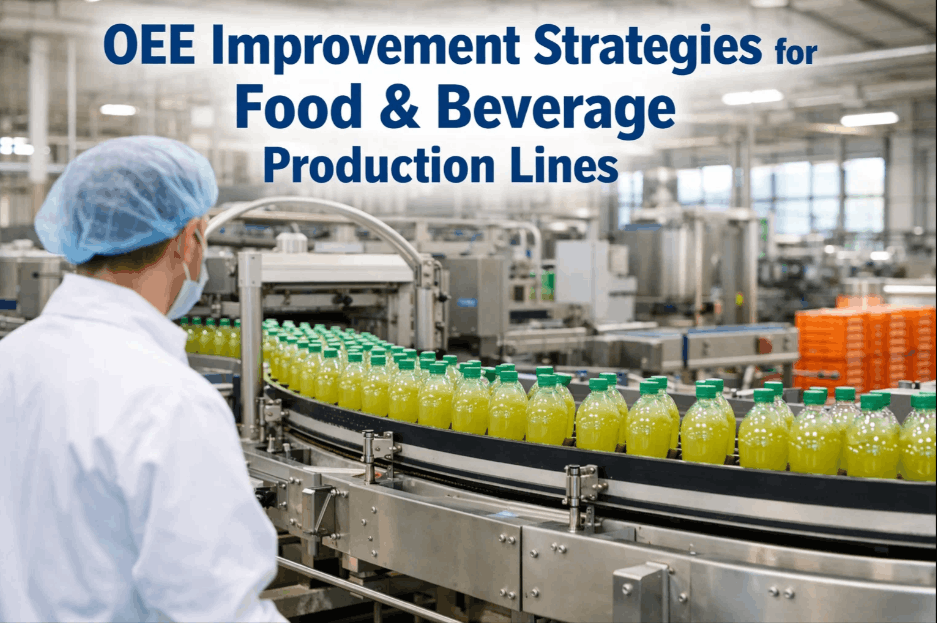
A leading regional snack food manufacturer was struggling to maximize throughput across its four primary production lines, operating at a stagnant Overall Equipment Effectiveness (OEE) of 68%. The facility experienced frequent micro-stops, unpredictable changeover delays, and reliance on reactive maintenance models that caused unplanned downtime during peak demand periods. By deploying ifactory's AI-driven Analytics & Reporting platform, the production team transitioned to automated preventative maintenance (PM), optimized their changeover sequences, and implemented real-time performance tracking. Within the first operational quarter, the facility increased average OEE to 91%, reclaimed over 400 hours of lost production capacity per month, and stabilized their throughput reliability to consistently meet expanding retail distribution requirements.
Snack Food Company Improves OEE from 68% to 91% Across 4 Production Lines
ifactory delivers automated preventive maintenance and real-time performance tracking — turning unpredictable downtime into structured, high-efficiency snack manufacturing operations.
High-Volume Snack Food Manufacturer. Multi-Line Operations. Persistent Profit Leaks.
The Visibility Gap Behind Stagnant 68% OEE
In continuous-flow food manufacturing, profitability is determined by asset uptime and speed stability. For this snack manufacturer, the gap between their 68% baseline and world-class OEE (85%+) was hidden in undocumented micro-stops, inefficient product changeovers, and reactive equipment maintenance. Without real-time visibility into machine health, maintenance teams were fighting fires rather than preventing them, while operators lacked the immediate feedback required to course-correct minor speed losses before they aggregated into missed production targets. Book a Demo to see how ifactory eliminates operational blind spots.
ifactory Analytics & Reporting: AI-Driven OEE Optimization
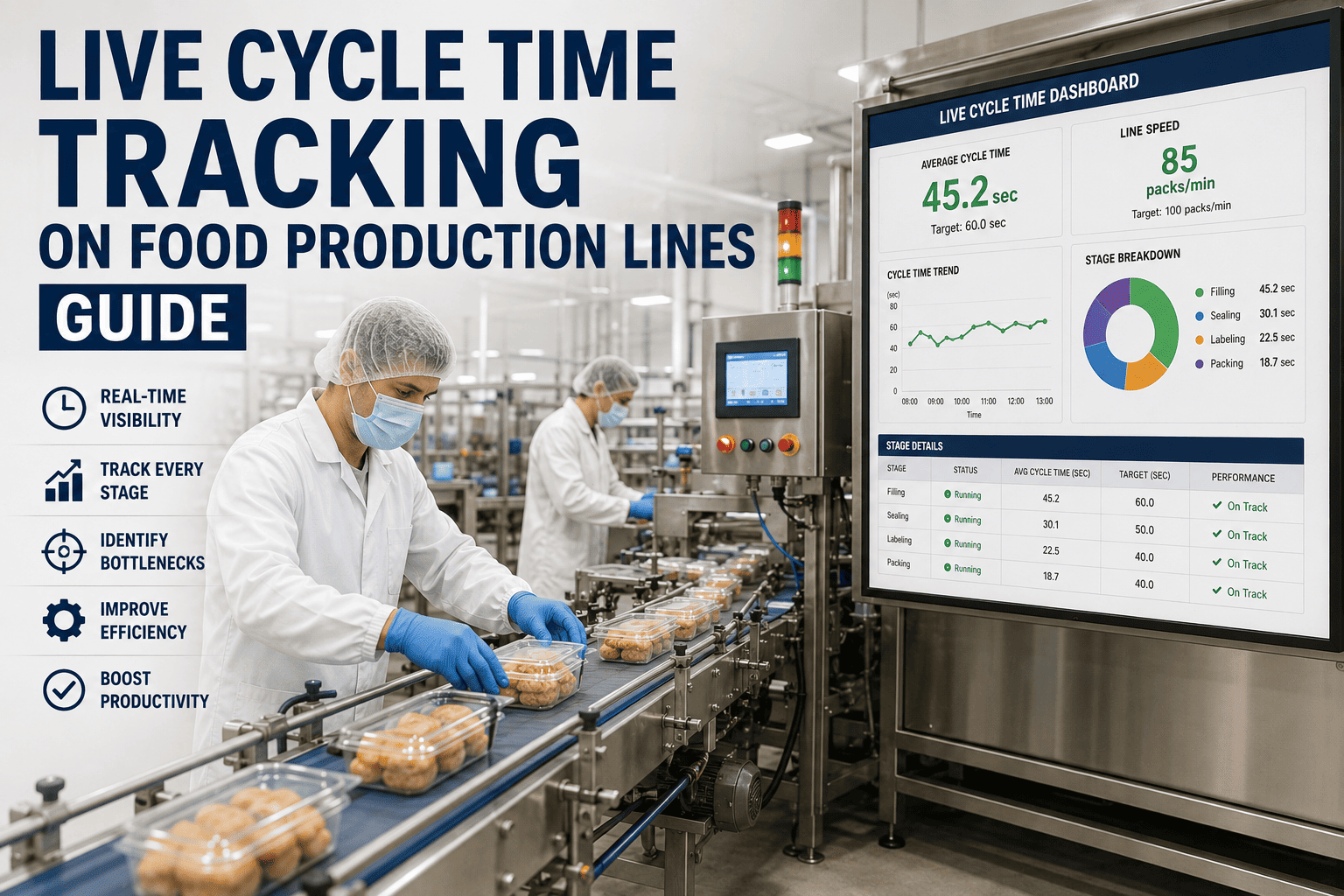
Recognizing that process visibility was their primary bottleneck, the manufacturer deployed ifactory's AI-driven Analytics & Reporting platform across all four production lines. The system integrated directly with the machinery's existing PLCs to capture cycle times, fault codes, and operational states without requiring manual data entry. This transformed continuous production streams into instantly actionable dashboards for operators, engineers, and plant managers.
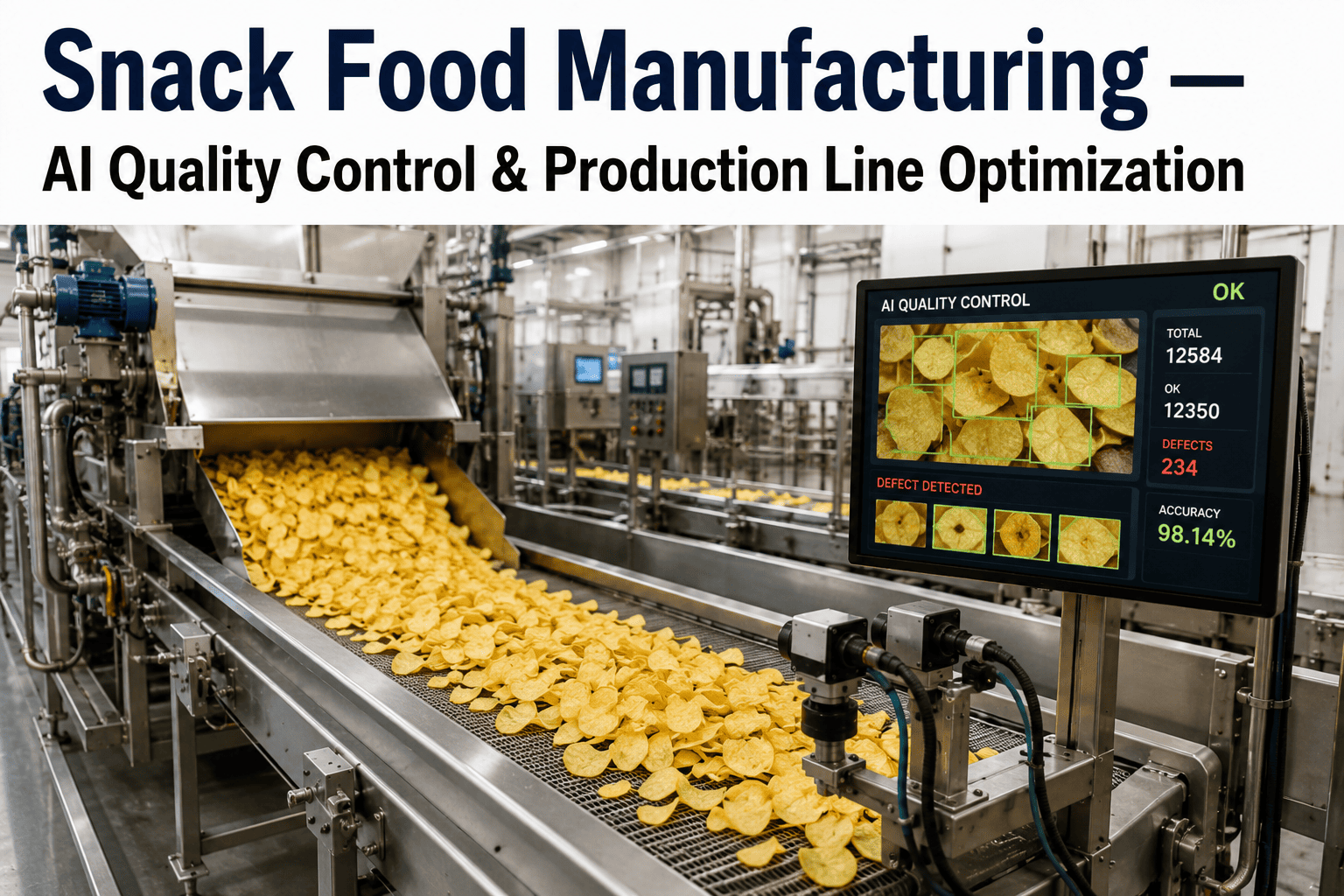
By analyzing historical wear patterns against live machine data, ifactory shifted the maintenance paradigm from reactive to prescriptive. The platform automatically generated predictive maintenance alerts before failure thresholds were breached. Concurrently, real-time performance tracking identified the hidden causes of micro-stops, allowing operators to systematically eliminate downtime drivers and standardize rapid changeover procedures.
Four Production Lines Integrated in Under 4 Weeks
ifactory edge devices were installed and mapped to existing PLCs across the extrusion, frying, and packaging machinery. Data tags for machine state, fault codes, and cycle times were verified without disrupting active production schedules.
The platform collected high-fidelity baseline data. Reporting architectures were established to accurately calculate Availability, Performance, and Quality against the plant's targeted operational standards, identifying the precise locations of micro-stops.
Historical failure data was synthesized to create AI-driven automated preventative maintenance schedules. Simultaneously, changeover sequences were benchmarked to identify optimal operator workflows and reset parameters.
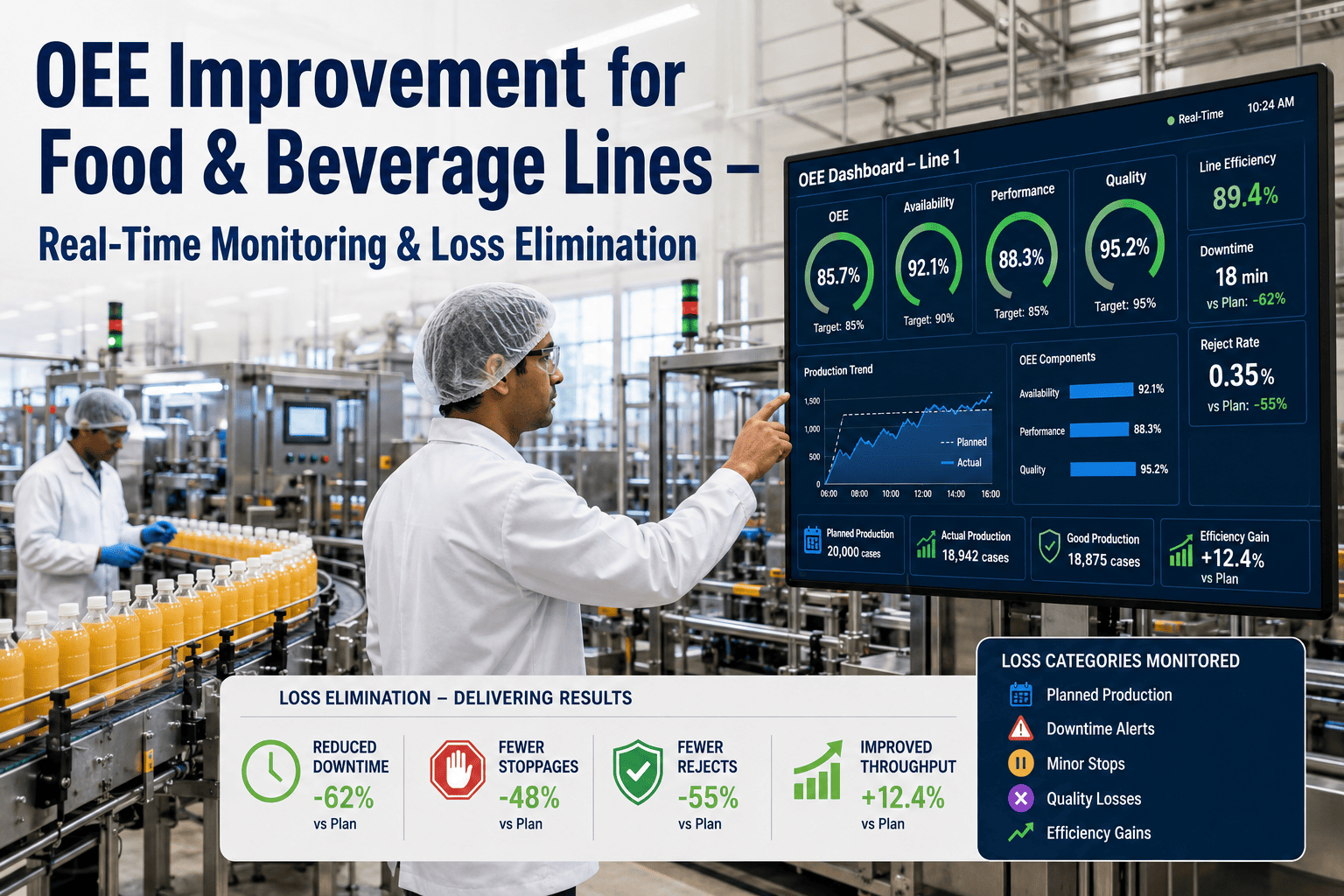
Operators began utilizing overhead dashboards to track live OEE. Maintenance engineers transitioned fully to ifactory's automated PM work orders. Performance optimization loops were officially engaged.
OEE Reaches 91%. Capacity Unlocked. Maintenance Modernized.
The implementation of ifactory fundamentally restructured the facility's production efficiency. Removing the visibility blind spots empowered teams to address the precise root causes of downtime. Reaching 91% average OEE across four lines effectively unlocked the equivalent throughput of adding a fifth production line, purely by eliminating waste and optimizing existing asset utilization.
| Performance Metric | Before ifactory | After ifactory | Change |
|---|---|---|---|
| Overall Equipment Effectiveness (OEE) | 68% | 91% | +23 pts target achieved |
| Average Changeover Time | 75 minutes | 32 minutes | 57% faster changeovers |
| Unplanned Downtime (Monthly) | 400+ hours | Under 40 hours | 90% reduction in breakdowns |
| Preventative Maintenance Compliance | 42% | 98% | Consistent automated PM Execution |
| Reporting Latency | 24 hours | Instant (Real-Time) | Immediate data availability |
| Micro-stops Response Time | Invisible/Unmeasured | Under 2 minutes | Immediate process course-correction |
The Strategic Advantage of AI-Driven OEE in Food Manufacturing
Scaling Manufacturing Through Optimization, Not Expansion
Data Visibility is the Foundation of World-Class Food Manufacturing
This snack food manufacturer proved that escaping the gravitational pull of sub-70% OEE requires migrating away from delayed, subjective reporting. By implementing ifactory's Analytics & Reporting platform, they replaced reactive guesswork with actionable, real-time data flow directly derived from the machines themselves. The immediate visibility into precise micro-stop locations, combined with automated preventive maintenance workflows, transformed their equipment efficiency from a daily struggle into a predictable, high-yield asset.
For modern food processors, optimizing existing capacity provides an astronomically higher return on investment than procuring new lines. Achieving 91% OEE guarantees that the facility operates with absolute capital efficiency — maximizing every scheduled hour, standardizing every changeover, and ensuring continuous readiness for expanding market demand.
Unlock the Hidden 20% in Your Production Lines Today.
Deploy an AI-driven Analytics & Reporting solution tailored for food processing. Eliminate downtime, accelerate changeovers, and hit 90%+ OEE.