Packaging Line Preventive analytics Checklist for Food and Beverage

By Josh Turley on April 15, 2026

packaging-line-preventive-analytics-checklist-for-food-and-beverage

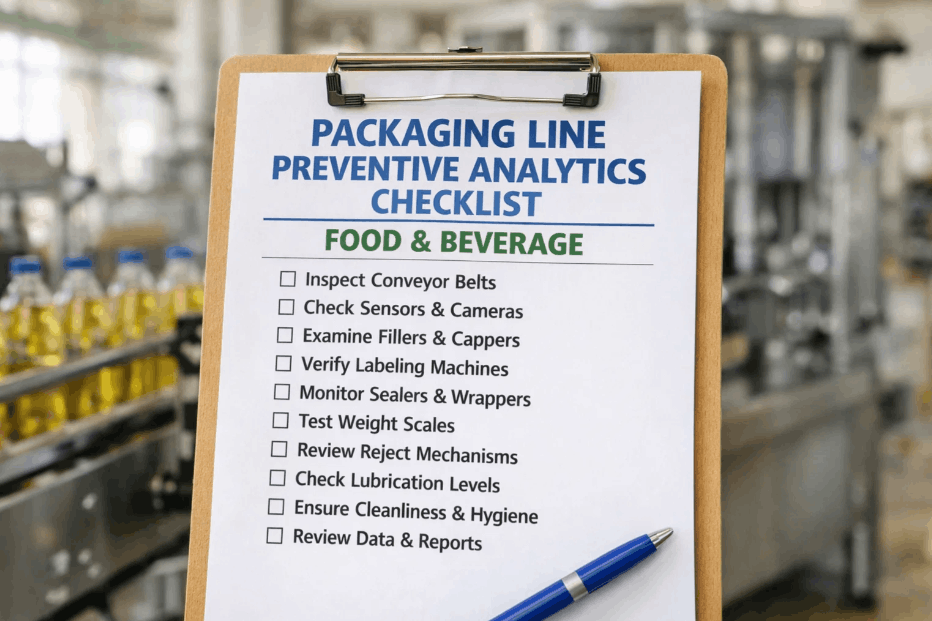
Consistent packaging line performance is essential for maintaining throughput, minimizing waste, and protecting product integrity in food and beverage operations. Unplanned downtime or suboptimal performance in fillers, sealers, labelers, cartoners, or case packers directly causes severe bottlenecks and missed shipments. Adhering to a structured preventive analytics and maintenance checklist ensures your entire end-of-line process runs at peak efficiency. Book a Demo to automate your preventive maintenance scheduling, digitally log inspection results, and monitor equipment health continuously across all production lines.

Automate Packaging Line Preventive Analytics Schedule preventive maintenance, track equipment performance, log filler accuracy parameters, monitor wear parts, and generate complete analytics reports for every machine in your packaging facility.

1. Filler & Dosing System Inspection

Inspect filler components to guarantee accurate volume and weight dosing. Prevent product giveaway and ensure regulatory compliance by verifying all dosing mechanisms. Book a Demo to automatically document filler accuracy and sensor checks.

2. Sealer & Capper Mechanism Check

Verify sealing integrity to prevent spoilage and leaks. Proper torque and temperature controls are critical for food safety and shelf-life extension. Book a Demo to digitally record all capper torque tests and sealer temperature readings.

3. Labeler & Vision System Analytics

Maintain precise label application and barcode readability. Labeling errors are a primary cause for retail rejection or regulatory recall.

4. Cartoner & Case Packer Protocols

Ensure smooth flat-to-box conversion and case erection. Case packers undergo immense mechanical stress and require diligent observation. Book a Demo to track case packer cycle rates and digitize mechanical check logs.

5. Palletizer & Integration Verification

Protect the end of the line continuously to prevent shipping hold-ups. Palletizers and conveyors manage the heaviest loads and present significant safety and operational risks. Book a Demo to digitally monitor entire line integration metrics.

6. Checkweigher & Quality Inspection Stations

Monitor inline quality control to ensure strict compliance. Checkweighers and inspection systems catch packaging anomalies before they leave the facility. Book a Demo to seamlessly monitor checkweigher accuracy.

7. Conveyor Drives & Accumulation Systems

Maintain stable product flow through drive maintenance. Smooth transitions and accumulation buffers prevent line-wide stoppages during downstream delays.
Digitize Your Packaging Preventive Analytics Program iFactory automatically schedules packaging equipment PMs, digitizes inspection checklists, logs sensor data, monitors changeover settings, and ensures maximum uptime across your entire end-of-line process.

Frequently Asked Questions — Packaging Line Analytics

1. How often should we run comprehensive preventive maintenance on fillers?
Depending heavily on cycle counts, daily sensory checks are mandatory, while deep mechanical inspections (o-rings, nozzle seals, piston calibration) are typically scheduled weekly or bi-weekly. Maintaining digital PM histories allows your plant to adjust these frequencies dynamically based on observed drift patterns rather than guessing.
2. Why do mispicks frequently happen on case packers?
Mispicks generally stem from three issues: deteriorating vacuum suction cups, dirty in-line air filters restricting vacuum flow, or misaligned magazine rails. Changing out suction cups before they turn brittle or crack will instantly eliminate the majority of these frustrating micro-stops.
3. Can preventive analytics predict capping mechanism failures?
Yes. Tracking torque output records digitally will reveal statistical drift over time. If a specific capper head begins displaying increasingly erratic torque readings or slowly drifting low despite calibration, analytics can red-flag that mechanism for clutch replacement or rebuild before it totally fails and ruins a batch.
4. How do I maintain vision system reliability on the labeling line?
Routine optical maintenance is vital. Factory environments contain dust, adhesive particles, and moisture. Clean lenses and sensor covers daily with appropriate wipes. Recalibrate the camera focus when changing to a different shaped bottle or label layout, and periodically verify with deliberate "bad" samples that the reject system physically responds correctly.

Share This Story, Choose Your Platform!