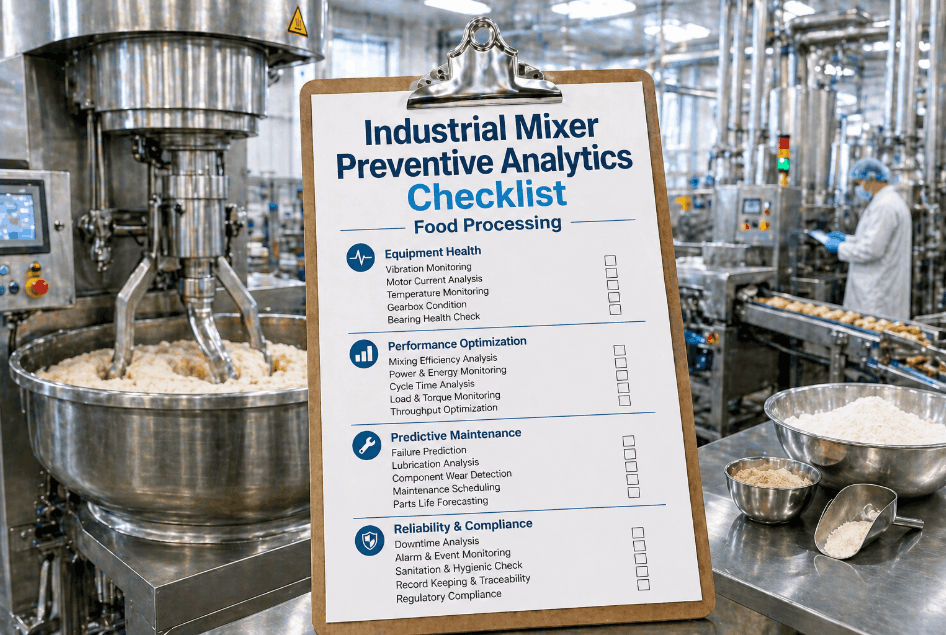
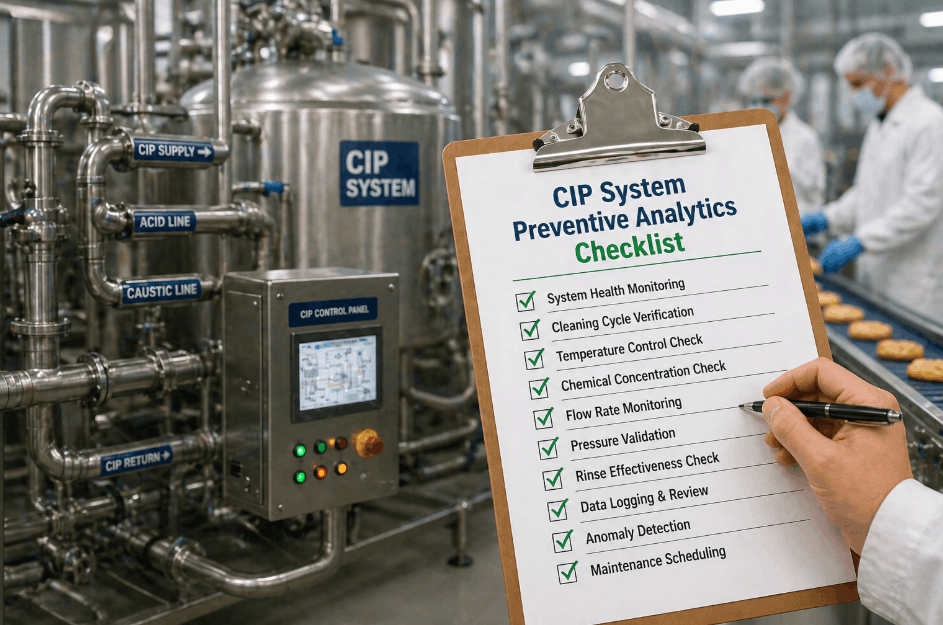
Food manufacturing facilities operating under HACCP plans face a dual obligation: maintaining equipment reliability and ensuring every Critical Control Point monitoring device, food-contact surface, and sanitary component performs within validated parameters at all times. A single miscalibrated CCP sensor or a failed sanitary seal can trigger a regulatory hold, product recall, or FDA 483 observation. This checklist maps preventive analytics tasks directly to HACCP plan requirements — covering CCP monitoring devices, food-contact equipment, sanitary design components, and compliance documentation. Book a demo to see how iFactory integrates HACCP compliance tracking with PM scheduling so inspectors and food safety managers work from a single audit-ready platform.
Automate HACCP-Integrated PM Scheduling for Food Equipment
Connect CCP monitoring tasks, sanitary inspections, and corrective action records into one compliance-ready platform built for food manufacturing.
Section 1: Critical Control Point (CCP) Monitoring Device Inspection
CCP monitoring instruments are the operational backbone of every HACCP plan. Temperature sensors, pH meters, metal detectors, and flow control devices must be verified, calibrated, and documented at frequencies defined in the validated HACCP study. Any out-of-tolerance reading requires immediate corrective action before that production lot is released. Book a demo to learn how iFactory automates CCP calibration task routing and deviation logging.
Verify CCP Temperature Sensor Calibration Against NIST-Traceable Reference
Test each CCP temperature probe against a calibrated reference thermometer at the critical limit temperature in the HACCP plan. Any sensor drifting beyond the validated tolerance must be tagged out-of-service and replaced before the next production run.
Inspect Metal Detector Sensitivity and Reject Mechanism at Validated Test Piece Sizes
Run ferrous, non-ferrous, and stainless steel test pieces at the sensitivity levels documented in the HACCP validation study. Log pass/fail results, test frequency, and operator ID per the site's CCP monitoring procedure.
Calibrate pH and Water Activity Meters Used at Formulation CCPs
Calibrate pH meters using two-point buffer calibration bracketing the critical limit value. Document calibration date, buffer lot number, and offset applied. Out-of-range instruments require immediate product hold and corrective action.
Test X-Ray Detection System Resolution and Belt Speed Accuracy
Verify X-ray sensitivity using certified test pieces for bone, glass, and dense plastic at the smallest validated detectable size. Belt speed deviations directly affect detection sensitivity and must be corrected before production resumes.
Verify Pasteurizer Flow Diversion Valve (FDV) Operation and Timing
Confirm the FDV diverts product correctly when process temperature falls below the critical limit. Any delay or failure to divert is a CCP deviation requiring immediate product segregation and corrective action before restart.
Section 2: Food-Contact Equipment Sanitary Condition Inspection
Food-contact surfaces that fail sanitary design standards or incomplete CIP cycles are a direct microbiological hazard and a HACCP pre-requisite program failure. All food-contact equipment must be inspected before production start for visible soil, biofilm indicators, and structural integrity of gaskets, seals, and surface finish. Schedule a demo to see how iFactory links pre-production sanitation clearance records to HACCP plan documentation.
Inspect All Food-Contact Surfaces for Visible Soil, Residue, and Biofilm Indicators
Examine conveyors, hoppers, filling heads, and mixing bowls under adequate lighting for visible soil, protein residue, and biofilm discoloration. Any surface failing visual inspection must be returned to sanitation and documented before production startup.
Check Gaskets, O-Rings, and Seals on Food-Contact Valves and Fittings
Inspect all tri-clamp gaskets and valve seals for cracking, swelling, or compression set failure. Replace any seal showing surface cracking or deformation and document the component and inspector signature before equipment is returned to service.
Verify CIP Cycle Completion Records — Temperature, Chemical Concentration, and Flow Rate
Review the automated CIP data log to confirm all sanitization steps achieved validated temperature, chemical concentration, and contact time. Any cycle that did not meet validated parameters must be repeated before equipment is released for production.
Inspect Stainless Steel Surface Finish for Pitting, Cracks, and Weld Failures
Check all product-contact stainless steel surfaces for pitting corrosion, crevice cracking, and weld bead irregularities. Document any surface defect with photo evidence and schedule resurfacing or replacement before the next production cycle.
Section 3: Allergen Control Equipment Inspection
Allergen cross-contact from shared equipment is a leading cause of Class I food recalls in the United States. HACCP plans with allergen CCPs require dedicated equipment inspection, validated changeover procedures, and ATP or immunological test verification before allergen-sensitive production begins. Talk to our team about automating allergen changeover checklists and test result documentation with iFactory.
Confirm Allergen Changeover Cleaning Procedure Was Completed per the Validated Protocol
Verify the allergen changeover cleaning record is signed, timed, and matches the validated procedure for each allergen transition. Missing or incomplete records require repeat cleaning before non-allergen product is introduced to the line.
Conduct ATP or Lateral Flow Immunoassay Testing on High-Risk Contact Points
Swab high-risk allergen retention points — blades, auger flights, and conveyor belt seams — using validated test methods. Any positive result requires repeat cleaning and re-testing before production authorization.
Inspect Dedicated Allergen Equipment for Correct Color-Coding and Segregated Storage
Verify allergen-dedicated utensils and contact parts are stored in designated allergen zones with correct color-code markings. Any mixing of allergen and non-allergen equipment requires immediate segregation and a documented corrective action before use.
Section 4: Lubrication and Mechanical Integrity of Food-Zone Equipment
Lubrication failure and uncontrolled mechanical wear in food-zone equipment creates physical contamination hazards — metal particles, grease drops, and gasket fragments — that are CCP physical hazard concerns under HACCP. All lubricants used in food-zone areas must be food-grade H1, with lubrication records traceable to the specific compound applied. Book a demo to see how iFactory manages food-grade lubrication schedules with compound traceability built into every PM record.
Verify All Food-Zone Lubricants Are H1 Food-Grade and Correctly Identified
Confirm only NSF H1-registered lubricants are present in the lubrication storage area and correctly labeled. Any unauthorized lubricant must be immediately removed and a root cause investigation initiated.
Inspect Food-Zone Bearings and Chain Drives for Lubricant Leakage and Over-Greasing
Check all bearing and chain lubrication points for grease purge and excess migration toward product contact zones. Purged H1 grease contacting open product constitutes an incidental contact event and must be documented as a deviation.
Check Slicing and Cutting Blade Condition for Chipping and Metal Fragment Risk
Inspect all cutting blades and portioning dies for chips and micro-fractures. Any chipped blade requires immediate removal, fragment risk assessment of the associated product lot, and metal detection re-verification before production resumes.
Verify Screen and Sieve Integrity on Ingredient Processing Equipment
Inspect all screens, sieves, and inline strainers for tears or mesh separation. Any screen with an opening exceeding the validated maximum must be replaced before the equipment is returned to service.
Section 5: Filling, Sealing, and Packaging Equipment Inspection
Filling and sealing equipment failures create double contamination risk: microbiological hazard from compromised package integrity and physical hazard from seal jaw debris. HACCP plans with packaging CCPs require fill weight verification, seal strength testing, and date-code confirmation as part of every production run's preventive inspection protocol.
Verify Fill Weight Accuracy and Volumetric Filler Calibration
Check filler calibration against certified weights at the start of each production run. Fill deviations triggering legal metrology non-compliance require immediate filler adjustment and lot segregation until verification is complete.
Inspect Heat Seal Jaw Condition and Confirm Seal Strength Testing
Examine seal jaw surfaces for pitting or PTFE coating delamination and conduct peel strength testing on production samples. Any seal below the minimum peel strength requires filler shutdown and temperature/pressure adjustment before product is released.
Confirm Date Code, Lot Number, and Best Before Marking System Operation
Verify the coding system is applying correct date codes, lot numbers, and best-before dates on every package. Any coding system failure requires immediate line stop and product hold until coding is re-verified on a confirmed good sample.
Section 6: Environmental Monitoring and Zoning Equipment Compliance
Environmental monitoring programs tied to HACCP pre-requisite programs require specific equipment — air handling units, drains, condensate collectors, and hygiene barriers — to maintain validated zonal separation between high-care and low-care production areas. Failure of any zoning equipment can invalidate the environmental control baseline and trigger expanded microbiological sampling obligations.
Inspect Air Handling Unit Filters Supplying High-Care and High-Risk Zones
Check filter integrity and pressure differential readings on all AHUs serving high-care production zones. Filters operating above the maximum pressure drop must be changed immediately with corrective action records filed in the HACCP pre-requisite program documentation.
Verify Positive Air Pressure Differentials Between High-Care and Adjacent Lower Zones
Confirm positive pressure is maintained in high-care zones relative to surrounding lower-care areas using calibrated magnehelic gauges. Any zone showing neutral or negative pressure differential must be investigated for filter failure or AHU malfunction before production continues.
Inspect Drain Covers, Condensate Lines, and Floor-Level Hygiene Barriers
Check all floor drains for intact covers, correct flow direction, and absence of pooling. Verify air curtains and hygiene barriers at zone boundaries are operational and unobstructed, and document any deficiency with corrective action assignment.
Close the Gap Between HACCP Plans and Daily PM Execution
iFactory links CCP calibration records, sanitation clearances, allergen changeover logs, and corrective actions into a single audit-ready compliance trail — eliminating documentation gaps that trigger FDA 483 observations.
Section 7: HACCP Compliance Documentation and Record Verification
HACCP records are legal documents under 21 CFR Part 120 (juice) and Part 123 (seafood) and operational requirements under FSMA Preventive Controls rules. Every CCP monitoring record, calibration entry, corrective action report, and verification activity must be completed in real time, signed by a qualified individual, and retained for the minimum regulatory period. Book a demo to see how iFactory generates FSMA-compliant PM records with automatic timestamping and inspector sign-off capture on mobile devices.
Verify All CCP Monitoring Records Are Complete, Signed, and Filed Within the Required Timeframe
Review all CCP monitoring forms for the previous production day to confirm entries are complete, legible, within critical limit parameters, and signed. Any unsigned record or out-of-limit entry without an associated corrective action must be resolved before the next production shift begins.
Confirm Corrective Action Records Are Linked to Every CCP Critical Limit Deviation
Verify every CCP deviation has a corresponding corrective action report documenting the cause, immediate action, product disposition, and preventive measure implemented. Unlinked deviations are a major FDA and GFSI audit finding requiring same-day resolution.
Review Calibration Certificates for All CCP Monitoring Instruments Currently in Service
Confirm each active CCP instrument has a current, traceable calibration certificate on file and flag any due within 30 days. Operating a CCP with an expired certificate constitutes a HACCP plan non-conformance requiring immediate corrective action.
Confirm HACCP Verification Activities Are Scheduled and Records Are Current
Check that all periodic HACCP verification activities — CCP record review, instrument verification, and annual plan reassessment — are scheduled and records are signed by the qualified HACCP team leader. Overdue activities must be completed or rescheduled with documented justification.
Frequently Asked Questions
Calibration frequency must be defined in the HACCP plan based on instrument stability data. Most GFSI schemes require minimum annual calibration with NIST-traceable references, and daily or per-shift verification for instruments at active CCPs. iFactory automates calibration due-date alerts and routes tasks to certified technicians before instruments fall out of compliance.
CCP monitoring records capture real-time process control data — temperature readings, metal detector results, or pH values — taken during production to confirm the process is under control. PM records document planned equipment inspections performed to maintain the reliability of equipment supporting CCP monitoring. Both are mandatory HACCP documentation categories and must be traceable, signed, and retained per regulatory minimum periods.
A failed metal detector test is a CCP critical limit deviation requiring immediate line stop and segregation of all product produced since the last successful check. The corrective action record must document the cause, product disposition, equipment repair, and re-verification result before production resumes.
Under FDA FSMA Preventive Controls (21 CFR Part 117), most records must be retained for a minimum of two years. Many GFSI-benchmarked schemes and customer contracts mandate three years or longer. Digital CMMS records provide the most defensible audit trail with automatic timestamping.
Yes — provided the CMMS produces tamper-evident, timestamped electronic records with individual user sign-off meeting 21 CFR Part 11 requirements. iFactory generates audit-ready PM and inspection records, routes corrective actions to responsible personnel, and produces the complete documentation package FDA auditors review during facility inspections.
Build a HACCP-Compliant PM Program the FDA and Auditors Can Trust
From CCP calibration scheduling to allergen changeover verification — iFactory keeps your food equipment inspection program consistent, documented, and ready for any audit, at any time.