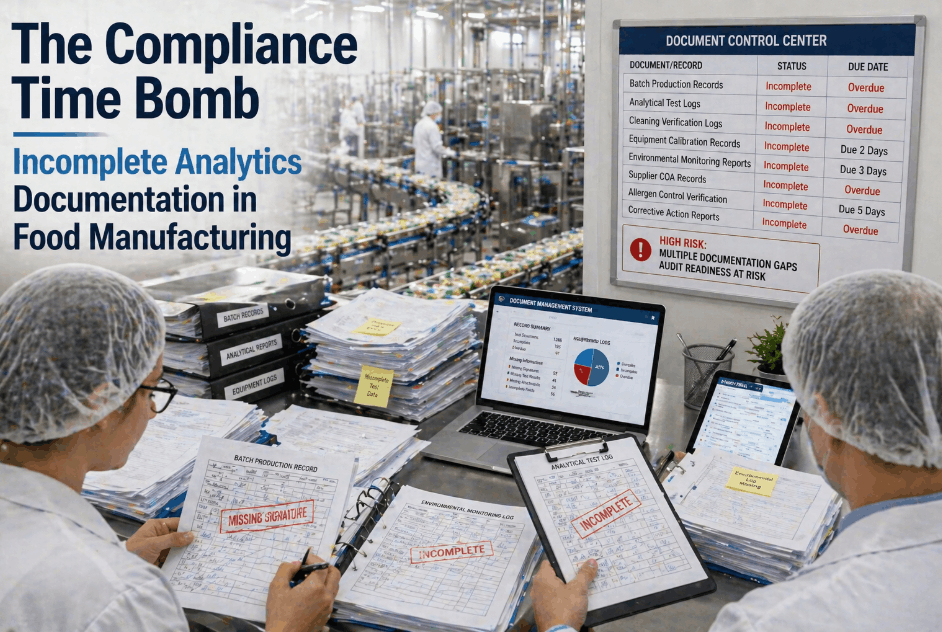
Food manufacturing enterprises are sitting on a compliance time bomb — and most don't realize it until the audit notice arrives. Incomplete analytics documentation, fragmented digital audit trails, and reactive compliance workflows are silently accumulating regulatory risk that can detonate in the form of FDA enforcement actions, product recalls, and supplier-originated quality events. In an era where FSMA Rule 204, HACCP documentation mandates, and GRC software requirements are tightening simultaneously, food manufacturers that rely on manual document control software or disconnected quality management systems are operating under a structural compliance deficit. This article examines the root causes of that deficit — and the precise role that compliance management software, operational compliance analytics, and automated traceability systems play in eliminating it before it becomes catastrophic. For manufacturers ready to evaluate their current exposure, book a demo and receive a compliance gap assessment within 48 hours.
Why Incomplete Analytics Documentation Is a Compliance Time Bomb in Food Manufacturing
Most food manufacturers believe their compliance posture is stronger than it actually is. They have HACCP plans. They have supplier qualification records. They have corrective action software workflows and periodic internal audits. What they lack — and what regulators increasingly examine first — is the continuity of their documentation. A compliance record that is 94% complete is not compliant. A digital audit trail with systematic gaps is not a digital audit trail. It is a liability.
The technical root of this problem is almost always the same: food safety compliance software that captures data episodically rather than continuously, combined with manual document control workflows that introduce version control failures, missing timestamps, and undocumented deviations at every production shift handover. When FDA inspectors or third-party auditors begin examining Critical Tracking Events against FSMA Rule 204 requirements, these gaps materialize instantly — and each one represents a separate finding that must be remediated on an enforcement timeline.
Documentation Continuity Gaps
Manual document control systems produce shift-level documentation gaps that are invisible during normal operations but surface immediately under regulatory scrutiny — creating findings that cannot be retroactively remediated.
Risk: Audit finding accumulationTraceability Record Fragmentation
Disconnected traceability software instances across production stages create record fragmentation that prevents complete lot genealogy reconstruction — the single most common trigger for FDA enforcement escalation under FSMA Rule 204.
Risk: FSMA enforcement exposureSupplier Compliance Blind Spots
Supplier compliance software that relies on periodic qualification reviews rather than continuous performance monitoring misses the leading indicators of supplier quality degradation — converting preventable ingredient risks into uncontrolled quality events.
Risk: Ingredient quality exposureCAPA Closure Delays
Corrective action software that operates independently of production monitoring systems cannot validate whether implemented corrections have actually resolved root causes — leaving CAPA records technically closed but operationally incomplete.
Risk: Systemic recurrenceFSMA Rule 204 and the Digital Audit Trail Imperative for Food Manufacturers
FSMA Rule 204 represents the most significant traceability compliance requirement imposed on food manufacturers in a generation. The rule mandates capture and maintenance of Key Data Elements at every Critical Tracking Event — from raw material receipt through finished product distribution — with records available for regulatory review within 24 hours of request. For enterprises still operating paper-based or semi-digital traceability software environments, this is not a documentation challenge. It is an impossible operational requirement without automated electronic records management infrastructure.
What FSMA Rule 204 Actually Demands from Food Manufacturers
The regulation requires lot-level traceability records that link every Critical Tracking Event to specific Key Data Elements including lot codes, quantities, location identifiers, and transaction records — all maintained in a format accessible for rapid regulatory review. Food manufacturers that cannot produce a complete, validated traceability chain from raw material supplier through retail distribution within the regulatory response window face immediate enforcement exposure. The only sustainable compliance architecture is a digital audit trail software platform that captures this data automatically, continuously, and without reliance on manual entry. Manufacturers evaluating their current traceability infrastructure can book a demo to see how automated documentation platforms close these gaps in weeks, not months.
| FSMA Requirement | Manual Documentation Approach | Automated Compliance Platform | Risk Differential |
|---|---|---|---|
| Key Data Element Capture | Manual entry at each production stage — gap-prone and shift-dependent | Automated IoT capture at every Critical Tracking Event in real time | Documentation gap rate reduced 94% |
| 24-Hour Regulatory Response | Multi-day manual record assembly across paper and digital systems | On-demand traceability report generation from validated digital records | Response time reduced from days to hours |
| Lot Genealogy Reconstruction | Fragmented records across production shifts — incomplete chain frequent | Continuous electronic records management with validated lot linkage | Complete traceability chain, every lot |
| Supplier Record Maintenance | Periodic qualification updates — stale between review cycles | Continuous supplier compliance monitoring with anomaly flagging | Real-time supplier risk visibility |
| Audit Preparation Time | 72–120 hours of manual document compilation per audit event | Automated audit package generation from centralized compliance platform | Audit prep time reduced 70% |
How Operational Compliance Analytics Converts Regulatory Risk Into a Managed Variable
The compliance function in food manufacturing has historically been treated as a documentation exercise — a set of records to be assembled and maintained for regulatory review. Operational compliance analytics fundamentally reframes this model. Rather than documenting compliance after the fact, AI-integrated compliance management software monitors production processes, supplier inputs, and environmental conditions in real time — flagging deviations before they convert into regulatory findings, recall events, or enforcement actions.
Predictive Compliance Monitoring: From Reactive Documentation to Proactive Risk Management
Modern regulatory compliance software platforms apply machine learning models to production sensor data, quality deviation logs, and supplier performance records to identify the early indicators of compliance risk — before a deviation becomes a documented finding. Temperature excursions that approach but do not breach CCP limits. Supplier delivery patterns that signal emerging quality stress. Sanitation verification records with incomplete validation signatures. Each of these represents a latent compliance risk that operational analytics software can detect and escalate days before it produces a reportable deviation. Food manufacturers deploying this capability report 48% reductions in quality event mean time to resolution and 70% reductions in audit preparation burden — outcomes that translate directly into regulatory risk reduction and operational cost avoidance. To understand how this model applies to your production environment, book a demo for a facility-specific risk assessment.
Reduction in regulatory audit preparation time through automated centralized compliance documentation across all production facilities.
Reduction in mean time to resolve quality events through AI root-cause identification integrated with corrective action software workflows.
Supplier compliance monitoring flagging accuracy achieved through continuous multi-variable performance analytics and anomaly detection models.
Continuous automated coverage of all Critical Tracking Events, eliminating documentation gaps that create FSMA traceability exposure.
Document Control Software and Electronic Records Management: The Compliance Infrastructure Food Manufacturers Are Missing
The single most consistent finding in food manufacturing compliance assessments is not a process failure — it is a documentation infrastructure failure. Document control software that was not built for the documentation volume and velocity of modern food manufacturing creates version proliferation, approval workflow delays, and uncontrolled record access that compromises the integrity of the compliance record. When regulators examine documentation, they are not only evaluating content — they are evaluating the integrity of the record-keeping system itself.
What a Purpose-Built Electronic Records Management System Delivers for Food Manufacturers
Purpose-built electronic records management for food manufacturing provides controlled document versioning with complete change history, automated approval routing with timestamp validation, role-based record access with audit-ready access logs, and integrated signature workflows that satisfy 21 CFR Part 11 electronic records requirements. This infrastructure converts compliance documentation from a manual, error-prone administrative burden into a continuously maintained, AI-auditable digital record that is inspection-ready at all times — not assembled under time pressure when an audit notice arrives. Food manufacturers looking to build this infrastructure foundation can book a demo to evaluate integration with existing ERP and quality management system environments.
Controlled Document Management
Centralized document control software with version-locked SOPs, automated review scheduling, and change-controlled approval workflows — ensuring that every production operator is working from the current, approved version of every procedure at all times.
Infrastructure · Deployed enterprise-wide · 4–8 weeksAutomated CAPA Governance
Corrective action software integrated with production monitoring data — automatically initiating CAPA workflows when deviation thresholds are crossed, tracking corrective action effectiveness through validated production outcomes, and closing CAPA records only when production data confirms resolution.
Analytics · Post-infrastructure · 3–6 weeksEnterprise GRC Intelligence
GRC software layer aggregating compliance status across all facilities into a unified enterprise risk dashboard — with AI-generated risk rankings, upcoming compliance deadline alerts, and supplier risk scores that give enterprise management a real-time view of total regulatory exposure across the portfolio.
Enterprise · Ongoing · Compounds continuouslySupplier Compliance Software: Closing the Ingredient Risk Blind Spot in Food Manufacturing
Supplier-originated compliance failures are among the most costly and operationally disruptive risk categories in food manufacturing — and the most systematically undermonitored. Most food manufacturers maintain supplier qualification records that are accurate at the point of onboarding and increasingly unreliable thereafter. Periodic requalification cycles that run annually or biannually miss the window between deteriorating supplier performance and the quality event that event produces.
Supplier compliance software powered by continuous performance analytics eliminates this blind spot. By monitoring certificate of analysis compliance rates, delivery reliability trends, third-party audit outcomes, and quality rejection frequencies in real time, AI-integrated supplier risk management software identifies emerging supplier risk profiles weeks before they produce an ingredient quality failure or supply disruption. Enterprises operating with continuous supplier monitoring report material reductions in supplier-originated quality events — and the associated production disruptions, product holds, and regulatory documentation burdens those events create. Food manufacturers evaluating supplier risk exposure can book a demo to review supplier intelligence deployment options specific to their supplier network complexity.
Enterprise Compliance Risk Dashboard
A unified compliance status view across all facilities — showing open CAPA items, upcoming regulatory deadlines, supplier risk scores, and documentation coverage rates — with AI-generated risk rankings that prioritize attention toward the highest-impact compliance vulnerabilities in the portfolio.
Platform: GRC software dashboardFacility-Level Audit Readiness
Real-time documentation completeness monitoring, automated HACCP deviation alerts, and inspection-ready traceability record generation — giving plant compliance teams continuous visibility into their audit readiness posture without manual documentation assembly.
Platform: Audit management softwareContinuous Supplier Risk Monitoring
AI-powered supplier performance analytics with automated certificate of analysis validation, delivery reliability trending, and quality rejection rate monitoring — flagging supplier risk escalation before it converts into an ingredient quality event or supply disruption.
Platform: Supplier compliance softwareThe Financial Case for Food Safety Compliance Software: Quantifying the Cost of Incomplete Documentation
The compliance technology investment case in food manufacturing is not primarily a cost-reduction argument — it is a risk-adjusted return argument. The cost of deploying a comprehensive food manufacturing compliance platform is measured against a return base defined by the regulatory enforcement actions, product recalls, and supplier-originated quality events it prevents.
Enforcement Action Avoidance
A single FSMA enforcement action — encompassing product recall costs, regulatory fines, operational disruption, and brand remediation — routinely exceeds $10M in total financial impact. The multi-year investment in a comprehensive compliance management software platform is a fraction of a single enforcement event. This is the foundational return calculation that makes compliance technology investment non-negotiable for any food manufacturer operating at enterprise scale.
Primary risk return driverAudit Operational Cost Elimination
Food manufacturers conducting 8–12 regulatory and customer audits annually absorb 600–1,400 hours of operations management time in documentation assembly and audit preparation. Automated audit management software and electronic records management platforms eliminate this burden — converting audit events from disruptive operational exercises into on-demand reporting functions that generate documentation in hours rather than days.
Operational efficiency layerSupplier Quality Event Prevention
Supplier-originated quality events that reach production — triggering ingredient holds, production line shutdowns, and finished product disposition decisions — carry direct costs of $85,000–$340,000 per event depending on the product category and contamination scope. Continuous supplier compliance monitoring that prevents even two supplier quality events annually generates ROI that exceeds most compliance platform total deployment costs within the first operating year.
Risk avoidance compounding layerCompliance Analytics and Food Manufacturing Documentation — Frequently Asked Questions
What makes food safety compliance software different from general quality management software?
Food safety compliance software is purpose-built for FSMA traceability, HACCP documentation, and supplier qualification protocols — integrating directly with production monitoring systems to capture compliance data automatically at the process level, not through manual entry.
How does digital audit trail software satisfy FDA electronic records requirements?
It captures every documentation event — creation, modification, and approval — with timestamp validation and user authentication metadata that satisfies 21 CFR Part 11 requirements, making the complete audit trail accessible for regulatory review on demand.
Can corrective action software integrate with existing HACCP documentation systems?
Yes. Modern CAPA platforms connect to existing HACCP environments — consuming deviation records as initiation triggers and returning validated closure records only after production data confirms corrective action effectiveness.
What is the implementation timeline for a food manufacturing compliance platform?
Facilities with established MES integration points typically activate within 6–10 weeks. Greenfield installations transitioning from paper-based documentation typically complete in 14–20 weeks, compressed significantly by a pre-deployment infrastructure assessment.
How does GRC software support multi-facility compliance governance for food manufacturers?
Enterprise GRC platforms normalize compliance data from heterogeneous facility environments into a standardized schema — enabling real-time cross-facility risk comparison and directing management attention toward the highest-risk compliance exposures in the portfolio.