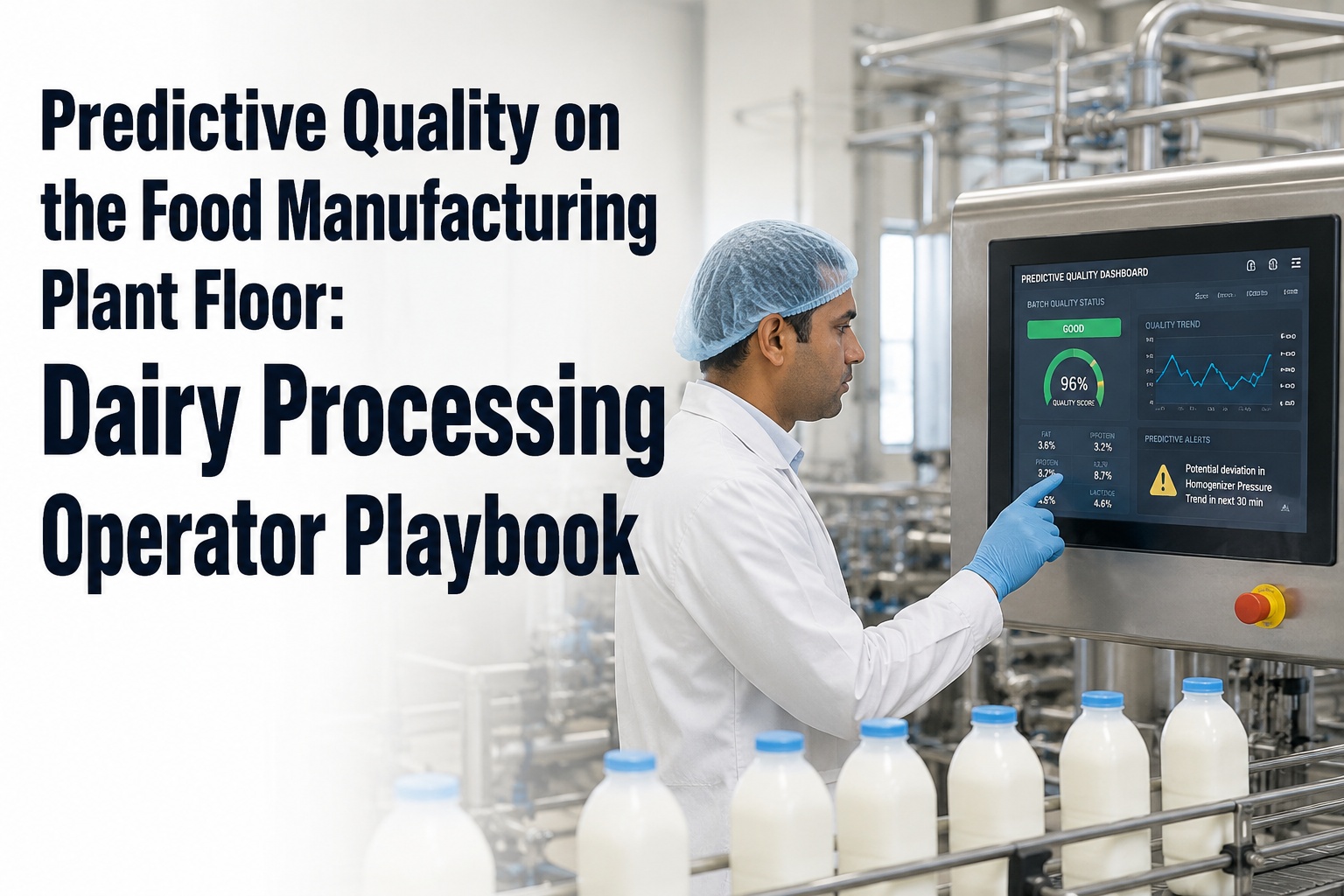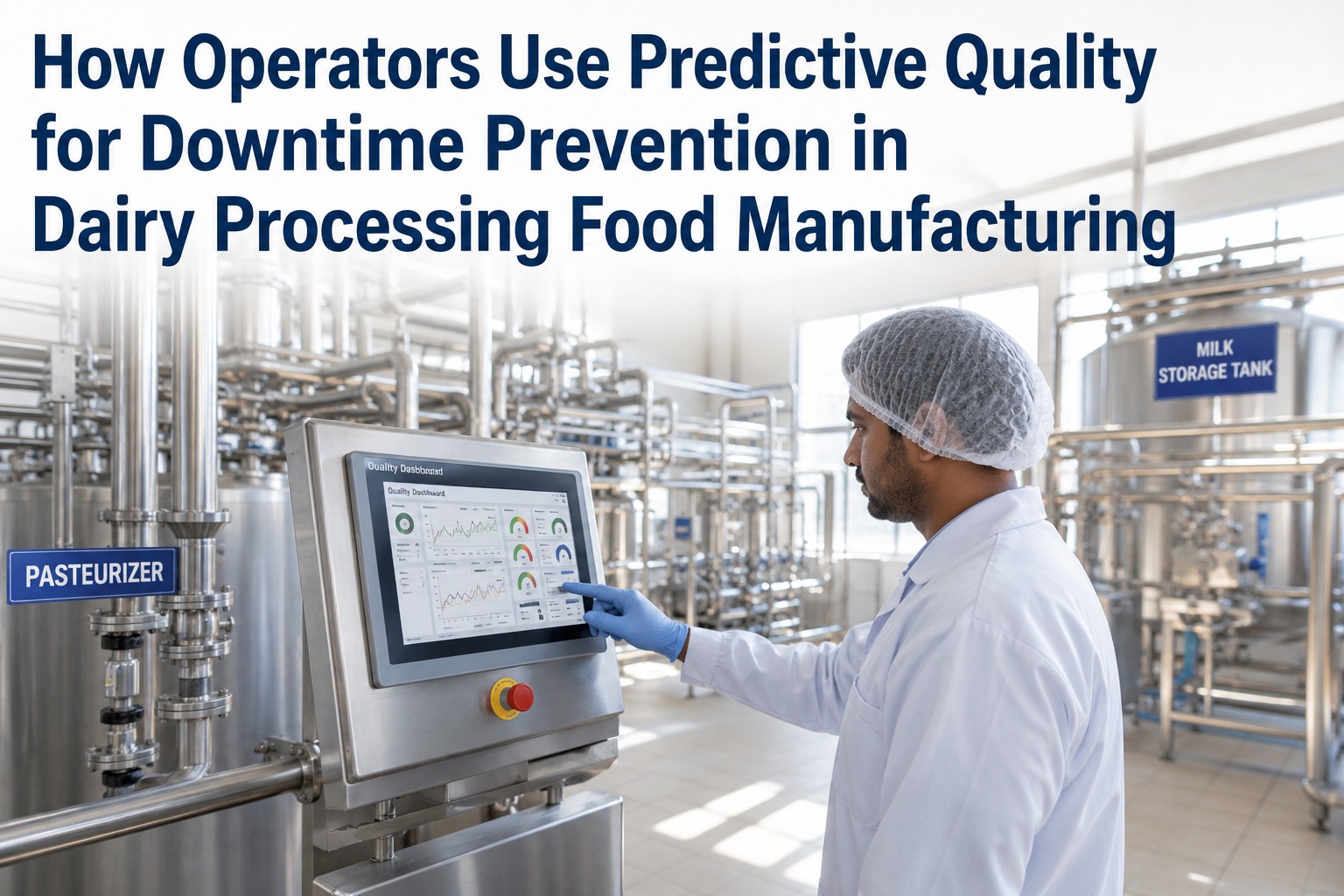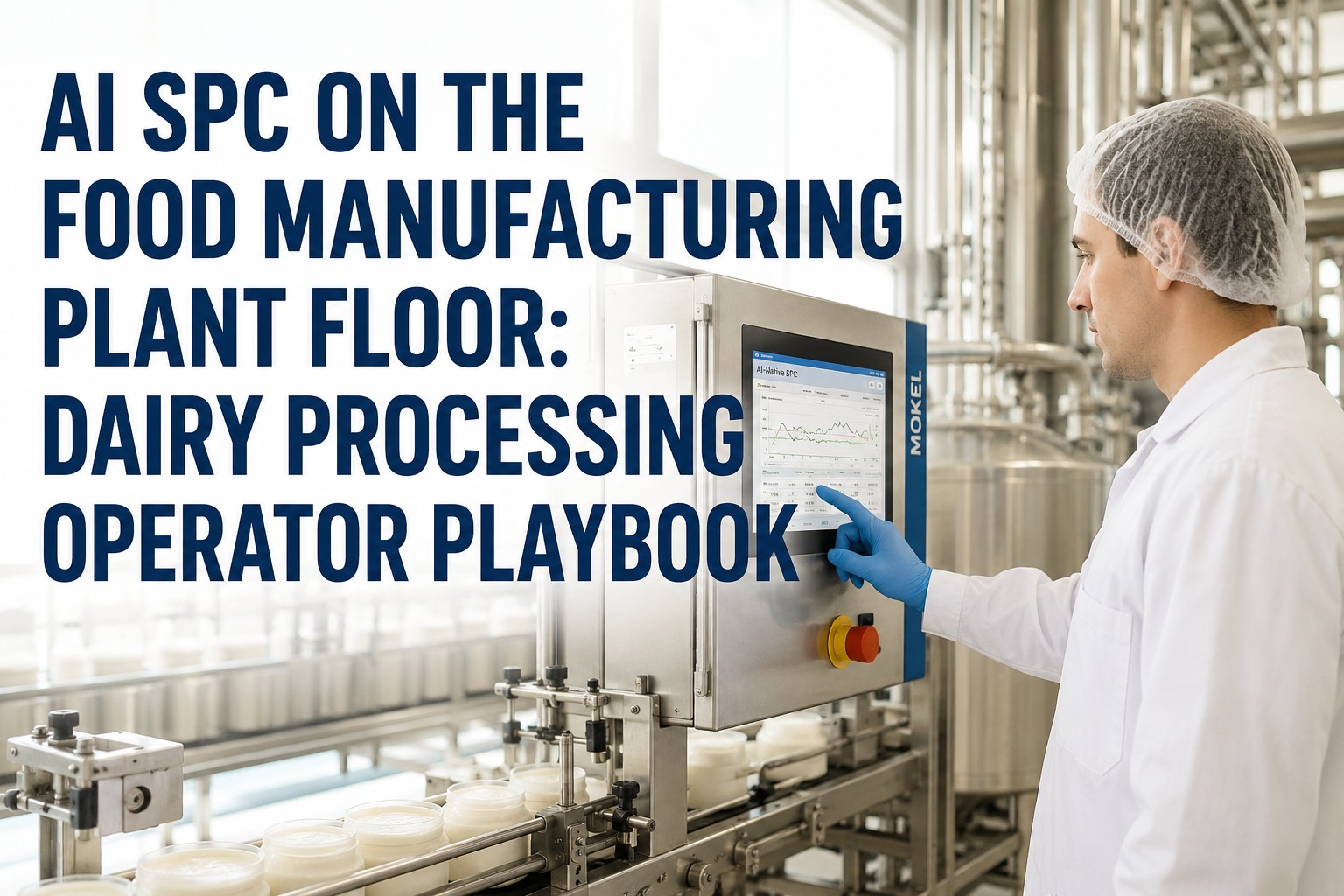
If you operate a dairy processing line, you already know which kinds of process drift end with the line stopped. The HTST hold-tube temperature creeping toward the 161°F minimum until the diverter valve trips and the entire run goes to re-pasteurization. The fat-protein ratio drifting across a separator run until downstream standardization fails and the batch goes on quality hold. The CIP conductivity recovery curve flattening until the cycle has to be re-run and the next run is delayed. Every one of those line stops is a process-drift event that traditional SPC charts caught only when the parameter actually crossed the limit — too late to prevent the stop. AI-native SPC inverts the timing. The same control charts, the same Western Electric and Nelson Rules, the same operator dashboards — plus an LSTM forecasting layer that watches the trend and alerts you 30–120 minutes before the parameter would breach the limit. Diversions don't happen because the operator corrected the drift while it was still 4°F above the threshold. Batch holds don't happen because the separator adjustment landed before fat-protein went out of spec. Across a typical 12-month deployment, this cuts unplanned downtime in dairy plants by 30–50%. iFactory delivers it on a turnkey on-premise NVIDIA appliance or fully managed cloud — same AI SPC stack, your deployment choice.
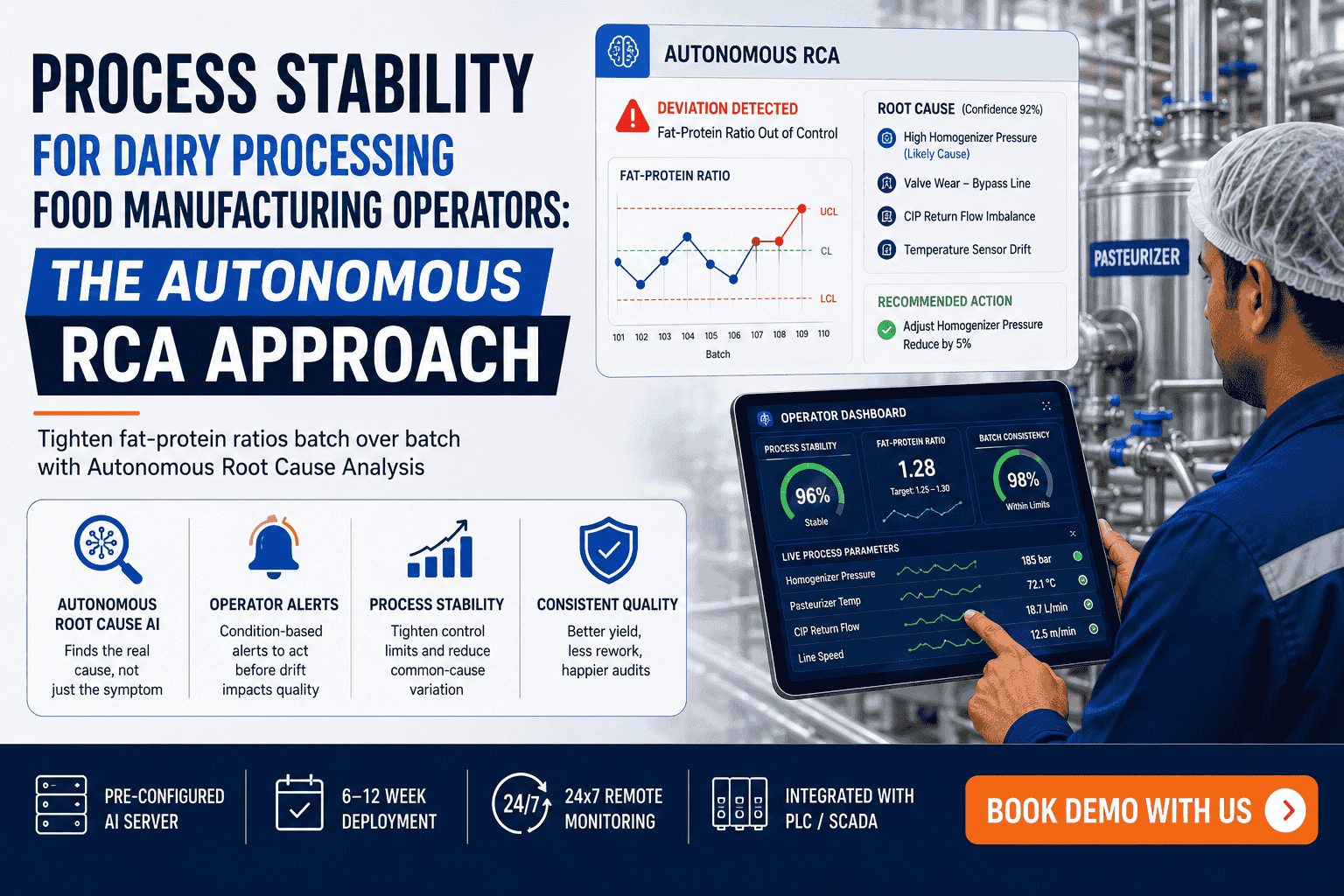
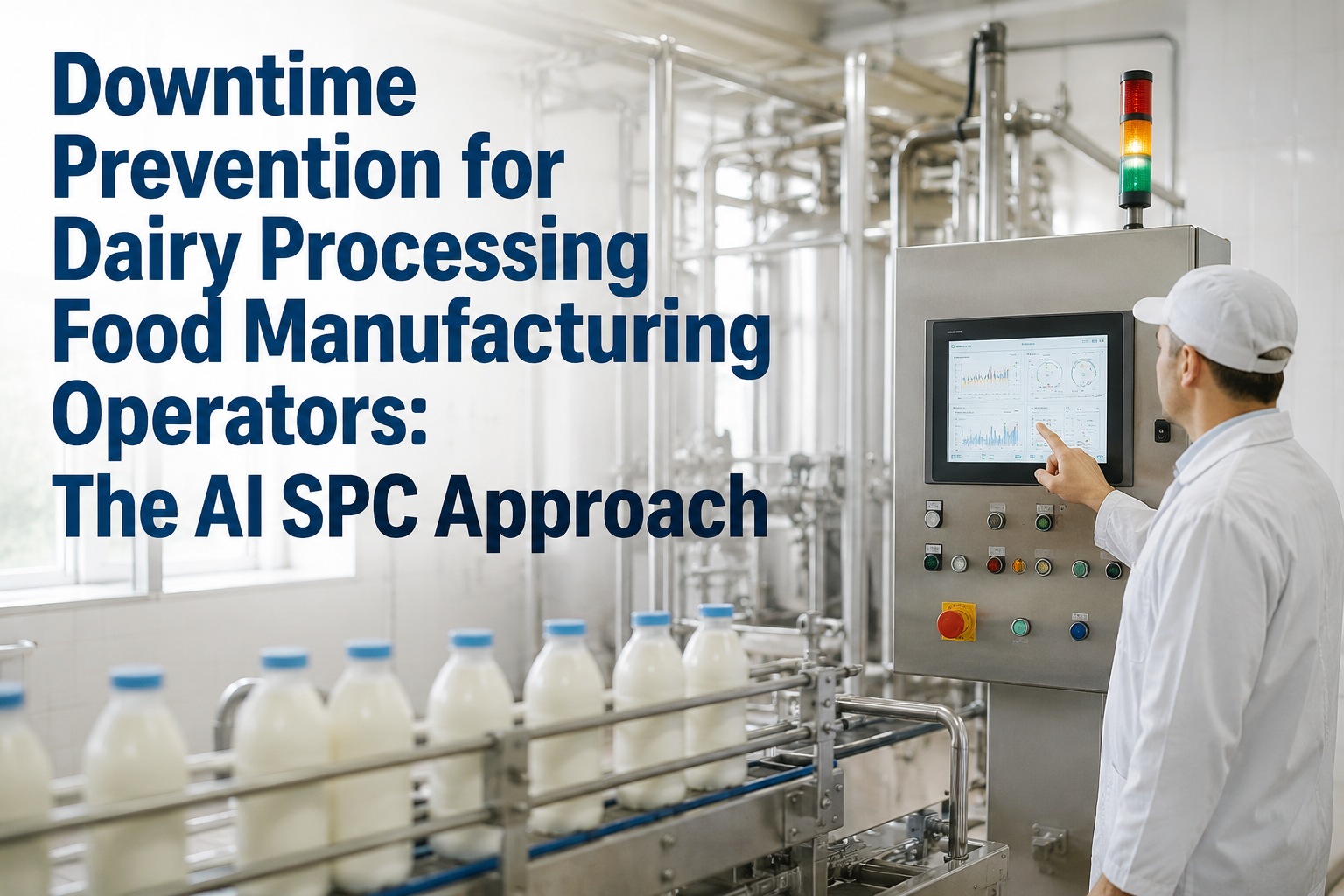
Downtime Prevention for Dairy Processing Food Manufacturing Operators: The AI SPC Approach
How dairy line operators use AI-native SPC to prevent the specific process-drift events that cause line stops — HTST diversions, fat-protein batch holds, CIP cycle failures, quality holds. 30–50% unplanned downtime reduction, no equipment changes required.
Why Dairy SPC Is the Hidden Downtime Driver
Most dairy plant downtime analyses miss the SPC contribution. Equipment failures get categorized as "maintenance." Quality issues get categorized as "QA." Material problems get categorized as "supply." But the SPC-driven downtime — diversions, batch holds, quality holds, CIP re-runs — gets distributed across multiple categories because nobody traces it back to the original parameter drift. When you do trace it back, SPC-driven downtime typically accounts for 25–40% of total unplanned downtime hours, making it the single largest controllable category in most dairy operations.
The cascade is the same for every SPC-driven downtime trigger in dairy — separator drift causing fat-protein batch holds, CIP cycle drift causing re-runs, filler valve drift causing fill-weight rejections. The pattern doesn't change; only the parameter and the impact category change. AI-native SPC catches the drift at the early-warning stage, before traditional SPC has anything to fire on.
Want to see your specific downtime cascade pattern? Request a retrospective downtime audit from iFactory support — we'll analyze your last 90 days of process data alongside the downtime log and identify how many stops showed predictive drift 30–120 minutes ahead, returned within 5 business days.
HTST Hold-Tube Temperature — The Highest-Impact Application
For fluid milk plants in particular, the HTST hold-tube temperature is the single highest-impact SPC application. The PMO minimum is 161°F for 15 seconds. Below that — even briefly — the diverter trips. Every diverter trip means product to re-pasteurization, line stop, deviation log, audit entry. AI-native SPC catches the temperature drift before it reaches the diversion threshold.
Six SPC-Driven Downtime Triggers in Dairy
Predictive AI SPC covers a specific set of dairy operations where process drift becomes line stops. These six are the highest-impact across fluid milk, cheese, and yogurt operations, and they account for the bulk of SPC-attributable downtime in most plants.
HTST Diversion Trips
AI tracks temperature trajectory and steam supply correlation. Catches drift 60+ minutes ahead and recommends steam adjustment before the diverter trips.
Fat-Protein Drift
Multivariate model correlates separator bowl temp, flow, and cream/skim density. Catches fat % drift in skim 30–60 minutes before standardization fails downstream.
CIP Cycle Failures
AI tracks CIP cycle parameters against the historical clean-cycle signature. Catches degraded cleaning 1–2 cycles before the failure that forces a re-run.
Quality Hold Cascades
Confidence fusion suppresses low-confidence alerts during normal variation. Operators stop the line only for high-confidence drift, not for nuisance alarms.
Filler Fill-Weight Drift
AI tracks fill-weight trends against fill-valve cycle count and product specs. Catches drift before fill-weight rejections trigger line stops or rework.
Batch Rejection Risk
LSTM forecasts batch completion parameters from in-process measurements. Catches batches trending toward rejection in time to adjust rather than scrap.
Want to see which of these six triggers contribute most to your specific dairy line's downtime? Book a Demo with Us — bring your downtime log and the iFactory team will map AI predictive coverage across all six trigger categories, with projected hours-saved per category. Sessions available this week.
Traditional SPC vs AI-Native SPC — The Timing Difference
Both systems use the same control charts, the same Western Electric Rules, the same Nelson Rules, and the same operator interface conventions. What differs is what happens between drift and breach. Traditional SPC waits silently; AI-native SPC alerts predictively.
Wait for the threshold
- Alert mode — after parameter crosses control limit
- Lead time — 0 (alert fires when limit is breached)
- Action window — none; cascade is in motion
- Operator workflow — stop line, investigate, recover
- Nuisance alarm rate — high; many false-positive stops
- Pattern detection — Western Electric / Nelson Rules
- Multivariate awareness — univariate; one parameter at a time
Catch the drift early
- Alert mode — when drift trajectory is detected
- Lead time — 30–120 minutes before limit breach
- Action window — operator can correct without stopping
- Operator workflow — adjust, verify, continue running
- Nuisance alarm rate — low; confidence fusion suppresses
- Pattern detection — Nelson Rules + LSTM + autoencoder
- Multivariate awareness — full correlated-parameter modeling
PMO, HACCP & GFSI Compliance — Preserved Through the Transition
Every SPC event and operator action logged for audit
- HTST PMO compliance evidence (time / temp / flow)
- Diversion valve activations with root cause attribution
- HACCP Critical Control Point records with timestamps
- SPC chart events with confidence scores and operator actions
- CIP cycle verification per circuit, per shift
- Batch composition records with continuous traceability
- Operator action log with electronic signatures (21 CFR Part 11)
- GFSI / SQF / BRC audit-ready evidence packages
The validated dairy control system continues operating exactly as it does today — diverter logic, alarm trips, PLC interlocks all unchanged. AI SPC sits as a predictive advisory layer above the validated system, so PMO compliance is preserved while operators get the early warning that prevents the conditions that would otherwise trigger validated alarms.
Two Real Dairy Plant Downtime Outcomes
Mid-volume fluid milk processor with chronic diverter trips on two HTST lines
A regional fluid milk processor running two HTST lines with chronic hold-tube temperature drift. Averaged 7–9 diversion events per week across the fleet — each consumed 60–90 minutes including re-pasteurization, deviation logging, and CIP. Annual SPC-driven downtime exceeded 580 hours, dominated by HTST diversions.
Specialty cheese producer with separator drift causing downstream batch holds
A specialty cheese plant with cream separator drift causing chronic fat-protein ratio variation in standardized milk feed to cheese vats. Batch holds for off-spec composition averaged 4–6 per week across the plant — each costing 60–120 minutes of vat downtime plus rework labor for milk re-standardization.
Neither scenario matches your dairy operation? Send your top SPC-driven downtime categories to iFactory support and the dairy team will return a customised projection — predictive coverage map, projected downtime reduction, and 12-month roadmap — typically within 3 business days, no obligation.
iFactory's Dairy Deployment — On-Premise or Cloud
Same AI-native SPC stack on either deployment model. Same LSTM forecasting, same multivariate analysis, same Western Electric and Nelson Rules automation, same audit trail. The choice depends on your IT strategy, data residency rules, and multi-plant approach.
iFactory On-Premise Appliance Default for single-plant dairy operations
- Pre-configured NVIDIA AI server — racked, software-loaded, ready to plug in.
- 24×7 monitoring — continuous AI coverage across all process tags.
- Integrated with PLC and SCADA — uses existing data, no new sensors needed.
- Works during WAN outages — predictive coverage continues uninterrupted.
iFactory Cloud For multi-plant dairy operations and central QA teams
- Fully managed — no rack, no facility requirements.
- Same AI-native SPC stack — LSTM, autoencoder, Nelson Rules automation.
- Cross-plant downtime benchmarking across all dairy plants in one tenant.
- Fastest deployment — first plant live in 2–4 weeks.
Diverter trips don't have to be a weekly event.
AI-native SPC catches the drift 30–120 minutes before the threshold is crossed. Operators adjust, line keeps running, PMO record stays clean, audit evidence builds itself. iFactory's dairy demo shows how this works on representative HTST, separator, CIP, and filler operations — with predictive alerts firing on real signal patterns. Sessions available this week, on-premise NVIDIA appliance or fully managed cloud.
Frequently Asked Questions
Will AI SPC change how our HTST diverter logic operates?
No. The validated HTST control system continues to operate exactly as today — diverter logic, alarm trips, PLC interlocks all unchanged. AI SPC runs as a predictive advisory layer that gives operators early warning before drift reaches the conditions that would trigger the validated alarms. PMO compliance is preserved, validation state is preserved, and the diverter still operates as your validation requires.
How does AI SPC catch fat-protein drift that traditional SPC misses?
Fat-protein drift across separator runs is a multivariate phenomenon — it involves bowl temperature, throughput, cream density, skim density, and product type. Traditional SPC charts each parameter univariately and only alerts when one crosses its individual limit. AI SPC correlates all five parameters together, catching the multivariate drift signature 30–60 minutes before any single parameter would breach its individual limit.
Do we need to replace our existing SCADA?
No. The iFactory platform integrates with existing PLC and SCADA via OPC UA, MQTT, Modbus, and proprietary protocols where needed. The deployment team handles integration during the 6–12 week installation. Operators continue using their existing HMI; the AI predictive alerts appear as a supplementary panel rather than replacing the existing interface.
How accurate are the 30–120 minute predictions?
For mature deployments (60+ days of training data on your specific equipment and product mix), prediction accuracy typically runs 85–93% within the lead time window. Confidence fusion suppresses low-confidence predictions, so the alerts operators actually see have high reliability. False positive rates typically drop below 8% within the first 90 days of operation.
Do I have to buy NVIDIA servers separately?
No. iFactory's on-premise appliance ships fully loaded — pre-configured NVIDIA AI server, software pre-installed, network gear, cabling, edge devices. You provide rack space, line power, Ethernet, and integration points with your PLC/SCADA. The team installs and configures everything during the 6–12 week deployment. For cloud deployment, there's no hardware investment at all.
What happens during the deployment? Will it disrupt production?
No production disruption. The AI predictive layer runs in shadow mode for the first 4–6 weeks — observing the same process data your operators see, training models, validating prediction accuracy without surfacing alerts to operators yet. Once accuracy is verified, predictive alerts go live progressively, one application at a time, with operator training per application. The validated control system continues to operate normally throughout.
Can we start with just HTST or separator and expand later?
Yes — that's the recommended approach. Start with the single highest-impact application — usually HTST diversion prevention for fluid milk plants, separator drift for cheese plants, or CIP analytics for cleaning-heavy operations. Validate the impact, prove the operator workflow, then expand to additional applications in 2–4 week waves. Full coverage across the six trigger categories typically completes in 3–4 months.
Cut SPC-driven downtime by 30–50% — same equipment, same operators, smarter SPC.
AI-native SPC catches the drift that drives the line stops you've come to accept as normal. HTST diversions, fat-protein batch holds, CIP failures, quality holds — all preventable with 30–120 minute predictive lead time. iFactory's dairy demo shows it running on representative equipment with real signal patterns. Sessions available this week, on-premise NVIDIA appliance or fully managed cloud.