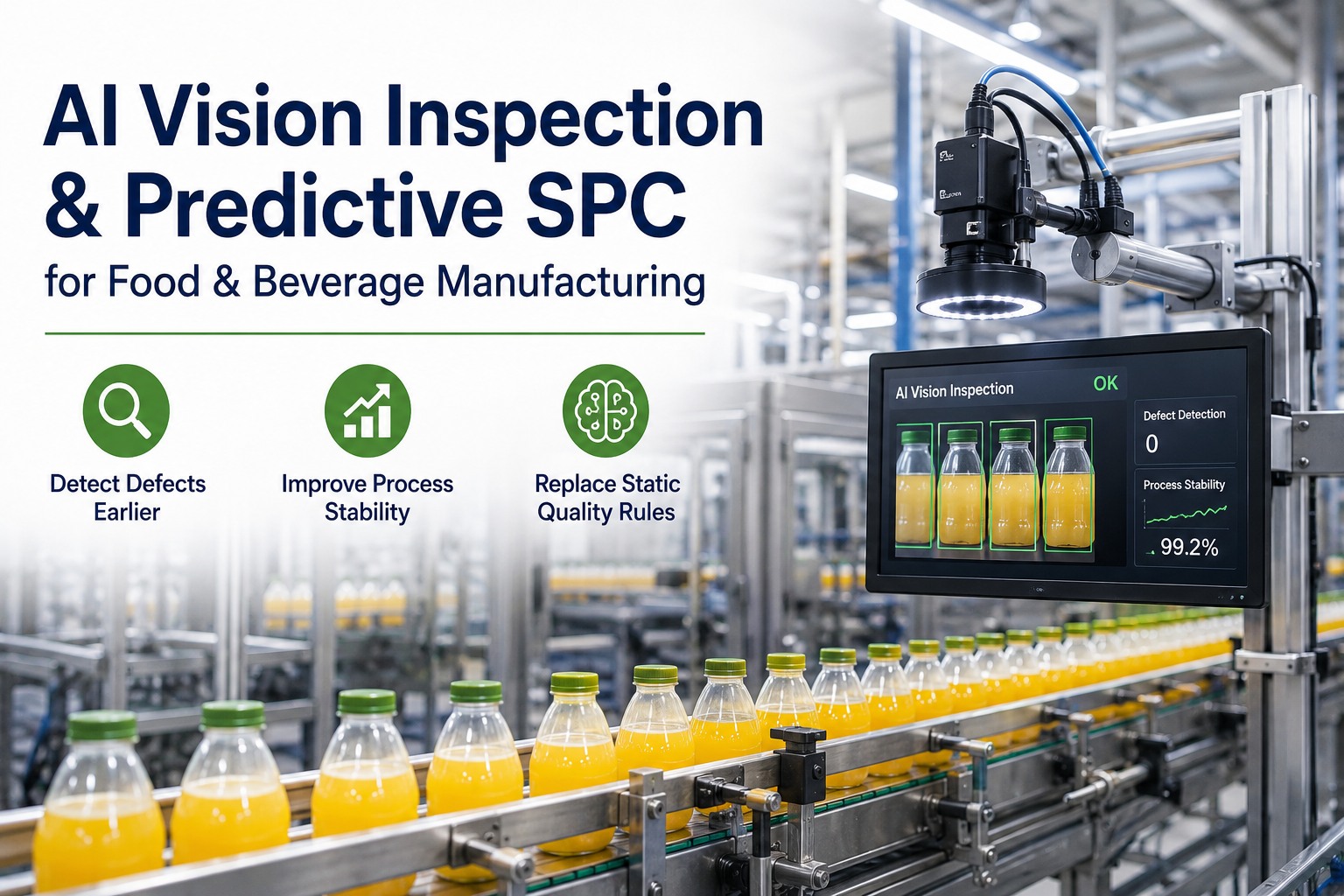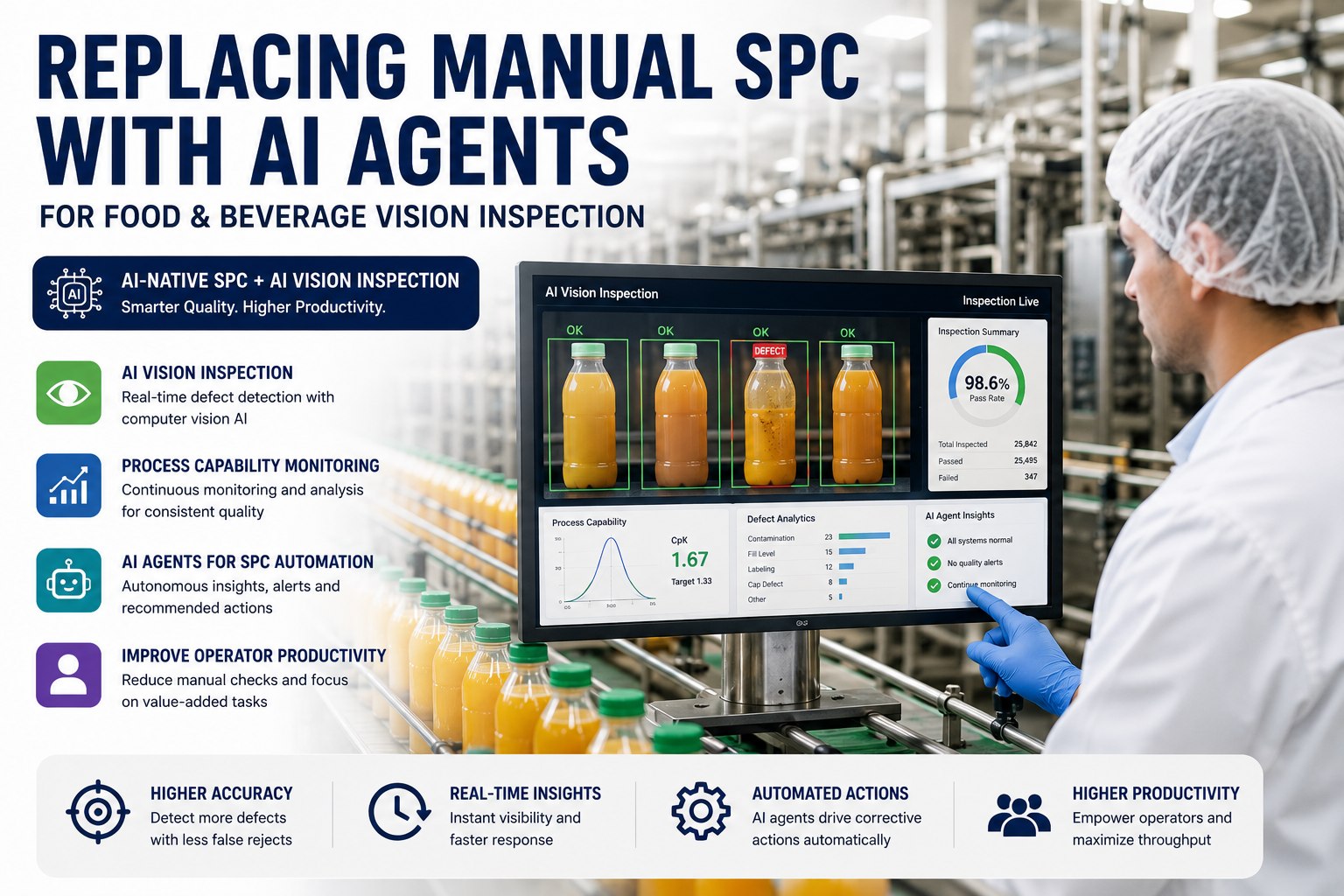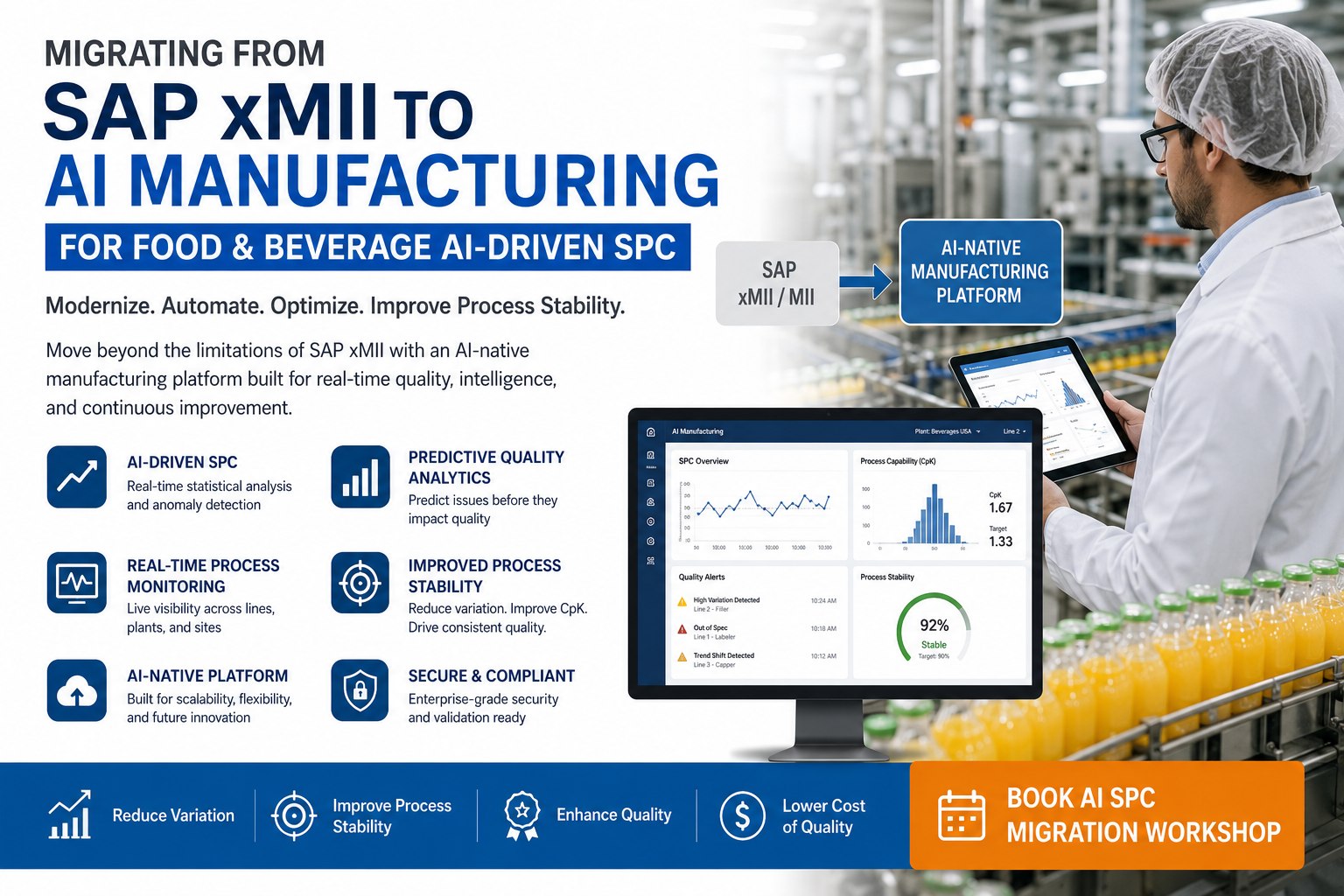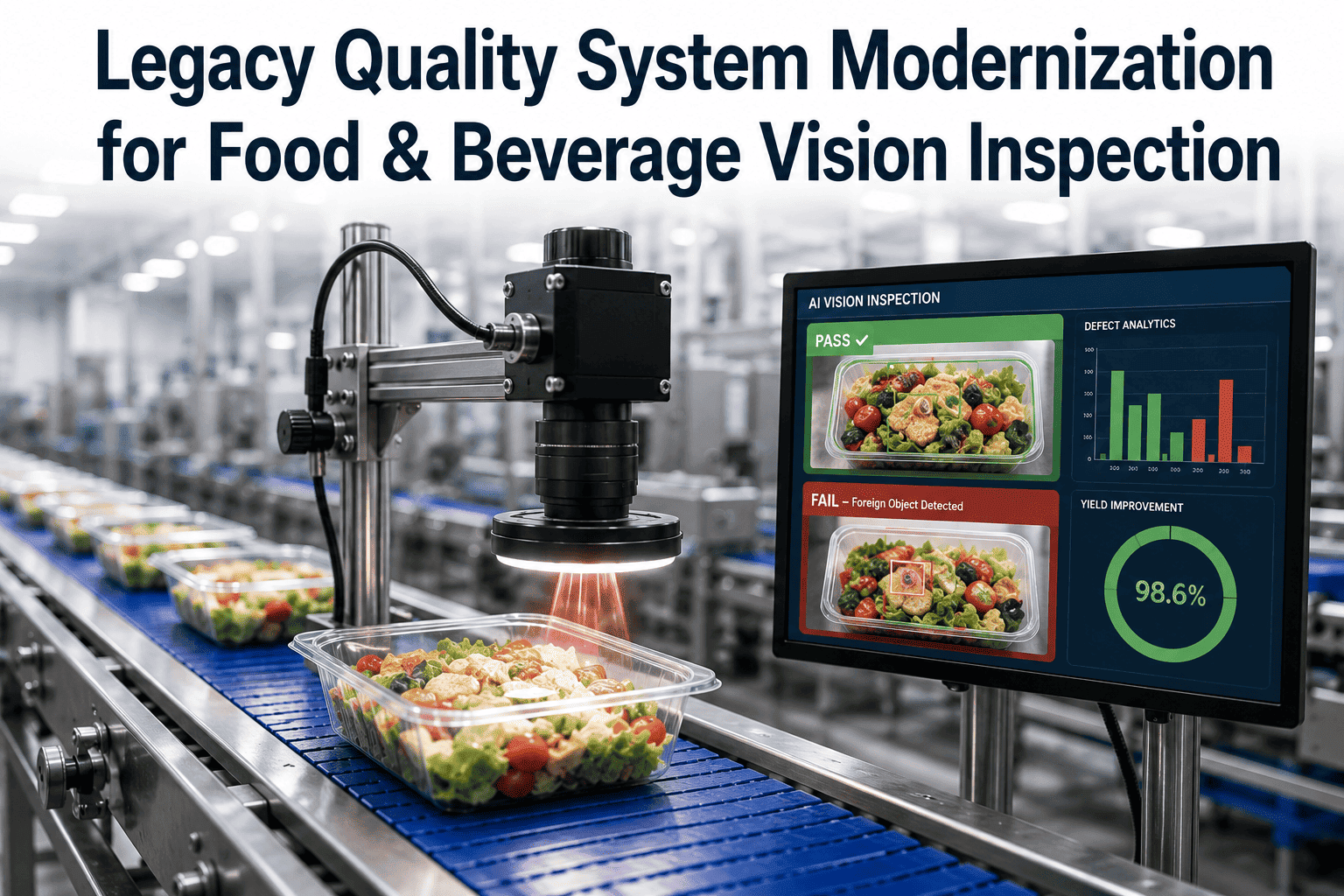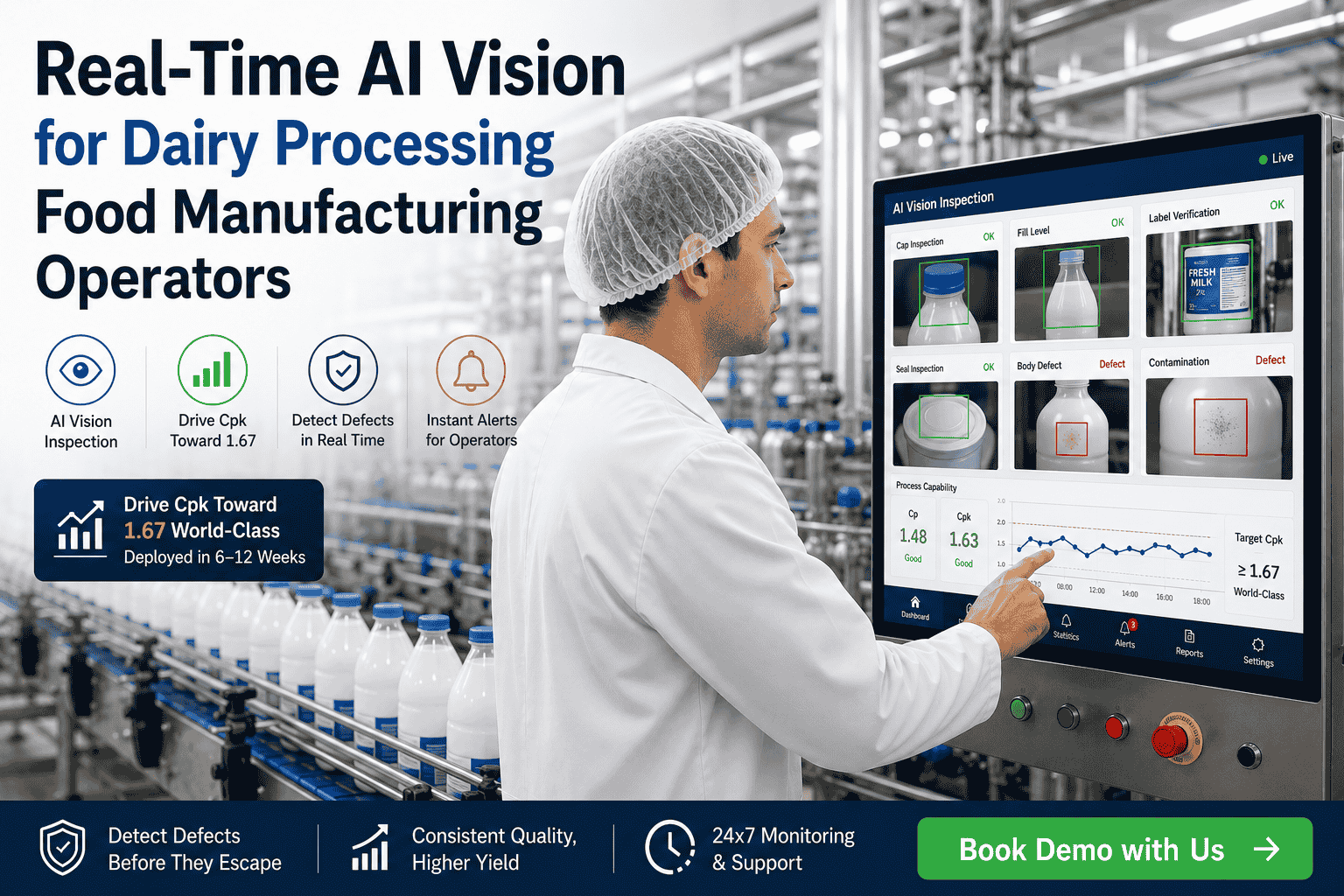
Every food and beverage plant running SAP xMII for batch SPC has the same yield conversation in the monthly operations review. Yield numbers aren't moving. Manual quality checks consume hours of operator time per shift. Lab results come back hours after the batch is finished, so corrective adjustments happen on the next batch instead of the current one. Audit prep eats a week before every customer or GFSI inspection. And the SAP MII / ME / xMII maintenance roadmap ends in 2027, forcing every plant to make a modernization decision in the next 12–24 months regardless. This page is the practical replacement guide. Not a vendor comparison — a step-by-step methodology for replacing SAP xMII SPC with AI-native predictive SPC in a way that delivers measurable yield improvement, accelerated compliance evidence, and reduced manual quality check burden. The 6-phase migration roadmap, the 12-item readiness checklist, the typical yield gains by application, and the deployment timeline that lands first-line production in 6–12 weeks with full plant rollout in 3–4 months. iFactory AI runs on a turnkey on-prem NVIDIA appliance — racked, software-loaded, ready to plug in — or as fully managed cloud for plants with hybrid IT strategies. Either way, the migration approach is the same.
How to Replace SAP xMII SPC in Food & Beverage Manufacturing
The practical 6-phase methodology to replace SAP xMII SPC with AI-native predictive SPC in F&B batch quality control. Yield improvement of 3–8%, compliance evidence built automatically, manual quality checks cut 60–80%, full plant migration in 3–4 months. Pre-configured NVIDIA appliance or fully managed cloud, your choice.
Where F&B Batch Yield Actually Disappears Today
Before designing the migration, it helps to be honest about where the yield losses come from. Most F&B plants have a similar profile across batch operations, and the contribution categories matter because the AI-native replacement strategy addresses each one differently. Here's where the yield typically lives in plants running SAP xMII or equivalent legacy SPC.
The total addressable yield gain across these six categories is the 3–8% improvement figure that shows up in industry case studies. AI-native predictive SPC addresses each category with a different mechanism — vision inspection for giveaway, in-flight forecasting for rework prevention, multivariate models for scrap reduction, and automatic compliance logging for manual check elimination. The replacement strategy explicitly maps each category to the AI capability that addresses it.
Want to see your specific yield-loss breakdown analyzed against the AI capabilities that would address each category? Request a yield-loss audit from iFactory support — we'll analyze 90 days of your batch records and return a category-by-category projection with the addressing AI capability, returned within 5 business days.
The 6-Phase Migration Roadmap — How to Actually Replace SAP xMII
iFactory has run this migration dozens of times across F&B plants. The methodology has settled into six phases that consistently complete in 6–12 weeks for first-line production go-live, with full plant rollout extending to 3–4 months. Each phase has clear entry and exit criteria.
Want the 6-phase methodology mapped to your specific F&B operation with line-by-line timelines? Book the AI SPC Migration Workshop — iFactory's team will sequence the migration across your batch lines with milestone dates and dependencies. Sessions available this week.
The Migration Readiness Checklist — 12 Items to Confirm Before You Start
Confirm these are in place before kicking off the 6-phase migration
-
1
SPC tag inventory complete
All SPC tags currently monitored in xMII listed with units, sample rates, and limit definitions.
-
2
Critical Quality Attributes (CQAs) defined
Top 8–15 batch quality outcomes with current Cpk baselines documented.
-
3
Historian data accessible
At least 12–24 months of historical SPC and lab data available for model training.
-
4
PLC and SCADA inventory
All PLCs, SCADA systems, and integration protocols documented (OPC UA, MQTT, Modbus).
-
5
Rack space identified
Server room with power, cooling, and network capacity for the NVIDIA appliance.
-
6
Network segmentation reviewed
IT/OT segmentation, firewall rules, security review process aligned to plant policy.
-
7
Quality team alignment
QA and operations leadership aligned on outcomes expected and validation criteria.
-
8
HACCP / GFSI framework documented
Current CCP monitoring approach, audit evidence requirements, customer scorecards identified.
-
9
Operator workflow current state
Manual quality check steps, frequencies, and time documented per line.
-
10
Pilot line selected
Highest yield-improvement-potential line chosen for first migration phase.
-
11
Parallel-run plan defined
Plan to run xMII and AI-native SPC in parallel during Phase 5 shadow mode.
-
12
Success metrics agreed
Yield, Cpk, manual check time, and audit prep targets defined with measurement plan.
Want the full 47-item migration checklist as a downloadable PDF, with each item expanded into specific tasks and owners? Request the F&B SPC Migration Checklist from iFactory support — returned same-day, no obligation.
Six F&B Batch Yield Applications Where Replacement Pays Back
Filler Weight Optimization
AI Vision + predictive SPC tightens fill-weight distribution so plants can run closer to spec minimum without over-fill, reducing daily giveaway losses.
Batch Hold Prevention
In-flight quality forecasting catches batches trending out-of-spec 30–120 minutes ahead, giving operators time to adjust rather than scrap or rework.
Bakery Moisture Yield
Predicts final moisture from oven zone profiles and dough parameters; operators land batches closer to spec maximum, capturing the moisture yield benefit.
Beverage Brix & Standardization
Multivariate Brix and pH prediction tightens beverage standardization, reducing ingredient over-use while maintaining customer spec compliance.
Multi-Component Assembly
AI Vision verifies portion-by-portion that all components are present and weight-compliant. Reduces over-portioning while preventing missing-component rejections.
Changeover Acceleration
AI Vision detects when a changeover has stabilized so production can resume earlier with confidence. Reduces the off-spec window between SKUs.
Want an application-specific yield projection for your top F&B batch operations? Send your top 3 yield-loss categories to iFactory support and the F&B team will return a projected yield improvement map with 12-month deployment roadmap — typically within 3 business days, no obligation.
Compliance Acceleration — Audit Prep From Weeks to Hours
What gets logged automatically once xMII is replaced
- HACCP Critical Control Point records with timestamps and operator signatures
- FSMA Preventive Controls (21 CFR Part 117) workflow evidence
- GFSI standards — SQF, BRC, FSSC 22000 audit-ready packages
- FDA Food Traceability Final Rule — forward and backward lot trace
- 21 CFR Part 11 electronic records and signatures
- Customer scorecard reporting (retailer-specific quality data)
- Allergen control program evidence with changeover verification
- Process capability (Cpk / Ppk) tracking per CQA, automatic
For a typical F&B plant, audit prep time drops from 2–4 weeks to 2–4 hours after the migration completes. The audit evidence builds automatically from the AI-native SPC platform's continuous monitoring; the QA team reviews and approves rather than assembling from spreadsheets, historian queries, and operator notebooks.
Two Real F&B SAP xMII Replacement Outcomes
National frozen ready meals producer with portion-control yield losses
A national frozen ready meals manufacturer running 4 multi-component assembly lines. Portion yield averaged 96.2% — 3.8% loss to over-portioning, missing-component rejections, and rework. Manual QC operators consumed 4.5 hours per shift on weight and presence checks. SAP xMII handled SPC but couldn't address the AI Vision capabilities needed.
Regional industrial bakery with moisture giveaway and weight overfill
A regional industrial bakery running 6 oven lines producing bread, rolls, and pastries. Combined yield losses from moisture giveaway (running below spec maximum) and weight overfill (running above target weight) totaled 5.8% across products. SAP xMII flagged out-of-spec batches reactively; couldn't move the giveaway numbers.
Neither scenario matches your situation? Send your current yield baseline and SAP xMII footprint to iFactory support and the F&B team will return a customised migration analysis with yield projection per category and 12-month roadmap — typically within 3 business days, no obligation.
iFactory's F&B SPC Deployment — On-Premise or Cloud
Same AI-native predictive SPC platform on either deployment model. Same yield improvement capabilities, same AI Vision, same automatic compliance evidence. The choice depends on your IT strategy, data residency, and multi-plant approach.
iFactory On-Premise Appliance Default for F&B plants with recipe IP or single-site operations
- Pre-configured NVIDIA AI server — racked, software-loaded, ready to plug in.
- 24×7 monitoring — continuous AI coverage across all batch lines.
- Recipe IP stays inside the plant — protects formulations.
- Works during WAN outages — yield optimization continues uninterrupted.
iFactory Cloud For multi-plant F&B operations and central operations teams
- Fully managed — no rack, no facility requirements.
- Same predictive SPC + AI Vision stack — yield, compliance, audit.
- Cross-plant yield benchmarking across all F&B plants in one tenant.
- Fastest deployment — first plant live in 2–4 weeks.
Replacement isn't a project. It's a roadmap.
The 6-phase methodology has run successfully across F&B plants of every size — fluid milk, beverages, frozen meals, snacks, bakery, sauces, confectionery, ready-to-drink, dairy ingredients. First line goes live in 6–12 weeks. Full plant completes in 3–4 months. The AI SPC Migration Workshop sizes the timeline, the yield projection, and the deployment milestones specifically for your operation.
Frequently Asked Questions
Can we run SAP xMII in parallel during the migration?
Yes — that's exactly what Phase 5 (Shadow Mode) is designed for. The AI-native SPC platform runs in parallel to your existing xMII for 2–4 weeks while operators verify predictions against actual lab results and adjust their workflow. xMII only gets formally retired after Phase 6 production go-live on each line. Most plants keep xMII online for the entire migration period and only decommission after full plant cutover.
What's the typical yield improvement we should expect?
For F&B batch operations, 3–8% first-year yield improvement is typical across the combined loss categories — giveaway, rework, scrap, lab-delay loss, changeover, manual checks. The specific number depends on baseline performance — plants with high giveaway rates or chronic batch rework see the bigger jumps. Plants already running tight operations still typically see 2–4% incremental improvement from AI-native multivariate modeling.
Do we need to migrate to SAP DMC if we replace SAP xMII?
No. The iFactory AI platform replaces SAP xMII's SPC functionality entirely. You don't need to migrate to SAP DMC unless you want to — and many F&B plants don't, because the AI-native platform delivers more capability than DMC at a fraction of the cost and timeline. For ERP integration, iFactory connects to SAP S/4HANA, Oracle, Infor, or any major ERP through standard connectors.
What happens to our existing batch records and audit history?
Historical batch records, SPC charts, lab results, and audit data migrate to the iFactory platform during Phase 2 (Data Extraction). The iFactory team handles ETL from your historian, batch record system, and lab systems. No data left behind. Audit trail continuity is preserved through the migration, with the legacy xMII data accessible through the iFactory platform after retirement.
How does this work for multi-plant F&B operations?
For multi-plant migrations, the recommended approach is pilot at one plant (6–12 weeks), then roll out to remaining plants in waves with 2–4 weeks per plant. Plant 2 onwards benefits from the templated workflows, validated models, and operator training materials developed during the pilot. Total program time for 5–8 F&B plants typically runs 8–14 months end-to-end.
Do I have to buy NVIDIA servers separately?
No. iFactory's on-premise appliance ships fully loaded — pre-configured NVIDIA AI server, software pre-installed, network gear, cabling, industrial cameras for vision inspection, edge devices for line-side inference. You provide rack space, line power, Ethernet, and PLC/SCADA integration points. The deployment team handles all installation and configuration during the 6–12 week deployment. For cloud, no hardware investment at all.
What does the AI SPC Migration Workshop actually cover?
The half-day workshop covers — current-state SAP xMII assessment with your team, yield-loss breakdown analysis with category-specific projections, 6-phase migration roadmap sized to your plant, 12-item checklist customized to your operation, live iFactory platform walkthrough with F&B batch quality use cases, deployment timeline with milestone dates. Outcome is a concrete migration plan with timeline and projected ROI. Suitable for operations leaders, QA, IT, and finance representatives.
The 2027 deadline isn't waiting. Neither is the yield.
Every month your F&B plant runs on SAP xMII is another month of yield losses that AI-native SPC would have addressed — giveaway, rework, scrap, lab-delay, manual check time. The 6-phase migration methodology delivers first line live in 6–12 weeks with $1–2M+ annual yield value typical for mid-size plants. The AI SPC Migration Workshop is the fastest way to size the timeline and projection for your specific operation.