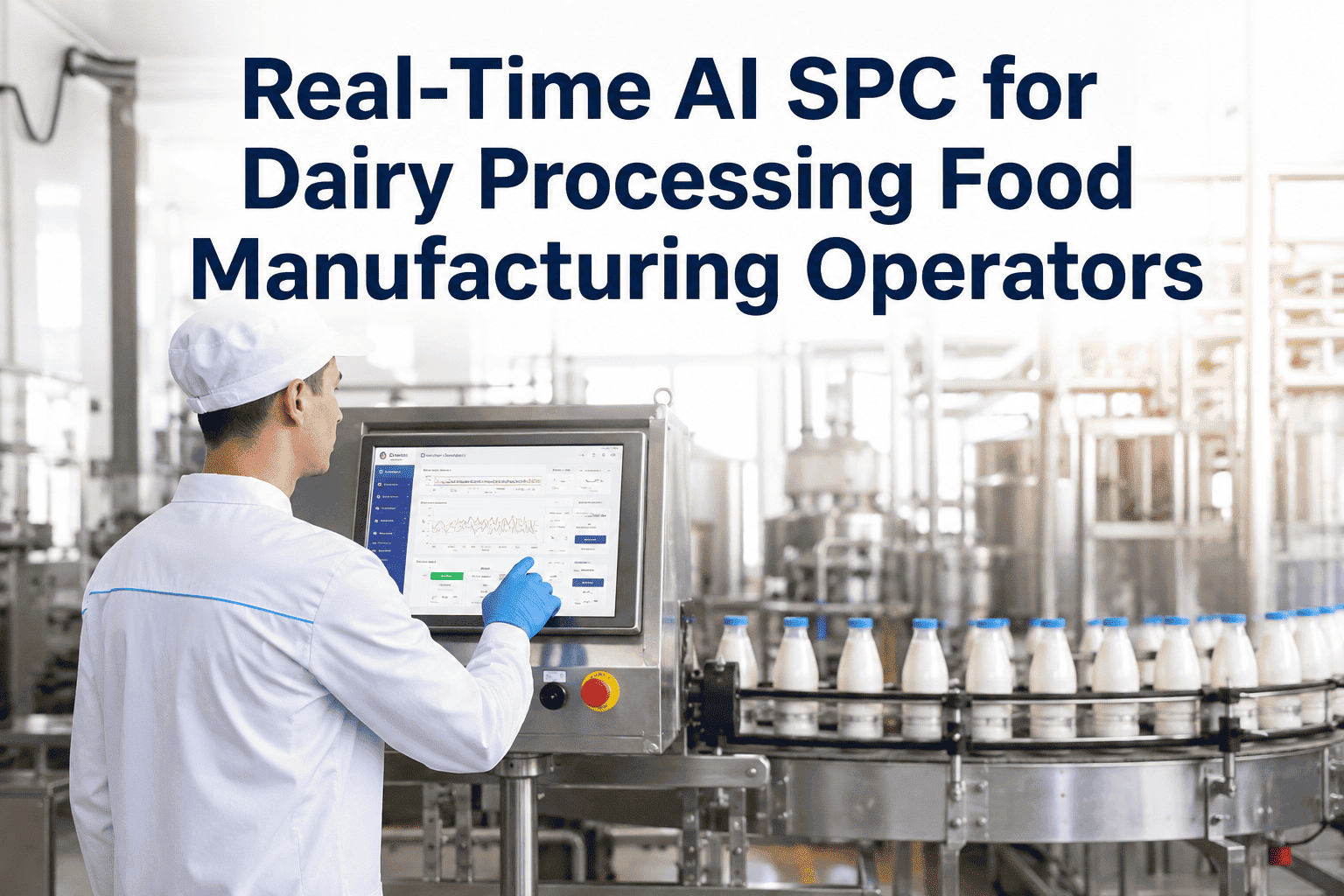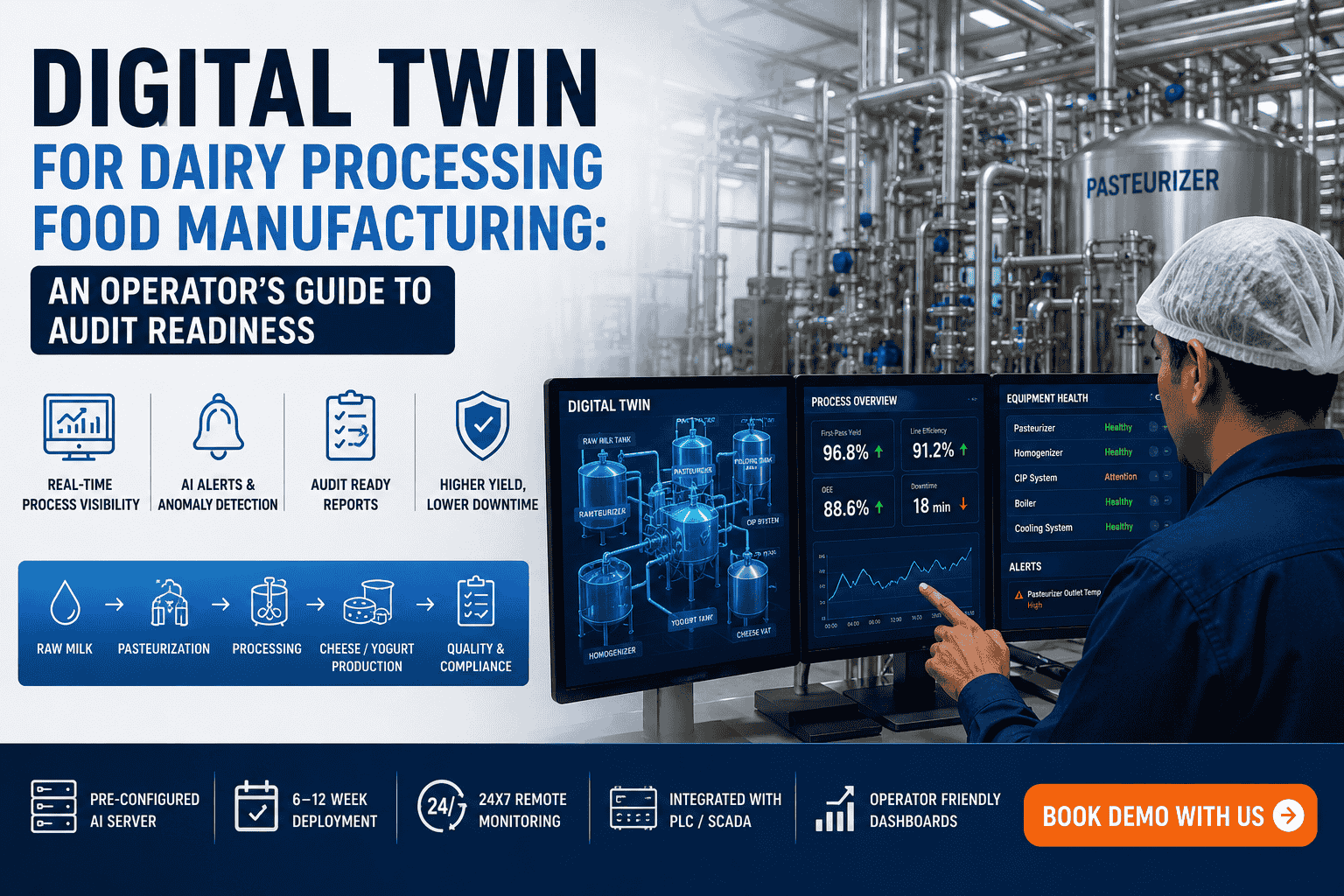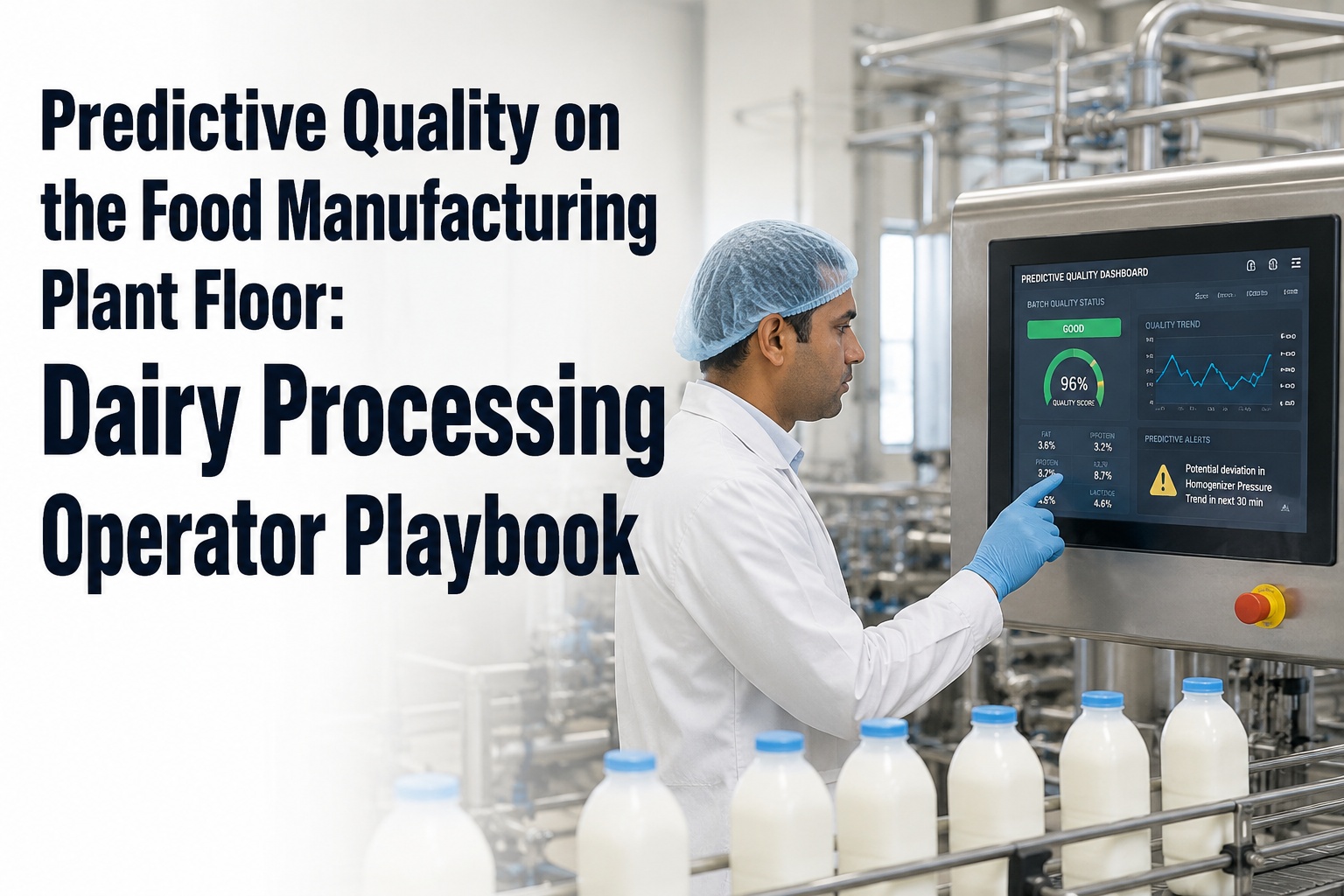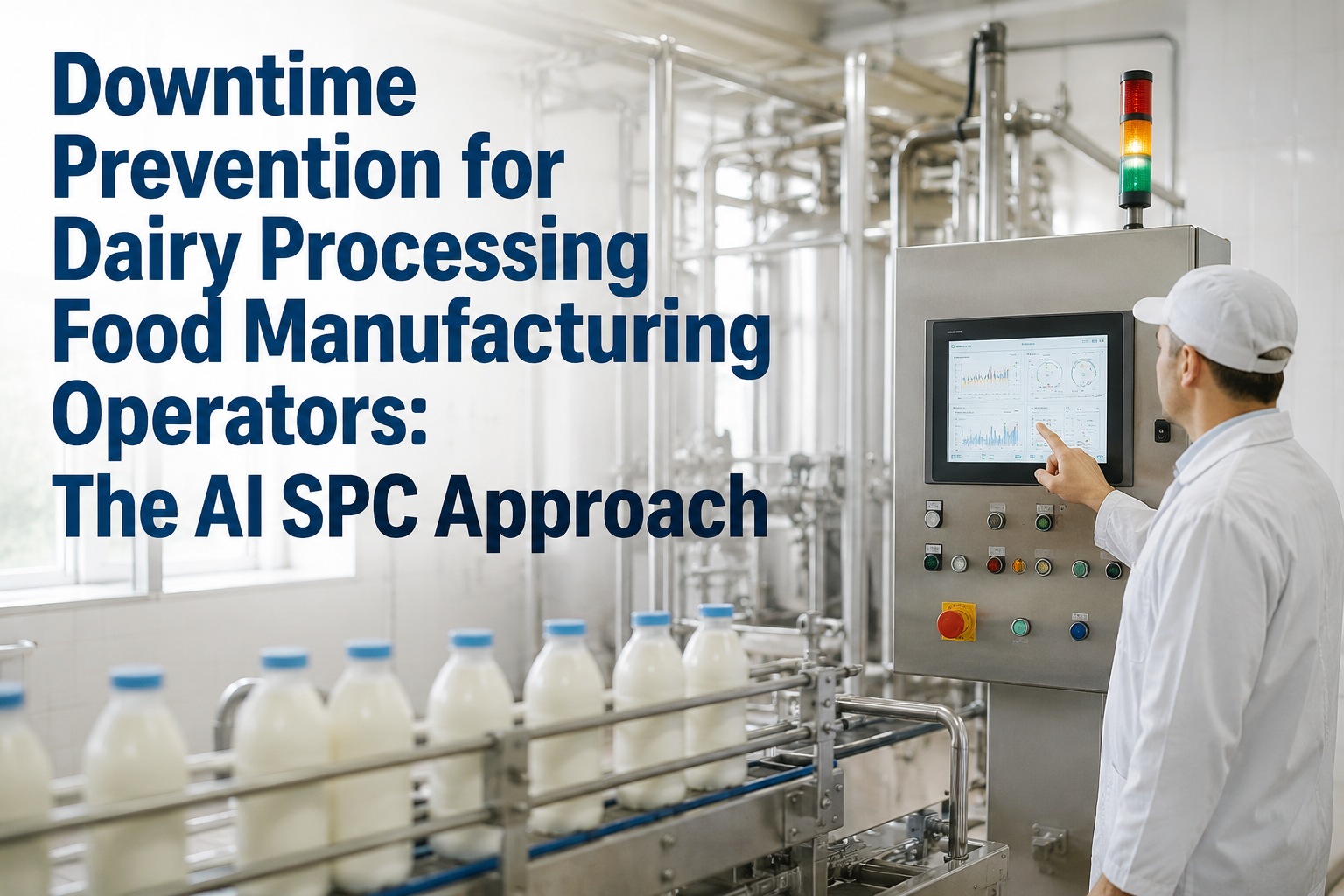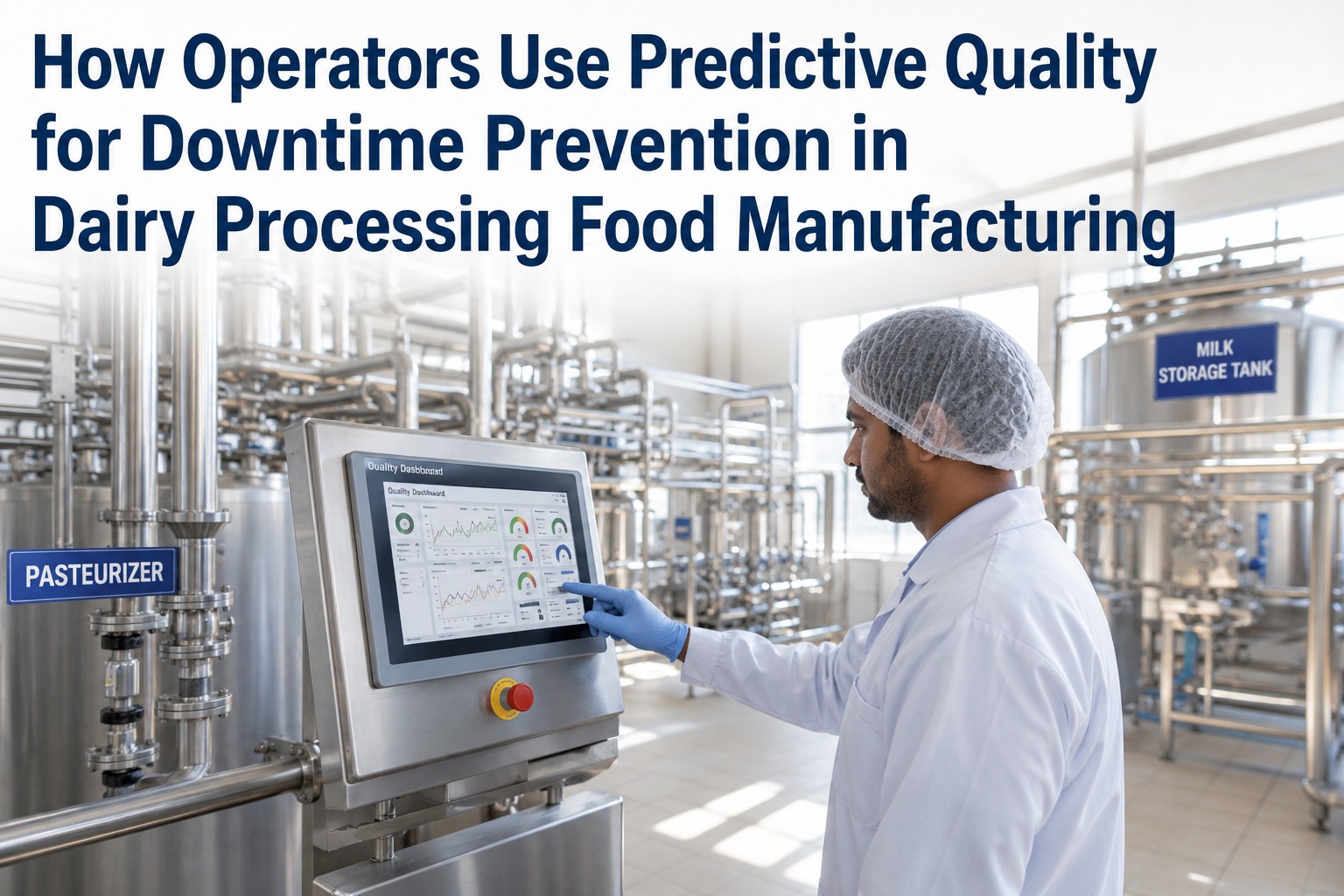
If you operate a dairy processing line — pasteurizer, homogenizer, cheese vat, yogurt fermenter, milk powder dryer — you're running one of the most heavily monitored, regulated, and yield-sensitive operations in food manufacturing. The PMO temperature limits aren't suggestions. Homogenizer drift over a shift doesn't just impact texture, it impacts shelf life, customer complaints, and the inevitable GFSI audit. Cheese yield variability of even half a percent on milk solids costs real money over a year. Yogurt firmness inconsistency lands you in retailer rejection territory. Traditional SPC charts on dairy parameters tell you a problem has happened; AI-native SPC tells you a problem is approaching — homogenizer pressure drifting toward a fat-globule problem hours before the QA lab catches it, fermenter pH trending toward an off-spec endpoint before the batch is set. This is the dairy operator's playbook for using AI-native SPC on the line — what it monitors, what defects it catches, how the shift flows differently, and how it cuts audit prep from weeks to hours. iFactory delivers it on a turnkey on-premise NVIDIA appliance or fully managed cloud — same AI SPC stack, your deployment choice.
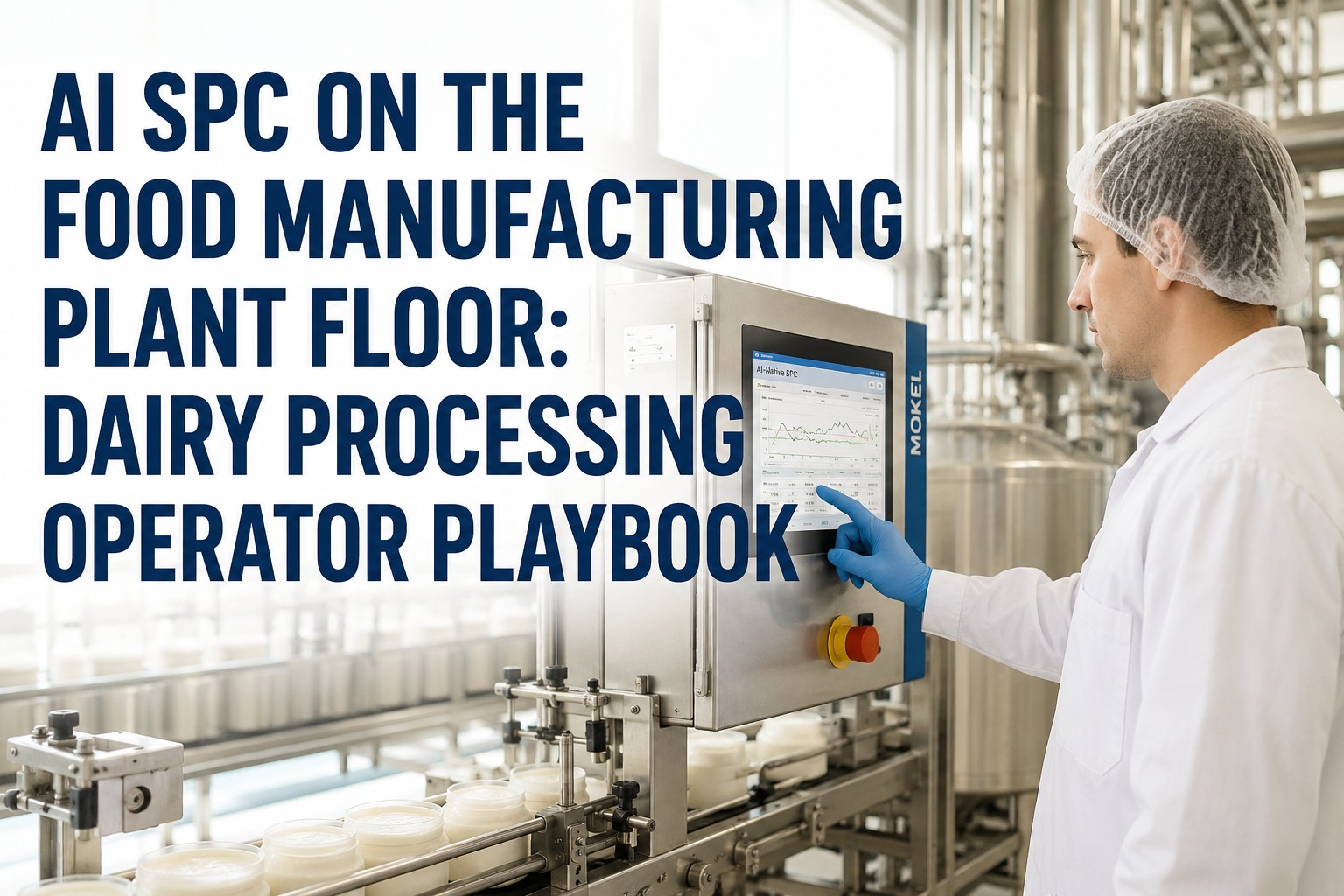
AI SPC on the Food Manufacturing Plant Floor: Dairy Processing Operator Playbook
The practical guide for dairy line operators using AI-native SPC — six dairy applications it covers, the shift-by-shift workflow, GFSI and FDA audit-ready evidence built automatically, and how first-pass yield on cheese and yogurt lines climbs without changing your equipment.
What AI-Native SPC Actually Does on a Dairy Line
Traditional dairy SPC charts show you temperature, pressure, pH, and flow against fixed control limits. They fire alerts when a parameter crosses those limits — which means the alert hits after the problem has been happening for some time. AI-native SPC adds three model families running alongside — LSTM time-series forecasting that predicts where parameters are heading, autoencoder anomaly detection that catches unusual multivariate patterns, and Nelson Rules automation that handles the conventional pattern detection without operators needing to memorize all eight rules. The combination catches drift 2–6 hours before traditional SPC fires its alert, with confidence-scored recommendations operators can act on directly.
Want to see what AI-native SPC catches on your specific dairy line — pasteurizer, homogenizer, or fermenter? Request a retrospective SPC audit from iFactory support — we'll run your last 30 days of PLC and lab data through the AI layer and identify drift patterns that occurred 2–6 hours before each control limit breach, returned within 5 business days.
Six Dairy SPC Applications AI-Native Coverage Handles
These are the six highest-impact dairy SPC applications where AI-native coverage moves the needle on first-pass yield, audit readiness, and operator efficiency. Each maps to a specific dairy operation with measurable outcomes.
Pasteurization Temp / Time
AI tracks the relationship between flow rate, plate heat exchanger temperature, and hold tube residence time. Catches drift before diversion-valve trip events.
Homogenizer Pressure
Multivariate model correlates pressure, temperature, and seal wear patterns. Catches the slow drift that produces fat-globule size issues and shelf-life problems.
Cheese Yield Optimization
AI predicts cheese block composition from upstream milk standardization, coagulant addition rate, and cut/cook timing. Reduces giveaway and rework.
Yogurt Fermentation pH
LSTM model predicts when pH endpoint will be reached based on starter culture activity, tank temperature, and milk solids. Catches slow fermentation early.
Cream Separation Efficiency
Monitors separator bowl temperature, RPM, and flow patterns. Catches efficiency drift before standardization is impacted downstream.
Cooling Curve / Shelf Life
AI tracks the entire cooling curve, not just endpoint temperature. Slow cooling patterns predict shelf-life issues before product reaches the cooler.
Want to see which of these six applications would deliver the biggest yield lift on your dairy operation? Book a Demo with Us — bring your top yield and quality issues, and the iFactory dairy team will show how each AI capability would have caught them in real-time with 2–6 hr lead time. Sessions available this week.
Audit Prep — From Weeks to Hours
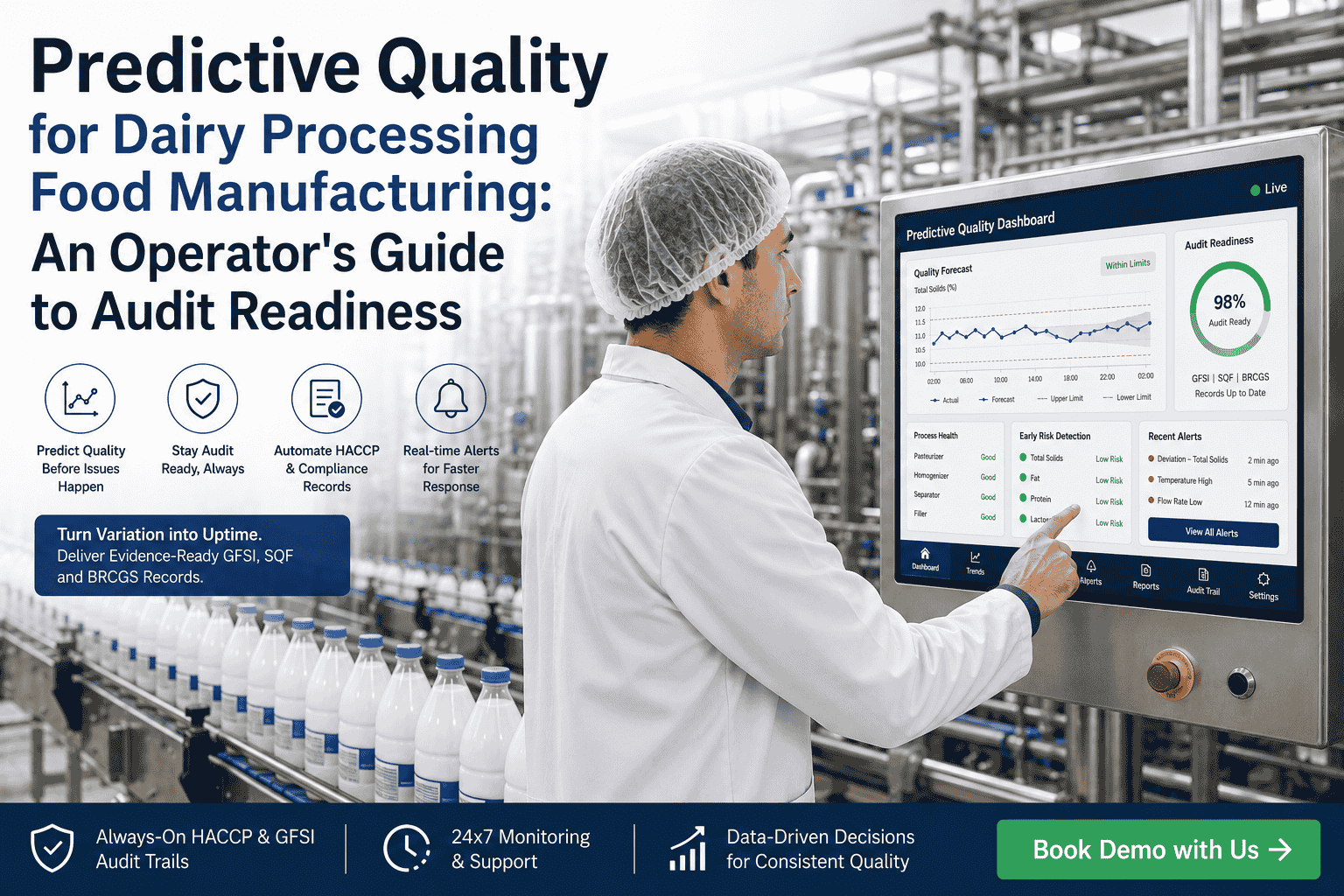
The single biggest unannounced benefit for dairy operators using AI-native SPC is what happens at audit time. GFSI audits (SQF, BRC, FSSC 22000), FDA inspections, USDA Grade A inspections, customer audits — all require the same kind of evidence pulled from the same data streams. Traditional dairy plants assemble that evidence manually over days or weeks. AI-native SPC builds it continuously, so audit prep becomes evidence review rather than evidence assembly.
Audit-Ready Evidence — Built Automatically Every Shift
Every dairy operation, every shift, builds the audit record
- HACCP Critical Control Point (CCP) records with timestamps
- Pasteurization PMO compliance evidence (temp / time / flow)
- Diversion valve activations with root cause attribution
- Cooling curve verification (4-hour rule compliance)
- CIP cycle completion records with parameter validation
- Lab result correlation with in-process measurements
- Operator action log with electronic signatures (21 CFR Part 11)
- Tamper-evident audit trail for all process events
For a dairy operator, this means the parts of the job that involve manual data entry — checking off CCP logs, recording diversion events, documenting deviations — happen automatically. You verify what's already captured. Plant QA reviews the assembled package. The auditor sees a complete, traceable record without the operator team spending weeks pulling it together.
The Dairy Operator's Daily Playbook
Predictive SPC doesn't change what you do as an operator — pasteurization checks, CIP verification, lab samples, paperwork — it changes how much of it is automatic and how early problems show up. Here's how a shift flows with AI-native SPC running.
Line readiness check
Dashboard shows AI-flagged trends from prior shift — homogenizer pressure trending, pasteurizer flow drift, anything needing attention before product runs.
Predictive alerts
If drift is detected — "Homogenizer pressure drift detected, fat globule issue likely in 3 hours, recommend valve check" — operator sees it with confidence score.
Auto-correlation
Lab results auto-correlate with in-process AI predictions. Confirms or refines the AI model. CCP verification logs build automatically.
Auto-generated handover
Production log, CCP record, yield summary, AI-flagged items for next shift — assembled automatically with full audit trail and operator sign-off.
Want to see this playbook running on your specific dairy operation — cheese plant, yogurt line, or fluid milk? Book Demo with Us — iFactory's dairy team will walk through a representative shift with your part numbers, your CCPs, and your KPI structure on the operator dashboard. Sessions available this week.
Two Real Dairy Plant Outcomes
Mid-size cheddar producer with chronic yield variance and giveaway losses
A regional cheese plant producing mostly cheddar and Monterey Jack across two cheese vats. Cheese yield ran 5.8–6.3% of milk solids — about 0.4% variance translating to roughly $480K annual giveaway. Variability driven by upstream standardization drift and inconsistent coagulant addition timing.
National yogurt brand with fermentation endpoint variability driving retailer rejections
A national yogurt brand operating four 8,000-liter fermentation tanks. pH endpoint timing varied batch-to-batch by 15–25 minutes, causing texture inconsistency that drove a 1.8% retailer rejection rate. Manual sampling caught issues only after fermentation was complete.
Neither scenario matches your specific dairy operation? Send your top yield and consistency challenges to iFactory support and the dairy team will return a customised projection — AI coverage map, yield lift estimate, and audit-prep impact — typically within 3 business days, no obligation.
iFactory's Dairy Deployment — On-Premise or Cloud
Same AI-native SPC stack on either deployment model. Same LSTM models, same multivariate analysis, same GFSI/HACCP audit trail. The decision depends on your data residency rules, IT capacity, and multi-plant strategy.
iFactory On-Premise Appliance Default for dairy plants with single-site operations
- Pre-configured NVIDIA AI server — racked, software-loaded, ready to plug in.
- Sub-50ms inference at the line — keeps up with high-speed pasteurization and packaging.
- All production data stays inside the plant — clean integration with PLC and SCADA.
- Works during WAN outages — line operations continue uninterrupted.
iFactory Cloud For multi-plant dairy operations and central QA teams
- Fully managed — no rack, no facility requirements.
- Same AI-native SPC stack — LSTM, autoencoder, Nelson Rules automation.
- Cross-plant yield benchmarking across all dairy plants in one tenant.
- Fastest deployment — first plant live in 2–4 weeks.
Drift in the homogenizer doesn't have to kill your run anymore.
AI-native SPC catches the drift hours before it impacts yield, texture, or shelf life. Audit evidence builds itself. First-pass yield climbs without changing your equipment. iFactory's dairy demo is the fastest way to see how this works on your specific line — pasteurizer, homogenizer, cheese vat, or yogurt fermenter. On-premise NVIDIA appliance or fully managed cloud, your choice on deployment.
Frequently Asked Questions
Do I need new sensors on the pasteurizer or homogenizer?
No, in most cases. AI-native SPC runs on the data your dairy line is already producing — PLC tags, SCADA signals, lab analyzer outputs, historian feeds. If specific applications need additional instrumentation (such as in-line fat globule sizing for advanced homogenizer monitoring), the iFactory team scopes it during the readiness assessment, but most deployments use existing signals.
Will AI-native SPC interfere with our PMO compliance for pasteurization?
No — and actually it strengthens it. The validated pasteurization control system continues to operate exactly as it does today; AI sits as an advisory layer above it, predicting drift before the validated system has to fire a diversion alarm. PMO compliance is preserved. The AI improves operations without touching the validated state.
How does this work for GFSI and FDA audits specifically?
Every operation that produces a CCP record, lab result, or process measurement is logged automatically with timestamp, operator, and electronic signature (21 CFR Part 11 aligned). Audit prep changes from compiling evidence to reviewing pre-compiled evidence. Plants typically see audit prep time drop from 2–4 weeks to 2–4 hours.
What's the typical yield improvement we should expect?
For cheese plants, +3–7% first-pass yield is typical, driven by tighter standardization control, more consistent coagulation timing, and reduced moisture/composition variance. For yogurt lines, the equivalent improvement shows up as texture consistency and reduced retailer rejection rates. Specific numbers depend on baseline performance — plants with high variability see the bigger jump.
Do I have to buy NVIDIA servers separately?
No. iFactory's on-premise appliance ships fully loaded — pre-configured NVIDIA AI server, software pre-installed, network gear, cabling, edge devices. You provide rack space, line power, and Ethernet. Integration with your PLC and SCADA is included in the deployment. For cloud deployment, there's no hardware investment at all.
How does AI predict homogenizer drift specifically?
The model watches the multivariate relationship between homogenizer pressure, inlet temperature, flow rate, and historical signature patterns. When pressure begins drifting in a way that historically preceded fat-globule issues — even before the pressure crosses any alarm limit — the AI flags it with the recommended action (typically valve seat inspection or seal replacement at next maintenance window).
Can we deploy at one line before going to the whole plant?
Yes — and this is the recommended approach. Start with the line where yield variability or audit pressure is highest. Validate the AI accuracy, prove the impact, build operator and QA confidence. Then expand to remaining lines in 2–4 week waves. Full plant deployment for 4–8 dairy lines typically completes in 3–4 months.
Audit prep in weeks. First-pass yield stuck. There's a better way.
AI-native SPC catches drift hours before it impacts your run, automates the audit evidence, and helps every operator on every shift get more first-pass yield. iFactory's dairy demo shows it running on a representative line — pasteurizer, homogenizer, cheese vat, or yogurt fermenter — with your KPIs and your CCPs. Sessions available this week, on-premise NVIDIA appliance or fully managed cloud.