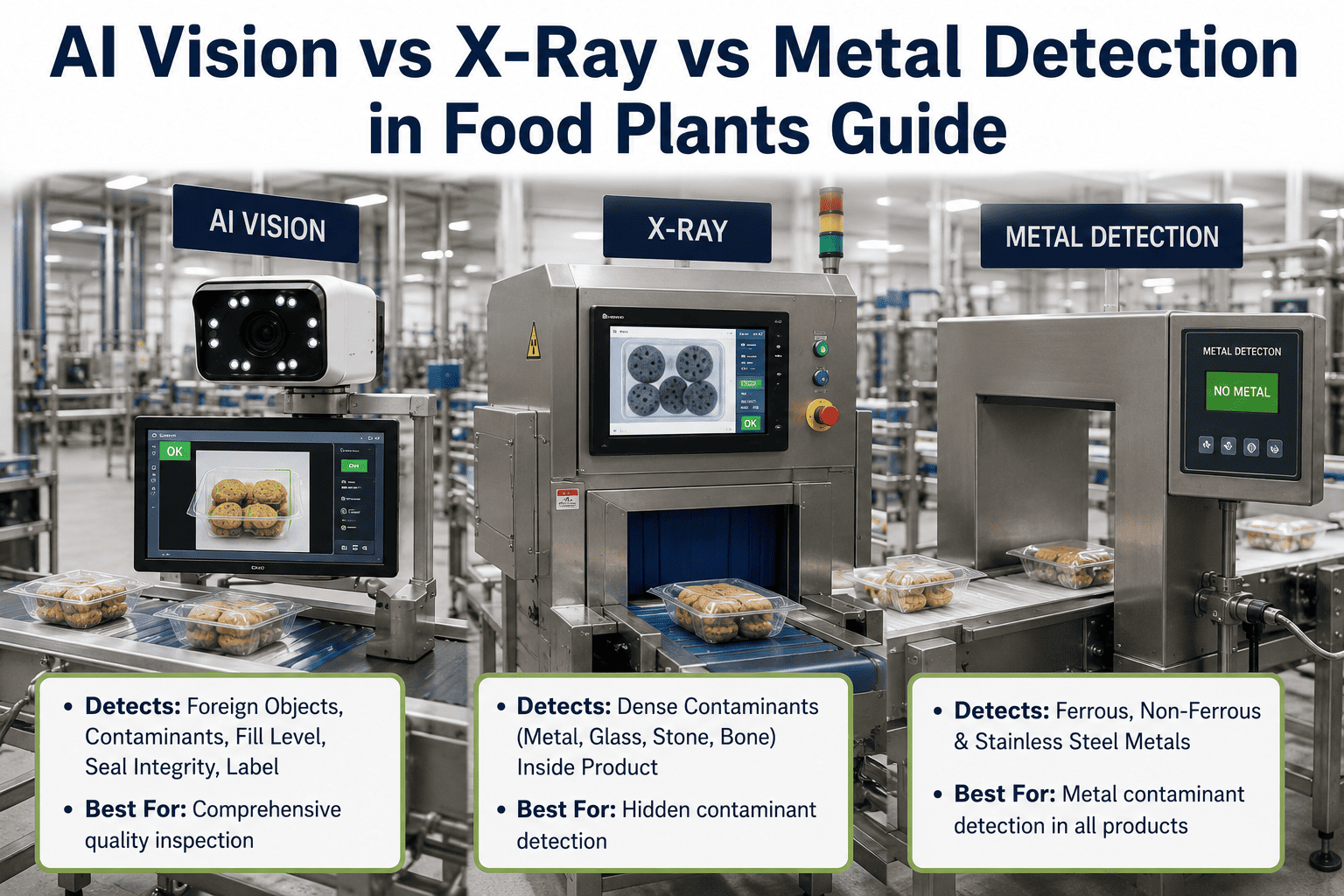
Metal detectors and X-ray inspection systems are the last line of defense against physical contamination in food production — and their reliability is only as strong as the documentation behind them. For food manufacturers operating under GFSI-benchmarked schemes like SQF, BRC, and FSSC 22000, these critical control points demand rigorous sensitivity testing, scheduled calibration, and airtight test records. When an auditor asks for proof that your detection equipment was performing correctly on a specific production date, your answer cannot be "we think so." AI-driven compliance tracking gives you certainty — and gives auditors the evidence they require.
Why Metal Detector and X-Ray Inspection Systems Are High-Risk CCPs
Physical contamination remains one of the leading causes of food recalls globally. Metal fragments, bone shards, glass, dense plastics, and calcified material all pose direct consumer safety risks — and regulatory bodies hold food manufacturers strictly accountable for detection system performance. Under BRC Global Standard Issue 9, SQF Edition 9, and FSSC 22000 Version 6, metal detectors and X-ray inspection equipment are classified as Critical Control Points (CCPs) subject to documented monitoring, verification, and corrective action requirements.
The challenge is not running the equipment — it is proving the equipment was working correctly at every production interval. Paper-based test logs, spreadsheet calibration records, and informal challenge test procedures are increasingly flagged by GFSI auditors as insufficient. A single undocumented test or an incomplete corrective action record can produce a major nonconformity that delays certification or triggers a retailer audit. Book a Demo to see how AI-driven analytics eliminate documentation gaps for detection equipment CCPs.
The Hidden Risk of Manual Metal Detector and X-Ray Records
Most food facilities conduct metal detector and X-ray challenge tests at the start of each production run, after line stoppages, and at defined intervals throughout the shift. That may be dozens of documented test events per day — across multiple detection systems. When records are kept manually, gaps are inevitable: a missed test entry, an illegible operator signature, a corrective action that was completed but never formally closed. Each gap is a potential major nonconformity waiting to be discovered by an auditor.
AI-driven detection equipment analytics automate the capture of every test event — recording the test piece used, the sensitivity setting verified, the operator, the timestamp, and the result. When a reject event occurs, the system automatically initiates a corrective action workflow and tracks it to verified closure. The result is a complete, tamper-evident documentation record that satisfies BRC Clause 4.10, SQF Element 2.4, and FSSC 22000 operational PRP requirements — generated without manual data entry. Book a Demo to see detection equipment documentation in action.
How AI-Driven Analytics Manage Metal Detector and X-Ray Inspection Equipment
iFactory's detection equipment module is built around the specific compliance requirements that GFSI auditors examine when reviewing metal detector and X-ray inspection CCP records. Each capability maps directly to a documented audit requirement.
Detection Equipment Compliance: Manual vs. AI-Driven Documentation
Documented outcomes from food facilities that transitioned from manual detection equipment records to iFactory's AI-driven analytics platform.
| CCP Requirement | Manual Documentation | AI-Driven (iFactory) | Impact |
|---|---|---|---|
| Sensitivity Test Records | Paper logs, shift-by-shift, gaps common | Automated, timestamped, frequency-tracked | Zero test record gaps |
| Calibration History | Spreadsheet-based, often incomplete | Fully tracked with scheduled reminders | 100% calibration coverage |
| Reject Verification | Informal, inconsistently documented | Two-step documented confirmation | Full reject audit trail |
| Corrective Actions | Triggered manually, often incomplete | Auto-triggered, tracked to closure | Complete corrective action chain |
| PM Documentation | Paper work orders, filed manually | Digital, auto-generated, searchable | Instant retrieval |
| Performance Trend Analysis | Manual review, reactive only | AI-driven, proactive alerts | Early failure detection |
| Audit Prep Time | 40–60 hours per audit cycle | 2–4 hours (automated reports) | 95% time reduction |
Detection Equipment Documentation: SQF, BRC, and FSSC 22000 Requirements
Each GFSI certification scheme has specific clauses governing metal detector and X-ray inspection documentation. iFactory maps detection equipment records directly to the scheme requirements your facility is audited against — so you are not just organized, but specifically audit-ready. Book a Demo to see scheme-specific detection equipment coverage in action.
- SQF Element 2.4: Food Safety Plan — CCP monitoring records for all detection equipment
- SQF Element 2.5.2: Corrective and Preventive Action — documented CAR records for failed challenge tests
- SQF Element 11: Maintenance and Calibration — PM schedules and calibration histories for detection assets
- SQF Element 2.4.7: Verification activities — periodic sensitivity verification and equipment performance review
- BRC Clause 4.10: Foreign Body Detection — challenge test frequency, test piece standards, reject verification
- BRC Clause 6.1: Equipment Maintenance — PM evidence for metal detector and X-ray systems
- BRC Clause 6.2: Calibration — instrument registers and calibration certificates for detection equipment
- BRC Clause 3.9: Corrective Action — nonconformity records from detection failure through closure
- ISO 22000 Clause 8.5: HACCP Operational PRPs — documented monitoring and verification for detection CCPs
- ISO 22000 Clause 8.9: Nonconformity — corrective action records for detection failures
- FSSC Additional Requirement 2.5.3: Preventive Maintenance — scheduled PM evidence for detection equipment
- ISO 22000 Clause 8.7: Monitoring and measurement — calibration records for detection instruments
From Manual Logs to Continuous CCP Compliance in 30 Days
Deploying AI-driven detection equipment analytics does not require production shutdowns or complex IT integration. iFactory connects to existing metal detector and X-ray inspection systems through IoT interfaces and operator-facing digital forms — capturing compliance data from day one without disrupting production flow.
Metal Detector vs. X-Ray Inspection: Analytics Requirements for Both Technologies
Food facilities operating both metal detection and X-ray inspection systems face distinct documentation requirements for each technology — and AI-driven analytics must handle both within a unified compliance framework. Understanding the specific monitoring and documentation needs of each system is essential for maintaining GFSI audit readiness across your full detection equipment program. Book a Demo to see unified detection equipment analytics for both technologies.
Metal detectors require documented challenge tests using calibrated test pieces in ferrous, non-ferrous, and stainless steel — with sphere diameters specified in the HACCP plan based on product type and packaging. iFactory tracks test piece standards, verification frequency, sensitivity drift indicators, aperture condition, and belt integrity alongside every test event record.
- Ferrous / non-ferrous / SS test piece standards by product SKU
- Sensitivity threshold verification at each test interval
- Reject mechanism confirmation and bin security documentation
- Environmental interference monitoring and alarm history
- Belt wear and aperture cleaning PM schedule tracking
X-ray inspection systems detect a broader range of contaminants — including bone, glass, dense plastics, and calcified material — but require different verification protocols than metal detectors. iFactory manages X-ray tube service intervals, detector panel calibration, test phantom verification, and image quality monitoring alongside CCP challenge test documentation.
- Test phantom standards by contaminant type and detection threshold
- X-ray tube service intervals and exposure hour tracking
- Detector panel calibration and image quality verification
- Reject confirmation and product disposition documentation
- Software version control and parameter change records
Frequently Asked Questions: Metal Detector and X-Ray Inspection Analytics
iFactory — AI-Driven Analytics for Metal Detector and X-Ray Inspection CCP Compliance
Stop managing detection equipment compliance with paper logs and spreadsheets. iFactory's AI-driven platform automatically documents every sensitivity test, calibration event, reject verification, and corrective action for your metal detectors and X-ray inspection systems — continuously, without manual data entry, and audit-ready on demand.