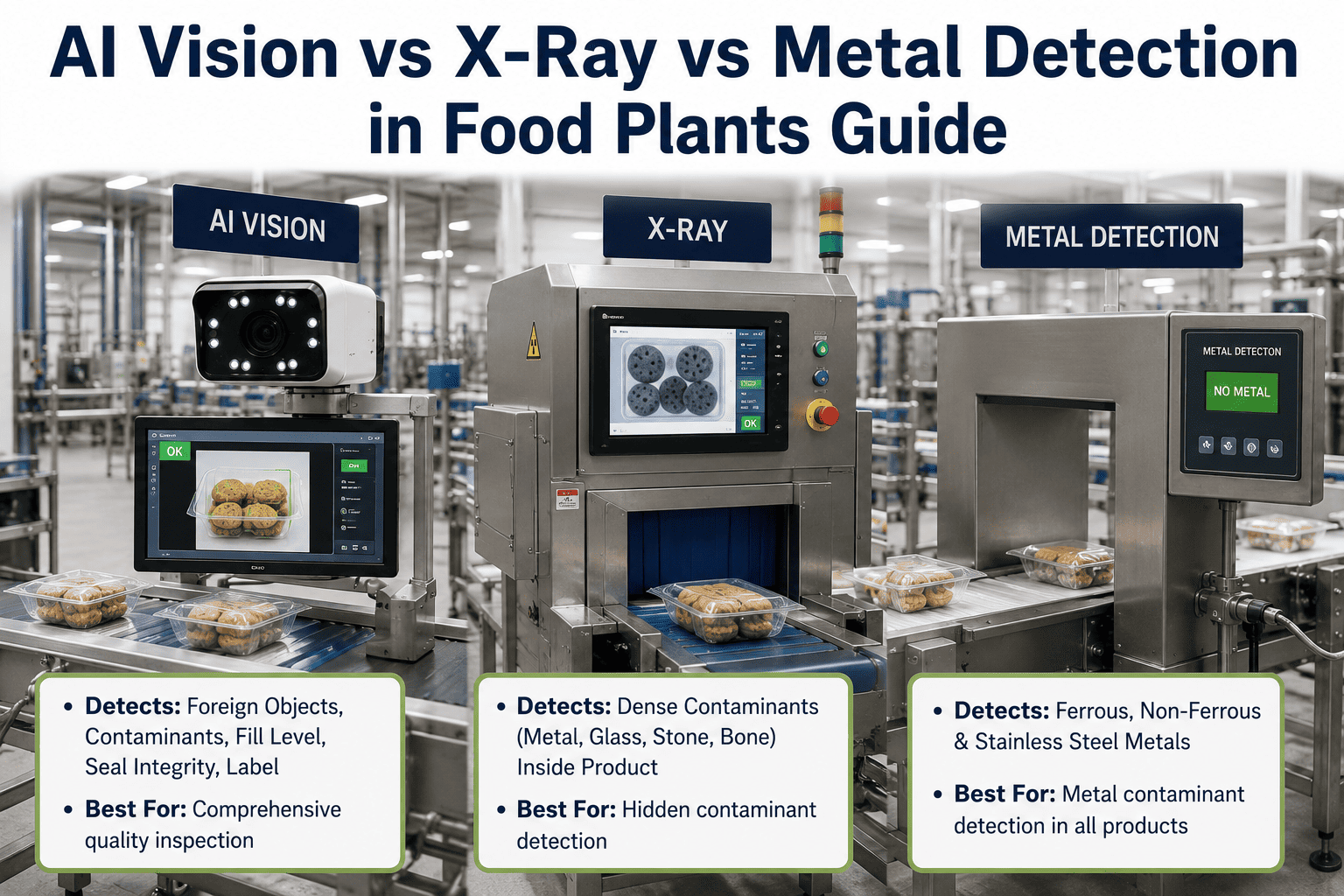
Metal detectors are tuned against a specific electromagnetic signature, which is exactly why a wet, salty, or acidic product can mask a genuine contaminant behind what's called the product effect, and why stainless steel, with its weak magnetic response compared to carbon steel, is the hardest common metal to catch reliably at small fragment sizes. A second detection layer that reads what the first one physically cannot, a camera trained to spot a stainless sliver or a non-ferrous fragment by sight rather than by magnetic field, is what closes that specific gap. Plants running metal detection alone can see what a vision layer catches that their detector currently misses.
A Second Pair of Eyes After the Metal Detector
iFactory AI adds a vision layer tuned to catch non-ferrous fragments and stainless slivers that a metal detector's magnetic field struggles to register.
Why Some Metal Fragments Pass a Detector Undetected
A metal detector is a reliable, well-proven technology, but its physics have specific, well-documented limits that do not change no matter how well the equipment is maintained.
Stainless Steel's Weak Magnetic Response
Austenitic stainless steel, common in food processing equipment itself, has a much weaker magnetic signature than carbon steel, making small fragments harder to isolate from noise.
The Product Effect
Wet, salty, or acidic products generate their own conductivity signal that can mask or mimic a genuine metal detection, forcing sensitivity to be turned down to avoid false rejects.
Fragment Orientation
A thin sliver passing through the coil edge-on presents a much smaller effective signal than the same fragment passing through flat, which can drop it below the detection threshold.
What a Vision Layer Reads Instead of a Magnetic Field
A camera does not need a metal fragment to be magnetic. It identifies a contaminant by visual characteristics that are consistent regardless of the metal's magnetic properties.
| Visual Cue | What It Reveals |
|---|---|
| Surface reflectivity | Metal typically reflects light differently than the surrounding product surface |
| Edge geometry | A sheared or cut metal edge has a distinct geometric signature from an organic shape |
| Color and contrast | Stainless and non-ferrous fragments often contrast against typical product coloring |
| Consistency across frames | A true fragment holds its shape across consecutive frames, unlike a lighting artifact |
This is a fundamentally different detection principle than a metal detector's magnetic field, which is exactly why the two methods catch different fragments rather than overlapping entirely.
Run a Stainless Fragment Test Against Your Own Line
Bring a sample product and a stainless test fragment to a 30-minute session and see how the two detection layers respond differently.
Where the Vision Camera Mounts Relative to the Detector
Positioning the camera immediately after the metal detector, rather than at a separate point on the line, keeps both layers inspecting the same product stream at the same point in the process.
An Illustrative Scenario: Stainless Fragment Trial
The figures below are a labeled illustrative composite, not a reported customer result, showing catch rate on small stainless fragments across a controlled trial run.
Teams sometimes ask whether a vision layer is meant to replace metal detection, and it isn't, nor should it be. The two methods fail differently and catch differently, which is the entire value of running them together. A stainless sliver that passes edge-on through a detector coil is exactly the case a vision camera, reading the fragment's surface rather than its magnetic signature, is positioned to catch instead.
Frequently Asked Questions
Will this reduce the false reject rate on our current metal detector?
Vision inspection does not change the metal detector's own settings, but having a second, differently-principled layer in place can give a plant more confidence to review sensitivity settings without accepting more risk, since a gap left by a lower sensitivity on one method may now be covered by the other. Review your current detector sensitivity settings in a short session.
Does this work on wet or high-moisture products that already struggle with product effect?
Yes, vision detection does not rely on electrical conductivity at all, so the product effect that forces a metal detector's sensitivity down on wet or salty products does not similarly limit a camera reading surface reflectivity and shape. Ask the iFactory AI team about your specific product type.
Can the camera tell the difference between a metal fragment and a shiny piece of the product itself?
The model is trained on your specific product's normal appearance alongside known metal fragment characteristics, so it learns to distinguish a genuine contaminant from a naturally reflective or shiny product feature rather than flagging every bright spot. See this trained against your own product's appearance in a demo.
What happens when both layers flag the same product?
The divert response is the same regardless of which layer or layers trigger it, but the reject log records which method caught the detection, which is useful data for understanding where your contamination risk actually concentrates over time. Review how dual-layer detections are logged with the support team.
How long does it take to calibrate the vision layer to our line?
Calibration depends on product variety and how much training data is available for your specific fragments and product appearance, but most plants see a working model within the broader rollout timeline rather than as a separate lengthy project. Get a realistic calibration timeline for your line on a call.
Catch What the Magnetic Field Can't See
iFactory AI adds a vision layer behind your metal detector, catching stainless and non-ferrous fragments by sight instead of signal. Book a walkthrough on your own line.