Every day, city halls, county offices, and public works departments across North America face the same operational challenge: managing hundreds of citizen service requests while keeping crews coordinated, budgets accountable, and response times predictable. A broken water main on Maple Street, a pothole reported on Fifth Avenue, a malfunctioning traffic light downtown—each request arrives through different channels (phone calls, online portals, social media, in-person complaints), sits in disconnected systems, and waits for someone to manually assign it to an available crew. Without a modern municipal work order system, these requests create bottlenecks, spawn duplicate efforts, and leave citizens frustrated when they can't track progress. A unified digital work order platform transforms this chaos into organized, transparent operations that serve both municipal staff and the public they serve.
Why Municipal Work Order Management Remains Fragmented
Traditional municipal operations rely on paper logs, spreadsheet tracking, radio dispatch, and manual handoff between departments. This fragmentation creates predictable problems: citizen requests get lost in voicemail queues, crews arrive at job sites unprepared, supervisors lack real-time visibility into work progress, and compliance documentation becomes impossible to assemble when auditors arrive. The core issue is that citizens, field crews, office staff, and management use entirely separate tools—each generating its own version of truth about what work needs doing and what actually got done.
Studies from major North American cities reveal that 30–40% of work order delays stem not from lack of crews, but from poor information flow. A request filed Tuesday morning doesn't reach the dispatcher until Wednesday afternoon. A crew completes work but forgets to photograph the resolution. A supervisor can't verify that overdue permits have been corrected. Each missing piece of communication extends resolution times, increases rework costs, and erodes public trust. Modern municipal work order software eliminates these gaps by creating a single source of truth—one platform where every request, every assignment, every status update, and every closure document flows through a centralized system that everyone can access in real time.
The Anatomy of a Modern Municipal Work Order System
A comprehensive citizen request and work order platform operates across five core workflows: intake, triage, dispatch, execution, and closure. Understanding how these pieces connect reveals why fragmented systems fail and why integration transforms operations.
Multi-Channel Intake: Capture Every Request, Every Time
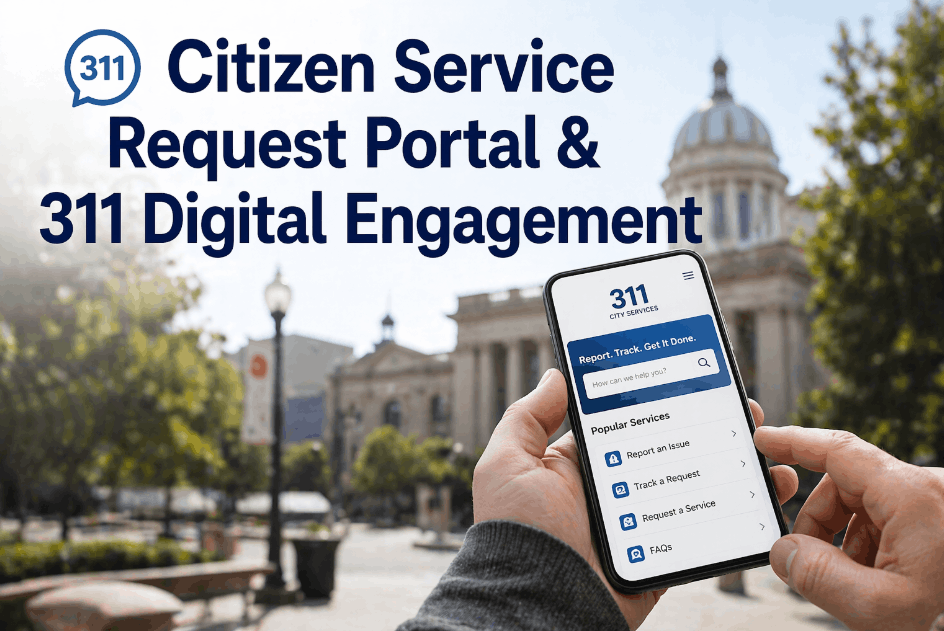
Citizens report problems through multiple channels—311 calls, web portals, mobile apps, social media, email, and in-person visits. A modern system consolidates all of these into one intake queue, with each request automatically tagged with channel, timestamp, location, and priority signals. Instead of a staff member manually transcribing a caller's address into a paper ticket, the 311 system auto-populates location data via address validation APIs. A mobile app user photographs a pothole and submits it with geolocation already attached. A web portal request includes structured data fields—asset type, complaint category, severity assessment—before submission even reaches human review.
Intelligent Triage: Route Work to the Right Team
Once a request enters the system, automated triage rules determine priority and route. Is this a safety hazard (fallen tree blocking traffic) or a routine maintenance request (faded road markings)? Does it belong to Public Works, Utilities, Parks, or Transportation? Are multiple departments involved? What permits, inspections, or contractor approvals are required before work can begin? A rule-based triage engine answers these questions instantly, preventing low-priority work from sitting alongside emergencies, and ensuring requests reach the team equipped to handle them rather than bouncing between departments.
Crew Dispatch and Real-Time Coordination
When a work order is ready for assignment, the system identifies available crews based on skill, location, workload, and current tasks. GPS-enabled dispatch apps push assignments directly to crew members' phones, eliminating radio delays and providing turn-by-turn routing. Crews can accept, decline, or message back (this route is blocked, we'll be 20 minutes late, we need additional tools) in real time. Supervisors see crew location, current task status, and estimated completion time on a live dashboard, enabling them to reassign resources on the fly if priorities shift or emergencies arise.
Digital Execution and Documentation
In the field, crews follow standardized digital checklists that match regulatory and organizational requirements. Upon arrival, they capture photos of the initial problem. As work progresses, they log time, materials used, and any complications discovered. Upon completion, they photograph the resolved work, confirm that all safety protocols were followed, and—critically—obtain customer or site sign-off digitally. All of this data flows back to the central system automatically, creating an audit trail that answers the question: "What exactly was done, by whom, when, and did it solve the problem?"
Closure and Performance Analytics
Once work is closed, the system automatically updates asset records (e.g., the traffic signal is now functioning), triggers follow-up surveys if configured, and feeds closure data into performance dashboards that reveal trends: which work order categories take longest, which crews perform fastest, which neighborhoods generate the most requests, which times of year are busiest. This intelligence informs staffing decisions, budget forecasting, and preventive maintenance planning.
How AI Vision Enhances This Industry
Computer vision—AI that analyzes images and video—unlocks operational visibility that manual inspections cannot provide. Progressive municipalities are deploying AI vision to verify work quality, detect asset deterioration, and trigger preventive maintenance before failures occur. Book a Demo to see AI vision capabilities integrated into your work order platform.
Municipal Work Order Software: Core Features Comparison
| Feature | Multi-Channel Intake | Real-Time Dispatch | Mobile Crew App | Analytics Dashboard | Citizen Portal Tracking |
|---|---|---|---|---|---|
| 311 & Phone Integration | Yes | Yes | — | — | — |
| Web & Mobile Request Submission | Yes | — | — | — | Yes |
| Automatic Location Validation | Yes | — | Yes | — | — |
| Intelligent Triage Rules | Yes | Yes | — | — | — |
| GPS Crew Tracking | — | Yes | Yes | Yes | — |
| Digital Checklists & Photo Capture | — | — | Yes | — | — |
| Automated Performance Reporting | — | — | — | Yes | — |
| Citizen Progress Notifications | — | — | — | — | Yes |
Real-World Impact: How Digital Work Orders Improve Municipal Operations
Cities that deploy modern work order platforms observe measurable improvements across operational and financial dimensions. Response times to citizen requests drop by 30–50%, primarily because request intake is automated and triage is instant rather than manual. Field crews spend less time waiting for assignments or calling dispatch to clarify details, meaning more time actually performing work. Duplicate requests fall by 40% because citizens can now track existing orders in the portal, seeing that their reported pothole is already scheduled for repair next Tuesday.
Administrative overhead shrinks dramatically. Supervisors no longer spend hours per week compiling reports for council meetings—dashboards generate them on demand. Auditors and compliance officers get searchable documentation of every work order, every closure photo, every safety checklist completion, rather than spending days hunting through filing cabinets. Asset management improves because every repair is automatically logged against the specific asset, creating a complete maintenance history that informs lifecycle planning and budget forecasting.
Citizen satisfaction increases because the public gains visibility. Instead of wondering whether a reported problem has been forgotten, residents track their request's status through a citizen portal, receive automated notifications when crews are assigned and en route, and can verify completion through before-and-after photos. This transparency builds trust—even when resolution takes longer than hoped, citizens understand why (permit delays, contractor availability, weather) and feel informed rather than abandoned.
Implementation Strategy: From Paper to Platform in 90 Days
Transitioning from fragmented systems to a unified platform follows a proven phased approach. Each phase delivers immediate value while building toward full integration. Book a Demo to build a deployment timeline for your municipality.
Staff training happens in parallel—crews learn mobile workflows through hands-on use, supervisors refine dashboard workflows through daily practice. This phased approach delivers visible wins that build organizational buy-in across departments.
Overcoming Common Implementation Challenges
The biggest barrier to municipal work order modernization is organizational inertia. Staff accustomed to radio dispatch and paper tickets may initially resist mobile workflows, especially if previous technology projects failed. The solution is clear executive sponsorship, early-adopter crew designation (assign your most flexible teams first), and visible wins celebrated across departments. When the public works team sees that dispatch time dropped from 90 minutes to 15 minutes, and that crews no longer waste time hunting for incomplete work order details, buy-in spreads. Book a Demo to demonstrate quick wins for your team.
Data quality poses a secondary challenge. Historical records are often incomplete or poorly categorized. Rather than pausing for a massive data cleanup, modern platforms import whatever data exists, then establish strict data entry standards going forward. Over time, the historical dataset improves through routine updates. Citizens refuse to accept slow citizen portals, so performance issues get fixed urgently, unlike legacy systems that accumulated technical debt. Integration with existing municipal software—budget systems, asset management platforms, GIS databases—requires API planning, but modern platforms support standard connectors that reduce custom development.
Measuring Success: KPIs That Matter
Modern work order platforms enable data-driven decision making. Three key indicators reveal whether your system is delivering measurable value. Book a Demo to see KPI dashboards in action.
The Broader Digital Transformation: Beyond Work Orders
A modern work order platform becomes the foundation for broader municipal digital transformation. Once citizens are comfortable submitting permit applications, license renewals, or complaints through a single digital system, additional services migrate onto the same infrastructure. Data flowing through the work order system reveals which neighborhoods have persistent infrastructure challenges, informing capital improvement prioritization. Integration with GIS systems transforms static maps into dynamic asset intelligence. Predictive analytics forecasting maintenance needs before failures occur enable budget smoothing and crew utilization optimization.
Municipalities in Canada, the United States, Germany, and the UAE that have embraced digital work order management are now expanding to AI-powered predictive maintenance, mobile-first citizen services, and advanced analytics. The competitive advantage lies not in any single feature, but in the data foundation that a unified platform creates—data that informs smarter decisions, more efficient operations, and ultimately, better public services.