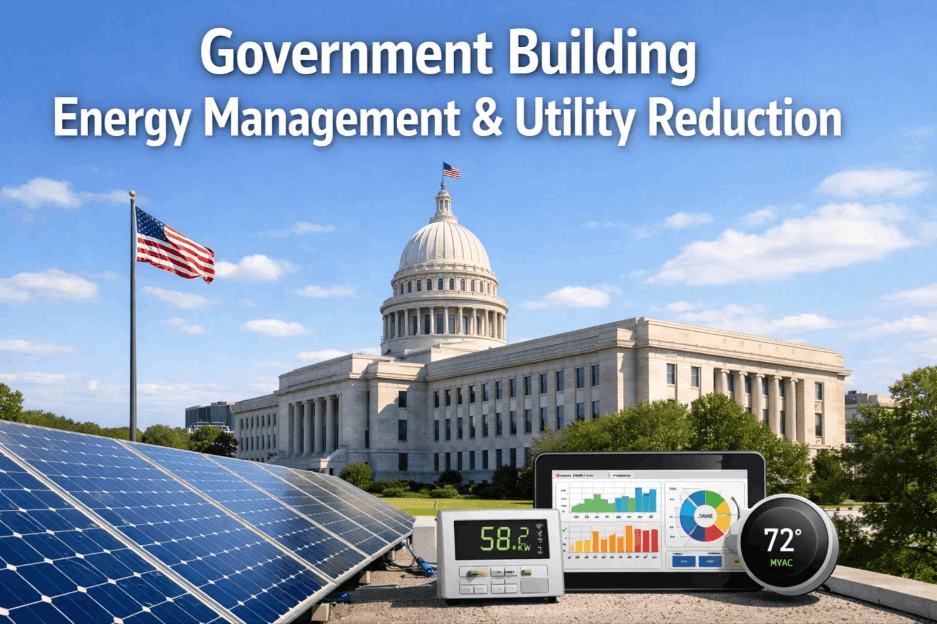
Government building energy management is undergoing a fundamental transformation as municipal and state agencies face the dual pressure of reduced operating budgets and aggressive decarbonization mandates. Public facilities—from city halls and courthouses to public safety headquarters—often represent some of the most energy-intensive assets in a city's portfolio. Effectively reducing government utility costs requires more than simple LED retrofits; it demands a unified building energy reduction strategy that synchronizes HVAC optimization, lighting controls, and real-time building automation into a single, proactive intelligence layer. Operating a public facility at peak energy efficiency today requires the ability to detect and correct energy drift in real-time, long before it appears on a monthly utility invoice. book a demo to see how iFactory's building energy management module automates your facility optimization.
Rule Every Kilowatt. Reduce Every Utility Bill.
Leverage advanced building energy analytics to monitor HVAC loads, automate lighting schedules, and ensure 100% compliance with energy benchmarking mandates across your government portfolio.
Why Public Building Energy Management is the Key to Budget Resilience
For most government agencies, utility expenses represent the second-largest operational outlay after personnel costs. Unlike fixed debt or payroll, energy consumption is a variable cost that can be aggressively managed through intelligent building automation and analytics. Research consistently demonstrates that government building HVAC systems often run at 20–30% higher intensity than necessary due to over-ventilation, sensor drift, and unoptimized equipment scheduling. Implementing an overarching energy management strategy allows facility directors to reclaim these lost funds, redirecting them from utility providers back into essential public services. AI-driven building energy reduction provides the verifiable data required for Energy Star benchmarking and the defensible metrics needed for local sustainability councils. book a demo to view the full ROI model.
Government Energy Optimization: The 6 Diagnostic Pillars
Total building efficiency expands beyond basic thermostat control. By monitoring the complex interaction between mechanical loads, occupancy patterns, and utility rate structures, the AI platform guarantees absolute fiscal efficiency from the boiler room to the executive suites.
HVAC Predictive Optimization
Integrates weather forecasts directly with building thermal mass models. Prevents energy-intensive over-cooling by pre-conditioning rooms based on predicted ambient temperature spikes and occupancy schedules.
Sub 2% Thermal DriftIntelligent Lighting & Access Control
Synthesizes data from occupancy sensors and access control systems to eliminate "Zombie Energy"—the cost of lighting and cooling vacant offices, courtrooms, or secure storage areas after hours.
60% Lighting SavingsDemand Side Management (DSM)
Automates load shedding during peak utility windows. AI identifies non-critical loads—like domestic water heating or parking garage ventilation—that can be momentarily modulated to avoid expensive peak demand surcharges.
Targeted Load SheddingMechanical Fault Detection (FDD)
Identifies "Silent Energy Hogs" like leaking pneumatic valves or failed economizer dampers by analyzing fan current and temperature gradients. Prevents the 15–20% energy waste caused by undiagnosed mechanical drift.
Verified Mechanical HealthEnergy Benchmarking & Compliance
Automates the collection and export of energy performance data to Energy Star Portfolio Manager. Ensures 100% compliance with local energy disclosure laws and state-level greenhouse gas reporting mandates.
Zero-Touch HUD/State ReportingCentral Plant Analytics
Monitors chiller COP (Coefficient of Performance) and boiler efficiency levels in real-time. Identifies the specific load conditions where central plants are losing efficiency, allowing for precision staging of primary equipment.
Optimized Plant StagingThe AI-Driven Energy Reduction Workflow
Reducing public building energy costs requires microsecond coordination between grid signals and mechanical servos. book a demo to see how iFactory optimizes central plants across entire city portfolios.
BMS & Smart Meter Ingestion
The platform absorbs data from existing Building Management Systems and utility smart meters, creating a unified real-time record of energy consumption across every mechanical asset and electrical circuit.
Unified Energy BaselineThermal Load Profiling
AI analyzes the unique thermal lag and occupancy patterns of each facility. By mapping how quickly a courtroom cools or a public lobby heats, the platform builds a custom energy-signature for every building.
Dynamic Behavior ModelingAutomated set-point arbitration
The AI-core continuously optimizes HVAC set-points and VFD (Variable Frequency Drive) speeds. If the grid alerts to a peak window, the platform automatically executes a pre-cooling cycle followed by a slow-drift period to shed load.
Active Demand SuppressionContinuous Efficiency Verification
Ongoing monitoring flags any equipment drifting from its peak efficiency curve. Correction orders are dispatched to facilities teams before energy waste compounds across the quarterly budget.
Locked-In Savings GainsPublic Facility Energy Sophistication
Many government buildings suffer from "Set and Forget" automation—relying on static schedules that fail to adapt to weather or occupants. book a demo to discover how to bridge the energy data gap.
Legacy Manual Control
Operators rely on physical thermostats and local light switches. No centralized visibility into energy spend. Building systems run 24/7 regardless of actual occupancy or utility rate peaks.
Basic BMS Scheduling
Automated building controls allow for basic time-of-day scheduling. However, systems are rigid and do not react to weather changes or variable occupancy, leading to significant "Over-Conditioning" waste.
Benchmarking & Data Awareness
Centralized energy tracking allows for monthly utility reconciliation and Energy Star benchmarking. Facility teams identify high-energy developments but lack the real-time controls to intervene automatically.
Fully Integrated Energy AI
The ultimate unified state. Machine learning binds HVAC set-points directly to grid pricing and real-time occupancy. The facility portfolio runs fully optimized for cost reduction and net-zero targets.
Technology Enablers for Building Energy Reduction
True visibility at the mechanical level requires processing thousands of data points across massive building footprints. See exactly how our gateways capture these feeds by book a demo with our energy implementation specialists.
| Source Integration Layer | Application in Public Buildings | Analytical Output |
|---|---|---|
| BACnet / Modbus Gateways | Pulling data from Chillers, Boilers, and Air Handlers | Real-time equipment performance and FDD alerts |
| Pulse-Output Metering | Sub-metering lighting, server rooms, and large motors | Granular breakdown of departmental energy usage |
| Environment Observation Networks | Monitoring CO2, humidity, and airflow rates | Optimizes outside air dampers to prevent over-ventilation |
| Smart Lighting Brushes | Wireless control of high-bay and office LED zones | Precision occupancy-based light shedding and dimming |
Automate Your Utility Reduction Roadmap
Mobilize real-time BMS data to identify mechanical faults and demand peaks before they impact your fiscal budget targets.
Ensuring Public Building Safety & Comfort
An energy reduction strategy must never compromise the mission of the building. Reducing courthouse energy spend must not lead to humidity-damaged records, and hospital energy reduction cannot compromise patient air quality.
Safe Ventilation Analytics
Uses real-time CO2 sensing to modulate outside air (OA) intake. Ensures building air quality exceeds ASHRAE 62.1 standards while eliminating the energy cost of heating/cooling unnecessary outside air.
Healthy Buildings, Lower CostsCritical Archive Protection
For libraries and municipal record rooms, AI maintains precise temperature and humidity envelopes 24/7. Energy optimization is bypassed in these zones to prevent catastrophic moisture damage to public history.
Zero-Failure Humidity ControlEmergency Active Override
Building management AI detects emergency system activation (Fire/Smoke) and instantly resets HVAC to maximum safety dampers. The platform prioritizes life-safety over energy reduction during every incident.
Compliance First Architecture12-Month Public Building Efficiency Progression
Government building energy reduction is a cumulative game. Minor mechanical corrections in the first quarter lead to massive utility offsets by year-end. Observe the direct efficiency progression on a typical municipal city hall complex. book a demo to calculate specific building ROI.
Specialized Building Energy Applications
Unlike private offices, public buildings focus intensely on high-occupancy lobbies, specialized courtrooms, and administrative centers with variable 24/7 loads.
Courthouses & Civic Halls
Fuses erratic courtroom schedules directly with the air handling units, ensuring perfect acoustics and comfort during active sessions while shedding non-critical lighting and HVAC loads when empty.
Public Safety & EOC Facilities
Achieving 24/7 efficiency without compromising continuity. Intensive focus on redundant cooling loads for emergency dispatch servers and backup power distribution monitoring.
Municipal Recreation & Libraries
Optimizes large-volume atmospheric maintenance. Uses stratified air monitoring to reduce energy waste in high-ceiling lobbies and recreation zones while protecting sensitive library collections.
Education & Campus Networks
Synchronizing whole-campus central plants. Provides district-level visibility into energy utilization, allowing for cross-building load sharing and utility rate optimization.
The Financial Case for Building Data Intelligence
Every kilowatt-hour saved is another dollar reclaimed for public services. Converting previously invisible energy waste directly into budget resilience yields massive financial uplifts. book a demo to start your recovery plan.
Operational Budget Recovery
Eradicating energy waste in lighting and HVAC immediately frees up operational capital that was previously allocated to utility providers, protecting the agency against rate hikes.
Mechanical Lifecycle Gains
Preventing equipment from working harder than necessary to overcome mechanical faults drops overall annual repair and replacement outlays by nearly 20% across the portfolio.
Sustainability Fund Capture
Generating verifiable, real-time energy reduction data entirely negates the challenges of winning state and federal green-building grants, accelerating your net-zero transition speed.
Peak Execution Savings
Automated load shedding during high-rate windows permits lines to satisfy peak building usage requirements without risking the massive financial penalties of peak demand events.
What Public Energy Managers Are Saying
"Before adopting the building energy management AI, our utility bills were a total black box. We would get a massive invoice and have no idea if it was caused by a weekend event or a failing chiller. Once we integrated real-time sub-metering with our BMS dashboards, the platform instantly traced 15% of our waste back to a single courthouse air handler that was stuck in cooling mode during a weekend freeze. We saved $12k in energy costs in the first month alone."
Frequently Asked Questions: Building Energy Analytics
Will this platform replace our existing building automation system (BAS)?
No. Our energy analytics layer interfaces natively with your existing BACnet or Modbus BMS. We pull data from your current controllers to add an advanced AI layer of fault detection, predictive set-point control, and utility rate optimization that standard automation lacks.
How does the platform prevent energy surcharges during peak utility events?
The platform's high-frequency logic scans grid-pricing feeds and building load profiles in real-time. If a high-rate event is detected, the AI executes automated load shedding across non-critical pumps, fans, and light zones, far preceding manual operator intervention.
How does building energy reduction support net-zero compliance?
The platform tracks exact carbon emission matrices, synchronized with Energy Star Portfolio Manager. Ensuring verifiable, real-time GHG reduction data inherently protects the agency's license to operate and satisfies state-level sustainability audit requirements.
Can AI monitor energy utilization in specialized courthouses?
Absolutely. The platform maps distinct courtroom occupancy analytics, measuring precise thermal-lag matrices against acoustic requirements to assure ultimate comfort during sessions while maximizing off-hour budget savings. Book a facility review.
Rule Every Kilowatt of Public Energy
Eradicate energy waste, destroy hidden maintenance drift, and assure unmatched building automation responses by mobilizing massive data across your entire government facility portfolio.