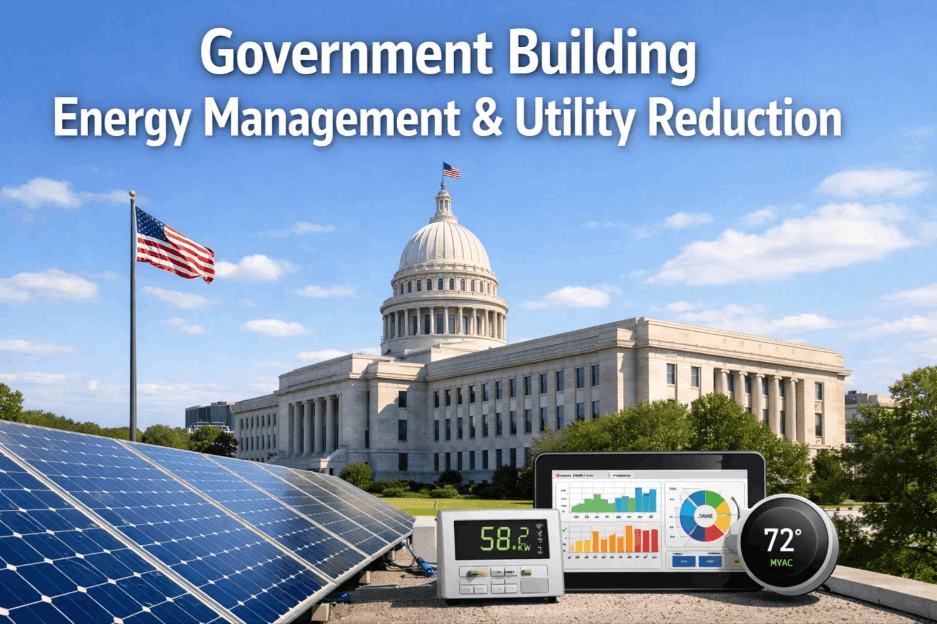
Government facilities across the United States spend billions annually on heating, ventilation, and air conditioning—yet nearly 39% of that energy is wasted due to aging equipment, deferred maintenance, and poor system oversight. According to the U.S. General Services Administration, a well-executed HVAC optimization strategy can deliver a 30% reduction in annual energy costs with a payback period of just three to five years. For facility managers navigating tightening federal mandates and shrinking budgets, the question is no longer whether to modernize HVAC maintenance—but how quickly you can start. Schedule a free 30-minute assessment and our team will walk you through a customized HVAC energy savings plan for your government facility.
Why Government Buildings Lose 39% of HVAC Energy
HVAC systems are the single largest energy consumer in government buildings, responsible for nearly 44% of all on-site energy use according to the U.S. Department of Energy. Unlike private commercial buildings, government facilities face unique challenges: strict occupancy schedules, legacy infrastructure that predates modern efficiency standards, multi-building campus configurations, and compliance mandates that demand documented proof of performance. When maintenance is deferred, the financial consequences multiply—every $1 of postponed HVAC upkeep eventually becomes $4 in capital renewal costs.
Where Government HVAC Energy Goes to Waste
01
Duct Leakage and Poor Insulation
In typical forced-air systems, 20–30% of conditioned air escapes through duct leaks, holes, and poorly connected joints—particularly in older government buildings where ductwork runs through unconditioned spaces like attics and crawlspaces.
02
Neglected Filters and Coils
Dirty air filters restrict airflow and force systems to work significantly harder. Neglected coils accumulate buildup that degrades heat transfer efficiency. Together, these two maintenance failures can increase energy consumption by 15–25% per unit.
03
Outdated Controls and Scheduling
Many government buildings still operate HVAC on fixed schedules rather than occupancy-based controls. Systems condition empty spaces during evenings, weekends, and holidays—wasting energy with no occupant benefit. Only about one in three government buildings has a building automation system installed.
04
End-of-Life Equipment Still in Service
HVAC systems older than 15 years operate well below original efficiency ratings. The Department of Energy recommends replacement after 10 years. Equipment beyond this threshold can waste 20–40% more energy than modern equivalents while requiring increasingly expensive emergency repairs.
Identify which HVAC units are wasting your facility's energy and budget. Get full visibility into every asset's maintenance status, energy performance, and overdue service alerts—so you can target the exact systems causing the highest waste first.
Get Support
HVAC Preventive Maintenance Checklist for Public Facilities
Preventive maintenance is the most cost-effective strategy available to government facility managers. The Department of Energy estimates that proper operations and maintenance practices deliver 5–20% annual energy savings, while comprehensive planned maintenance programs cut total maintenance costs by 50% compared to reactive approaches. The following checklist covers the seasonal and interval-based tasks that have the greatest impact on government building HVAC performance.
Spring and Fall Changeover
How to Cut HVAC Operating Costs Without Capital Replacement
Not every energy improvement requires purchasing new equipment. Some of the highest-return strategies involve optimizing the systems you already have. Government facilities that combine no-cost operational changes with low-cost maintenance improvements routinely achieve 15–25% energy reductions before any capital investment.
Optimize Scheduling and Setpoints
Adjust HVAC schedules to match actual building occupancy—not default settings from initial construction. Implement night setback and weekend shutdown protocols. Widen the temperature deadband by 2–4 degrees during unoccupied hours. These changes cost nothing and can be implemented within days.
Seal Ductwork and Fix Air Leaks
Use mastic sealant or metal-backed tape to seal duct joints in unconditioned spaces. Add insulation where ductwork passes through attics, crawlspaces, or mechanical rooms. Duct sealing and insulation can improve HVAC distribution efficiency by 20% or more—often the single highest-ROI maintenance action available.
Deploy Smart Thermostats and Occupancy Sensors
ENERGY STAR certified smart thermostats save approximately $100 per unit annually in government buildings by automatically adjusting for occupancy. Adding occupancy sensors to meeting rooms, lobbies, and intermittently used spaces prevents conditioning empty zones throughout the day.
Retrofit with Variable Frequency Drives
Retrofitting constant-speed fan and pump motors with VFDs allows equipment to modulate output based on actual demand rather than running at full capacity continuously. In government buildings with variable occupancy, VFDs consistently deliver some of the fastest payback periods of any HVAC retrofit.
Want to implement these cost-saving strategies across your entire building portfolio? See how Oxmaint automates PM scheduling, tracks energy savings from each maintenance action, and gives your team a single dashboard to manage setpoint optimization, duct sealing follow-ups, and VFD retrofit tracking.
Book a Demo
Break-Fix vs. Planned Maintenance: The Real Cost Difference
The financial gap between reactive and preventive HVAC maintenance is not a marginal difference—it is a multiplier. Research across thousands of government and commercial facilities consistently shows that planned maintenance programs outperform reactive approaches across every measurable dimension.
Break-Fix Approach
Emergency repairs cost 50–100% more than scheduled service calls
Running equipment to failure costs 3–10x more than planned maintenance
30% higher energy consumption from poorly maintained systems
Equipment lifespan shortened by 5–10 years on average
No documentation trail for compliance audits or energy reporting
10–12 yr
average system life before failure
Planned Maintenance with CMMS
50% lower total maintenance expenditure over equipment lifecycle
70–75% reduction in unplanned system breakdowns
5–20% annual energy savings from sustained peak performance
Equipment lifespan extended to 15–20 years with proper care
Complete audit trail for federal energy and safety compliance
18–20 yr
average system life with preventive care
Federal HVAC Energy Mandates Every Facility Manager Must Know
Government buildings operate under a stricter regulatory framework than the private sector. Federal energy mandates, building codes, and environmental regulations create overlapping compliance obligations that demand meticulous documentation—and significant penalties for non-compliance.
Executive Order 13693
2.5% annual reduction in federal building energy intensity through 2025
Requires documented HVAC efficiency improvements, energy tracking through metering systems, and annual performance reporting
EISA 2007 Section 432
Comprehensive energy and water evaluations for covered federal facilities every 4 years
Mandates HVAC system commissioning, re-commissioning, and benchmarking against ASHRAE standards with documented findings
ASHRAE 90.1 and IECC
Minimum SEER, EER, and COP ratings for all new and replacement HVAC equipment
Government procurement must meet or exceed ENERGY STAR efficiency levels; state-adopted IECC codes may impose additional requirements
EPA Section 608 and AIM Act
Refrigerant management, leak detection, and HFC phasedown compliance
Systems with 15 or more pounds of refrigerant require quarterly leak checks, certified technicians, and documented recovery procedures
42 USC 6834 Federal Building Standards
New federal buildings must achieve 30% energy reduction below ASHRAE baseline
Drives adoption of high-efficiency HVAC, advanced controls, and renewable energy integration in all new federal construction
Facing an upcoming EISA audit or Executive Order energy report? Automatically generate timestamped maintenance logs, refrigerant tracking records, and energy benchmarking reports that satisfy federal inspectors—without manually compiling documentation from spreadsheets and paper files.
Get Support
What a CMMS Actually Does for Government HVAC Teams
A Computerized Maintenance Management System replaces spreadsheets, paper logs, and tribal knowledge with a centralized digital platform that automates scheduling, tracks every asset and work order, and provides the analytics needed to make smarter maintenance and budget decisions. For government HVAC operations, these capabilities translate directly into lower energy costs, longer equipment life, and effortless compliance documentation.
Automated Work Orders
Preventive maintenance tasks generate automatically based on calendar intervals, runtime hours, or sensor-triggered conditions. Filter replacements, coil cleanings, and seasonal inspections never fall through the cracks—regardless of staff turnover or schedule complexity.
Complete Asset Registry
Every HVAC unit is documented with make, model, installation date, warranty status, maintenance history, and real-time condition. Capital replacement planning becomes data-driven rather than based on guesswork or emergency failures.
Mobile Field Access
Technicians receive, update, and close work orders on mobile devices. They log parts, capture photos, record meter readings, and document completion—all from the equipment location without paperwork delays or data re-entry.
Energy and Cost Analytics
Dashboards correlate maintenance activity with energy consumption trends. Identify which buildings, systems, or equipment types are driving cost overruns—and quantify the savings impact of each maintenance intervention.
Vendor and Contractor Management
Assign work orders to external HVAC contractors, track response times, verify completion quality, and compare vendor performance—all within the same platform used for internal team management.
Audit-Ready Compliance Reports
Generate one-click compliance documentation showing complete maintenance histories, inspection results, and regulatory adherence by equipment, building, or timeframe. Every record is timestamped and linked—inspector-ready at all times.
Government HVAC Maintenance ROI: What the Data Shows
Investing in structured HVAC maintenance is not a cost—it is a documented savings strategy. Across government and institutional building portfolios, the measurable returns from preventive maintenance programs consistently exceed initial projections.
20–40%
Energy Cost Reduction
U.S. Department of Energy data shows that upgrading and properly maintaining HVAC systems reduces utility bills by this range—with the highest savings achieved in facilities transitioning from deferred maintenance to structured PM programs.
23%
Government Energy Intensity Decline
Between 2003 and 2012, government buildings reduced average energy intensity from 105,300 BTU per square foot to 81,200 BTU per square foot—outpacing the 12% decline across all commercial buildings during the same period.
50%
Maintenance Cost Savings
Comprehensive planned maintenance programs cut total maintenance costs in half compared to reactive approaches, according to DOE research. The savings come from eliminating emergency repair premiums, reducing parts waste, and extending equipment life.
3–5 yr
Simple Payback Period
The Whole Building Design Guide confirms that typical HVAC energy optimization programs in government facilities pay for themselves within three to five years through reduced utility costs, lower maintenance spend, and deferred capital replacement.
Your HVAC Systems Are Either Saving You Money—Or Wasting It
Government facility managers who shift from reactive break-fix to CMMS-driven preventive maintenance consistently report lower energy bills, fewer emergency repairs, longer equipment life, and effortless compliance documentation. Oxmaint provides the platform to make that shift—with automated scheduling, real-time dashboards, mobile work orders, and built-in reporting designed specifically for the demands of public building management.
Frequently Asked Questions
How much can a government building realistically save on HVAC energy costs?
Most government facilities achieve 20–30% reduction in HVAC energy costs within the first year of implementing a structured preventive maintenance program. Quick wins from filter management, thermostat calibration, and duct sealing often produce measurable savings within 30–60 days. The GSA reports that comprehensive HVAC optimization programs deliver a 30% reduction in annual energy costs with a payback period of three to five years.
Schedule a free savings assessment for your facility—our team will analyze your building size, equipment age, and current maintenance practices to project your specific first-year energy savings.
What are the highest-priority HVAC maintenance tasks for government facilities?
Start with three high-impact, low-cost actions: monthly air filter replacement, thermostat calibration, and duct sealing in unconditioned spaces. These three tasks alone can improve system efficiency by 15–25% with minimal investment. From there, build out a quarterly and annual preventive maintenance schedule that includes coil cleaning, refrigerant inspections, belt and bearing checks, and full seasonal changeover inspections.
How does a CMMS help meet federal energy compliance requirements?
A CMMS automatically records every maintenance activity with timestamps, technician details, parts consumed, and completion verification. This creates a continuous, auditable digital record that satisfies requirements under Executive Order 13693 energy reporting, EISA Section 432 facility evaluations, EPA refrigerant tracking under Section 608, and ASHRAE commissioning documentation.
Get Support and explore the compliance dashboard—see how each maintenance activity automatically maps to the specific federal mandate it satisfies.
Can CMMS software integrate with existing building automation systems?
Yes. Modern CMMS platforms integrate with building automation systems to receive real-time HVAC performance data including temperature readings, runtime hours, and fault codes. This enables condition-based maintenance—where work orders are automatically triggered when equipment parameters exceed optimal ranges—significantly reducing both energy waste and unplanned downtime.
What is the typical payback period for a CMMS-based HVAC maintenance program?
Government facilities typically see positive return on investment within 6–9 months. Initial savings come from eliminating emergency repair premiums and reducing energy waste through consistent maintenance execution. Long-term returns compound as equipment life extends and capital replacement budgets are deferred by years.
Book a demo to see a live ROI calculator—enter your building count, average equipment age, and current maintenance spend, and we will project your payback timeline on screen during the call.