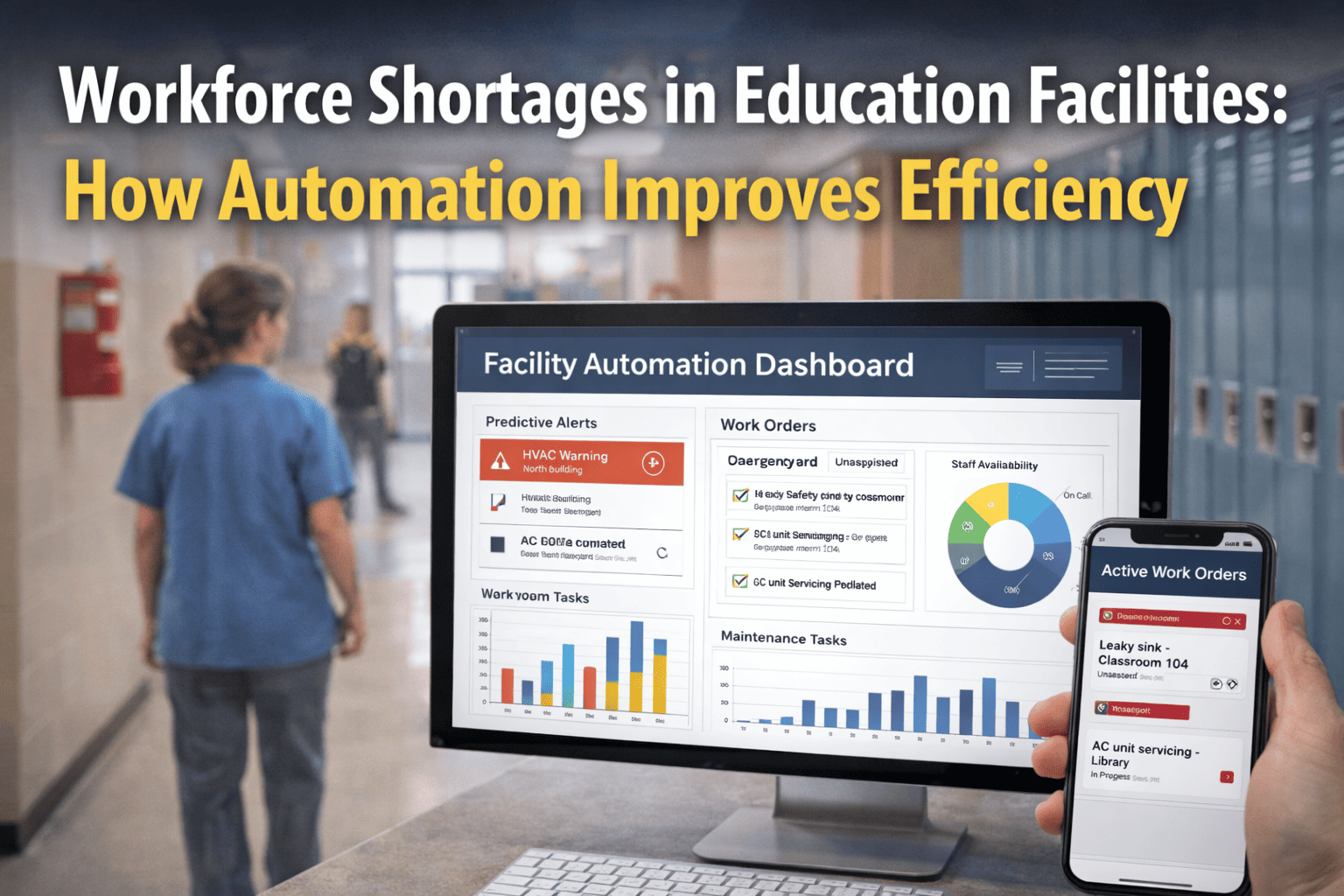
School and university facilities teams are being asked to do more with fewer people every year. Maintenance technician vacancies are at record levels, experienced staff are retiring faster than replacements can be hired, and budgets are not keeping pace with aging infrastructure. The result: deferred work orders, missed preventive maintenance, compliance gaps, and emergency failures that overwhelm already stretched teams. Automation is the operational bridge that keeps facilities functioning while the workforce gap persists. See exactly where automation closes your staffing gap — Book a Demo.
Why Workforce Shortages Are a Crisis for Education Facilities in 2026
Technician vacancy rates at large campuses now exceed 18%, with positions unfilled for 12 months or longer. Preventive maintenance windows are missed, compliance documentation falls behind, and capital assessments are delayed. The problem is not effort — it is capacity. Automation is the only scalable mechanism available to close the gap without waiting for the hiring market to recover. Map your staffing gap to specific automation outcomes in a live 30-minute demo.
The Compounding Cost of an Understaffed Facilities Team
Every vacancy creates a cascade of deferred decisions and accumulated risk. Institutions that deploy facility automation consistently show the same pattern: a backlog an 12-person reactive team couldn't clear is resolved by an 8-person team using automated scheduling, predictive alerts, and centralized workflow management.
2026 Compliance Pressures That Understaffed Teams Cannot Absorb Manually
The compliance environment in 2026 has tightened significantly at exactly the moment when staffing capacity has declined.
New federal rule requires documented HVAC maintenance schedules and temperature monitoring records in all occupied spaces. Automated maintenance scheduling and documentation generation closes this gap without additional staff hours.
Lead, air quality, and chemical exposure testing now require documented facility condition baselines and maintenance histories. Institutions without automated data systems face retroactive testing costs and enforcement action they have no bandwidth to defend against.
Credit agencies now factor deferred maintenance backlogs and documentation quality into institutional credit assessments. Automated condition scoring turns existing staff capacity into continuous documentation — without manual assembly burden.
How Facility Automation Software Closes the Workforce Efficiency Gap
Every hour a skilled technician spends on admin coordination, manual reporting, or reactive crisis management is an hour not spent on preventive work. Automation eliminates that overhead and converts reactive workflows into predictive ones — multiplying effective output without adding headcount. See how each automation function maps to your team's workflow bottlenecks in a live demo.
- AI condition scoring generates work orders automatically when asset thresholds are breached
- Work orders routed to the right technician with full asset history and priority classification
- No manual dispatch coordination required from supervisors or admin staff
- PM completion rates tracked by building, system, and technician in real time
- Sensor data feeds AI models that score failure probability per asset continuously
- Alerts generated weeks before failure reaches critical threshold
- Technicians dispatched at optimal intervention point before damage occurs
- 60–75% reduction in emergency work orders within 18 months
- All campus assets, work orders, and compliance status visible in one interface
- Supervisors manage the entire team workload from one screen
- Backlog visibility prevents deferred maintenance accumulating invisibly
- Performance metrics tracked per technician without manual data entry
- OSHA, EPA, ISO, and accreditation records generated automatically from live maintenance data
- Compliance reporting reduced from 140 staff hours to 18 hours automated
- Audit packages exported on demand — no manual assembly required
- Documentation never falls behind regardless of staffing level
- Summer windows automatically populated with deferred work order backlogs
- Priority sequencing based on condition scores — highest-risk assets first
- Contractor coordination and procurement integrated into scheduling engine
- No manual planning needed to convert available windows into productive cycles
- Continuous AI condition scoring replaces manual inspection cycles
- Five-year cost-of-deferral calculations generated per asset from live data
- Board-ready capital request packages produced in one click
- Condition data never more than 30 days stale vs. 18–26 months at reactive institutions
Automation Impact Across Education Facility Roles
| Role | Manual Burden Eliminated | Automation Capability | Hrs Reclaimed/Mo | Outcome |
|---|---|---|---|---|
| Technician | Manual work order receipt, paper logs | Automated dispatch, digital logs | 12–18 hrs | More field time on skilled maintenance |
| Supervisor | Manual scheduling, status calls | AI scheduling, real-time dashboard | 20–30 hrs | Strategic oversight replaces reactive coordination |
| Compliance Mgr | Manual report assembly | Automated compliance report generation | 50–80 hrs/quarter | Zero audit deficiencies without manual prep |
| Energy Mgr | Manual meter reads, spreadsheets | Per-building live energy dashboard | 10–15 hrs | 30–40% energy cost reduction |
| Capital Planner | Manual condition surveys | Continuous AI condition scoring | 30–40 hrs/cycle | Capital variance reduced from 22% to 6% |
| F. Director | Manual data consolidation from silos | Unified analytics dashboard | 15–20 hrs | Data-backed decisions replace intuition |
| IT Staff | Manual system reconciliation | Open API integration with existing systems | 8–12 hrs | Single source of truth eliminates reconciliation |
Implementation: Deploying Facility Automation Without Disrupting Operations
The platform connects via open API to existing systems with no replacement required. Core automation is live within 60–90 days. Full predictive model maturity develops over 12–18 months.
- BMS, CMMS, ERP, and energy systems connected via open API
- Asset registry standardized across all campus buildings
- All facilities staff onboarded in under 12 hours
- Condition data age reduced from 18–26 months to 8 months immediately
- AI condition scoring and automated work orders active across all asset classes
- Predictive alerts replacing reactive complaint-driven dispatch
- Compliance reporting automated and producing first on-demand reports
- Staff reporting hours drop from 140 to under 18 hrs per cycle
- Centralized analytics dashboard with full cross-department visibility
- Capital planning dashboard with five-year cost-of-deferral modeling active
- Energy optimization running on HVAC and lighting across connected buildings
- Emergency work orders down 40–60% from pre-deployment baseline
- 18–30% total maintenance cost reduction fully documented
- Emergency work orders down 60–75% with planned maintenance ratio restored
- Equipment lifespan extension of 40% documented across all tracked categories
- AI model sharpens continuously as campus-specific failure history accumulates
Documented Results: What Facility Automation Delivers
Results below are documented across K-12 district and university campus deployments, measured against the same operational budget and staffing level before and after implementation. Model these outcomes against your institution's current staffing profile and budget in a live demo.
| Metric | Manual Baseline | Automated Platform | Change |
|---|---|---|---|
| Compliance Hours/Cycle | 140 hrs manual | 18 hrs automated | -87% |
| Emergency WOs | 60–75% of total budget | 60–75% fewer events | -60% to -75% |
| Maintenance Cost/SqFt | $4.85 reactive average | $3.40–$3.99 documented | -18% to -30% |
| Condition Data Age | 18–26 months average | Under 30 days continuously | -98% |
| Equip Lifespan | Premature replacement cycles | Up to 40% extension documented | +40% |
| Capital Cost Variance | 22% average overage | 6% average documented | -73% |
| Audit Deficiencies | Undocumented exposure each cycle | Zero deficiencies documented | -100% |
| Planned/Reactive Ratio | 25% planned, 75% reactive | 75% planned, 25% reactive | 3x Improvement |
Key Benefits for Understaffed Education Facility Teams
Automated report generation eliminates the 140-hour quarterly burden. Reclaimed time redirects toward physical inspections, preventive maintenance, and capital coordination that only human staff can perform.
AI condition scoring detects deterioration weeks before failure, giving a reduced team lead time to schedule interventions at planned cost. Breaking the emergency spiral is the single most impactful efficiency gain available.
AI-driven scheduling generates work order sequences based on asset condition, technician location, and seasonal windows — no manual coordination required. Every hour of available capacity is applied to the highest-priority work.
AI deterioration modeling maintains current condition scores without requiring physical inspection time. Capital requests miss scope by 6% on average rather than 22% — and require no dedicated field time from a constrained team.
Compliance documentation generated automatically from live maintenance data never falls behind. OSHA, EPA, accreditation, and credit agency requirements are met continuously — no manual assembly, no penalty exposure.
Each month of platform operation adds campus-specific history that improves AI prediction accuracy and sharpens PM scheduling. Efficiency gains at month 18 are a documented floor that continues to improve over time.