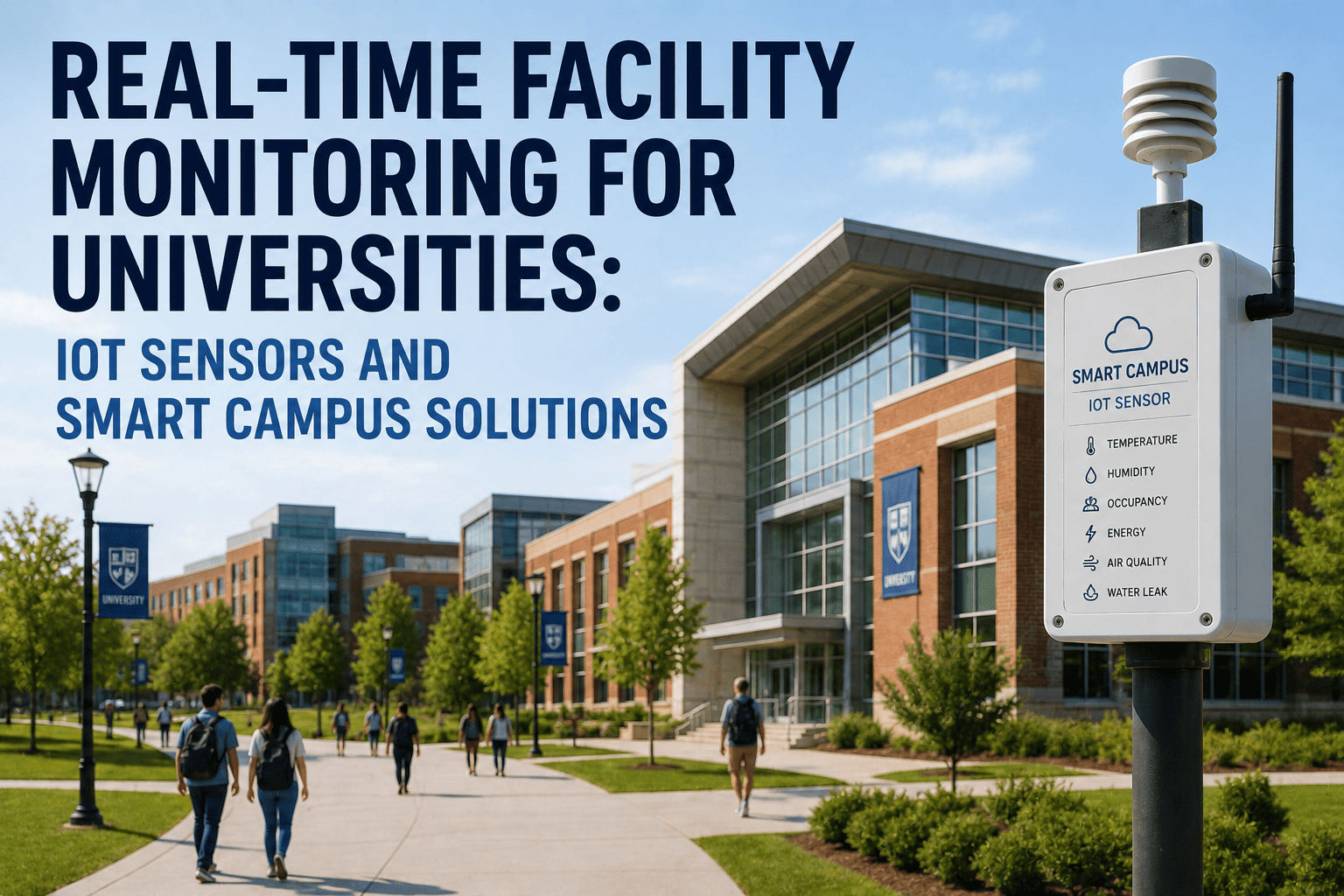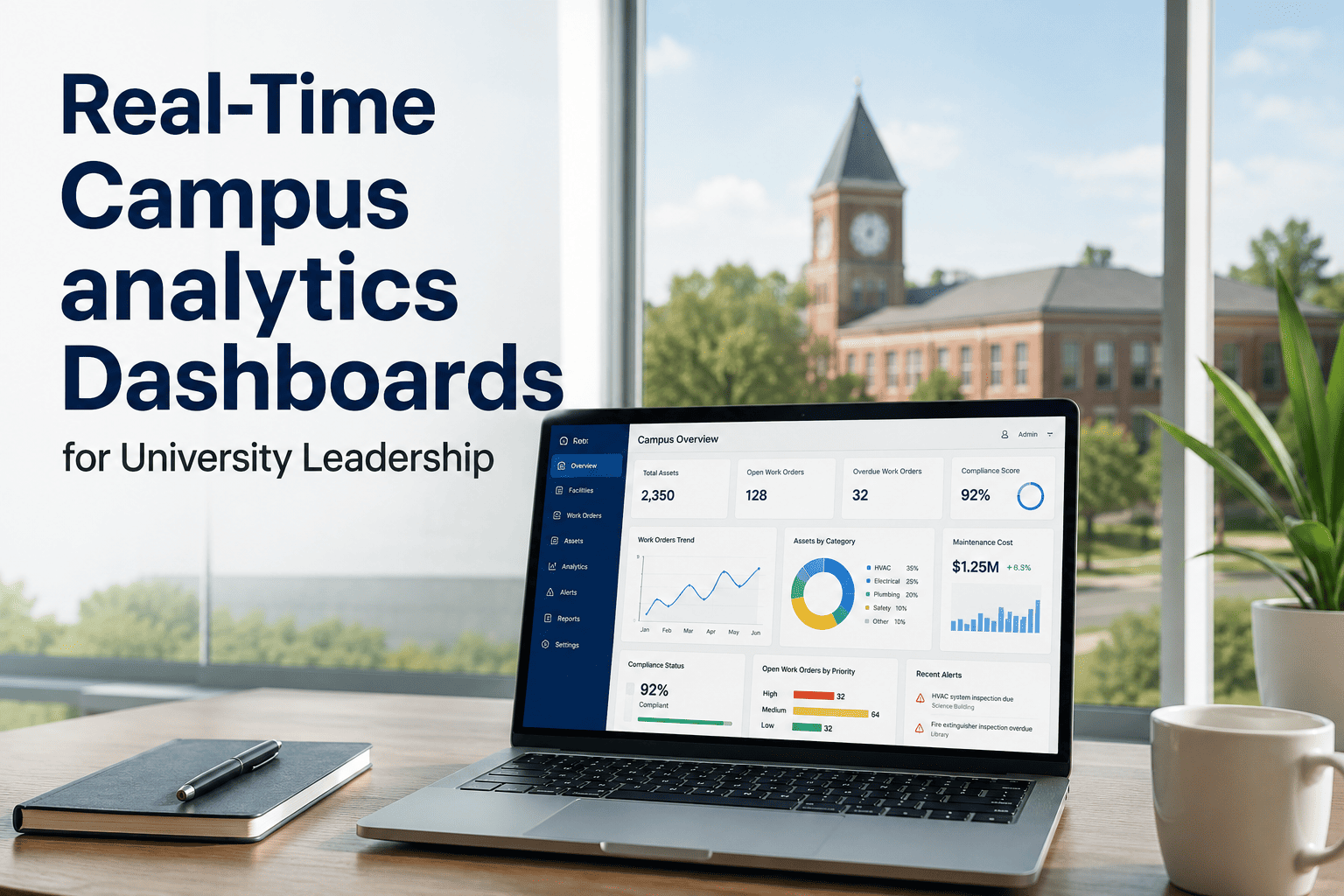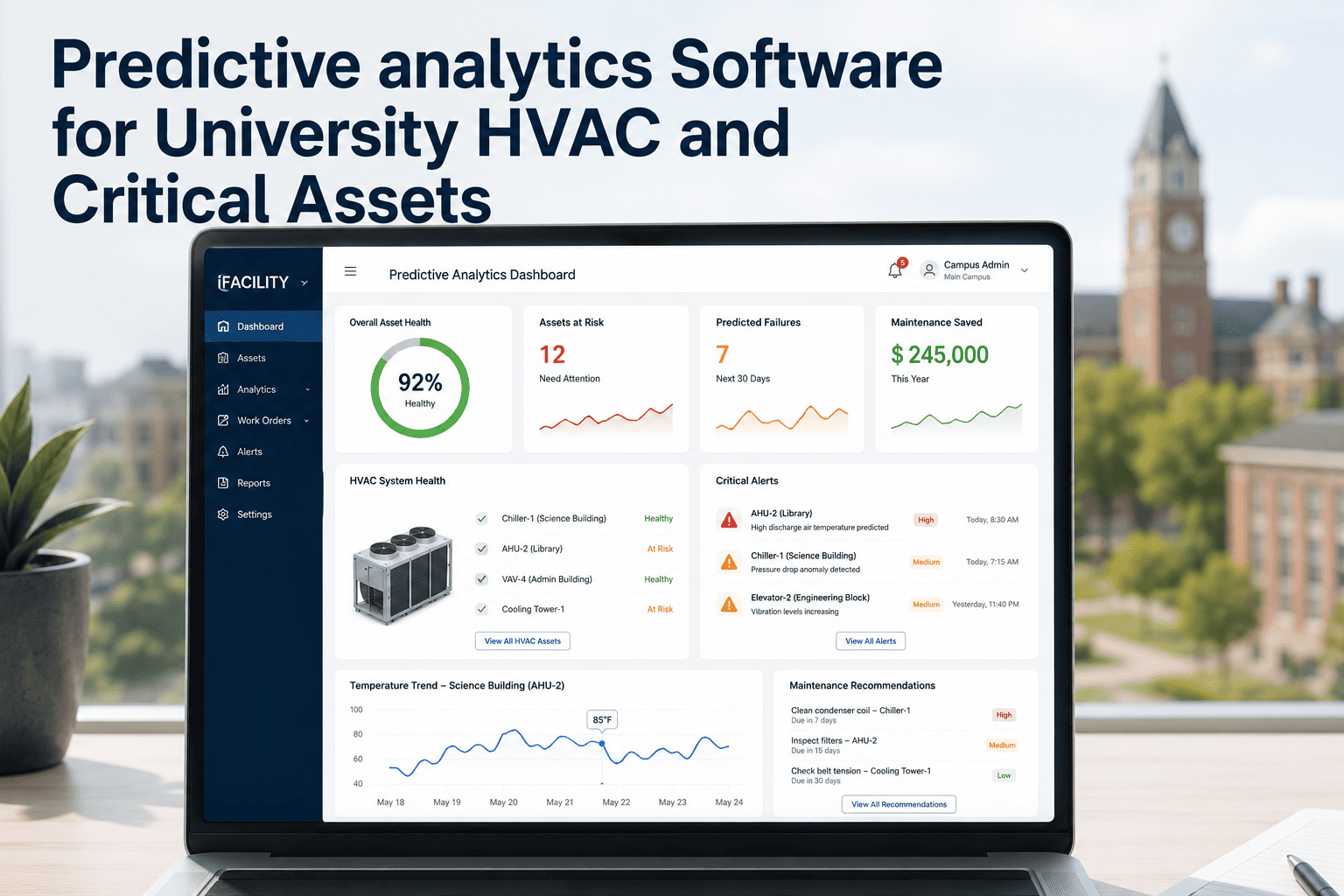
Most universities collect more operational data today than at any point in their history — maintenance work orders, energy readings, space utilization counts, compliance logs, and capital records across dozens of disconnected systems. The problem is not data scarcity. It is that this data never converges into a unified analytics layer that drives decisions. Universities that have built centralized data-driven analytics strategies report 18-30% reductions in maintenance costs, 40-60% fewer compliance reporting hours, 15-19% energy cost reductions, and board capital approvals that have transformed from deferred to single-session. See how a data-driven analytics strategy applies to your campus portfolio — Book a Demo.
What a Data-Driven University Analytics Strategy Actually Requires
A data-driven analytics strategy is not a reporting initiative. It is a structural change in how operational data flows from source systems to decision-makers. Most universities already have data in their CMMS, BAS, energy software, and space utilization tools. What they lack is the integration layer connecting these systems, the AI engine converting raw data into predictions, the KPI framework defining what to measure, and the dashboard layer surfacing it all without manual assembly. All four layers must be built simultaneously — not sequentially.
In 2026, the business case has become financially and regulatorily unavoidable for any institution managing more than 500,000 sq ft. Credit agencies factor deferred maintenance data into bond ratings. Accreditors flag inadequate facilities data maturity. OSHA and EPA require documentation granularity that manual systems cannot reliably produce. And campus condition is now an admissions variable visible to prospective students. Assess your institution's current analytics maturity and get a roadmap — Book a Demo.
The Four Layers of a University Analytics Strategy
Every effective university analytics strategy is built on four layers that must work together. Implementing any one layer in isolation produces reports without action, or dashboards without the underlying AI to make them meaningful.
Connects all existing source systems — CMMS, BAS, smart meters, IoT sensors, space utilization, and ERP — into a unified data pipeline. Without this foundation, every other analytics investment requires manual consolidation before any cross-system insight is possible. Open API integration is the standard that avoids replacing existing systems while enabling data convergence across 11+ platform sources.
Sits above the integration layer and converts raw connected data into condition scores, deterioration predictions, anomaly alerts, and energy optimization recommendations. Without an AI engine, universities have more organized data but still no predictive capability and no automated action generation from that data.
Defines which metrics matter, how they are calculated, and which stakeholder sees which dashboard. Without a structured KPI framework, dashboards become data displays rather than decision tools. A university framework must span maintenance, energy, compliance, capital planning, and space utilization simultaneously.
Delivers the right KPI subset to the right stakeholder without manual report assembly. A facilities director needs a different dashboard than a compliance officer, energy manager, or CFO. When dashboards are role-configured, every stakeholder makes faster, better-informed decisions without requiring custom analytics preparation throughout the year.
The AI model improves monthly as campus-specific data accumulates. KPIs are reviewed annually and adjusted as the strategy matures. The feedback loop between operational outcomes and model inputs separates a compounding analytics strategy from a one-time reporting implementation that goes stale within its first year.
Analytics strategy without governance produces dashboards nobody acts on. A governance structure assigns KPI domain ownership, establishes performance review cadences, and creates escalation protocols for threshold breaches. Without it, the best analytics platform becomes a reporting exercise rather than an operational performance management system.
The University Campus KPI Framework: What to Measure and Why
The KPI framework is the strategic core of a data-driven analytics strategy. Without clearly defined metrics connecting operational inputs to institutional outcomes, dashboards become data displays rather than performance management tools. See how this KPI framework maps to your institution's data sources and reporting requirements — Book a Demo.
- Maintenance cost per sq ft tracked monthly against peer benchmarks and pre-deployment baseline
- Planned-to-reactive work order ratio measured weekly with department-level accountability reporting
- Mean time to resolution per asset class tracked to identify systemic maintenance execution gaps
- PM completion rate as percentage of scheduled work orders closed within required timeframe
- Emergency work order volume trend as primary indicator of predictive maintenance effectiveness
- FCI per building updated continuously from IoT sensor data replacing periodic manual assessments
- Asset condition data age tracked — no capital decision relies on assessments older than 90 days
- Portfolio-level FCI trend tracked quarterly against remediation program pace
- Five-year capital replacement liability quantified per building and updated monthly
- Capital project cost variance measured against AI-informed scoping over time
- Energy use intensity per building tracked monthly against sustainability targets and peer benchmarks
- Peak demand charge exposure monitored in real time with automated demand response active
- Per-building energy variance flagged when outliers indicate underlying maintenance failures
- Occupancy-driven HVAC efficiency ratio measuring conditioning hours tied to actual occupancy
- Carbon intensity per sq ft tracked for sustainability reporting and accreditation submissions
- Open compliance findings by framework tracked with days-to-closure against regulatory deadlines
- Inspection completion rate as percentage of scheduled inspections closed within required window
- Corrective action closure rate tracked against deadlines with automated escalation at breaches
- Audit readiness score measured continuously from live IoT and documentation data
- Documentation maturity score tracked against peer benchmarks and prior-cycle performance
- Occupancy rate per room and building tracked against scheduled capacity to flag underutilization
- Peak utilization hours per building informing HVAC scheduling and maintenance window planning
- Underutilized space identified from continuous sensor data for reprogramming or consolidation
- Maintenance cycle acceleration triggered automatically for spaces exceeding utilization thresholds
- Space efficiency ratio tracking actual versus designed utilization across all facility types
- Deferred maintenance backlog tracked per building and portfolio-wide against remediation pace
- Capital budget utilization rate measuring planned versus actual expenditure with variance attribution
- Cost-of-deferral exposure quantified per deferred project to prioritize backlog by financial consequence
- Board approval cycle time tracked to measure data quality impact on governance efficiency
- Credit agency and accreditor documentation readiness scored against required submission standards
Implementation Roadmap: Building the Strategy in Four Phases
The roadmap is designed to operate within existing capital and operational budgets. Service delivery is uninterrupted throughout all phases. Core data integration and initial KPI dashboards are operational within 60-90 days.
- All CMMS, BAS, smart meters, and sensors connected via open API
- KPI framework configured per stakeholder role with baseline metrics from historical data
- Initial role-based dashboards live with baseline KPI data by end of month three
- Asset registry built with AI baseline condition scores for all monitored assets
- AI deterioration model active across all IoT-connected asset classes campus-wide
- Automated work order generation and dispatch replacing manual scheduling workflows
- KPI trends visible with planned-to-reactive ratio improving as predictive scheduling activates
- Energy optimization live with occupancy-driven HVAC replacing fixed timer programming
- FCI dashboard live with per-building scores updated continuously from IoT data
- Compliance documentation automated for OSHA, EPA, NFPA, and ADA requirements
- First board-ready capital presentation produced from live IoT-informed FCI data
- Credit-agency and accreditor-ready documentation formats available on demand
- 18-30% maintenance cost reduction fully documented against pre-implementation baseline
- 15-19% energy cost reduction measured per-building against pre-deployment baseline
- Zero audit deficiencies across all compliance categories in first post-deployment audit
- AI model continues improving as 18 months of campus-specific data accumulates
Documented Analytics Strategy Outcomes
Results drawn from documented university deployments measured against pre-deployment baselines on existing operational budgets. No additional headcount was added. See how these results translate to your institution's existing infrastructure — Book a Demo.
| Analytics Strategy KPI | Before Implementation | After 18 Months | Change |
|---|---|---|---|
| Maintenance Cost per Sq Ft | $4.85 reactive avg | $3.40-$3.99 | -18% to -30% |
| Planned-to-Reactive Ratio | 69:31 | 91:9 | +22 pts planned |
| Emergency Work Orders | 60-75% of budget | 60-75% fewer | -60% to -75% |
| Energy Operating Costs | No per-building visibility | 15-19% reduction | -15% to -19% |
| Compliance Reporting Hours | Approx 140 hrs per cycle | Approx 18 hrs per cycle | -87% |
| Audit Deficiencies | Multiple per cycle | Zero documented | -100% |
| Asset Condition Data Age | 18-26 months average | Under 30 days | -98% |
| Capital Project Cost Variance | 22% average overage | 6% average | -73% |
| Documentation Maturity Score | 41 out of 100 | 79 out of 100 | +38 pts |
| Peer Institution Ranking | Bottom 22% | Top 40% | +18 percentile pts |