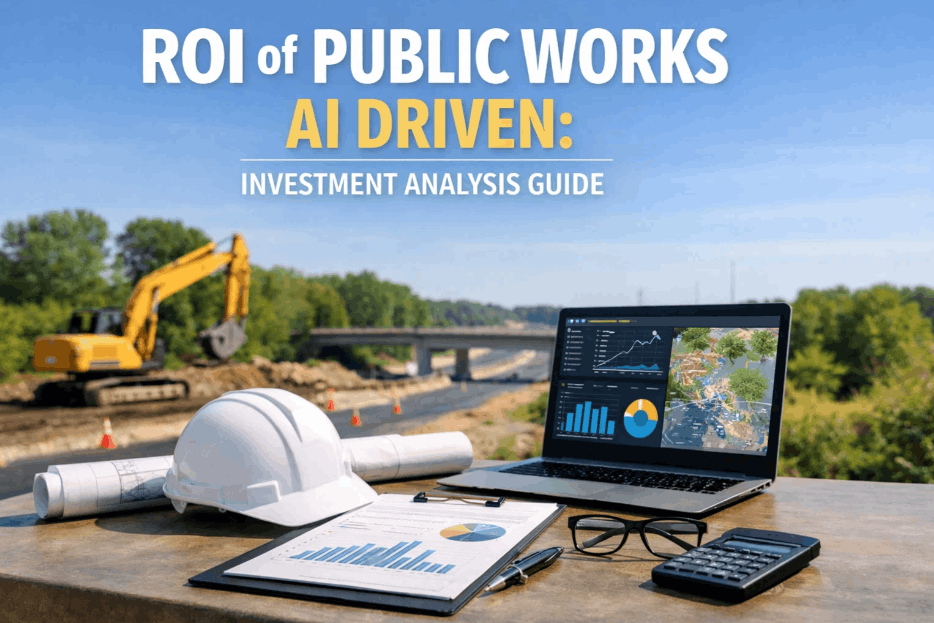
Calculating the ROI of public works technology is no longer just a financial formality — it is a critical mandate for municipal leaders seeking to justify taxpayer investments and secure multi-year budgets. In the infrastructure sector, where a single bridge failure or water system downtime can result in millions of dollars in emergency repairs and public safety liabilities, the ROI of Public Works AI is measured by the delta between reactive repair and predictive precision. For City Managers, Finance Directors, and Public Works Commissioners across the US, UK, and Canada, mastering the investment analysis for government analytics is the key to transitioning from a cost-center to a high-performance value-engine.
What Is the Return on Investment (ROI) for Public Works AI?
Public works ROI analysis is the rigorous process of quantifying the total value generated by an AI deployment — including hard cost savings, deferred capital expenditure, and soft benefits like public transparency. Book a Demo. Unlike standard software, government AI ROI must account for unique municipal variables: jurisdictional compliance, infrastructure lifespan extension, and the avoidance of catastrophic failure payouts.
Fiscal Impact Analysis: TCO vs. Total Value of Ownership
The most common mistake in government procurement is evaluating technology on the license price alone. A comprehensive ROI model must evaluate the Total Cost of Ownership (TCO) against the "Total Value of Ownership" (TVO) — which includes the salvaged value of infrastructure assets that would otherwise reach critical fatigue without AI intervention.
TCO vs. TVO: The Government Investment Matrix
| Investment Dimension | Total Cost of Ownership (TCO) | Total Value of Ownership (TVO) |
|---|---|---|
| Investment Focus | Acquisition & Operational Expense | Life Extension & Fiscal Avoidance |
| Infrastructure Lifespan | Static Manufacturer Cycle | Data-Driven Extension (+30%) |
| Failure Management | Optimized Repair Costs | Total Prevention (100% Saving) |
| Compliance Strategy | Manual Audit Readiness | Continuous Sovereign Visibility |
| Budgeting Model | Reactive Cost Center | Predictive Value Engine |
Synchronize Your Public Works with Real-Time Risk Curves
Identify hidden CAPEX recovery opportunities and eliminate emergency repair premiums across your city-wide infrastructure.
Identifying the "Ghost" Bottlenecks in Municipal Operations
Legacy public works systems hide systemic inefficiencies that bleed municipal budgets through "invisible" friction. iFactory identifies these bottlenecks using automated pattern analysis.
Operational Phase: Measuring Efficiency and SLA Compliance
Once deployed, the ROI of public works AI moves into the "efficiency phase." This is where the integration of field data and predictive modeling creates a feedback loop of productivity. iFactory tracks the "Time-to-Task" metric to prove the business case for digital workforce management.
Workforce Productivity (28% Gain)
iFactory dispatches crews based on GPS proximity and skill certification, eliminating "dispatch lag." This ensures that 100 technicians deliver the output of 128 under a legacy manual system.
SLA Compliance Tracking
Automation provides 100% visibility into repair SLAs. Proving that 99.9% of safety-critical work orders are closed within the required window reduces city liability profiles.
Predictive Part Kitting
AI identifies the exact parts needed for a failure 3 weeks before the technician arrives. This eliminates "double-trips" and search-time at the central warehouse.
Real-Time Risk Scoring
Automated risk curves prioritize high-impact infrastructure maintenance over low-risk decorative tasks, ensuring standard budgets protect critical safety assets first.
Want to see our ROI calculator for your city? Book a Demo to see exactly how iFactory recovers your CAPEX.
ROI Maintenance: Strategy Comparison for Public Assets
The maintenance strategy you choose is the single largest driver of your ROI. Moving from "Reactive" to "AI-Driven Lifecycle" management doesn't just lower costs; it transforms the financial stability of the entire municipality.
| Dimension | Reactive (Break-Fix) | Scheduled (Calendar) | Predictive (Sensor) | AI-Driven ROI Model |
|---|---|---|---|---|
| Unplanned Failures | 15-20% | 5-10% | <1% | <0.05% |
| Annual Labor Spend | Uncontrolled | Fixed High | Lowered | -28% Optimized |
| Public Safety Risk | Extreme | Moderate | Very Low | Managed 0% |
| Audit Documentation | Manual/Missing | Paper Logs | Digital | Instant/Secure |
| CAPEX Recovery | $0 | Limited | Moderate | +$1.4M / City |
| Citizen Satisfaction | Low (Comp-driven) | Moderate | High | Sovereign Proof |
How AI Vision Validates the Public Works ROI Business Case
AI Vision provides the "Visual Truth" that finances directors need to prove work completion and asset health. By analyzing camera data from city vehicles and stationary infrastructure, AI Vision provides a 100% accurate record of asset condition — eliminating the need for expensive manual specialty inspections.
Government agencies in the USA and Canada use iFactory AI Vision to automate their regional infrastructure reporting. Book a Demo to see the ROI of visual governance.
The ROI Trajectory: 12-Month Municipal Savings Milestone
Implementing an AI-driven public works platform follows a specific three-phase ROI trajectory. In Month 1, the value is in Visibility. By Month 6, the value is in Efficiency. By Month 12, the value is in Capital Recovery.
Frequently Asked Questions
Transition your public works department from a cost center to a value engine. iFactory provides the data, the analytics, and the visual proof required to justify your AI investment and protect your municipal infrastructure for the next generation.