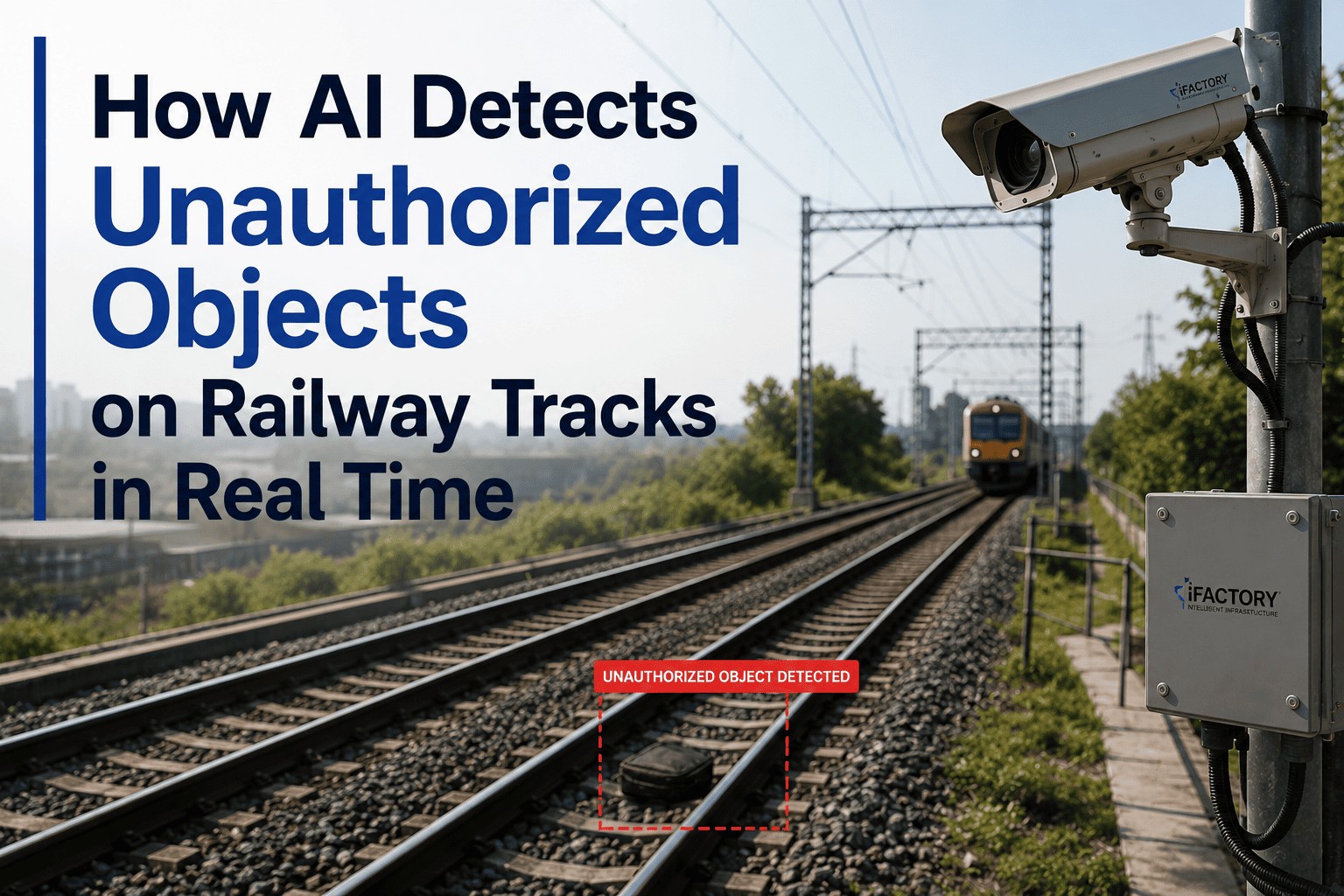
How AI Detects Unauthorized Objects on Railway Tracks in Real Time

By Grace on May 25, 2026

ai-detects-unauthorized-objects-railway-tracks

A train travelling at 200 km/h covers 55 metres every second. At that speed, the gap between a foreign object appearing on the track and an unavoidable collision can be measured in seconds — sometimes less. Manual patrols, physical fencing, and legacy video monitoring systems were never built to close that gap reliably. They miss small objects, fail at night, degrade in rain and fog, and require a human to be watching a screen at exactly the right moment. AI unauthorized object detection on railway tracks changes that equation entirely — using computer vision, LiDAR, and sensor fusion to identify pedestrians, animals, rocks, fallen debris, and vehicles on or near the track in real time, and triggering alerts before a collision becomes unavoidable. This is how modern AI detection systems actually work, and why rail operators deploying them are achieving detection accuracy above 90% in live operational environments. Book a Free Demo to see iFactory's intelligent railway infrastructure platform in action.

55m Distance a train at 200 km/h covers in one second

95%+ Human detection accuracy achieved by deep learning monitoring systems

91.8% Mean IoU accuracy for AI track segmentation and object classification

24/7 Continuous monitoring across night, fog, rain, and tunnel conditions
AI RAILWAY INFRASTRUCTURE PLATFORM
Is Your Track Network Still Relying on Manual Patrols and Legacy Cameras?
iFactory's AI infrastructure platform connects computer vision, LiDAR sensing, and real-time alert workflows — detecting every intrusion class across your full track network, day and night.
THE CORE PROBLEM

Why Traditional Track Monitoring Cannot Keep Pace With Modern Rail

The Detection Gap That Puts Every Train at Risk

Track intrusion — trespassing, animals straying onto rails, rockfalls, fallen trees, vehicles at level crossings — is one of the leading causes of serious railway accidents worldwide. The challenge is not that these events are unpredictable. The challenge is that existing monitoring systems were not designed for real-time, autonomous response. Manual patrols cover only a fraction of the network at any given time. Physical barriers are breached routinely. Legacy CCTV requires a human observer watching continuously. And none of these methods can reliably detect a small object — a rock, a bag, a child — on a high-speed line in time to stop a train.

Critical
Manual patrol gaps
A patrol team covering 50km of track cannot physically verify every section more than once or twice per shift. Between checks, anything can appear on the line — with no one aware until the next scheduled pass.
High risk
Legacy CCTV limitations
Fixed cameras provide static coverage with no automated detection logic. Night performance degrades sharply. Rain, fog, and motion blur create false negatives. And a human operator cannot watch hundreds of feeds simultaneously.
Operational
False alarm overload
Conventional sensor systems generate high false alarm rates — vibration triggers from wind, lighting artefacts flagged as intrusions. Each false alert desensitises operators and delays response to genuine hazards.
HOW IT WORKS

The AI Detection Stack — From Camera Feed to Stop Signal in Seconds

Four sensor and intelligence layers working in concert

Modern AI track intrusion detection is not a single camera on a pole. It is a layered architecture of sensing hardware, edge processing, deep learning models, and alert infrastructure — each layer solving what the previous one cannot.

01
Computer Vision — Camera-Based Real-Time Classification
High-resolution cameras mounted trackside or onboard trains feed continuous video into deep learning object detection models — primarily YOLO-architecture variants trained on railway-specific datasets. These models classify what they see: person, animal, vehicle, debris, or clear track. Detection happens at frame-level speed, identifying intrusions in complex backgrounds — curved tracks, tunnels, varying light — with mean average precision exceeding 83% on validated railway datasets. Semantic segmentation models simultaneously define the track boundary, so any object within the danger zone triggers an alert regardless of type.
YOLO real-time detection Semantic track segmentation Multi-class classification Night and tunnel capable

02
LiDAR Sensing — 3D Spatial Mapping Beyond Camera Range
3D LiDAR sensors complement camera systems with precise spatial data — measuring the exact position, size, and distance of any object within the detection zone, up to 300 metres ahead. Operating at 10–20 frames per second with ±3cm accuracy, LiDAR is unaffected by lighting conditions, making it the primary sensing layer for tunnels, nighttime operations, and adverse weather. Vehicle-mounted LiDAR on the train itself dynamically scans the track ahead, giving the driver and control systems an early warning window determined by detection distance and train speed — not by whether a camera happened to be positioned at that point.
300m detection range ±3cm positional accuracy Weather-independent Onboard and trackside

03
Sensor Fusion and AI Model Layer — Reducing False Alarms
Camera data and LiDAR point clouds are fused at the edge processing layer, where AI models cross-validate detections before alerting. An object classified by the vision model is confirmed by LiDAR spatial data — eliminating false triggers from shadows, blowing debris, or lighting transients that single-sensor systems cannot resolve. Anomaly detection models trained on normal track appearance continuously score each frame against the expected baseline, flagging deviation rather than just known object classes — which means novel or unexpected intrusion types are caught even if they were not present in training data.
Camera + LiDAR fusion False alarm suppression Anomaly baseline scoring Edge processing

04
Alert Workflow and Control Integration
Confirmed detections trigger a tiered alert: immediate in-cab warning to the train driver, simultaneous notification to the signalling control centre, and automatic track segment flagging in the operations management platform. Each alert includes object classification, GPS coordinates, confidence score, and a timestamped image clip. If the system is integrated with automatic train protection (ATP) infrastructure, confirmed high-confidence detections can trigger speed restrictions or emergency braking commands without waiting for human confirmation — removing human latency from the critical response window entirely.
In-cab driver alert Control centre notification ATP integration GPS incident logging
WHAT AI DETECTS

Every Intrusion Class — Classified in Real Time


Trespassers
Pedestrians on the right-of-way, including those who have entered through fence breaches, crossed at non-designated points, or collapsed onto the track. Detected and classified within milliseconds of entry.

Animals
Large animals — cattle, deer, horses — as well as smaller animals triggering track circuit anomalies. Multi-class AI models distinguish species, enabling route-specific risk calibration for wildlife corridors.

Debris and rockfall
Fallen trees, landslide material, rocks, and construction debris. Particularly critical at high-risk cuttings and embankments where geological monitoring alone cannot provide real-time track clearance confirmation.

Vehicles at crossings
Stalled or stranded vehicles within the crossing danger zone, detected and classified even after barrier activation — triggering train warnings before the vehicle can be cleared through manual intervention.

Abandoned objects
Bags, equipment, cargo spillage, and other stationary objects left on or immediately adjacent to the track. Anomaly detection models flag these even when the object class has never been seen in training data.

Track structure anomalies
Displaced track components, damaged sleepers, and deformed rail geometry — detected through comparison against the expected track segmentation baseline, flagging structural deviation before it becomes a derailment risk.
DETECTION PERFORMANCE

What the Research and Deployments Actually Show

83.8%
mAP@0.5 — MACENet Railway Dataset
The MACENet model trained on 7,200 railway images achieved 83.8% mean average precision at IoU 0.5, a 4.9% improvement over baseline YOLOv8 — while maintaining equivalent computational efficiency for real-time deployment.
95.68%
Human Detection Accuracy
Deep learning monitoring systems integrating multiple detection models achieved over 95% overall accuracy for human detection — including across nighttime, weather-degraded, and high-motion scenarios that conventional CCTV systems fail to handle.
91.8%
Track Segmentation MIoU
Semantic segmentation models defining track boundaries achieved 91.8% mean intersection over union — the foundational layer that tells the detection system where the danger zone is, so any object within it triggers an alert regardless of what that object is.
<2s
Detection-to-Alert Latency
End-to-end latency from frame capture to confirmed alert dispatch — across fused camera and LiDAR pipelines on edge-deployed hardware — operates under two seconds. At 200 km/h, this represents over 100 metres of additional braking distance compared to human-observed detection.
Manual monitoring vs. AI detection — the operational gap
Capability Manual / Legacy Systems AI Detection System Outcome
Coverage continuity Patrol gaps of hours 24/7, every metre Zero blind windows
Night / tunnel performance Severely degraded LiDAR unaffected Full dark capability
Small object detection Frequently missed Classified at frame rate Nothing overlooked
Response latency Minutes (human) Under 2 seconds 100m+ extra braking
False alarm rate High — operator fatigue Suppressed via sensor fusion Reliable signal quality
Incident data logging Manual, inconsistent GPS, timestamped, automatic Audit-ready records
FROM REACTIVE TO REAL-TIME
See How iFactory Protects Rail Infrastructure With AI
iFactory connects camera systems, LiDAR sensors, and predictive alert workflows into one intelligence platform — covering your entire track network, around the clock.
FREQUENTLY ASKED QUESTIONS

What Rail Safety Managers Ask About AI Object Detection

Modern AI detection systems address false alarms through two mechanisms. First, sensor fusion — combining camera classification with LiDAR spatial confirmation means a detection is only escalated when two independent sensing modalities agree. A shadow moves across the camera frame but generates no LiDAR return; a person on the track generates both. Second, anomaly scoring — AI models trained on normal track appearance continuously score incoming frames against an expected baseline. Transient artefacts like blowing leaves or lighting flicker produce anomaly scores below the threshold; persistent objects that alter the track appearance exceed it. Together, these approaches have reduced false positive rates to operationally viable levels in deployed railway systems.

Yes — and this is one of the primary reasons LiDAR became a core component of railway intrusion detection rather than cameras alone. LiDAR sensors operate on active infrared pulses and are entirely independent of ambient light. They perform identically in full darkness, in tunnels, and in adverse weather including rain and fog that severely degrade optical camera performance. In high-speed rail deployments, vehicle-mounted LiDAR provides the driver with a continuous 3D map of the track ahead up to 300 metres — well beyond headlight range and completely unaffected by the lighting conditions that make tunnels and nighttime the highest-risk periods for undetected intrusions. Camera systems are still used alongside LiDAR for classification context in lit conditions; the two sensing modalities complement rather than substitute for each other.

AI detection models trained on railway datasets classify a wide range of intrusion categories: pedestrians and trespassers, large and small animals, vehicles at level crossings, fallen rocks and landslide debris, abandoned bags and equipment, fallen trees, and displaced track components. More advanced systems using anomaly detection — rather than pure object classification — go further by detecting any object that deviates from the expected track appearance, even object types not present in training data. This is particularly important for novel hazards like unusual cargo spillage or unfamiliar debris types that a class-trained model might not recognise but an anomaly model would flag as out-of-baseline.

The alert chain is designed for minimum latency. When the AI system confirms a detection — typically within two seconds of the intrusion appearing in sensor data — the alert is simultaneously dispatched to the train cab display, the signalling control centre, and the operations management platform. For vehicle-mounted systems, the driver receives an in-cab visual and audible warning based on the distance to the object and current speed, with time-to-impact calculated in real time. For systems integrated with Automatic Train Protection (ATP) infrastructure, high-confidence detections can trigger automatic speed restrictions or emergency braking commands without requiring human confirmation — removing the reaction time gap entirely. At 200 km/h, a two-second detection-to-alert cycle gives the train over 100 metres of additional braking distance compared to a human-observed incident.

Yes — modern AI infrastructure platforms, including iFactory, are built to connect with existing railway operations platforms, CMMS, GIS systems, and signalling infrastructure through standard APIs and data exchange protocols. The AI detection layer operates independently from certified signalling systems, receiving data and sending alerts without writing to or modifying any safety-critical control equipment — which means it avoids the full re-certification requirements that intrusive system modifications trigger. Alert data, incident logs, GPS records, and detection clips are surfaced through your existing operations dashboard. Integration timelines are typically 30 to 60 days for monitoring and alerting functionality, with deeper ATP integration requiring additional signalling authority coordination.
DETECT EVERYTHING. MISS NOTHING.
Ready to Put AI on Your Railway Track Network?
iFactory's AI platform connects computer vision, LiDAR sensing, and real-time alert workflows into one system — covering every intrusion class, every section of track, around the clock. No infrastructure replacement required.

Share This Story, Choose Your Platform!