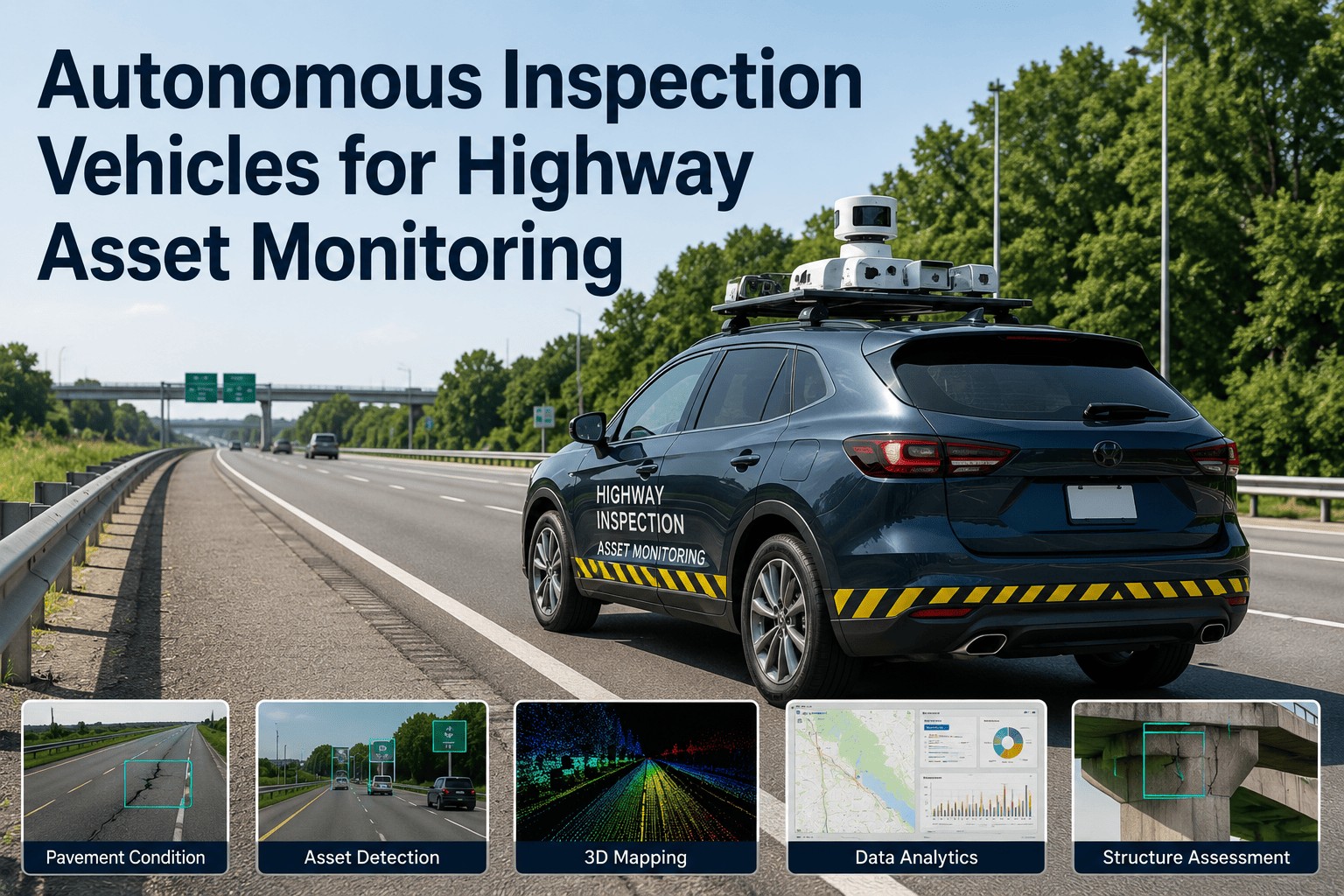
Highways don't fail overnight. They degrade slowly — a hairline crack here, a drainage blockage there — and by the time a visual inspection catches it, the repair bill has multiplied five times over. Autonomous inspection vehicles are changing that equation entirely. Equipped with AI, LiDAR, computer vision, and real-time analytics, these platforms drive, fly, or roll along highway corridors continuously — detecting what humans miss, logging what spreadsheets can't, and flagging what matters before it becomes catastrophic. This is not a future technology. It is operational today across three continents, and the agencies deploying it are cutting inspection costs by up to 50% while achieving defect detection accuracy that manual teams cannot match.
for Highway Asset Monitoring
Why Highway Agencies Are Stuck in a Reactive Loop
Most highway inspection programs run on fixed cycles — every 2 years, every 5 years, or after a complaint. Inspectors walk or drive the corridor, log findings on paper or tablet, and submit reports that take weeks to process. By the time a repair is authorized, the defect has grown. By the time it's repaired, the cost has tripled.
This cycle is not an edge case — it is the operating standard for the majority of highway agencies worldwide. The American Society of Civil Engineers estimates that more than 46,000 US bridges are structurally deficient. The technology to catch defects early exists. The inspection frequency to act on it does not — yet.
The Autonomous Inspection Stack: From Road Surface to Decision
Autonomous inspection vehicles are not simply cameras on wheels. They are multi-sensor platforms that fuse multiple data streams into a single, continuously updated picture of highway condition — processed by machine learning, delivered to asset managers in real time.
Three Ways Autonomous Inspection Reaches Your Highway Assets
No two highway networks are identical. Autonomous inspection platforms are deployed across three primary formats — each suited to different asset types, budget structures, and data frequency requirements.
What Agencies Are Actually Achieving — Published Benchmarks
| Metric | Manual Inspection | Autonomous AI Platform | Difference |
|---|---|---|---|
| Defect Detection Accuracy | ~24% (human visual) | 96% (AI vision) | +300% |
| Inspection Speed | Days per structure | Hours per structure | −75% |
| Data Frequency | Every 2–5 years | Continuous / on-demand | Unlimited |
| Report Turnaround | Weeks to months | Under 4 hours | −95% |
| Worker Safety Risk | High — live traffic exposure | Near-zero — remote operation | Eliminated |
| Operational Cost | Full baseline burden | 40–60% lower | −40–60% |
| Subsurface Detection | None without coring | GPR to 1.5m depth | New capability |
What Highway Agencies Ask Before Deploying Autonomous Inspection
How accurate are autonomous inspection vehicles compared to human inspectors? ▼
AI-powered autonomous inspection platforms achieve approximately 96% defect detection accuracy — compared to roughly 24% for manual visual inspections. The gap exists because human inspectors are limited by line-of-sight, lighting conditions, inspector experience variability, and the physical impossibility of examining every square centimeter of a surface. Autonomous systems with LiDAR, thermal imaging, and computer vision have no such constraints: they scan every point, every pass, with consistent sensitivity. For subsurface defects — moisture infiltration, voids, rebar corrosion — autonomous platforms using ground-penetrating radar and thermal cameras detect issues that are completely invisible to human inspection without destructive testing.
Can autonomous inspection vehicles integrate with our existing asset management systems? ▼
Yes — modern autonomous inspection platforms, including iFactory's infrastructure AI, are designed for integration rather than replacement. Inspection data is delivered via standard APIs to existing GIS platforms, CMMS (like Maximo, SAP, or Fiix), and highway asset management databases. Every defect is georeferenced and tagged with severity scores, enabling direct import into work-order systems without manual transcription. Integration timelines are typically 30–60 days with no disruption to existing operations. The AI layer sits on top of your current infrastructure — consuming data from inspection vehicles and sensors, then pushing prioritized maintenance recommendations into your existing workflows.
What is the typical ROI timeline for autonomous highway inspection deployment? ▼
Most highway agencies see measurable ROI within 60–90 days of deployment. The fastest return typically comes from three sources: avoided emergency repairs (catching defects before they become crisis-level), reduced manual inspection crew costs (37% fewer manual inspections required on average), and faster maintenance scheduling — the 42% scheduling efficiency improvement means repair crews are deployed more precisely, reducing both overtime and mobilization costs. For agencies managing 500km or more of highway, combined annual savings from reduced inspection costs, averted emergency repairs, and optimized maintenance scheduling consistently exceed $400,000 — against platform investments that pay back within 12 to 18 months in most documented deployments.
Do autonomous inspection vehicles require lane closures or traffic disruption? ▼
Ground-based inspection vehicles travel at normal highway speeds within existing traffic lanes — no closures, no contraflow, no TMP required for routine data collection. UAV-based inspection of bridges and elevated structures operates within FAA airspace frameworks and typically requires only standard exclusion zones beneath the structure, not full lane closures. In many bridge inspection deployments, drone operations eliminated the scaffold erection and lane closure sequences that previously took 2–3 days per structure. The net effect: more frequent inspections, zero traffic disruption, and dramatically lower worker safety risk — inspectors are replaced by remote operators working from a safe vantage point or control room.
Is autonomous inspection viable for smaller highway agencies with limited budgets? ▼
Absolutely — and the economics often favor smaller agencies more than large ones. Cloud-based AI inspection platforms scale efficiently down to networks of 50km or fewer. Hardware costs have dropped significantly: LoRaWAN-connected sensor networks, low-cost UAV platforms, and software-as-a-service AI analytics have removed the capital barriers that previously restricted access to well-funded DOTs. In addition, inspection-as-a-service models allow agencies to contract autonomous inspection runs on a per-kilometer or per-structure basis — converting capital expenditure to operational expenditure and eliminating fleet ownership risk. The road inspection vehicle market already records 31% municipal fleet upgrade activity, indicating growing adoption well below the state DOT tier.