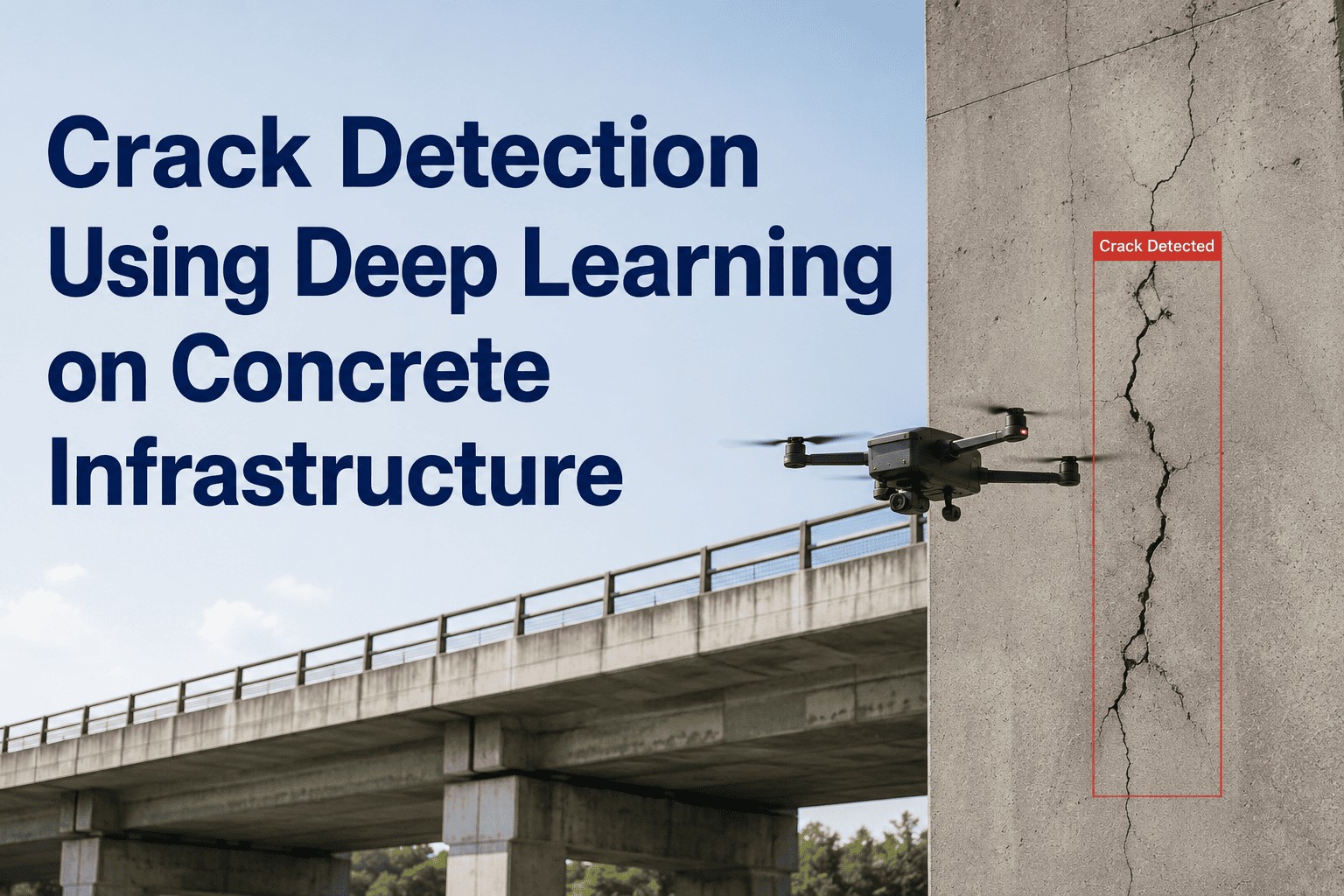
A hairline crack in a concrete beam is the difference between a $200 sealant repair and a $200,000 structural rehabilitation. The problem is that hairline cracks are nearly invisible to busy inspectors, and visual inspection programs reach each asset only every 12 to 24 months. Deep learning is changing that economic equation entirely. Modern convolutional neural networks trained on millions of labelled concrete images can detect cracks down to 0.1 mm width from a smartphone photo, segment crack pixels with mean IoU above 0.85, and classify severity automatically — turning every drone flyover, every inspection walk, every CCTV camera into a continuous crack-monitoring sensor. Published research consistently demonstrates classification accuracy above 95% and pixel-segmentation F1-scores above 0.90 on real concrete imagery, with the most modern architectures pushing past 99% on clean test sets. This article walks through how deep-learning crack detection actually works on concrete infrastructure — the datasets that train it, the CNN architectures that dominate the field, the accuracy benchmarks worth trusting, and the deployment realities operators hit on day one. Book a Demo to see iFactory's crack-detection pipeline running on live infrastructure today.
Technical Article · Deep Learning Crack Detection
From Hairline Cracks to Pixel-Perfect Segmentation — at Scale.
iFactory orchestrates VGG, ResNet, U-Net, and Mask R-CNN architectures with transfer learning and edge inference — detecting and segmenting cracks on bridges, buildings, tunnels, and dams across the UK, EU, and MENA infrastructure networks.
95%+
Classification accuracy typical of modern CNN architectures on concrete imagery
0.90+
F1-score on pixel-level crack segmentation in published research
0.1 mm
Minimum crack width detectable with high-resolution imagery + DL
30+ fps
Real-time inference on edge devices using quantised models
Three Tasks, Three Models — Knowing What You Actually Need
"Crack detection" is not one problem — it is three. Each task uses a different deep-learning approach and gives different output. Picking the right one matters more than picking the latest model.
Task 01
Classification
Does this image patch contain a crack?
Binary or multi-class output per image patch. The simplest, fastest task. Best for high-throughput screening of large image volumes from drones or fixed cameras.
Typical models: VGG-16, ResNet-50, Inception-v3, MobileNet
Task 02
Detection
Where is the crack in the image?
Bounding box localisation around each crack region. Single-stage YOLO or two-stage Faster R-CNN both work — choose by speed-versus-accuracy trade-off.
Typical models: YOLOv7/v8, Faster R-CNN, RetinaNet
Task 03
Segmentation
Which pixels are crack, which are background?
Pixel-precise mask of each crack. Required for crack-width measurement, length calculation, and quantitative deterioration tracking over time.
Typical models: U-Net, FCN, DeepLabv3+, Mask R-CNN
The CNN Architectures Doing the Work
Six architecture families dominate concrete crack detection. Each has its own strength, weakness, and deployment niche.
A1
VGG-16 / VGG-19
Classic deep CNN with stacked 3×3 convolutions. 138M and 144M parameters respectively. Reliable baseline for transfer-learning starts and still widely used in crack classification studies.
Best for: simple binary crack-vs-no-crack classification, baseline benchmarking.
A2
ResNet-50 / ResNet-101
Residual connections prevent vanishing gradients in deeper networks. The default backbone for high-accuracy crack classification and the encoder in many segmentation architectures.
Best for: production crack classification, multi-class severity rating.
A3
U-Net & Encoder-Decoder Variants
U-shaped architecture with skip connections — originally for biomedical segmentation, now the workhorse of pixel-level crack mapping. Segments a 512×512 image in well under a second on modern GPUs.
Best for: pixel-precise crack segmentation, crack-width measurement.
A4
Mask R-CNN
Two-stage detector with per-region segmentation masks. Strong on multi-class detection where cracks, spalling, leakage, and corrosion appear together in one image.
Best for: multi-defect detection on bridges, tunnels, and dams.
A5
YOLO Single-Stage Detectors
Real-time detection at 30+ fps on edge hardware. Bounding-box outputs are less precise than segmentation but more than adequate for triage and screening.
Best for: live drone inspection, on-vehicle crack screening.
A6
MobileNet & Lightweight CNNs
Compact architectures designed for mobile and embedded deployment. With quantisation-aware training, models drop into smartphone-class hardware while preserving useful accuracy.
Best for: smartphone inspection apps, UAV onboard inference.
Training Data — The Real Bottleneck
A deep-learning model is only as good as the images it learns from. Most concrete crack model failures trace back to dataset gaps, not architecture choices.
01
Public Concrete Crack Datasets
SDNET2018, CCIC, Crack500, and DeepCrack provide tens of thousands of labelled images across bridges, walls, and pavements — a strong starting point for transfer learning.
02
Transfer Learning from ImageNet
Pre-training on ImageNet's 14M general images and fine-tuning on a few thousand concrete images is the standard recipe. Reduces labelled-image requirement by 10–50×.
03
Augmentation Pipeline
Rotation, flip, brightness jitter, Gaussian noise, and synthetic shadow generation expand a 5,000-image dataset into 50,000 effective training samples.
04
Facility-Specific Labelling
A few hundred images annotated from your own assets — bridges with your specific lighting, surface texture, weathering — typically lift production accuracy by 10–15%.
The Production Crack Detection Pipeline
From raw imagery to actionable maintenance work order — five stages, fully automated. The human enters only at engineering review.
Stage 01
Image Capture
Drone, vehicle-mounted camera, fixed CCTV, or smartphone inspection app. Resolution typically 4–12 megapixels with GPS metadata.
Stage 02
Preprocessing
Tile large images into 256×256 or 512×512 patches. Apply Retinex enhancement for uneven lighting. Reject blurred frames automatically.
Stage 03
CNN Inference
Classification + segmentation pass. Edge-deployed quantised models for live; deeper models in cloud for batch reprocessing of flagged sections.
Stage 04
Crack Quantification
Width, length, orientation, and density measured per crack from segmentation masks. Output georeferenced and asset-tagged.
Stage 05
Maintenance Trigger
Severity threshold determines action: log, schedule inspection, or auto-generate work order in CMMS for engineering review and intervention.
Accuracy Benchmarks — Reading the Numbers Honestly
Published accuracy claims dominate vendor marketing. These benchmarks are taken from real peer-reviewed research on concrete crack detection.
Task
Architecture
Metric
Typical Result
Binary crack classification
VGG-16 + transfer learning
Test accuracy
97–99%
Multi-class defect classification
ResNet-50 ensemble
Top-1 accuracy
92–96%
Pixel-level crack segmentation
U-Net / CrackSegNet
Mean IoU
0.85–0.90
Pixel-level crack segmentation
U-Net / DeepCrack
F1-score
0.90–0.94
Multi-defect detection (tunnel)
Mask R-CNN + morphology
Overall accuracy
~82%
Edge inference (MobileNet QAT)
MobileNetV2 + quantisation
F1 (vs FP baseline)
0.83 (~60% energy saved)
Real-world accuracy is typically 5–15% below published benchmarks due to lighting, weathering, and asset-specific background noise. Facility-specific fine-tuning closes most of the gap within 3–6 months.
Five Deployment Realities Teams Hit on Day One
01
Background noise dominates false positives. Concrete formwork lines, joints, stains, cables, and graffiti all look like cracks to a poorly trained model. Multi-class training with explicit distractor classes solves this.
02
Class imbalance crashes early models. Crack pixels are 1–5% of every image. Without weighted loss (focal loss, Dice loss), the model collapses to "no crack" predictions everywhere.
03
Lighting variation breaks generalisation. Models trained on noon imagery fail on dusk or shadowed photos. Augmentation must explicitly cover the lighting range your real deployment will see.
04
Width measurement is harder than detection. Detecting a crack exists is one problem; measuring its sub-millimetre width accurately is another. Calibration against known reference targets is essential.
05
Edge versus cloud is a trade-off, not a choice. Real-time alerts need on-device inference; high-accuracy quantification needs cloud GPU. Production pipelines run both.
iFactory Crack Detection Platform
Catch the 0.1 mm Crack Today. Skip the $200,000 Repair Tomorrow.
iFactory orchestrates classification, detection, and segmentation models with transfer learning and edge inference — deployed on bridges, tunnels, buildings, and dams across utilities, transport, and water authorities.
Trusted by infrastructure engineers, asset owners, and inspection teams managing multi-billion-dollar concrete portfolios.
Frequently Asked Questions
Tap any question to reveal the answer.
There is no single best model — it depends on the task. For binary classification (crack / no crack on image patches), VGG-16 or ResNet-50 with transfer learning typically reaches 97–99% accuracy. For pixel-level segmentation needed to measure crack width and length, U-Net and its derivatives (CrackSegNet, CrackRecNet, DeepCrack) deliver mean IoU 0.85–0.90 and F1 around 0.90. For multi-defect detection where cracks co-occur with spalling or leakage, Mask R-CNN is the standard. For real-time edge inference on drones or smartphones, MobileNet with quantisation-aware training preserves most accuracy at a fraction of the compute. Book a demo to see the full stack.
Far less than people assume — thanks to transfer learning. A baseline production classifier needs roughly 3,000–10,000 labelled image patches plus heavy augmentation (rotation, flip, brightness, noise). Pixel-level segmentation models need 5,000–15,000 mask-annotated images for strong performance. Pre-training on ImageNet's 14M general images and fine-tuning on concrete imagery reduces the facility-specific labelling burden by 10–50×. Many deployments start with a public dataset like SDNET2018 or DeepCrack and add a few hundred facility-specific images to capture local conditions.
Both — but they are different problems. Detection (does a crack exist) is solved by classification or bounding-box models at high accuracy. Width measurement requires pixel-level segmentation plus camera calibration. The standard approach is to extract the segmentation mask, skeletonise it to a 1-pixel-wide centreline, and measure perpendicular pixel widths along that centreline. Conversion from pixels to millimetres requires either a known reference target in the image (sticker, scale bar) or calibrated camera-to-surface distance. Production deployments routinely measure cracks down to 0.1 mm with high-resolution imagery.
Yes — but only when explicitly trained for it. The dominant cause of false positives in real deployments is background features that visually resemble cracks. The fix is multi-class training: instead of binary crack-vs-background, train the model with separate explicit classes for formwork joints, cables, stains, graffiti, shadows, and surface texture. The model learns specific features for each distractor instead of treating everything that is not a crack as one class. Augmentation must include these distractor classes in proportion to their real-world occurrence in your imagery.
No — and regulators do not currently allow it to. Periodic visual inspections by qualified engineers remain mandatory under most infrastructure safety frameworks (FHWA, AASHTO, UK ORR, EU ERA, national dam safety regulators). AI augments those inspections by providing continuous monitoring between mandated cycles, flagging early-stage defects that human inspection misses, and producing audit-ready documentation for safety reviews. The combined approach — mandated inspection plus continuous AI monitoring — produces measurably better outcomes than either alone, particularly on aging concrete portfolios.
iFactory connects natively to SAP PM, IBM Maximo, Fiix, Infor EAM, OxMaint, and other major CMMS platforms via REST API. Detected cracks flow with their geo-referenced location, severity classification, width measurement, and AI confidence score directly into the maintenance workflow — auto-generating work orders against your existing approval process. Visual evidence (annotated images, segmentation overlays) is attached automatically for inspector review. The platform layers on top of your existing inspection and asset management stack — no rip-and-replace required, and typical integration is completed in 2–4 weeks.