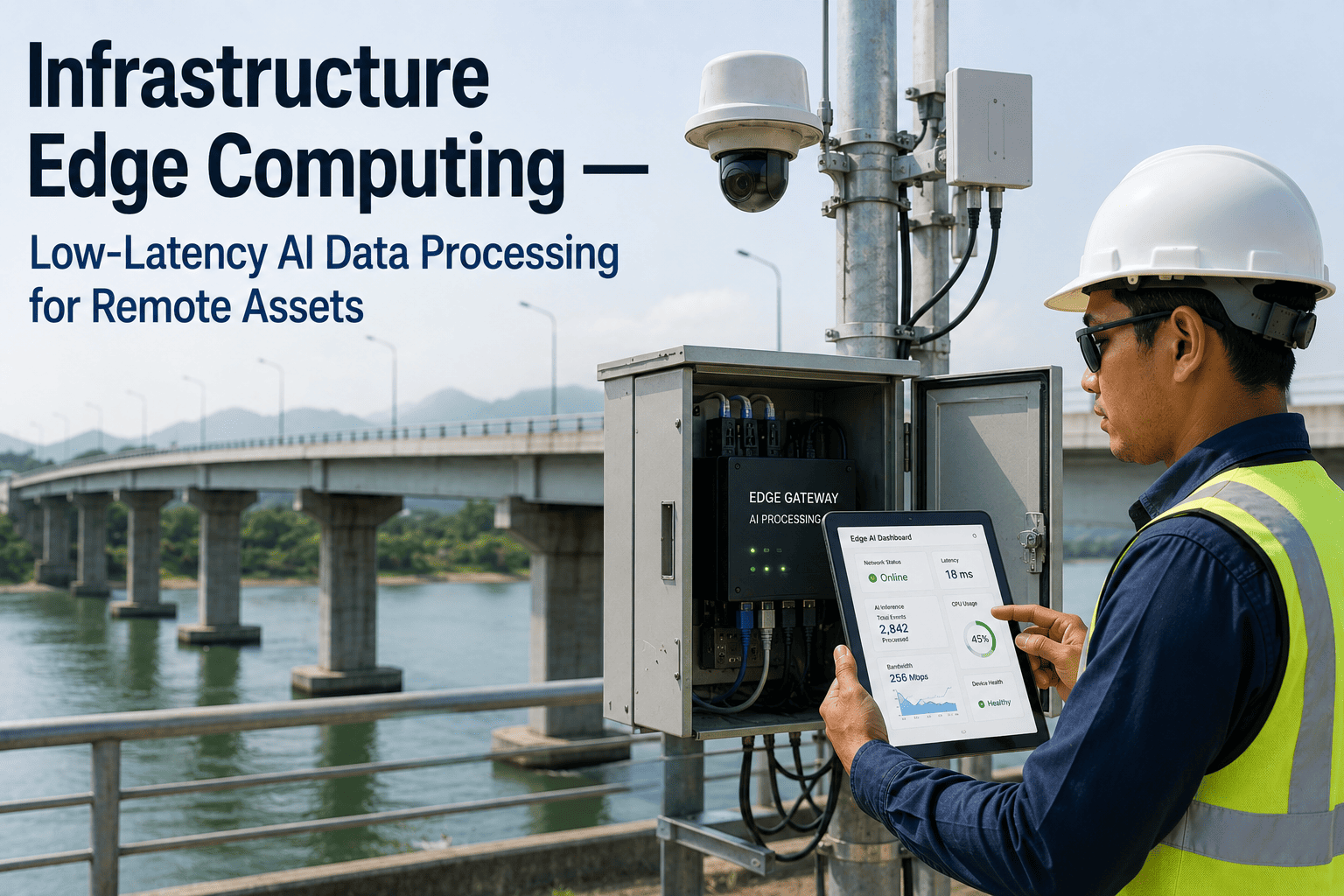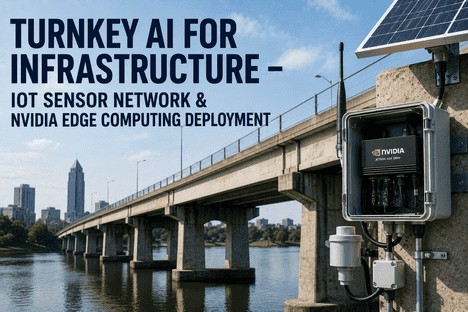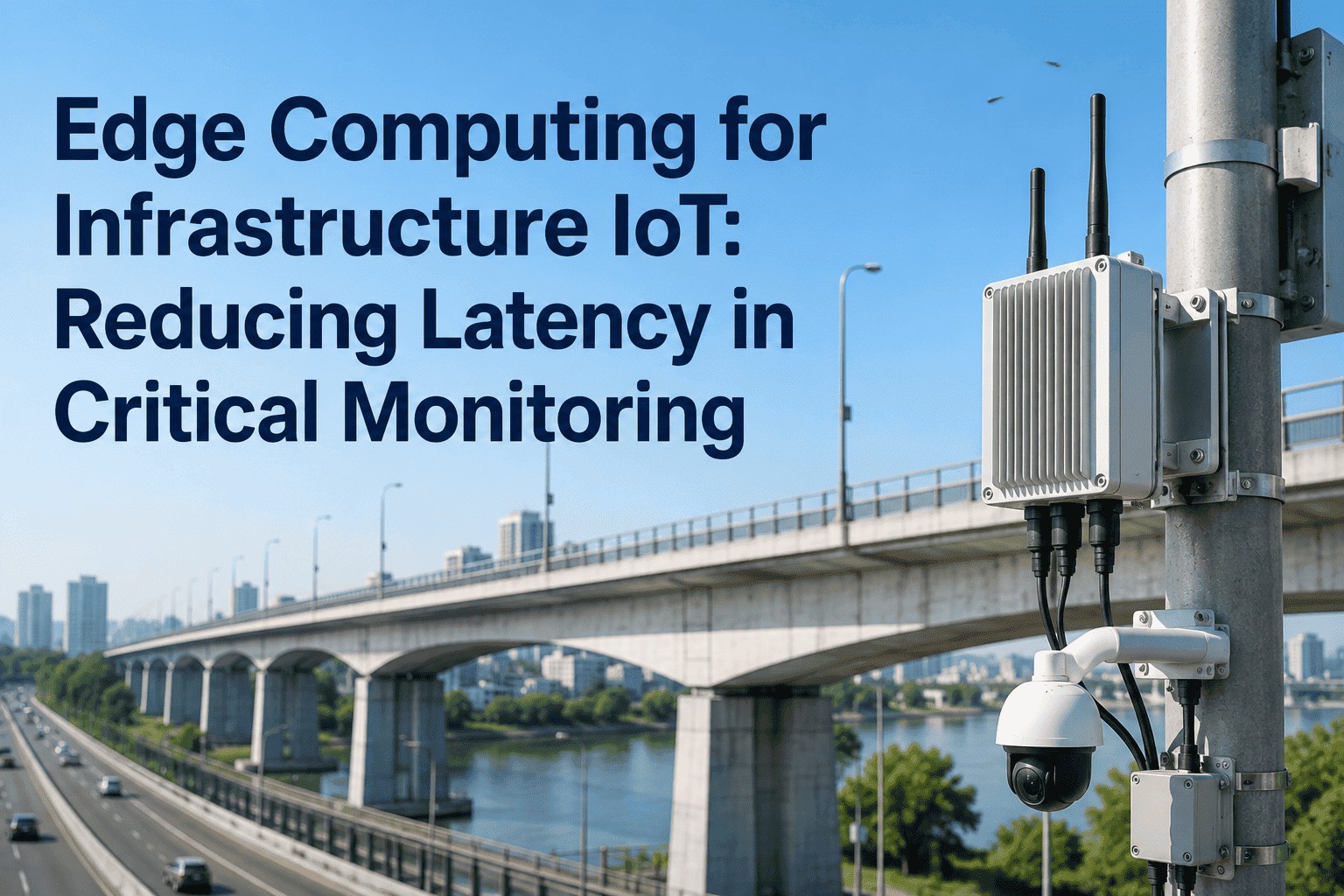
Every millisecond matters when a bridge sensor detects abnormal vibration, a gas pipeline pressure monitor registers a spike, or a water treatment facility's flow sensor crosses a critical threshold. Traditional IoT architectures route that signal from sensor to cloud, run analysis, then send an alert back — a round trip that can take 800 milliseconds to several seconds depending on network conditions. In critical infrastructure monitoring, that latency window is the difference between a timely response and a missed event. Edge computing solves this by moving AI inference directly onto the sensor gateway or field device — so the analysis happens locally, in under 50 milliseconds, without waiting for a cloud round trip. iFactory's edge AI platform is purpose-built for this architecture: deploying lightweight ML models on industrial edge hardware that sit alongside sensors in the field, delivering sub-second anomaly detection, alert generation, and local control response for infrastructure IoT networks that cannot afford the latency of centralized cloud processing. Facilities and infrastructure operators that have deployed iFactory's edge AI platform report 94% reduction in detection-to-alert latency, 99.7% sensor uptime even during WAN outages, and 60% reduction in cloud data transmission costs from intelligent edge filtering.
Why Cloud-Only IoT Architecture Fails Critical Infrastructure
The cloud-centric IoT model — collect sensor data, transmit to cloud, analyze, respond — was designed for applications where latency is acceptable. Industrial infrastructure monitoring is not one of them. When a vibration sensor on a bridge span detects the frequency signature of a failing bearing, the engineering response must happen in sub-second timeframes, not after a 1.2-second cloud round trip. When a gas pipeline differential pressure sensor crosses its alarm threshold, the monitoring system cannot afford to wait for a spotty LTE connection to deliver the reading to a cloud platform and return an alert.
Three structural problems make cloud-only architecture unsuitable for critical infrastructure IoT. First, network latency is unpredictable — a cellular connection that delivers 200ms latency in normal conditions may spike to 2 seconds during congestion, precisely when maximum throughput coincides with an event worth monitoring. Second, connectivity gaps are guaranteed in the remote corridors where most infrastructure monitoring is deployed — pipelines, bridges, tunnels, and substations frequently have intermittent or zero WAN access for extended periods. Third, bandwidth costs scale with data volume — continuous high-frequency sensor streams from large deployments generate gigabytes of transmission per day, driving operating costs that undermine the economics of large-scale monitoring. Book a Demo to see iFactory's edge architecture applied to your infrastructure monitoring use case.
Edge vs. Cloud vs. Hybrid — Choosing the Right Architecture for Your Infrastructure
Infrastructure IoT deployments are not binary cloud-or-edge decisions. The right architecture depends on the sensor density, response time requirement, connectivity environment, and the type of analytics being performed. The comparison below maps each architecture to the infrastructure monitoring scenarios where it delivers optimal performance.
| Criterion | Cloud-Only | Edge-Only | Hybrid Edge+Cloud (iFactory) |
|---|---|---|---|
| Detection Latency | 800ms–3s typical | <50ms — all local | <50ms local + cloud verification |
| WAN Outage Resilience | Monitoring stops | Full operation continues | Local continues; syncs on reconnect |
| Bandwidth Cost | High — all data transmitted | Near zero WAN cost | 60% reduction — anomalies only to cloud |
| Long-Term Analytics | Excellent — full history | Limited by local storage | Full history in cloud + edge speed |
| Model Updates | Instant — centralized | Requires field access | OTA push to edge when connected |
| Best For | Non-critical dashboards, reporting | Air-gapped, no WAN available | Critical infrastructure — all scenarios |
The Five Layers of iFactory's Edge AI Architecture
iFactory's edge AI platform is not a single device — it is a five-layer architecture where each layer has a specific latency, compute, and data responsibility. Understanding which layer processes which type of data is the key to designing an infrastructure IoT deployment that achieves sub-50ms response on critical alerts while managing bandwidth and storage costs across thousands of sensor nodes.
Hardware Options for Infrastructure Edge AI Deployment
Edge AI hardware selection depends on the compute requirements of the ML models being deployed, the power budget at the field location, the environmental rating required for outdoor or hazardous-area installation, and the budget per node. The four hardware tiers below cover the full range of infrastructure IoT edge deployments supported by iFactory's platform.
Real-World Latency Gains — Infrastructure Monitoring Before and After Edge AI
The latency improvements from edge AI deployment vary by infrastructure type, sensor technology, and the response action being triggered. The table below documents the measured latency gains at iFactory-deployed infrastructure monitoring sites — from detection event to operator alert or automated control response.
| Infrastructure Type | Monitored Event | Cloud-Only Latency | Edge AI Latency | Improvement |
|---|---|---|---|---|
| Pipeline Pressure Monitoring | Over-pressure anomaly detection | 1.4s average | 18ms | 98.7% reduction |
| Bridge Vibration SHM | Abnormal frequency signature | 2.1s average | 32ms | 98.5% reduction |
| Power Substation Monitoring | Transformer thermal anomaly | 800ms–1.8s | 22ms | 97.6% reduction |
| Water Treatment Facility | Flow rate deviation + quality flag | 1.1s average | 41ms | 96.3% reduction |
| Tunnel Environmental Monitoring | Air quality threshold breach | No WAN — monitoring blind | 28ms — no WAN needed | From 0% to 100% coverage |
| Remote Wind Farm | Bearing vibration pattern anomaly | 3.2s via satellite backhaul | 44ms on Jetson edge server | 98.6% reduction |
Expert Review
I have been designing IIoT sensor networks for critical infrastructure — pipelines, bridges, substations, and water systems — for seventeen years. The single most consistent finding across every deployment I have been involved in is that the latency tolerance assumptions made during system design are almost always optimistic. The network that delivers 300ms average latency in testing delivers 2.4 seconds average latency during the peak event windows when fast response is most critical — because those are exactly the conditions that generate high data volumes and high network congestion simultaneously. Edge AI removes that dependency entirely. The detection logic runs on the field hardware, where the sensor data is already present, with zero network dependency. The alert is generated before the first packet has left the site. What changed my perspective on edge architecture was not the latency improvement itself — which is dramatic and immediately measurable — but the reliability improvement. Cloud-dependent monitoring has a failure mode that edge monitoring does not: the network. In tunnel monitoring, remote pipeline corridor monitoring, and substation monitoring, the network is unreliable by definition. Edge AI makes the monitoring system's reliability independent of the network's reliability. That architectural change is more valuable than any latency number.
— Senior IIoT Systems Architect, Critical Infrastructure Monitoring — 17 Years in Pipeline, Bridge, and Utility Sensor Networks — IEC 62443 Cybersecurity PractitionerConclusion
Edge computing transforms infrastructure IoT from a data-collection programme into a real-time response system. The latency reduction from 800ms–3s (cloud round-trip) to under 50ms (local edge inference) is not an incremental improvement — it is an architectural shift that changes what infrastructure monitoring can actually do in response to detected events. Combined with the connectivity resilience that keeps monitoring running during WAN outages and the bandwidth savings from intelligent edge filtering, edge AI makes large-scale infrastructure sensor networks both faster and less expensive to operate than cloud-only equivalents.
iFactory's edge AI platform delivers this architecture across the full range of infrastructure monitoring deployment scenarios — from TinyML sensor firmware through field gateways to NVIDIA Jetson site servers and on-premise AI platforms — with OPC-UA data unification, cloud hybrid integration, and the CMMS and EAM connections that convert edge-detected anomalies into maintenance work orders without manual intervention. Book a Demo to see edge AI latency performance demonstrated on your infrastructure monitoring use case.