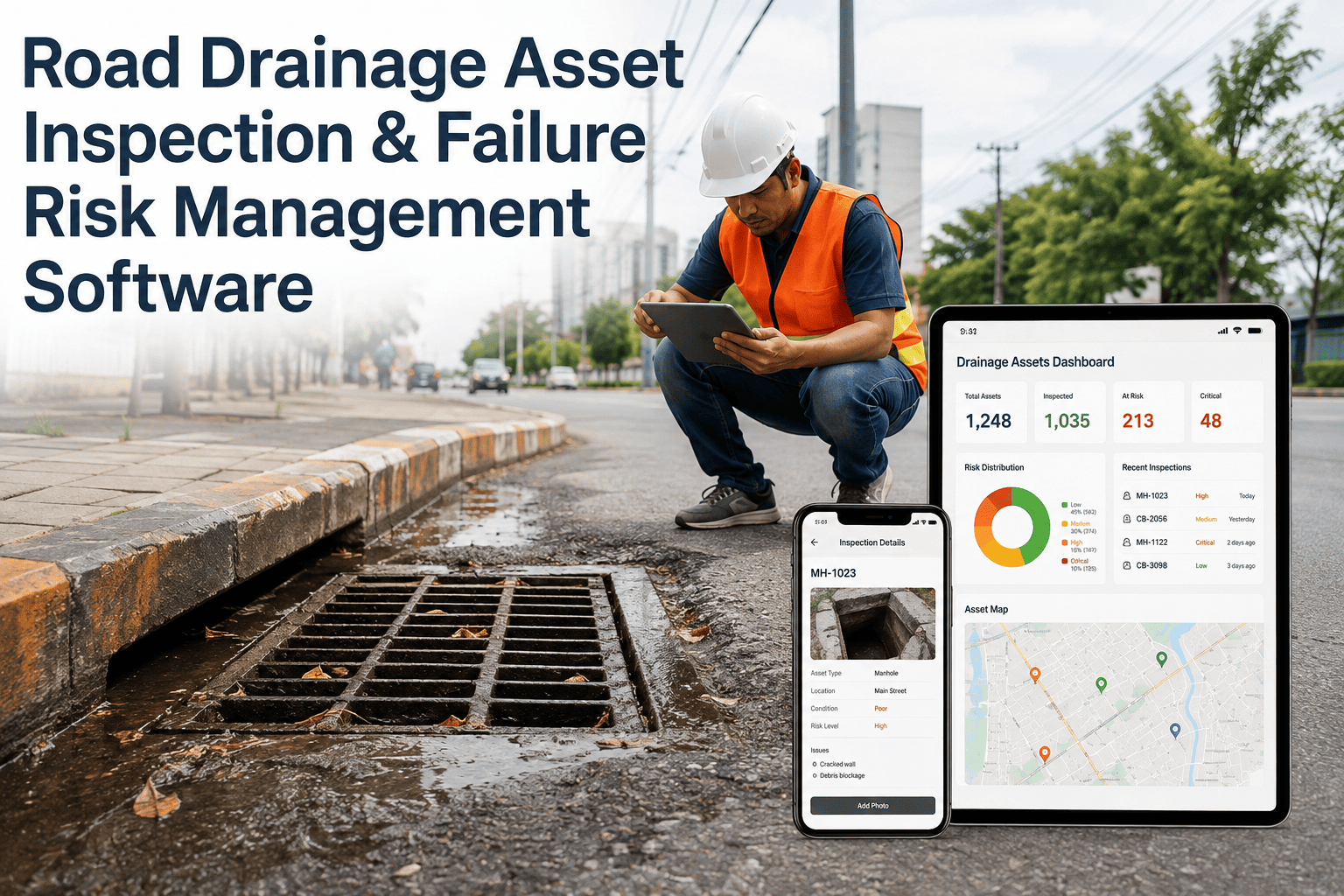
Road maintenance teams across the world share a frustrating reality: they find out a road is failing when drivers start filing complaints — or worse, when an emergency crew is already on site. A cracked sub-base does not announce itself. Fatigue damage forming 8 inches below the asphalt surface is invisible to any scheduled inspection walkdown. Yet the physical warning signs are there, measurable, and detectable weeks before the surface ever breaks. IoT sensor networks paired with AI predictive analytics close that gap entirely — flagging pavement degradation up to 60 days before failure reaches the surface, at a fraction of the cost of emergency reconstruction. If your transport authority or public works department is still managing road asset health on visual inspection cycles and reactive repair orders, the data shows you are paying 7× more per lane-mile than organizations that have already made the shift. Book a live demo with iFactory to see how AI pavement intelligence works on your network data.
INTELLIGENT PAVEMENT MONITORING
60-Day Early Warning.
Zero Emergency Closures.
iFactory's IoT + AI platform detects pavement degradation signatures deep below the surface — triggering automated work orders before a single pothole forms, and before a single lane closes unplanned.
60days
Advance failure detection window with embedded IoT sensors + AI
7×
Cost multiplier of emergency reconstruction vs. early-stage intervention
40%
Reduction in annual highway maintenance costs with AI predictive systems
91%
Detection accuracy for fatigue cracking on high-load arterials (iFactory data)
Why Roads Fail While Nobody Is Watching
The Structural Blindspot in Every Traditional Inspection Programme
Pavement failure is almost never sudden. It is a cascade that takes weeks to months to reach the surface — and every stage of that cascade produces a measurable physical signal. Micro-fatigue cracks form at the bottom of the asphalt layer under repeated axle loading. Sub-base stiffness gradually degrades as moisture infiltrates. Thermal cycling opens hairline fractures that water then enlarges. By the time a visual inspection crew sees a crack, the structural damage beneath it is already advanced. The repair required is no longer a crack seal or a targeted inlay. It is a full-depth reconstruction — costing between $25,000 and $80,000 per lane event, plus emergency crew mobilisation, overnight freight for materials, and unplanned traffic disruption that carries its own public liability exposure.
Traditional maintenance programmes — whether reactive or fixed-schedule preventive — share the same fundamental flaw: they use surface-visible evidence as the primary decision trigger. IoT-based structural monitoring inverts this entirely. The sensor network is inside the pavement structure, detecting degradation at the earliest physical stage, not waiting for it to propagate to the surface.
The US DOT finding every public works CFO should know
Every $1 spent on timely pavement maintenance prevents approximately $7 in future repair costs. The gap between those two numbers is entirely a timing problem — and IoT + AI is the timing solution.
The Sensor Layer: What Goes Inside a Smart Road
Six Sensor Technologies That Make Pavement Degradation Visible Before It Is
Detection window: 45–60 days
Piezoelectric Sensors
Detect vehicle weight and axle frequency in real time. AI correlates overloaded vehicle events with accelerated sub-base degradation and adjusts failure timelines dynamically.
Detection window: 30–50 days
MEMS Accelerometers
Wireless MEMS sensors detect shifts in vibration frequency spectra. Sub-base stiffness loss — often the earliest structural precursor — shows up as a measurable frequency drift weeks before visible symptoms appear.
Detection window: 40–60 days
Temperature + Moisture
Sub-surface moisture tracking combined with thermal gradient data predicts freeze-thaw cracking zones in cold climates 4–8 weeks in advance of surface expression.
Detection window: 28–45 days
Vehicle-Mounted Sensors
Accelerometers on patrol vehicles or connected fleet assets generate continuous surface-level condition data across an entire network — delivering broad-area detection without embedded sensor infrastructure investment.
Detection window: 14–30 days
From Raw Signal to Scheduled Work Order: The AI Pipeline
How iFactory Converts Sensor Data Into Actionable Maintenance Intelligence in 5 Stages
01
Data Ingestion & Edge Processing
Sensor streams collected via LoRa, Zigbee, or 4G/5G gateways. Edge-layer processing filters noise and compresses signal data before cloud transmission — ensuring zero-latency alerts for critical structural events.
↓
02
Baseline Modelling Per Segment
AI builds a behavioural baseline for every road segment under normal traffic, load, and weather conditions. This baseline is the reference point against which all future signals are compared.
↓
03
Anomaly Detection
Temporal Convolutional Networks (TCNs) flag deviations from baseline continuously. A sub-1% drift in vibration frequency triggers elevated monitoring before any human inspector would notice a change.
↓
04
Failure Probability Scoring
Each segment receives a live health score updated every monitoring cycle. The rate of score degradation feeds a probabilistic model that predicts time-to-failure with documented 91% accuracy for fatigue cracking.
↓
05
Automated Work Order Generation
When failure probability crosses the configured threshold, iFactory auto-generates a CMMS work order with treatment type (crack seal vs. mill-and-inlay vs. full-depth repair), materials list, and an off-peak scheduling window. No dispatcher required.
See the pipeline running on live pavement data
iFactory connects to your existing sensor infrastructure or designs the full stack for new deployments.
A Real Detection Sequence: Day-by-Day
What iFactory Actually Does When a Road Segment Starts to Fail
Observation
Sub-base stiffness begins declining
MEMS accelerometers detect a 4% shift in vibration frequency response. No alarm triggered. AI flags segment for elevated monitoring and begins continuous trend analysis. No action required from your team.
Advisory
Strain pattern confirms fatigue accumulation
Strain gauges record increasing deformation under standard axle loads. Failure probability: 51%. Maintenance supervisor receives an advisory notification: "Plan intervention within 35 days on Segment 14-B."
Alert
Moisture ingress detected post-rain event
Sub-surface moisture sensor registers elevated saturation. Model updates: failure probability rises to 74% within 22 days. Failure zone is mapped to GPS coordinates. Treatment type auto-recommended: mill-and-inlay.
Work Order
Automated CMMS work order generated
Failure probability reaches 82%. iFactory creates the work order automatically — treatment spec, materials list, crew size, and a low-traffic scheduling window. Parts pre-ordered. No emergency call-out needed.
Resolved
Planned repair complete — zero emergency events
Inlay completed during overnight low-traffic window. Total cost: ~$8,400. Emergency reconstruction scenario cost avoided: $35,000–$65,000. Lane never closed to daytime traffic. Baseline reset for segment. Model improves.
Detection Accuracy by Failure Type
What the AI Gets Right — and How the Numbers Were Established
iFactory's accuracy figures are drawn from hybrid deep learning models combining IoT sensor data with pavement condition index ratings across infrastructure deployments. Detection window is defined as days before visible surface distress.
Fatigue cracking — high-load arterials
91%
Thermal cracking — freeze-thaw zones
87%
Moisture-driven sub-base failure
84%
Top-down surface cracking
79%
Pothole formation prediction
76%
Source: iFactory infrastructure deployment data, ASCE AI Pavement Research 2025, Springer IoT-IAAF Framework study December 2025
Reactive vs. Scheduled vs. AI Predictive: The Numbers
Why the Same Budget, Deployed at the Right Moment, Protects Far More Network
Reactive
Fix it after it breaks
✗No advance warning
✗Emergency rates + overnight freight
✗Unplanned daytime lane closures
✗Full-depth reconstruction often required
$25K–$80K per event
Scheduled PM
Fixed calendar, ignores condition
〜Calendar-driven, not condition-driven
✗Misses 61% of between-cycle failures
✓Predictable crew scheduling
✗Replaces sections still in good shape
15–25% cost reduction vs. reactive
AI Predictive
Condition-driven, always-on
✓Up to 60 days advance detection
✓Planned rates, no emergency premium
✓Off-peak scheduling, no closures
✓Low-cost treatment applied early
30–45% cost reduction vs. reactive
Memphis, Tennessee demonstrated this effect at scale: after deploying AI-driven pavement monitoring, the city reported a 75% increase in potholes fixed — most of them addressed long before a single citizen complaint was filed. The AI found failure zones the inspection programme was never going to catch in time.
"Catching distress precursors in the sub-base early extended our pavement service life by 4.2 years and reduced public complaints by 65%."
— Director of Public Works, State Highway Agency (iFactory deployment, 2025)
Frequently Asked Questions
How far in advance can IoT + AI detect pavement failure?
With embedded sensors such as strain gauges and MEMS accelerometers, the iFactory platform detects sub-base stiffness degradation and fatigue accumulation up to 60 days before failure reaches the road surface. Vehicle-mounted mobile sensors typically provide a 14–30 day detection window for surface-initiated failures. The detection window varies by failure type and sensor density, but even the shortest detection window is sufficient for planned intervention at standard cost rates.
Does iFactory require ripping up roads to install sensors?
No. Most deployments combine vehicle-mounted sensor data — drawn from patrol vehicles or connected fleet assets already operating on your network — with selective embedded sensor installation on priority corridors during scheduled resurfacing work. iFactory also ingests existing PCI survey data, GIS shapefiles, and historical maintenance records, allowing the AI model to begin generating value from data your organisation already holds before a single new sensor is installed.
What types of road networks does this work for?
iFactory's AI pavement monitoring platform is calibrated for high-load arterials, urban road networks, highway corridors, and public utility access roads. It is in active deployment across DOT networks, municipal public works operations, and utility infrastructure maintenance programmes. The AI model's accuracy improves as it accumulates site-specific consumption and failure data — networks with longer operational histories yield the highest forecasting precision.
How quickly does the platform pay for itself?
Most agencies realise a 5.2× ROI within 24 months. Immediate savings come from a reduction in emergency procurement premiums and emergency crew mobilisation. Longer-term gains accrue from extended pavement service life — iFactory deployments consistently document 4+ years of additional service life per resurfacing cycle when AI-guided early intervention replaces reactive repair. Many pilots reach financial breakeven within 6–9 months of network activation.
STOP FINDING OUT TOO LATE
Get an AI Pavement Health Assessment for Your Road Network
iFactory's infrastructure intelligence team will map your current inspection coverage, identify your highest-risk corridors, and show you exactly what 60-day advance warning looks like on your network data.