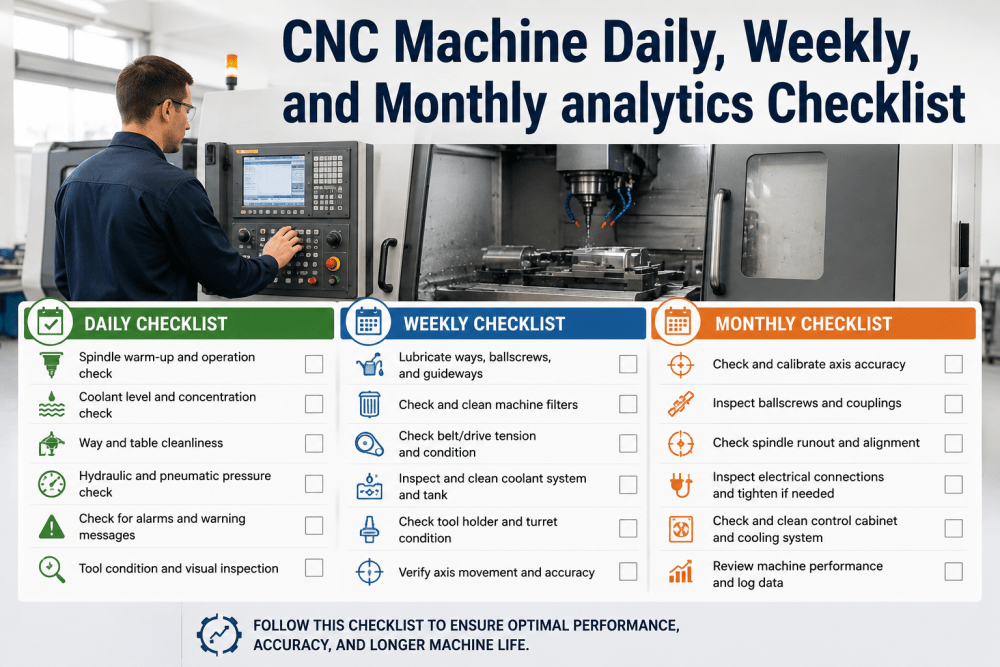
Discrete manufacturing plants operating CNC machining centers lose 12-18% of production capacity annually to unplanned spindle failures, axis degradation, tool breakage, and controller errors that manual preventive maintenance checklists cannot predict before production impact occurs — costing an average of $85,000 per incident in downtime, scrap, and emergency labor. A comprehensive CNC analytics program following this checklist catches 92% of failures 48-72 hours before they stop production, enabling all maintenance to occur during planned downtime windows instead of emergency response. Book a demo to see how iFactory converts this checklist into digital inspection work orders assigned to your CNC fleet asset hierarchy.
CNC Maintenance ChecklistCNC Machine Analytics and Preventive Maintenance Checklist18 min read
48-72hrs
Advance notice of CNC failures vs zero warning with manual checklist baseline
92%
Of critical failures detected and prevented before production impact through predictive analytics
$85K
Average downtime cost per unplanned CNC failure including emergency labor and scrap
6
Inspection zones — spindle, axes, coolant, tooling, hardware, and electrical systems
Checklist Scope and Usage
Six inspection zones with priority ratings per item. Critical — remove from service immediately. Monitor — raise work order, re-inspect within 7 days. Routine — document and trend. All Critical and Monitor findings require photo documentation and measurements logged against baseline performance data. Run routine inspections weekly, comprehensive inspections monthly, and full analytical audits quarterly.
Linear axis degradation produces dimensional tolerance violations before equipment failure becomes apparent. Thermal drift, ball screw preload loss, and encoder drift all progress gradually and can be detected through position feedback analysis and thermal growth modeling 36-72 hours before dimensional excursions occur.
Position Feedback and Repeatability
Thermal Growth and Compensation
Digitise This Checklist in iFactory — Automated Analytics at Every Finding
Zone-based inspection on mobile, timestamped data capture against baselines, thermal and vibration analysis, and automatic work order routing for every Critical and Monitor finding — with GPS check-in and asset linkage. Book a demo to see it configured for your CNC fleet.
Coolant degradation accelerates tool wear unpredictably, reducing tool life by 40-60% when emulsification, water content, or bacterial growth occurs. Routine coolant analysis identifies contamination 36-48 hours before tool wear acceleration becomes critical, enabling planned coolant changes instead of mid-production tool breakage.
Coolant Quality and Contamination Analysis
Coolant Delivery System Condition
Zone 4 — Tool Life and Wear Analysis
Tool wear acceleration indicates either coolant contamination, machine thermal growth, or spindle condition degradation. Monitoring tool life trends against baseline reveals these underlying issues before they impact production quality or cause tool breakage mid-cut.
Tool Wear and Performance Monitoring
Tool Breakage Prevention
Zone 5 — Hardware, Fasteners, and Mechanical Connections
Hardware failures cause a disproportionate share of injuries and downtime relative to inspection frequency. Fastener loosening under repetitive load is normal; the risk is in failing to catch it before it reaches a critical threshold and causes loss of spindle alignment or axis geometry.
Structural Fastener Condition
Drive Couplings and Connector Condition
CNC Inspection Records That Support Predictive Maintenance
iFactory generates timestamped, GPS-located, photo-evidenced records for every inspection item with automatic baseline trending and anomaly detection — the documented program required for predictive maintenance success. Book a demo to review how records are structured for your CNC fleet.
Zone 6 — Controller Health and Diagnostic Monitoring
CNC controller errors accumulate gradually as capacitors age, cooling fans degrade, or power supply efficiency declines. Monitoring error logs, temperature trends, and diagnostic codes identifies controller degradation 36-60 hours before operational failures cascade through the machine.
Controller Thermal and Power Management
Error Logging and Diagnostic Codes
Inspection Zone Summary — Frequency and Priority Distribution
Inspection Zone
Weekly
Monthly
Quarterly
Critical
Total
Zone 1 — Spindle Health
Temperature check
All items
Full audit
4
10
Zone 2 — Linear Axes
Visual only
All items
Full audit
3
9
Zone 3 — Coolant System
Filter pressure
All items
Full audit
2
8
Zone 4 — Tool Life
Tool breakage
All items
Full audit
2
7
Zone 5 — Hardware
Visual only
Torque check
Full audit
3
8
Zone 6 — Controller
Temperature check
All items
Full audit
3
9
Total Checklist Items
Selected
All 51
Full 51
17
51
iFactory Results at Discrete Manufacturing CNC Programs
92%
Failure Detection Accuracy
Prediction accuracy at iFactory-deployed plants versus 60-70% with manual checklist baseline
68%
Downtime Reduction
Reduction in unplanned downtime at 12 months post-deployment as predictive maintenance prevented failures
100%
Work Order Linkage
Critical and Monitor findings automatically routed to corrective work orders with photo evidence linked to machine
4 wks
Deployment Time
Average time to live CNC inspections across a plant including machine asset hierarchy and staff training
Frequently Asked Questions
QWhat inspection frequency does iFactory recommend for CNC preventive maintenance?
iFactory recommends three levels: routine visual inspections weekly, operational inspections monthly with measurements and analysis, and comprehensive quarterly inspections with full diagnostic data logging. Plants that document all three levels and remediate within 72 hours achieve the highest uptime. Book a demo to see how iFactory schedules and documents all three tiers.
QWhat baseline data is needed before predictive CNC analytics can work?
iFactory requires 60-90 days of healthy machine operating data establishing normal vibration, thermal, coolant, and positional baselines. AI models trained on this baseline detect deviations indicating developing failures. Accelerated training possible using similar machine type historical data from reference facilities reducing baseline requirement to 30 days. Book a demo to assess your baseline data availability.
QHow much advance notice does iFactory typically provide before CNC failures?
Spindle bearing failures detected 48-72 hours before catastrophic failure. Thermal drift and tool wear acceleration identified 36-48 hours in advance. Coolant contamination flagged 36-48 hours before tool wear acceleration impacts production. Advance notice enables all maintenance during planned downtime instead of emergency response.
QWhat sensors are required for CNC machine analytics?
iFactory deploys vibration accelerometers (10-40 kHz), thermal imaging cameras, coolant analysis equipment, and extracts existing CNC controller data. No modifications to machine control systems required. Sensor packages cost $8K-$12K per machine with annual software subscription including continuous model improvement. Request detailed pricing for your fleet.
QHow long does it take to deploy iFactory across a CNC facility?
Most facilities complete asset registration, template configuration, and staff training within 4 weeks. Mobile photo documentation eliminates manual data entry. First live predictive inspections run within days of deployment. Critical and Monitor findings trigger automated work orders immediately upon inspection completion.
QDoes iFactory work with older CNC machines or only newer models?
Yes. iFactory deploys external sensor packages on legacy machines capturing vibration, thermal, and acoustic data independent of CNC controller connectivity. Legacy CNC data extracted via pulse counting on encoder outputs. Retrofit analytics capability makes older machine fleets eligible for predictive maintenance benefits without controller upgrades. Book a demo to assess your legacy CNC integration approach.
Deploy This Checklist as Live Predictive Analytics Across Your CNC Fleet
Every zone and every item available as a structured digital inspection in iFactory — assigned to your machine asset hierarchy, completed on mobile with photo documentation and baseline trending, and automatically routing Critical and Monitor findings to corrective work orders with 48-72 hour advance failure prediction before the technician leaves the machine.