Industrial Asset Management: Best Practices for Manufacturing Plants
By oxmaint on March 5, 2026
Manufacturing plants invest heavily in physical equipment—CNC machines, pumps, conveyor systems, compressors, boilers, and production lines—that directly determine throughput, product quality, and profitability. Yet research shows that the average facility loses around $25,000 for every single hour of unplanned downtime, with larger operations exceeding $500,000 per hour. The root cause is almost always the same: fragmented asset data, inconsistent maintenance practices, and decisions driven by gut feeling rather than equipment history. Industrial asset management solves this by unifying asset tracking, lifecycle planning, preventive maintenance, and performance analytics into one structured system that keeps your machines running, your costs predictable, and your production targets on track.
How Poor Asset Tracking Costs Manufacturing Plants Millions
Most manufacturing plants do not fail at asset management because of a lack of effort. They fail because of fragmented visibility. Maintenance history sits in one system, condition data lives somewhere else—or nowhere at all—and operators carry critical knowledge about problem machines only in their heads. This disconnect means problems are discovered too late, repairs cost more than they should, and the same failures keep recurring because nobody connects the dots across the full picture.
60%+of maintenance activities in typical plants are reactive or unnecessary—driven by lack of asset condition visibility
29%of unplanned downtime is caused by aging equipment that could have been flagged through proper lifecycle tracking
2–5xhigher cost of reactive repair compared to planned maintenance—including emergency labor, expedited parts, and collateral damage
Close the visibility gap in your plant. Get a single source of truth for every asset—its condition, maintenance history, and performance trends—all in one platform.
The Five Stages of Asset Lifecycle Management in Manufacturing
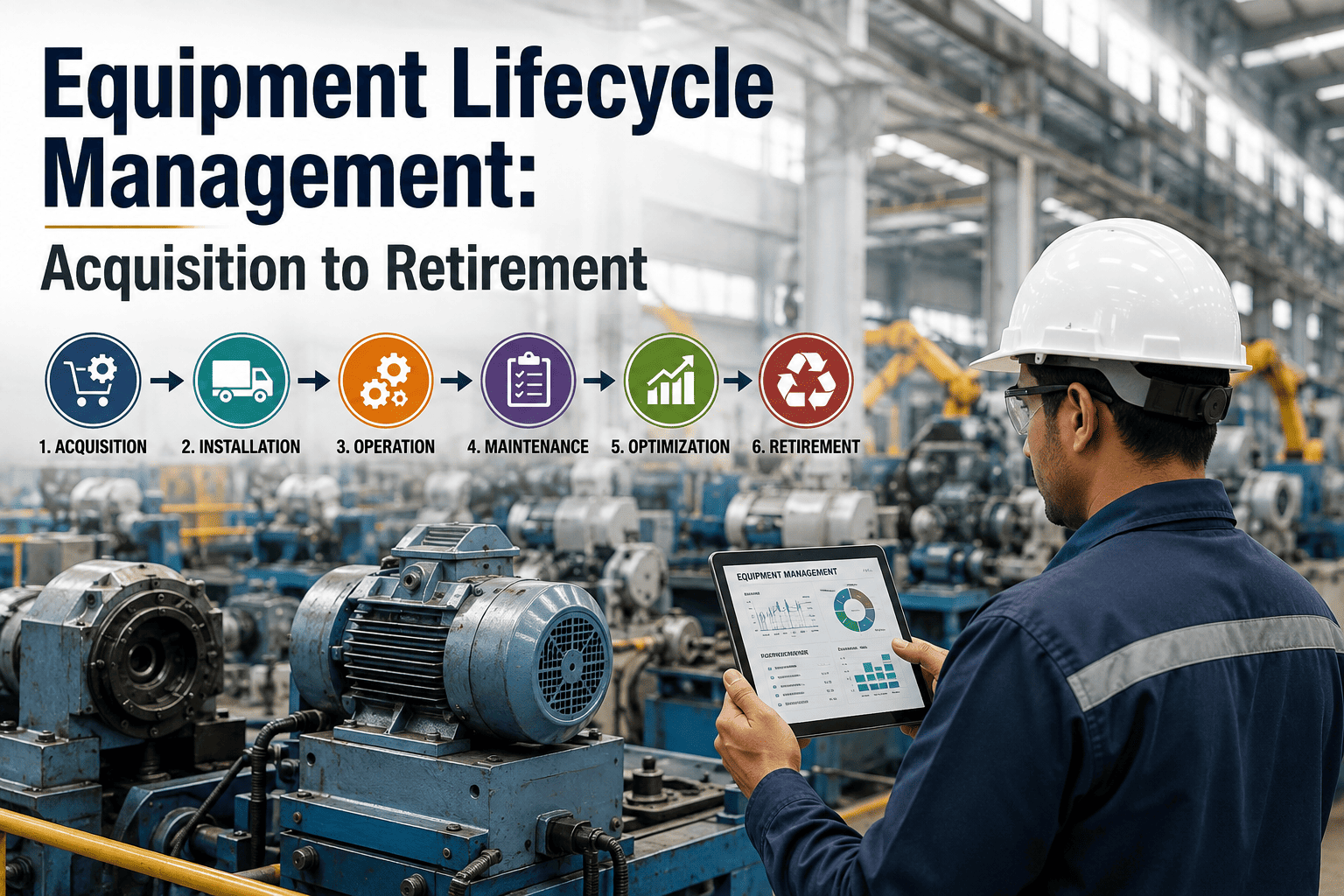
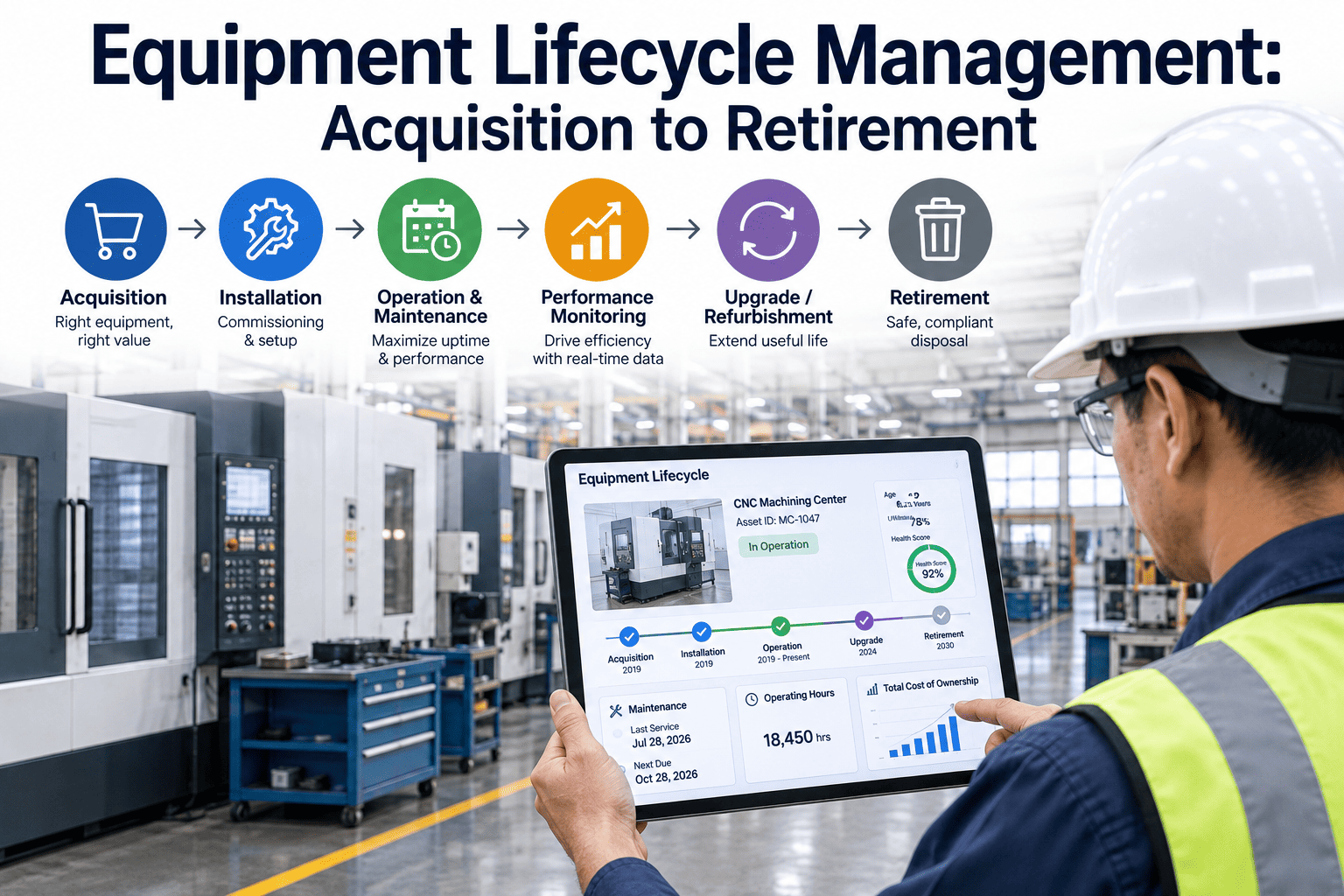
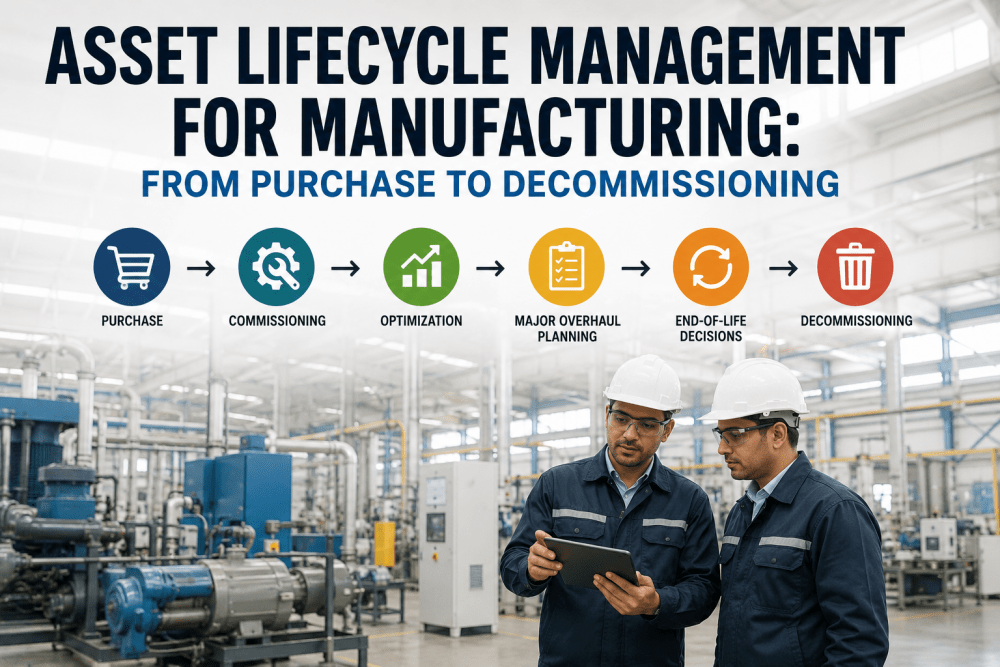
Every piece of equipment in your plant follows a lifecycle from acquisition to disposal. Managing each stage intentionally—rather than just reacting when things break—is what separates high-performing plants from those trapped in a cycle of emergency repairs and budget overruns. Here is how effective lifecycle management unfolds.
Stage 1
Planning and Procurement
Evaluate total cost of ownership before purchasing—not just the sticker price. Factor in energy usage, spare parts availability, vendor support quality, expected maintenance frequency, and compatibility with your existing systems. A $50,000 machine that costs $15,000 per year to maintain may be a worse investment than a $70,000 machine that costs $5,000.
Stage 2
Installation and Commissioning
Register every new asset in your CMMS immediately with full specifications, warranty details, and manufacturer-recommended maintenance schedules. Attach manuals, wiring diagrams, and spare parts lists. This single step prevents the most common problem in asset management: missing baseline data that makes future decisions guesswork.
Stage 3
Operation and Preventive Maintenance
This is where the majority of an asset's value is either captured or lost. Run preventive maintenance on schedule, capture every work order with accurate failure codes and labor hours, and monitor key indicators like vibration, temperature, and energy consumption. The data generated here fuels every optimization decision downstream.
Stage 4
Performance Optimization
Analyze maintenance data to refine PM intervals, address chronic failure patterns through root cause analysis, and deploy condition-based monitoring on high-value assets. Compare identical equipment across shifts and lines to identify why one performs better than another. Small optimizations at this stage compound into significant cost and reliability improvements.
Stage 5
Retirement and Replacement
When cumulative maintenance costs approach 50% of replacement value—or when failure frequency makes the asset a production liability—it is time to replace. Use lifecycle cost data to build compelling capital expenditure requests. Document decommissioning thoroughly for compliance records and institutional knowledge.
Asset Criticality Analysis: How to Prioritize What Matters Most
Not every asset in your plant deserves the same level of attention. A criticality assessment scores each piece of equipment based on its impact on production, safety, quality, environmental compliance, and repair cost. Assets scoring highest across these dimensions—your Criticality A equipment—receive the most intensive maintenance, the strictest monitoring, and priority in capital planning. This approach ensures your limited resources go where they generate the most value.
Asset Criticality Classification Framework
Criticality A
Production-Critical
Failure stops production entirely or creates immediate safety hazards. Receives predictive monitoring, highest-priority PM schedules, dedicated spare parts stock, and fastest response times for any deviation from normal operating parameters.
Criticality B
Production-Important
Failure reduces output or quality but does not halt production. Receives scheduled preventive maintenance, periodic condition checks, and standard spare parts availability. Monitored through work order history and KPI trends.
Criticality C
Support Equipment
Failure causes inconvenience but no direct production impact. Receives basic time-based maintenance and run-to-failure approach where replacement is faster and cheaper than the cost of intensive monitoring programs.
Identify your most critical assets and protect them first. Built-in criticality scoring helps you focus maintenance resources on equipment that drives the most production value.
Preventive vs. Reactive Maintenance: The True Cost Difference
The shift from reactive to preventive maintenance is the single highest-impact change most manufacturing plants can make. Reactive maintenance is not just more expensive per repair—it creates a cascade of secondary costs including emergency overtime, expedited shipping for parts, collateral damage to adjacent equipment, quality defects from rushed restarts, and missed customer deliveries.
Reactive Approach
Equipment runs until it breaks down
Emergency repairs at premium overtime rates
Expedited parts shipping at 3–10x normal cost
Collateral damage to connected equipment
No maintenance history to guide future decisions
$15,000+
Typical cost per unplanned breakdown event
Preventive Approach
Scheduled maintenance during planned windows
Standard labor rates with adequate preparation
Parts ordered at normal cost with lead time
Issues caught before cascading to other assets
Complete work order history drives optimization
$3,000
Typical cost for same repair performed as planned work
How a CMMS Centralizes Your Entire Asset Management Program
Every best practice described in this guide—from digital asset registers and criticality scoring to preventive scheduling and lifecycle cost tracking—requires a central platform to execute consistently. A Computerized Maintenance Management System is that platform. Without a CMMS, asset data stays scattered across spreadsheets, email threads, paper logs, and the memories of long-tenured technicians. With one, every decision is backed by accurate, accessible data.
Centralized Asset Register
Every asset, its specifications, location, criticality rating, warranty terms, and complete maintenance history—searchable and accessible from any device by every team member who needs it.
Automated Preventive Scheduling
Time-based and meter-based PM triggers generate work orders automatically. No more missed maintenance because someone forgot to check the calendar or the spreadsheet.
Digital Work Order Management
Create, assign, and close work orders with failure codes, parts used, labor hours, and photos. This data powers every KPI, trend report, and lifecycle cost calculation your team needs.
Real-Time Performance Dashboards
MTBF, MTTR, OEE, planned maintenance percentage, and cost-per-asset—calculated automatically and displayed in dashboards that give managers instant visibility into maintenance health.
Spare Parts Inventory Control
Link parts to specific assets and work orders. Track consumption patterns, set automated reorder points, and ensure critical components are always available without overstocking.
Step-by-Step: Building an Asset Management Program from Scratch
Audit and register your top 20% most critical assets in the CMMS. Assign criticality ratings. Set up initial PM schedules based on manufacturer recommendations. Train your core maintenance team on digital work orders.
Month 2–3
Expansion
Extend the asset register to all production equipment. Link spare parts inventory to assets. Activate KPI tracking—MTBF, MTTR, planned maintenance percentage. Establish weekly metric reviews with assigned action items.
Month 4–6
Optimization
Deploy condition monitoring on highest-value assets. Refine PM intervals using actual failure data. Implement repair-vs-replace analysis for aging equipment. Build lifecycle cost models to support capital budget requests.
Ongoing
Continuous Improvement
Expand predictive capabilities. Benchmark performance across shifts, lines, and facilities. Use data trends to drive annual capital planning. Foster a maintenance culture where every metric review produces concrete improvement actions.
Take Control of Every Asset on Your Plant Floor
Disconnected spreadsheets, paper logs, and tribal knowledge cannot deliver the visibility, consistency, and data-driven decisions that competitive manufacturing demands. A centralized asset management platform unifies your equipment register, PM schedules, work orders, spare parts, and performance dashboards—helping your team reduce unplanned downtime, extend asset lifespan, and make every maintenance dollar count.
What is industrial asset management in a manufacturing context?
Industrial asset management is the end-to-end practice of tracking, maintaining, and optimizing physical equipment throughout its entire lifecycle—from procurement and installation through daily operation, preventive maintenance, performance optimization, and eventual retirement or replacement. In manufacturing, this covers machinery, production lines, supporting infrastructure, vehicles, and facilities. The goal is to maximize equipment uptime and performance while minimizing total cost of ownership.
How does asset lifecycle management reduce downtime?
By managing each lifecycle stage intentionally—registering assets with complete data, running preventive maintenance on schedule, monitoring condition trends, and replacing equipment before it becomes a reliability liability—plants catch problems weeks or months before they cause production stoppages. Structured lifecycle management typically reduces unplanned downtime by 20% or more. Get Support to set up automated PM schedules for your critical assets and start reducing unplanned stops within the first month.
Why is a CMMS essential for asset management?
A CMMS serves as the central hub for all asset management activities—storing your asset register, automating maintenance scheduling, managing work orders, tracking spare parts, and calculating performance KPIs automatically. Without one, asset data stays fragmented across spreadsheets, paper files, and individual memory, making consistent proactive management nearly impossible at any scale.
How should we decide which assets to focus on first?
Most plants identify significant quick wins within 30–60 days by establishing PM schedules for critical assets and eliminating the most common reactive failures. Within six months, teams typically see measurable improvements in planned maintenance percentage, fewer emergency work orders, and lower spare parts costs. Full optimization—including condition monitoring and lifecycle cost analysis—develops over 12–18 months as your data foundation matures.