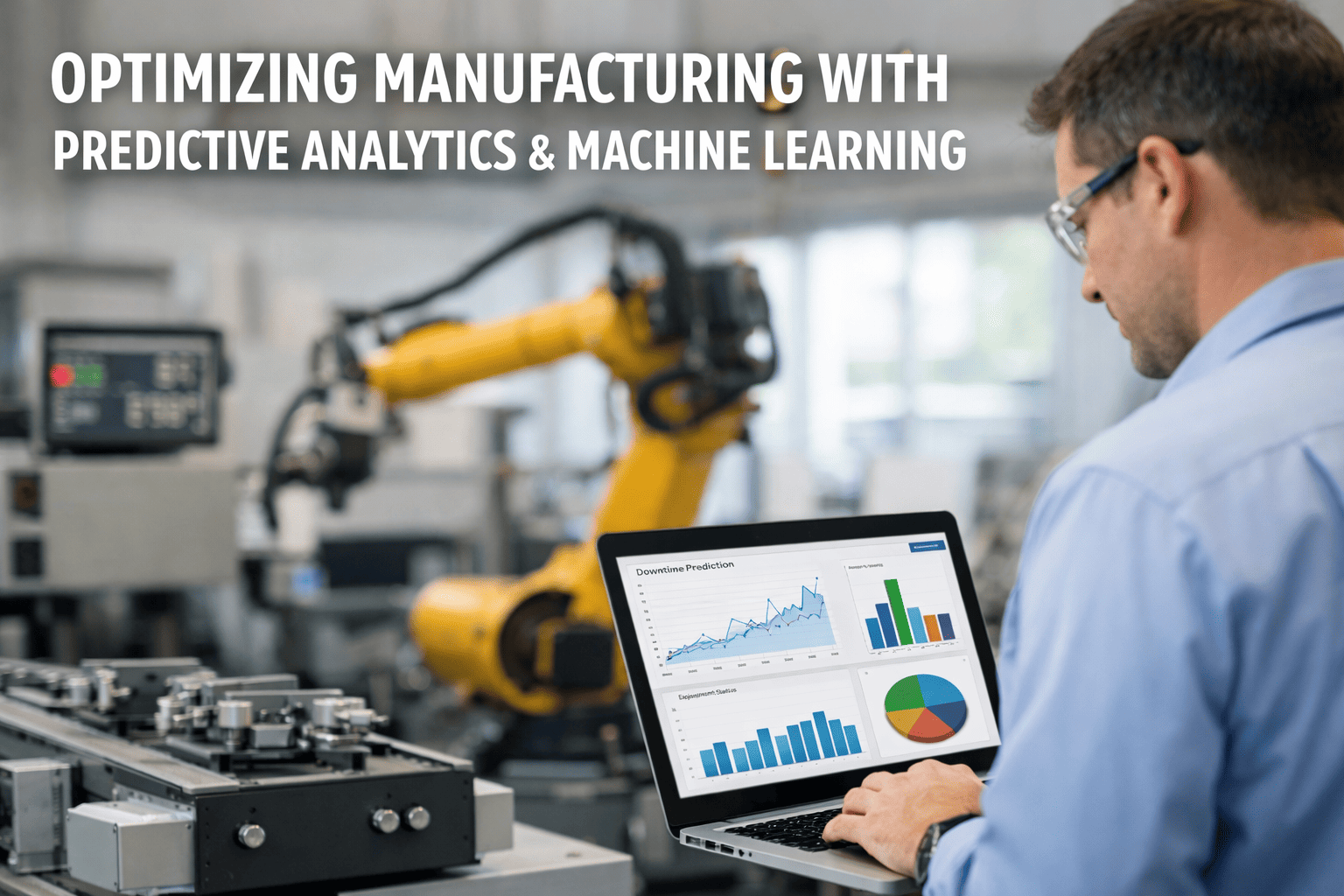
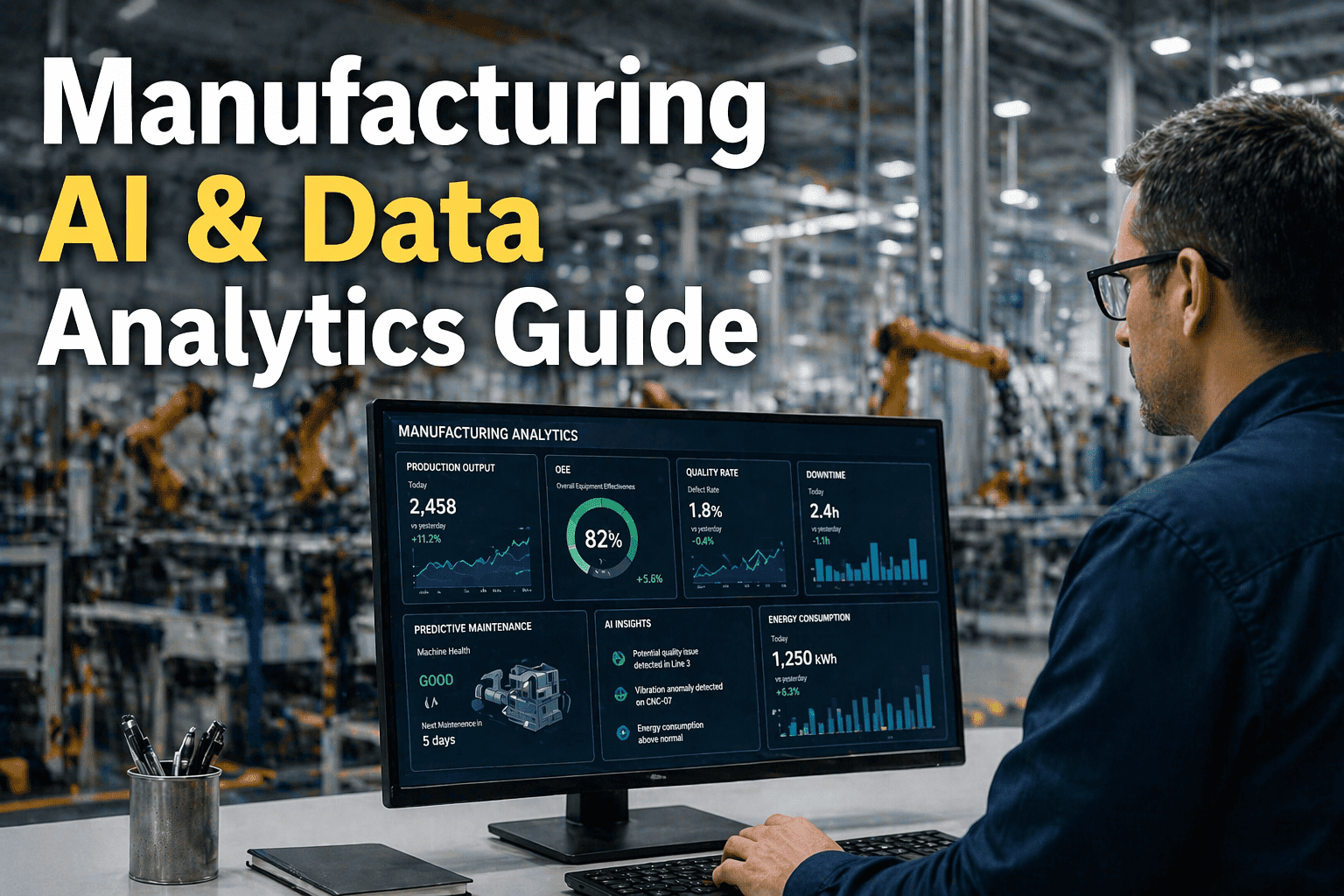
Every minute of unplanned downtime costs manufacturers an average of $260,000. Yet most factories still operate reactively—waiting for equipment to fail, relying on manual inspections, and making production decisions based on gut instinct rather than data. Predictive analytics and machine learning are rewriting this script entirely. By transforming raw sensor data into forward-looking intelligence, these technologies let manufacturers anticipate failures weeks in advance, optimize throughput in real time, and make every production decision with data-backed confidence. Schedule a free demo to see how predictive analytics can cut your downtime by up to 50% and start making data-driven production decisions.
What Is Predictive Analytics in Manufacturing and Why Does It Matter
Predictive analytics applies statistical algorithms and machine learning models to historical and real-time operational data, generating forecasts about what will happen next on the factory floor. Instead of reacting to equipment breakdowns, quality failures, or supply disruptions after they occur, manufacturers gain the ability to see problems forming and act before impact. The manufacturing predictive analytics market was valued at $1.6 billion in 2024 and is projected to reach $6.6 billion by 2033—a clear signal that data-driven manufacturing is no longer optional.
$22B+
Global predictive analytics market size in 2025
22.5%
Annual growth rate through 2032
46%
Market share held by North American manufacturers
How Machine Learning Powers Smarter Factory Decisions
Machine learning sits at the core of modern predictive analytics. Unlike traditional rule-based systems that only flag known patterns, ML algorithms learn continuously from incoming data—discovering subtle correlations between process variables that human analysts would never detect. The result is a factory that gets smarter every day it operates.
A
Pattern Recognition at Scale
ML models process millions of data points from vibration sensors, thermal cameras, and power analyzers simultaneously—identifying degradation patterns invisible to human inspectors operating on fixed schedules.
B
Continuous Self-Improvement
Every confirmed prediction or false alarm refines the model. Algorithms adapt to seasonal changes, new product mixes, and equipment aging without manual recalibration—delivering compounding accuracy gains over time.
C
Multi-Variable Correlation
Where a technician might check temperature OR vibration, ML correlates dozens of variables at once—ambient conditions, material batch properties, operator shift patterns, and machine state—to produce far more accurate predictions.
Supervised Learning
Time-Series Forecasting
Computer Vision (CNN)
Reinforcement Learning
Digital Twin Simulation
ML technique adoption rates across manufacturing deployments
See how machine learning can optimize your production line. Our engineers will map the highest-impact ML applications for your specific operation.
Predictive Maintenance: Eliminating Downtime Before It Starts
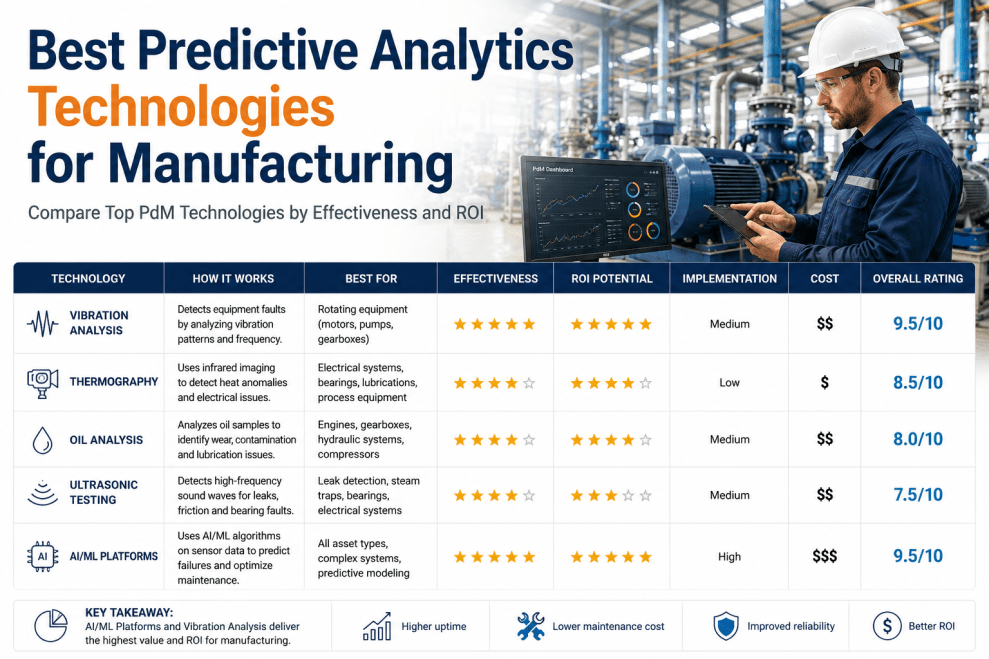
Predictive maintenance is the most adopted and highest-ROI application of manufacturing analytics. Rather than replacing parts on a fixed calendar or waiting for catastrophic failure, ML models analyze real-time equipment health signals to predict exactly when intervention is needed. Manufacturers using predictive maintenance have reduced unplanned downtime by 30-50% and maintenance costs by 18-25%.
Step 1
Continuous Condition Monitoring
IoT sensors mounted on critical assets capture vibration signatures, thermal profiles, acoustic emissions, and electrical characteristics at sub-second intervals—building a real-time digital health record for every machine.
01
02
Step 2
Baseline Learning and Anomaly Detection
ML algorithms establish what "normal" looks like for each asset under varying operating conditions. When sensor readings drift outside learned baselines, the system flags anomalies automatically—often weeks before a human would notice.
Step 3
Remaining Useful Life Estimation
Advanced models calculate the probability of failure over upcoming time windows—estimating how many operating hours remain before a bearing, motor, or pump reaches critical degradation. This gives planners precise scheduling flexibility.
03
04
Step 4
Automated Work Order Generation
Data-Driven Quality Control and Defect Prevention
Quality problems caught at the end of the production line cost 10x more to fix than issues detected in-process. Machine learning shifts quality control from post-production inspection to in-line prediction—correlating hundreds of process variables to forecast defect probability before a single bad part is produced.
Real-Time Process Variable Monitoring
Algorithms continuously analyze speed, pressure, temperature, humidity, and material properties during production. When variable combinations approach known defect zones, operators receive instant alerts to adjust parameters.
Computer Vision Inspection at Line Speed
Deep learning models trained on thousands of defect images inspect every part at production speed—detecting surface flaws, dimensional deviations, and cosmetic issues with 99%+ accuracy and sub-second processing time.
Root Cause Analysis Automation
When defects do occur, ML models automatically correlate the event with upstream process data—pinpointing whether the cause was raw material variation, machine drift, environmental change, or operator technique differences.
Supplier Quality Prediction
Predictive models score incoming material batches based on supplier history, test results, and production outcomes—flagging high-risk shipments for enhanced inspection before they enter the production process.
Stop catching defects after production—start predicting them before they happen. See how AI-powered quality analytics can transform your yield rates.
Demand Forecasting and Production Scheduling with AI
Accurate demand forecasting is the foundation of efficient production. Traditional methods relying solely on historical averages miss the complexity of modern markets. AI-driven forecasting combines internal sales data with external signals—weather patterns, economic indicators, social trends, and competitor activity—to deliver forecasts that are up to 85% more precise than conventional approaches.
What Traditional Forecasting Misses
Relies on historical averages that lag market shifts
Ignores external factors like weather and economic data
Static models that require manual quarterly updates
No correlation between demand signals and production capacity
Typically produces 40-60% forecast accuracy
What AI Forecasting Delivers
Adapts to demand shifts in real time as new data arrives
Integrates weather, economic, social, and market signals
Self-updating models that retrain automatically on new patterns
Direct linkage between forecasts and production scheduling
Achieves 80-85% forecast accuracy with continuous improvement
Real-World ROI: What Manufacturers Are Achieving with Predictive Analytics
The business case for predictive analytics in manufacturing is no longer theoretical. Across industries—from automotive and aerospace to food processing and electronics—data-driven factories are documenting measurable gains in uptime, throughput, quality, and cost efficiency.
Predictive maintenance catches failures weeks before they occur, virtually eliminating surprise breakdowns
Optimized scheduling, reduced changeover times, and bottleneck elimination drive measurable output gains
Condition-based strategies eliminate unnecessary preventive maintenance while preventing costly emergency repairs
Multi-source AI models dramatically outperform traditional historical average forecasting methods
Workers spend less time firefighting and more time on value-adding activities with predictive guidance
Want to calculate the ROI for your factory? Our team will model the savings potential based on your specific equipment, production volumes, and current downtime costs.
Industry Applications: Where Predictive Analytics Delivers the Most Value
While predictive analytics benefits any manufacturing environment, certain industries see outsized returns due to equipment complexity, production value, and the cost of quality failures. Here is how leading sectors are applying these technologies.
Predictive models optimize robotic welding parameters, detect paint defects via computer vision, and forecast demand across vehicle configurations. Line downtime reductions of 45% are common in high-volume assembly plants.
ML monitors critical machining operations where tolerances are measured in microns. Digital twins simulate component stress before physical production begins, reducing prototype cycles and ensuring first-pass quality.
Temperature, humidity, and contamination risk models protect product safety throughout continuous processing. Demand forecasting reduces perishable waste by 25-30% while maintaining optimal inventory freshness.
Yield prediction models correlate wafer-level process variables with device performance. AI identifies drift in lithography and etching processes that would otherwise result in entire batch losses worth millions.
Process analytical technology powered by ML ensures batch consistency and regulatory compliance. Predictive models reduce batch rejection rates and accelerate release testing with real-time quality assurance.
AI optimizes reactor conditions, catalyst performance, and energy consumption in continuous chemical processes. Predictive analytics reduces feedstock waste and improves overall plant energy intensity.
Building Your Predictive Manufacturing Roadmap
Successful predictive analytics adoption does not require a massive upfront investment or a dedicated data science team. The most effective approach starts small with high-impact use cases and scales as models prove value and organizational confidence grows.
Foundation
Month 1-2
Assess, Prioritize, and Baseline
Audit existing data sources and sensor infrastructure. Identify the top 3-5 pain points where predictive insights would deliver the highest value—typically starting with unplanned downtime on your most critical or most failure-prone assets. Establish current-state performance baselines for comparison.
Pilot
Month 3-5
Deploy, Train, and Validate
Install retrofit IoT sensors where needed. Connect data streams to the analytics platform. Deploy pre-built ML models for your first use case—typically predictive maintenance on a critical production line. Validate model accuracy against actual outcomes and refine detection thresholds.
Integrate
Month 6-8
Connect Systems and Close the Loop
Scale
Month 9+
Expand Coverage and Advanced Models
Roll out analytics across additional lines, assets, and use cases—quality prediction, demand forecasting, energy optimization. Deploy advanced models including digital twins and reinforcement learning for process optimization. Measure cumulative ROI and plan next-phase capabilities.
Ready to build your predictive manufacturing roadmap? Get a customized deployment plan with clear milestones, resource requirements, and expected ROI for each phase.
Overcoming Common Implementation Barriers
Every manufacturing analytics journey encounters obstacles. The key is recognizing these challenges early and applying proven strategies that successful adopters have already validated across hundreds of deployments.
Challenge
Legacy Equipment Without Smart Sensors
Solution
Retrofit IoT sensors (vibration, thermal, current) can be added to virtually any machine without modifications. Start with your highest-value assets and expand coverage based on demonstrated savings.
Challenge
Fragmented Data Across Siloed Systems
Solution
Modern platforms connect to MES, SCADA, ERP, and historian systems via standard APIs and industrial protocols (OPC-UA, MQTT). A unified data layer eliminates silos without replacing existing infrastructure.
Challenge
No In-House Data Science Expertise
Solution
Pre-built industry ML models and AutoML platforms enable operations teams to deploy predictive analytics without writing code. Domain expertise matters more than data science degrees for initial success.
Challenge
Resistance from Plant Floor Teams
Solution
Start with a visible quick win that solves a real pain point operators care about. Involve maintenance technicians in model validation. When teams see predictions confirmed in the real world, adoption accelerates naturally.
Turn Your Production Data Into Predictive Intelligence
Your factory generates terabytes of operational data every day. Right now, most of it is sitting unused while equipment fails unexpectedly, quality issues slip through, and production schedules miss the mark. iFactory transforms that data into real-time predictive insights—anticipating failures before they happen, optimizing production in real time, and giving your teams the foresight to make smarter decisions at every step of the manufacturing process.
Frequently Asked Questions
How long does it take to see measurable results from predictive analytics?
Do we need to replace our existing equipment to use predictive analytics?
No. Predictive analytics works with your existing equipment. Retrofit IoT sensors—including vibration monitors, temperature probes, current clamps, and acoustic sensors—can be added to virtually any machine without physical modifications or production interruptions. Most successful deployments start by instrumenting the most critical or failure-prone assets first, then expanding sensor coverage based on proven results.
What is the difference between predictive maintenance and preventive maintenance?
Preventive maintenance follows a fixed schedule—replacing parts or servicing machines at set intervals regardless of actual condition. This often results in unnecessary work (replacing parts still in good shape) or missed failures (breakdowns between scheduled services). Predictive maintenance uses real-time sensor data and ML models to determine actual equipment condition and predict remaining useful life, so maintenance happens exactly when needed.
Get Support to see how iFactory transitions your maintenance strategy from calendar-based to condition-based with pre-built predictive models.
Can predictive analytics integrate with our existing MES, SCADA, and ERP systems?
Yes. Modern predictive analytics platforms are built for interoperability. They connect to MES, SCADA, DCS, CMMS, and ERP systems through standard APIs and industrial protocols including OPC-UA, MQTT, and Modbus. This enables closed-loop workflows where predictive insights automatically trigger maintenance work orders, adjust production schedules, or update inventory plans—without manual data transfer or duplicate entry.
Which manufacturing industries benefit most from predictive analytics?
Any manufacturing operation with measurable process variables can benefit. However, the highest ROI is typically seen in automotive (robotic assembly, paint quality), aerospace (precision machining, composite layup), semiconductor (yield optimization), food and beverage (temperature-critical processes, perishable inventory), and chemical processing (reactor optimization, energy management). The common factor is expensive downtime and high quality stakes.
Book a demo tailored to your industry to see the exact ML models and dashboards built for your manufacturing sector.