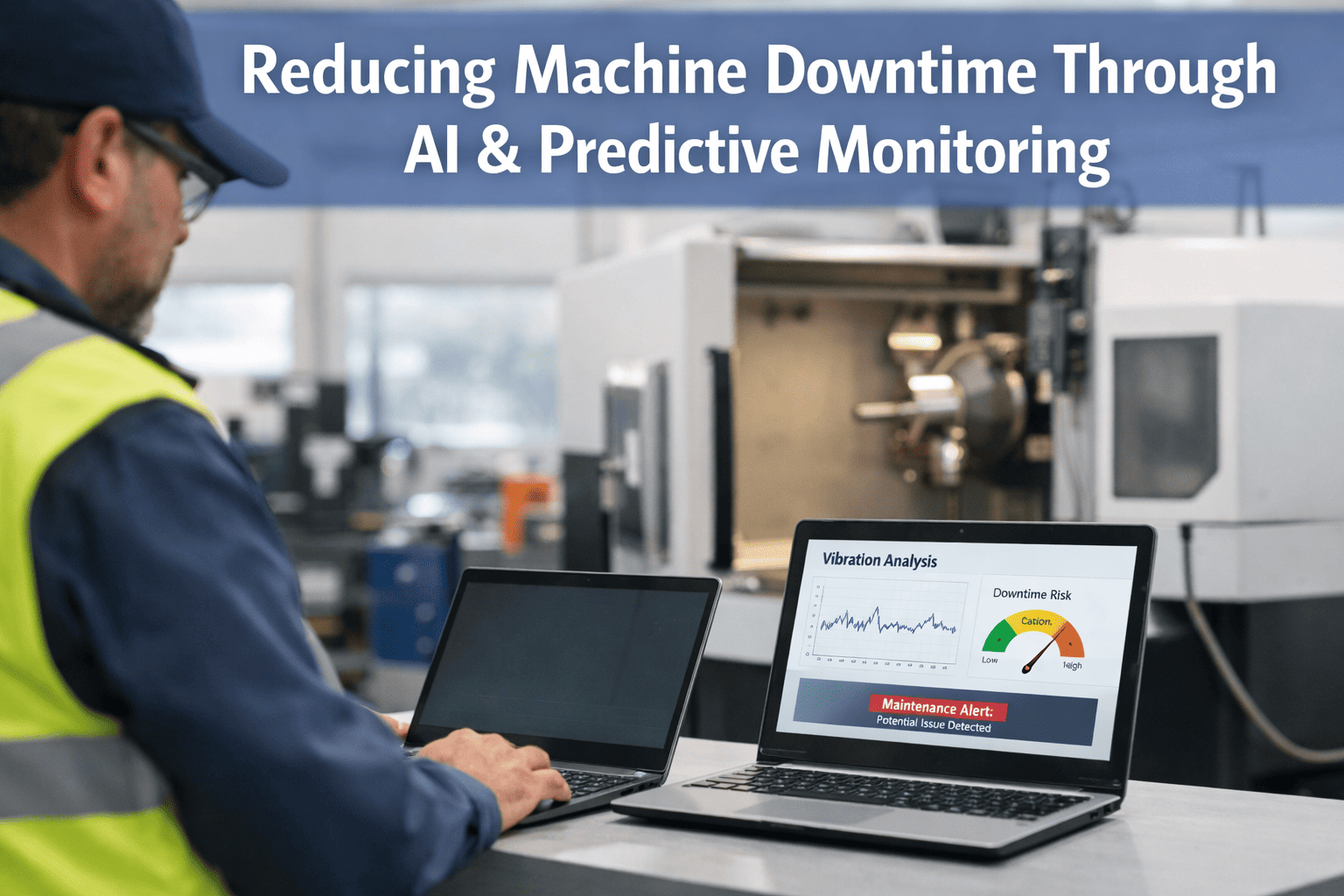
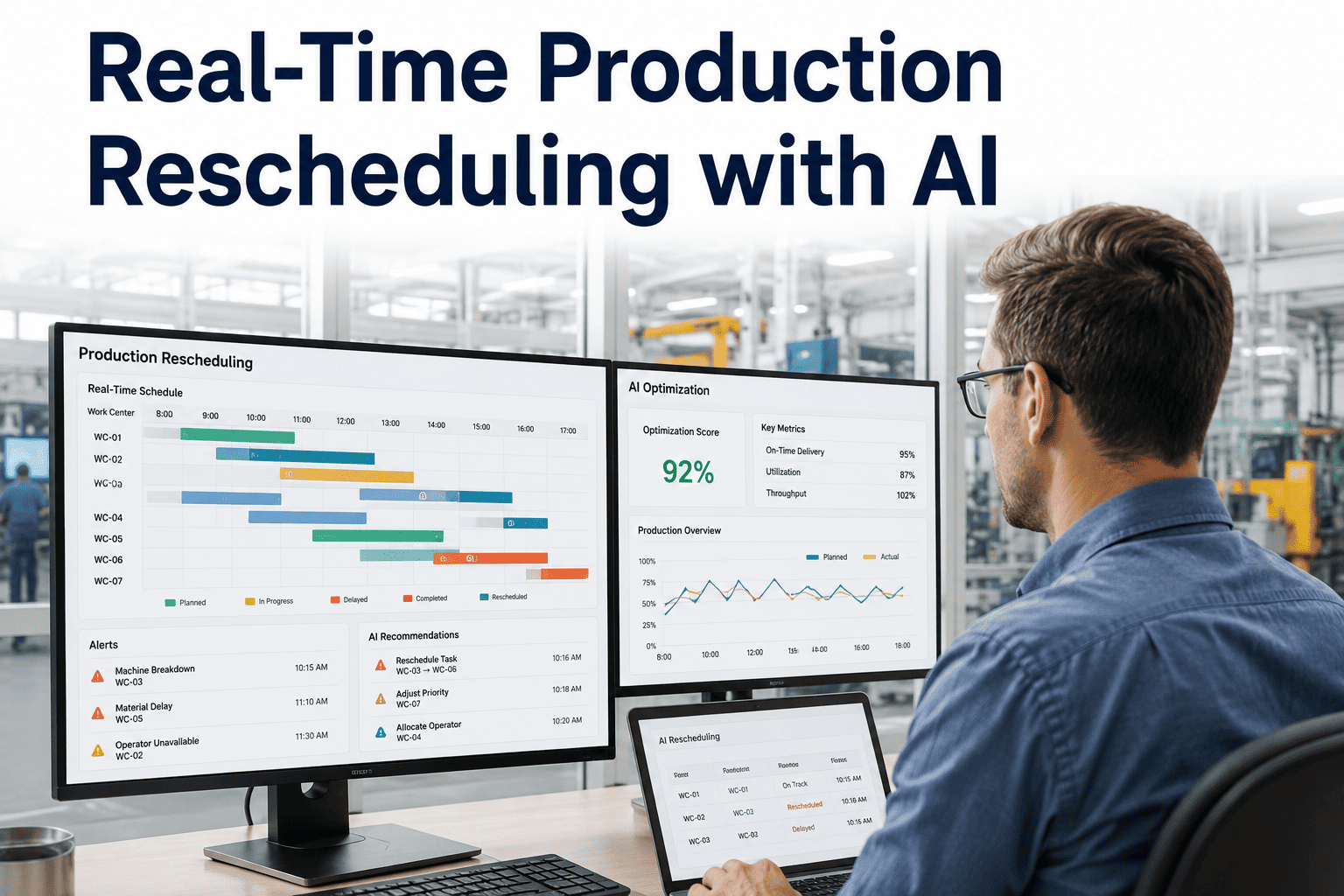
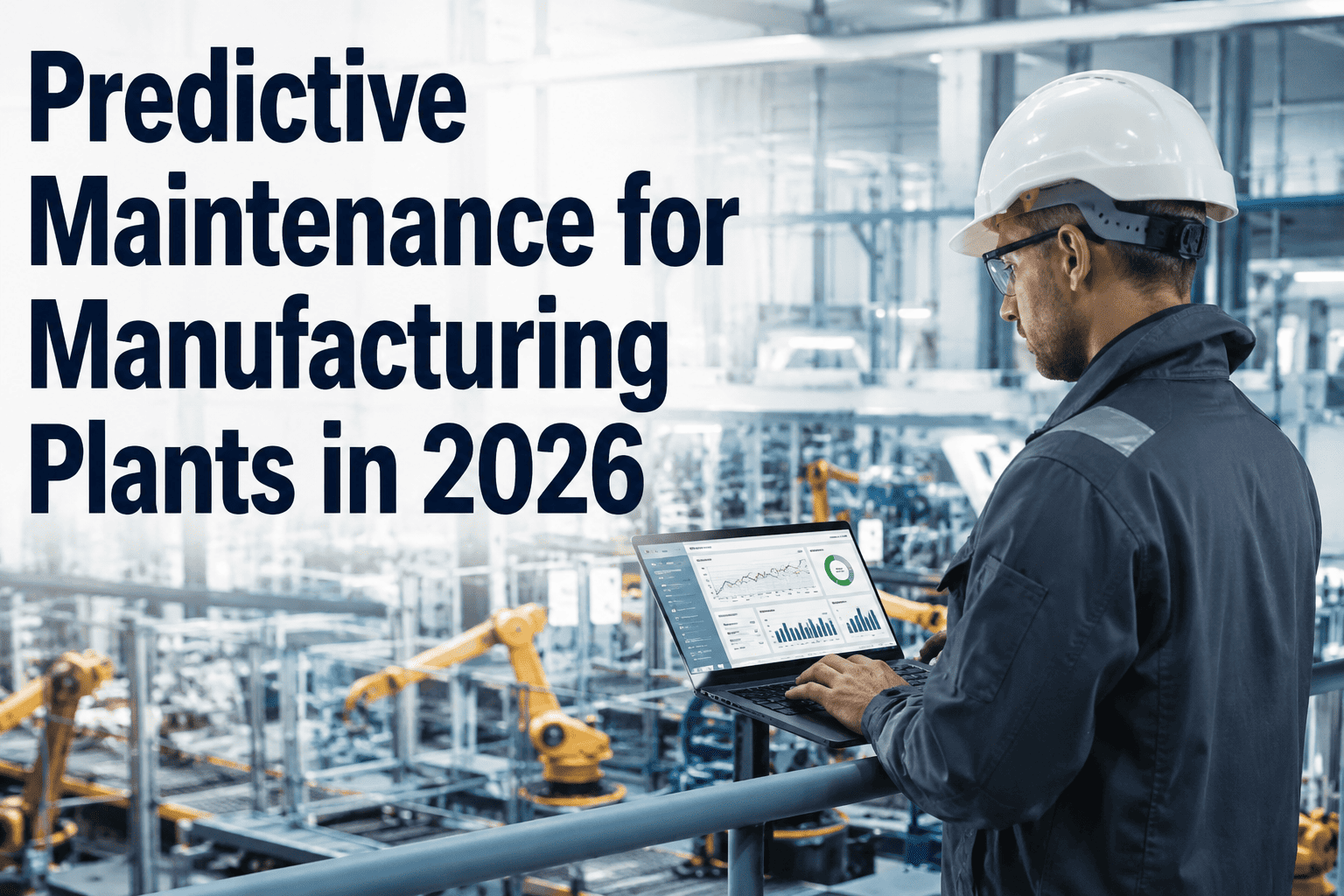
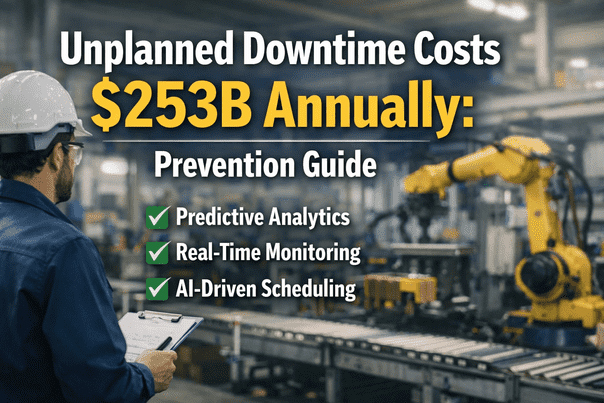
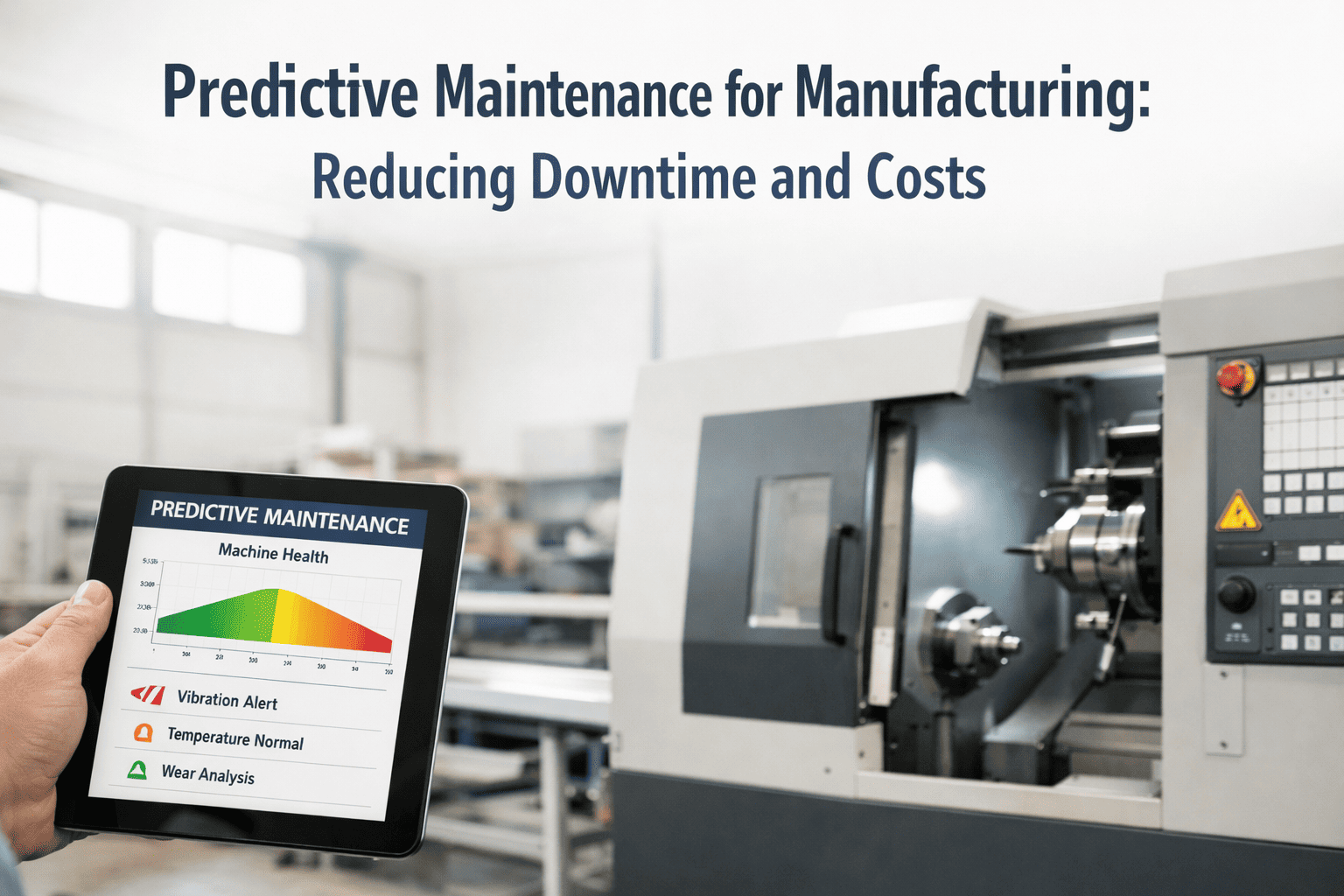
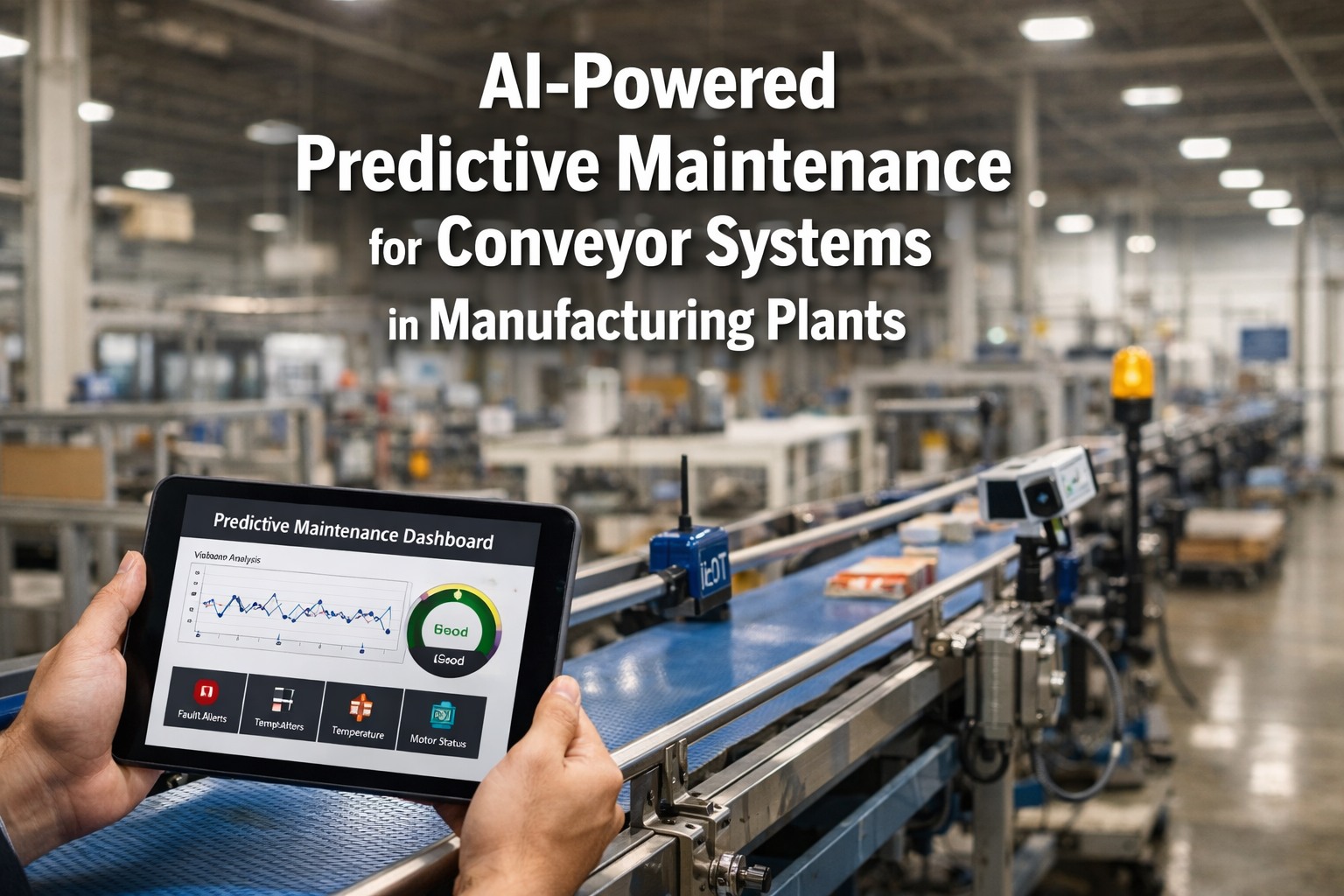
Every hour of unplanned machine stoppage drains revenue, delays orders, and puts production targets at risk. Across global manufacturing, unplanned equipment failures account for billions in annual losses, yet the majority of these breakdowns follow detectable warning patterns that traditional maintenance methods simply miss. AI-powered predictive monitoring closes this gap by continuously reading sensor signals from every critical asset on your floor, identifying anomalies invisible to human inspection, and generating actionable alerts days or weeks before a failure event. The shift from scheduled or reactive maintenance to condition-based, AI-driven strategies is no longer a competitive advantage; it is becoming an operational necessity. Schedule a consultation to see how predictive monitoring can protect your production uptime.
What Machine Downtime Actually Costs Your Operation
Downtime costs extend far beyond the repair bill. When a critical machine goes offline unexpectedly, the financial impact cascades through idle labor, missed shipments, scrapped materials, expedited freight charges, and potential contract penalties. Many facilities undercount downtime losses by 2x to 3x because they fail to capture these secondary effects. Understanding the true scope of downtime damage is the first step toward building the business case for AI-based prevention.
$260K+
Average hourly cost of unplanned downtime in manufacturing, with automotive sector losses exceeding $2M per hour
800 hrs
Average annual downtime per manufacturing facility, equating to roughly two hours of lost production every single day
$50B
Estimated annual cost of unplanned downtime across global industrial manufacturers combined
Reduce Your Downtime Costs
Find out how much unplanned downtime is costing your facility each month
Get Support for iFactory and get access to real-time downtime tracking dashboards, automated loss calculations, and AI-powered alerts that catch failures before they drain your production budget.
Get Support
How AI Detects Equipment Failures Before They Happen
Traditional maintenance relies on either fixed schedules or waiting for something to break. AI predictive monitoring takes an entirely different approach: it learns what healthy equipment sounds, vibrates, and behaves like, then watches for the subtle shifts that signal trouble is developing. This is not simple threshold alarming. Modern machine learning models correlate dozens of parameters simultaneously to catch complex failure patterns that single-sensor monitoring would miss completely.
01
IoT Sensor Deployment
Vibration accelerometers, temperature probes, current transducers, ultrasonic microphones, and pressure transmitters are installed on critical rotating and reciprocating equipment. These sensors capture high-frequency data streams that form the foundation for AI analysis. Wireless retrofit sensors make deployment possible on legacy equipment without wiring changes or downtime.
02
Intelligent Baseline Modeling
Machine learning algorithms analyze weeks of operational data under varying production loads, ambient conditions, and product types to build dynamic baselines for each monitored asset. Unlike static alarm thresholds, these baselines shift automatically as operating context changes, dramatically reducing false alerts while maintaining sensitivity to real anomalies.
03
Real-Time Anomaly Detection
Once baselines are established, AI engines run continuous comparisons between live sensor data and expected behavior. When vibration spectra shift, thermal patterns deviate, or power consumption drifts outside learned norms, the system identifies the anomaly type and assesses severity. Multi-sensor correlation confirms developing faults with high confidence before alerting maintenance teams.
04
Remaining Useful Life Forecasting
Beyond detecting that something is wrong, predictive models estimate how much operational life remains for degrading components. This enables maintenance planners to schedule interventions at the optimal moment, maximizing component lifespan while preventing unexpected failures. Time-to-failure estimates improve continuously as models learn from each confirmed prediction.
05
Automated Work Order Dispatch
When AI identifies a developing failure, it automatically generates prioritized maintenance work orders containing diagnostic context, recommended actions, and required spare parts. Direct integration with CMMS platforms ensures the right technician receives the right information without manual handoffs.
Get Support for iFactory to connect predictive alerts directly to your maintenance workflow.
Sensor Technologies Powering Real-Time Asset Health
The accuracy of AI predictions depends entirely on the quality and diversity of the sensor data feeding the models. Modern predictive monitoring platforms leverage multiple sensor types simultaneously because different failure modes present through different physical signals. A bearing defect shows in vibration data long before it affects temperature, while an electrical insulation breakdown appears in current waveforms before any mechanical symptom emerges.
Mechanical
Vibration Monitoring
Triaxial accelerometers capture velocity, acceleration, and displacement across X, Y, and Z axes. Frequency-domain analysis reveals bearing defects, gear mesh problems, shaft misalignment, rotor imbalance, and looseness. Often the earliest indicator of rotating machinery degradation.
Thermal
Temperature Tracking
Contact RTDs and infrared sensors monitor bearing housings, motor windings, electrical panels, and hydraulic systems. AI trend analysis distinguishes normal load-dependent heating from abnormal thermal runaway indicating insulation breakdown, lubrication failure, or friction increases.
Electrical
Current and Power Analysis
Motor current signature analysis (MCSA) detects rotor bar defects, stator faults, and driven-load abnormalities through electrical signals alone. Power consumption trending reveals efficiency degradation, mechanical binding, and process anomalies without direct mechanical access.
Acoustic
Ultrasonic Detection
High-frequency acoustic sensors detect compressed air leaks, steam trap failures, valve seat erosion, and early-stage bearing defects in the ultrasonic range. Particularly effective in noisy plant environments where audible cues are masked by ambient sound.
Process
Pressure and Flow Monitoring
Pressure transmitters and flow meters track hydraulic circuit health, pump performance curves, and coolant system integrity. AI detects filter clogging, pump cavitation, seal degradation, and system blockages through flow pattern deviations.
Fluid
Oil Condition Analysis
Inline oil sensors measure particle count, moisture content, viscosity, and dielectric properties continuously. AI correlates oil degradation rates with equipment operating parameters to optimize change intervals and flag contamination events that accelerate wear.
Why Reactive Maintenance Fails and Predictive AI Succeeds
The gap between traditional maintenance approaches and AI-driven predictive strategies is not incremental. It represents a fundamental shift in how manufacturers protect their production assets. Reactive maintenance treats every failure as an emergency, while scheduled preventive maintenance often services equipment that does not need it and misses equipment that does. AI monitoring eliminates both problems by letting each machine's actual condition dictate when maintenance occurs.
Reactive and Scheduled Approaches
Repairs happen after failure, causing emergency stops and production chaos
Calendar-based service ignores actual equipment condition and wastes resources
No advance warning means parts must be expedited at premium cost
Root cause analysis happens after damage is done, not before
Safety risks increase when equipment fails without warning
8-20%
production capacity typically lost
AI Predictive Monitoring
Failures detected weeks ahead, repairs scheduled during planned windows
Maintenance triggered by real-time condition data from each specific asset
Parts ordered proactively based on predicted replacement timelines
AI provides diagnostic context before technicians even reach the machine
Hazardous conditions flagged and addressed before they endanger workers
<3%
downtime with continuous optimization
Move Beyond Reactive Maintenance for Good
iFactory unifies sensor data, AI analytics, and maintenance workflows into one intelligent platform that gives your team complete visibility over every asset's condition, predicted health trajectory, and recommended maintenance actions.
Which Industries Gain the Most from Predictive Maintenance AI
While AI predictive monitoring delivers value across all manufacturing sectors, some industries see outsized returns due to the high cost of individual downtime events, the critical nature of their equipment, or regulatory requirements that demand documented maintenance compliance. The technology adapts its detection algorithms to each sector's unique equipment signatures and failure characteristics.
Critical AssetsRobotic welding arms, stamping presses, paint booth conveyors, CNC machining centers
Top Failure RisksServo motor degradation, hydraulic seal leaks, bearing fatigue in high-cycle tooling
AI Monitoring FocusTorque profile anomalies, cycle time drift, robotic arm joint temperature trending
Critical AssetsMixers, fillers, conveyors, refrigeration compressors, pasteurization systems
Top Failure RisksMotor burnout, seal degradation in wet environments, temperature control failure
AI Monitoring FocusHygiene-critical seal integrity, compressor efficiency curves, CIP system performance
Critical AssetsRolling mills, blast furnaces, overhead cranes, cooling water pumps
Top Failure RisksBearing catastrophic failure, refractory lining erosion, motor thermal overload
AI Monitoring FocusVibration spectral envelope, rolling force profiles, furnace thermal mapping
Critical AssetsTablet presses, granulators, HVAC systems, lyophilizers, autoclaves
Top Failure RisksPunch wear, agitator imbalance, filter clogging, HEPA integrity loss
AI Monitoring FocusGMP compliance tracking, cleanroom differential pressure, compression force consistency
Your Industry, Your Equipment
See how AI monitoring is configured for your specific machines and production environment
Book a demo tailored to your industry. Our team will walk through real detection scenarios for your equipment types, showing exactly how predictive alerts and automated work orders work on your production floor.
Book a Demo
Calculating the ROI of AI-Based Downtime Prevention
The return on investment for AI predictive monitoring compounds across multiple value streams simultaneously. Direct savings from reduced emergency repairs and parts expediting are only the beginning. Extended equipment lifespan, improved OEE scores, lower insurance premiums, reduced safety incidents, and better customer delivery performance all contribute to the total financial picture.
Aggregated results from manufacturing implementations across multiple sectors
50%
Reduction in unplanned downtime events
40%
Lower total maintenance expenditure
35%
Increase in overall equipment effectiveness
25%
Extension in average machine lifespan
70%
Fewer safety incidents related to equipment failure
A Practical Guide to Deploying Predictive Monitoring
Successful implementation does not require replacing your entire equipment fleet or overhauling your maintenance organization overnight. The most effective deployments start small with high-impact assets, prove value quickly, and expand based on demonstrated results. This phased approach manages risk, builds internal expertise, and creates organizational momentum for broader adoption.
Phase 1
Week 1-3
Asset Audit and Pilot Selection
Review maintenance records to identify highest-impact failure-prone equipment
Calculate current downtime costs per asset to establish ROI baselines
Select 3 to 5 critical machines for initial pilot deployment
Map existing sensor infrastructure and identify monitoring gaps
Phase 2
Week 4-7
Sensor Installation and Data Pipeline
Deploy wireless IoT sensors on pilot equipment without production interruption
Establish secure data connections to edge computing and cloud analytics
Integrate sensor feeds with existing SCADA, MES, and CMMS platforms
Validate data quality and sensor calibration against known baselines
Phase 3
Week 8-12
AI Training and Alert Optimization
AI models learn normal operating envelopes for each monitored asset
Anomaly detection thresholds calibrated to minimize false positives
Maintenance team trained on alert interpretation and response protocols
First predictive insights delivered with recommended corrective actions
Phase 4
Week 13+
Scale Across the Plant Floor
Expand monitoring to additional production lines based on pilot ROI
AI models improve prediction accuracy as they learn from confirmed outcomes
Automated work order generation integrated into daily maintenance workflows
Continuous model refinement drives ongoing improvement in detection capability
The shift from reactive to predictive maintenance is not about replacing your maintenance team. It is about giving them the ability to see problems developing inside machines weeks before any human sense could detect them. AI does not replace expertise. It amplifies it with data.
Industrial Operations Intelligence Report
Turn Every Machine Into a Self-Reporting Asset
Calendar-based service schedules cannot tell you that a motor winding is deteriorating at 3 AM or that a pump impeller will fail before the next scheduled inspection. iFactory connects AI predictive monitoring to your entire production operation, delivering real-time health visibility, intelligent failure prediction, and automated maintenance workflows that transform how your plant manages uptime.
Frequently Asked Questions
How soon does AI predictive monitoring start delivering measurable results?
Most manufacturing facilities begin receiving actionable anomaly alerts within the first 30 to 45 days of sensor deployment. Quick wins such as detecting previously unknown air leaks, identifying misaligned drives, or catching early bearing degradation often deliver payback within the first 6 months. Prediction accuracy improves continuously as AI models accumulate more operational data from your specific equipment and conditions.
Schedule a consultation to estimate timelines for your facility.
Can we implement AI monitoring on older or legacy equipment?
Yes. Wireless retrofit IoT sensors can be installed on virtually any equipment regardless of age or manufacturer. Vibration sensors attach magnetically to bearing housings, temperature sensors clamp onto motor casings, and current monitors clip around power cables with zero wiring modifications. There is no need to replace machines or install new PLCs to begin capturing the data needed for predictive analytics.
What kinds of machine failures can AI actually predict?
AI monitoring is effective at predicting bearing wear, shaft misalignment, rotor imbalance, gear mesh degradation, pump cavitation, belt deterioration, motor insulation breakdown, hydraulic seal failure, lubrication starvation, and electrical connection degradation. The technology excels at catching gradual degradation patterns that develop over days, weeks, or months, precisely the types of failures that escape routine visual inspections and scheduled service intervals.
Get Support for iFactory to explore AI detection capabilities for your equipment.
How does predictive monitoring integrate with our existing CMMS or ERP system?
AI platforms connect to CMMS, ERP, SCADA, and MES systems through standard REST APIs and industrial communication protocols such as OPC-UA, MQTT, and Modbus TCP. When an anomaly triggers a predictive alert, the system can automatically generate a work order in your CMMS complete with diagnostic context, recommended repair actions, priority classification, and parts requirements, all without manual data entry.
Will AI alerts overwhelm our maintenance team with false positives?
AI predictive systems are specifically engineered to minimize false alarms through multi-sensor correlation and adaptive threshold learning. Unlike simple high-low alarms, AI evaluates anomalies against the full operating context, including production load, ambient conditions, time of day, and equipment age. Industrial deployments consistently achieve detection precision above 90 percent, meaning the vast majority of alerts represent genuine developing issues that warrant attention.
Book a demo to see how intelligent alerting filters noise from signal.