Manufacturers worldwide are entering what industry analysts call the execution era of digital transformation. After years of piloting IoT sensors, testing AI models, and experimenting with automation, 2026 is the year factories must scale what works—or risk falling behind competitors who already have. With 92% of manufacturing executives now viewing smart manufacturing as their primary competitive driver, the gap between leaders and laggards is widening fast. But the path from pilot to production-wide transformation is where most plants struggle. This guide breaks down the real-world barriers, proven solutions, and measurable outcomes that define successful smart factory programs today. Schedule a free demo to see how iFactory helps plants like yours accelerate every phase of the transformation.
What Is Driving the Urgency Behind Factory Digitization
The pressures pushing manufacturers toward smart factory adoption are not theoretical—they are financial, operational, and existential. Volatile supply chains, rising energy costs, labor shortages, and customer demand for faster customization have converged to make traditional manufacturing models unsustainable at scale.
80%
of manufacturers plan to invest 20%+ of improvement budgets in smart factory initiatives over the next 24 months
3.8M
new manufacturing employees needed by 2033 to fill the growing skills gap across digital and traditional roles
$964B
projected global IIoT market value by 2035, reflecting the foundational role of connected sensors in every transformation
The convergence of these forces means manufacturers who delay transformation are not just missing efficiency gains—they are actively losing ground. Companies that have already connected their shop floors with IoT, AI, and automation are reporting production throughput improvements of up to 20%, while their competitors still rely on spreadsheets and monthly reporting cycles. Get Support for iFactory and discover where the fastest efficiency gains are hiding in your current operations.
The Five Barriers That Stall Most Transformation Programs
Smart factory transformation fails more often from organizational and infrastructure friction than from technology gaps. Understanding where programs stall helps manufacturers plan around these obstacles rather than running into them mid-deployment.
01
Most Cited
Aging Equipment That Cannot Communicate
Most factories operate with a patchwork of old and new machines. Older assets lack digital interfaces, making it impossible to collect the real-time data that AI and analytics platforms require. Retrofit sensor kits and protocol gateways (OPC-UA, Modbus, HART) bridge this gap without full equipment replacement—letting you start capturing production data from legacy lines within weeks.
02
+15pp YoY
Data That Lives in Disconnected Systems
Data interoperability surged as a top concern in 2026, with 37% of manufacturers now identifying it as a primary roadblock—up from just 22% the previous year. When ERP, MES, SCADA, and quality systems operate in isolation, no single team has the complete picture needed to optimize across the value chain. Unified data platforms with standardized APIs solve this by creating a single source of truth.
03
Workforce Readiness and the Skills Mismatch
Over one-third of manufacturing executives rank equipping workers with smart factory skills as their top human capital concern. The solution is not replacing people with machines—it is augmenting teams with role-based dashboards, AR-guided training, and AI decision-support tools that make complex data actionable for operators who know the production process best.
04
Largest YoY Increase
Cybersecurity Across Connected Operations
As operational technology networks link to enterprise IT systems, the attack surface grows dramatically. 68% of manufacturers performed a cybersecurity risk assessment of their smart factory stack in the past year. Zero-trust OT architectures, edge-first processing that keeps sensitive data on-premises, and continuous vulnerability monitoring are becoming baseline requirements.
05
Improving
Expanding Pilots Into Full-Scale Deployments
The good news: five major roadblocks—leadership buy-in, cultural resistance, lack of roadmap, pilot-to-scale difficulty, and skills shortages—all declined by seven or more percentage points from 2025 to 2026. Manufacturers are learning that defining clear KPIs before deployment, phasing rollouts with governance structures, and forming dedicated transformation teams are the keys to scaling.
Facing one or more of these barriers? Our team helps manufacturers build phased transformation plans that address infrastructure, data, and people challenges together.
Book a Demo
How IoT, AI, and Automation Work Together on the Shop Floor
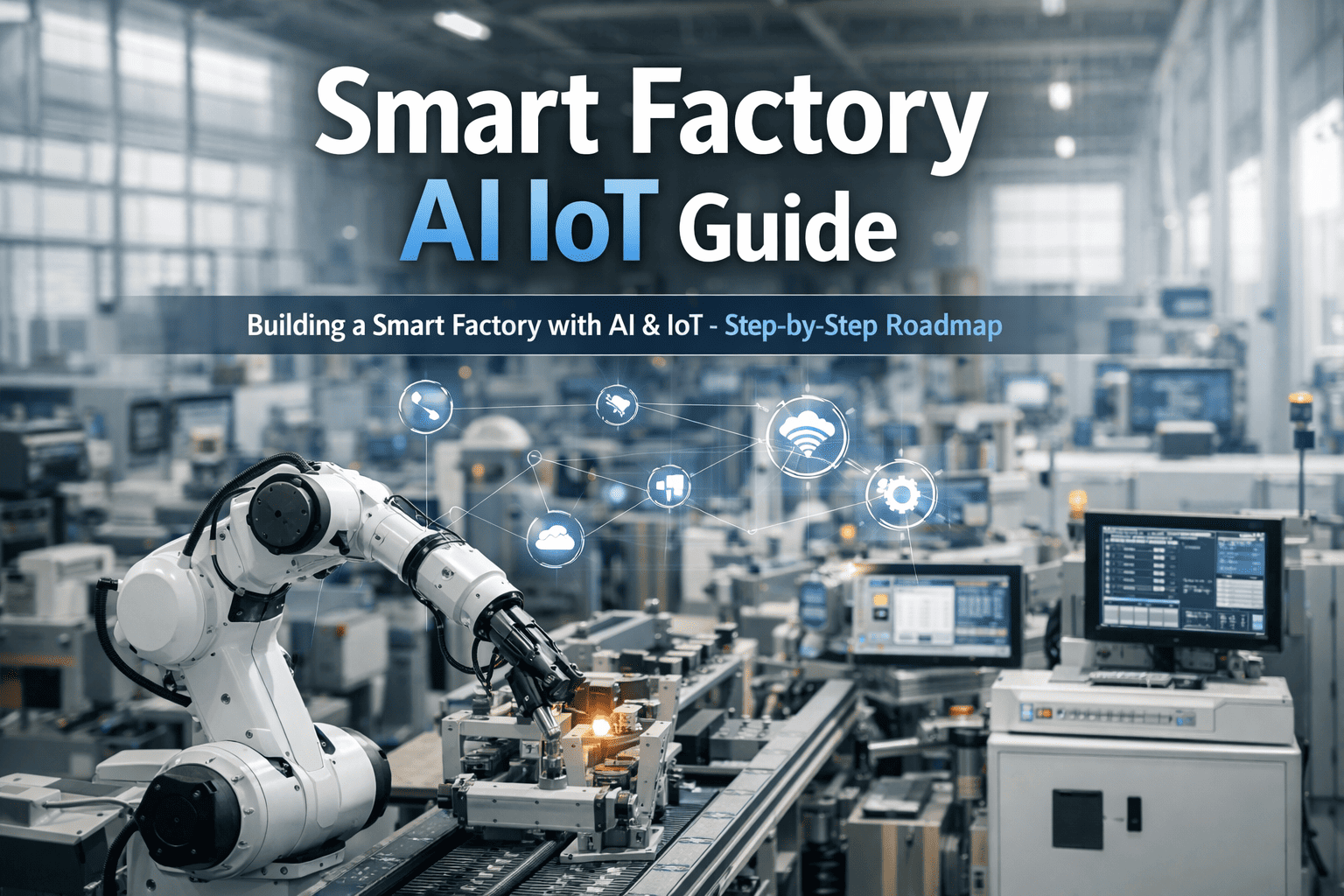
A smart factory is not a single technology—it is an architecture where sensors, analytics, and automated systems form a closed feedback loop. Each layer generates data that the next layer consumes, creating a system that continuously learns and self-optimizes.
Sense
IIoT Sensors and Edge Devices
Temperature, vibration, pressure, energy, and cycle-time sensors capture operational data at sub-second intervals across every production asset. Edge computers process this data locally for immediate anomaly detection—even during network outages. Investment priorities for 2026 show 34% of manufacturers targeting active sensor deployment as a top budget item.
Decide
AI Analytics and Digital Twins
Machine learning models analyze sensor streams against production schedules, quality data, and historical baselines to predict failures, forecast demand, and identify efficiency gaps. Digital twins simulate process changes and capacity scenarios virtually—eliminating costly trial-and-error on live production lines. 29% of surveyed manufacturers now use AI at the facility or network level.
Act
Automation, Robotics, and Closed-Loop Control
Collaborative robots handle repetitive, precision, and hazardous tasks while AI vision systems inspect quality at full line speed. Automated scheduling adjusts production sequences based on real-time demand signals. 5G connectivity enables millisecond-latency coordination between robots, AGVs, and control systems across the factory floor.
Schedule a demo to see how iFactory connects these layers into one intelligent platform for your existing infrastructure.
Measurable Outcomes from Real-World Deployments
The business case for smart factory transformation is no longer speculative. Across industries and geographies, manufacturers are documenting consistent, measurable returns from their digital investments.
20%
Average Productivity Gain
In both production output and workforce efficiency, as reported by manufacturers who have deployed smart factory technologies across their operations
70–75%
Reduction in Equipment Breakdowns
Through IoT-enabled condition monitoring and AI-driven predictive maintenance that catches failures before they cascade into unplanned downtime
25%
Lower Maintenance Costs
By replacing calendar-based preventive schedules with data-driven maintenance triggered by actual equipment condition and degradation patterns
30%
Fewer Product Defects
AI vision systems and real-time SPC detect quality issues at the moment they occur—not after the batch is complete—enabling immediate corrective action
12–24
Months to Full ROI
Most manufacturers achieve complete payback within one to two years, with initial benefits visible within the first three to six months of deployment
95%
Positive ROI for Predictive Maintenance
With 27% of adopters achieving payback in under 12 months—the US Department of Energy documents potential 10x returns from predictive maintenance programs
Want to model these outcomes for your plant? Our team can estimate ROI based on your specific equipment, production volumes, and current downtime metrics.
Book a Demo
Industry-Specific Transformation Use Cases
Smart factory implementation looks different in every sector because each industry has unique production workflows, compliance requirements, and optimization priorities. These are the patterns that are delivering the highest impact across verticals.
Automotive
EV Assembly and High-Voltage Quality Assurance
AI-powered robotic cells handle battery module assembly and high-voltage testing with precision beyond manual capability. Vision systems inspect welds and component placement at full line speed, while digital twins simulate retooling for new vehicle platforms without stopping production. Manufacturers report up to 30% reduction in assembly defects.
Pharma
Batch Intelligence and Regulatory Compliance
IoT sensors monitor every batch parameter—temperature, humidity, pressure, particulate counts—generating audit-ready compliance documentation automatically. AI detects subtle process deviations before they impact product quality, reducing batch rejection rates by up to 45% while meeting FDA and GMP requirements.
Food & Beverage
Connected Lines and Adaptive Cleaning Cycles
Smart sensors track product flow from raw material intake through packaging. AI-optimized CIP systems adjust cleaning cycles based on actual contamination levels rather than fixed schedules—reducing water and chemical usage while maintaining food safety standards. OEE improvements of 25% are common in early deployments.
Electronics
High-Mix Flexibility and Zero-Defect Production
AI vision systems recognize component types and orientations without manual programming, enabling rapid changeovers across high-mix product portfolios. Edge computing processes inspection data in milliseconds for real-time quality gating. Changeover times drop by up to 60% with AI-guided line reconfiguration.
Where Smart Factory Budgets Are Going in 2026
Understanding where peer companies are directing investment helps manufacturers benchmark their own strategies. The data shows a clear pattern: foundational infrastructure first, advanced analytics second, with cybersecurity running as a parallel priority throughout.
Turn Your Factory Data Into Competitive Advantage
iFactory brings IoT, AI analytics, and workflow automation together in one platform—connecting your machines, teams, and systems so you can move from reactive firefighting to proactive optimization. Whether you are instrumenting your first production line or scaling across multiple plants, the platform adapts to your pace.
A Practical Roadmap for Getting Started
Industry leaders consistently recommend a phased approach that delivers quick wins while building toward comprehensive optimization. Trying to transform everything at once is the fastest way to stall. Here is the sequence that works.
1
Month 1–2
Audit and Prioritize
Conduct an infrastructure assessment to identify which assets generate the most downtime and cost. Map your current data flows to find gaps between systems. Define three measurable business outcomes—such as first-pass yield, on-time-in-full, or energy per unit—that will anchor every subsequent decision.
2
Month 3–5
Connect and Capture
Deploy IoT sensors on your highest-impact assets first. Establish edge computing for real-time data processing and install protocol gateways to bring legacy equipment into the data ecosystem. Integrate sensor feeds with your MES, ERP, and SCADA systems through a unified data platform.
3
Month 6–8
Analyze and Predict
Activate AI-driven analytics dashboards and predictive maintenance models. Calibrate anomaly detection thresholds using baseline data. Train operators on role-based decision-support interfaces that translate machine learning outputs into clear, actionable recommendations.
4
Month 9+
Optimize, Automate, and Scale
Enable closed-loop automation where AI recommendations trigger actions without manual intervention. Expand monitoring to additional production lines and facilities. Implement digital twins for scenario planning and capacity optimization. Track ROI continuously and use proven results to fund the next expansion phase.
Ready to map your transformation roadmap? Get a customized implementation plan with timeline, budget estimates, and expected outcomes for your specific operation.
Book a Demo
Frequently Asked Questions
How long does it take to see results from a smart factory program?
Most manufacturers identify measurable improvements within three to six months of deploying connected sensors and analytics on their highest-impact assets. Quick wins from anomaly detection and basic predictive maintenance often justify the initial investment within the first year. Full transformation across a facility typically takes 12 to 24 months, depending on equipment diversity and data readiness.
Schedule a personalized demo to map out a realistic transformation timeline for your facility.
Can we digitize a factory that runs mostly older equipment?
Yes. Retrofit IoT sensor kits, protocol translators, and edge computing devices can connect machines that are decades old to modern analytics platforms—without replacing the equipment itself. The key is starting with the assets that generate the most downtime or cost, instrumenting them first, and expanding from there based on proven value.
What budget should we plan for a smart factory pilot?
Initial pilots focusing on sensor deployment and cloud-based analytics for a single production line can be structured to deliver payback within six to twelve months. The phased approach means you do not need massive upfront capital. Start small, demonstrate ROI, and use those results to build the case for broader investment.
Get Support for iFactory to get budgeting guidance and a pilot plan customized for your facility size and production goals.
Do we need to hire data scientists to run a smart factory?
Not necessarily. Modern platforms are built with role-based interfaces that translate complex analytics into actionable insights for operators, engineers, and managers. The goal is to augment your existing workforce—turning maintenance technicians into technician-analysts and line operators into process supervisors—rather than building an entirely new data team from scratch.
How does smart factory technology improve sustainability and compliance?
Predictive maintenance extends asset lifespans and reduces embodied carbon from premature replacements. Energy-aware scheduling shifts high-power operations to lower-carbon grid windows or periods of peak renewable availability. Digital twins let teams model the tradeoffs between throughput and environmental impact before making changes on the production floor. Automated compliance documentation eliminates manual audit preparation.
Book a demo to see real sustainability dashboards and compliance workflows in action for your industry.