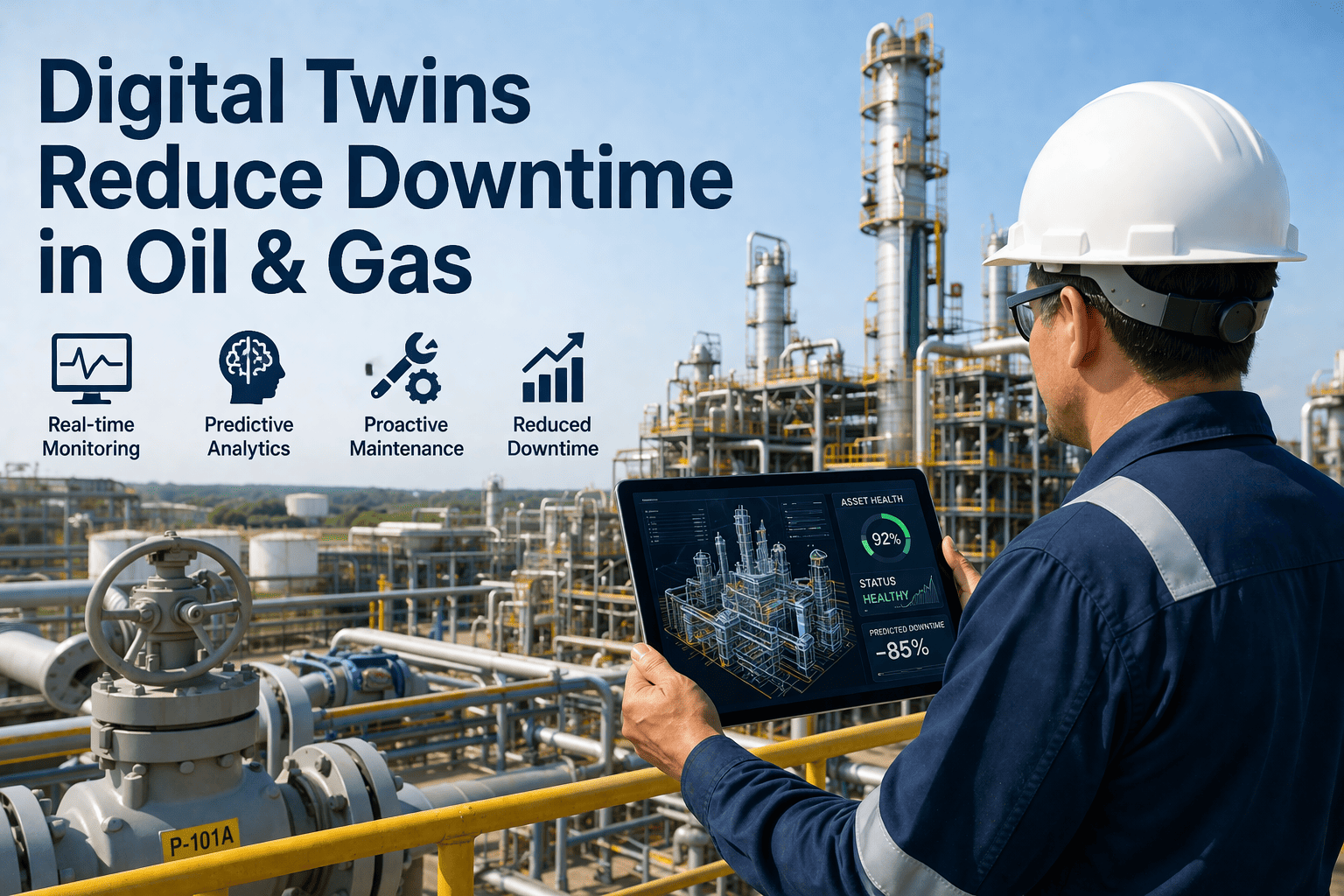
Factory's AI-powered predictive maintenance platform continuously monitors equipment health across upstream drilling operations, midstream pipeline networks, and downstream refining facilities, detecting failure signatures 14-21 days before breakdowns occur, auto-generating work orders with exact failure predictions and recommended actions, and eliminating 40% of unplanned downtime through condition-based interventions that traditional preventive maintenance programs cannot achieve. The equipment failures costing you $2.4 million annually in emergency repairs and lost production now become scheduled 4-hour maintenance events executed during planned shutdowns with zero revenue impact. Book a demo to see predictive maintenance for your oil and gas operations.
Quick Answer
iFactory's AI predictive maintenance integrates real-time data from SCADA systems, DCS controllers, IoT sensors, and historians to detect equipment degradation patterns 14-21 days before failures occur. Machine learning models trained on millions of oil and gas equipment failure events analyze vibration signatures, temperature trends, pressure anomalies, and performance data to forecast pump seal failures, compressor bearing wear, turbine blade degradation, and wellhead equipment issues. System auto-generates prioritized work orders, schedules maintenance during planned shutdowns, and provides technicians with exact failure predictions and repair recommendations. Result: 40% reduction in unplanned downtime, 35% lower maintenance costs, 28% longer equipment life, and complete integration with existing operational technology infrastructure.
AI Predictive Maintenance for Oil & Gas
Stop Equipment Failures Before They Stop Production
iFactory predicts compressor, pump, turbine, and wellhead failures 14-21 days ahead, eliminating emergency repairs and unplanned downtime across upstream, midstream, and downstream operations.
Understanding Oil & Gas Operations and Equipment Criticality
Oil and gas operations span three distinct segments, each with unique equipment reliability requirements and downtime cost profiles. Predictive maintenance strategies must account for operational differences between exploration wells, pipeline compression stations, and refining process units.
Critical equipment includes ESP motors, rod pumps, wellhead systems, drilling rigs, and production separators. Failures cause immediate production loss from multiple wells. Remote locations make emergency repairs expensive, requiring helicopter deployment and specialized technicians. Predictive maintenance prevents costly well shutdowns and maximizes production uptime.
Technology Stack: SCADA systems, downhole sensors, wellhead pressure/temperature monitoring, production historians, PLCs controlling artificial lift systems.
Compressor stations, pumping systems, storage facilities, and thousands of miles of pipeline infrastructure. Equipment failures trigger emergency shutdowns, regulatory scrutiny, and potential environmental incidents. Pipeline integrity monitoring and compressor reliability are critical. Unplanned compression station downtime disrupts entire distribution networks.
Technology Stack: DCS systems, pipeline SCADA, inline inspection tools, corrosion monitoring sensors, compressor vibration analysis, flow computers, leak detection systems.
Refinery process units, distillation columns, crackers, reformers, compressors, pumps, heat exchangers, and rotating equipment. High-temperature, high-pressure operations where equipment failures cause process upsets, safety incidents, and millions in lost production. Predictive maintenance optimizes turnaround planning and prevents unscheduled shutdowns.
Technology Stack: Advanced DCS systems, process historians, vibration monitoring, temperature arrays, pressure transmitters, corrosion probes, analyzer systems, safety instrumented systems.
Critical Equipment Failures Costing Oil & Gas Operators Millions Annually
Every failure scenario below represents real downtime events that occur when equipment degradation goes undetected by manual inspection programs and time-based preventive maintenance schedules. These problems persist because traditional maintenance cannot predict when failures will occur or identify developing issues before catastrophic breakdowns.
ESP Motor Failures Halting Well Production
Electric submersible pump motors fail without warning due to insulation degradation, bearing wear, or seal leaks. Failure shuts down production from well, requires workover rig mobilization costing $85,000-$140,000, causes 8-14 day production loss worth $180,000+ per well. AI fix: Motor current signature analysis detects insulation breakdown 3 weeks early, vibration monitoring identifies bearing degradation, system schedules preventive replacement during planned workover, eliminating emergency rig costs and production loss.
Gas Compressor Bearing Failures During Peak Demand
Compressor station bearings degrade gradually from contamination, lubrication issues, or alignment problems. Catastrophic failure occurs during high-throughput periods when downtime costs exceed $15,000/hour. Emergency repairs require 48-72 hours, specialized bearings procurement, field machining. AI fix: Vibration frequency analysis detects bearing defects 21 days ahead, oil analysis reveals contamination trends, system schedules bearing replacement during low-demand window, preventing peak-period failures.
Pipeline Pump Seal Leaks Triggering Emergency Shutdowns
Mechanical seals in pipeline transfer pumps fail from wear, dry running, or thermal cycling. Small leaks detected during inspection trigger immediate shutdown per safety protocols. Repair requires pump isolation, seal replacement, pressure testing, 18-24 hour downtime. Hydrocarbon releases create regulatory reporting obligations, potential fines. AI fix: Seal chamber temperature monitoring detects abnormal heat patterns 14 days before leak develops, pump performance trending identifies efficiency loss indicating seal wear, preventive seal change scheduled during planned maintenance window.
Refinery Heat Exchanger Tube Failures Causing Process Upsets
Heat exchanger tubes develop leaks from corrosion, erosion, or thermal fatigue. Tube failure allows cross-contamination between process streams, forcing unit shutdown for tube plugging or replacement. Downtime: 36-96 hours depending on severity. Production loss: $2-8 million per event. AI fix: Differential temperature and pressure monitoring across exchanger detects tube degradation patterns, fouling rate analysis predicts performance decline, system recommends proactive tube inspection/replacement during planned turnaround rather than forced outage.
Turbine Blade Degradation Leading to Catastrophic Failure
Gas turbine blades suffer from high-cycle fatigue, creep, or hot corrosion. Blade failure causes turbine destruction, 6-12 month rebuild timeline, $3-8 million repair cost plus lost generation capacity. Insurance claims, regulatory investigation, safety stand-downs across fleet. AI fix: Vibration signature analysis detects blade crack initiation, combustion dynamics monitoring identifies hot gas path deterioration, borescope inspection intervals optimized by AI health scoring, blade replacement scheduled during planned outage before failure risk escalates.
Rod Pump Failures From Undetected Downhole Conditions
Sucker rod pumps fail from fluid pound, gas interference, parted rods, or worn barrel/plunger. Failure detected only when production drops significantly, requiring immediate well intervention. Workover costs $40,000-$75,000, production loss 5-10 days per well. Multiple failures across field compound impact. AI fix: Dynamometer card analysis via surface unit current/position data detects downhole pump problems 10-14 days early, fluid level trending identifies gas interference developing, system recommends production optimization or pump replacement before failure, eliminating emergency workovers.
The Complete AI Platform for Oil & Gas Operations
iFactory delivers integrated predictive maintenance, pipeline integrity monitoring, work order automation, and ESG compliance reporting in a unified platform purpose-built for oil and gas operational technology environments. Unlike generic industrial IoT solutions, iFactory understands upstream well operations, midstream pipeline networks, and downstream refining processes.
Predictive vs Reactive Maintenance: Performance Comparison
Traditional time-based preventive maintenance and reactive failure response cannot match AI predictive maintenance for downtime reduction, cost efficiency, and equipment reliability in oil and gas operations.
| Metric |
Reactive Maintenance |
Time-Based Preventive |
iFactory AI Predictive |
| Unplanned Downtime |
High (failures occur unpredictably) |
Moderate (scheduled but not optimized) |
40% reduction vs baseline |
| Maintenance Costs |
Very High (emergency labor, expedited parts) |
Moderate (fixed schedule, some waste) |
35% lower than reactive |
| Equipment Life |
Shortest (run-to-failure accelerates wear) |
Moderate (over-maintenance possible) |
28% longer asset life |
| Failure Prediction |
None (respond after failure) |
Calendar-based estimates |
14-21 day advance warnings |
| Parts Inventory |
High safety stock for emergencies |
Moderate stock levels |
Optimized just-in-time |
| Technician Efficiency |
Low (firefighting, diagnostics) |
Moderate (scheduled work) |
High (precise interventions) |
Platform Capability Comparison: Oil & Gas Maintenance Solutions
Purpose-built oil and gas predictive maintenance platforms deliver superior integration, specialized analytics, and industry-specific failure models compared to generic industrial monitoring systems.
| Capability |
iFactory |
QAD Redzone |
IBM Maximo |
SAP EAM |
Fiix (Rockwell) |
UpKeep |
| AI Predictive Maintenance |
✔ Advanced ML models |
Basic analytics |
Health Insights add-on |
Requires SAP Predictive |
Limited AI |
✗ Not available |
| SCADA/DCS Integration |
✔ Native connectors |
✗ Not available |
Custom integration |
Via PI System |
Rockwell only |
✗ Not available |
| Real-Time Monitoring |
✔ Sub-second latency |
✔ Real-time |
Minutes delay |
Minutes delay |
Limited sensors |
Manual logging |
| Work Order Automation |
✔ AI-generated WOs |
Manual creation |
✔ Workflow engine |
✔ Workflow engine |
Template-based |
Template-based |
| Pipeline Monitoring |
✔ Integrity module |
✗ Not available |
Linear assets |
Custom config |
✗ Not available |
✗ Not available |
| ESG Reporting |
✔ Automated emissions tracking |
✗ Not available |
Sustainability module |
EHS module |
✗ Not available |
✗ Not available |
| Edge AI Capability |
✔ On-premise deployment |
Cloud only |
Hybrid available |
Hybrid available |
Cloud only |
Cloud only |
| Oil & Gas Specialization |
✔ Pre-trained models |
Generic manufacturing |
Industry templates |
Industry solutions |
Generic CMMS |
Generic CMMS |
Comparison based on publicly available product documentation as of April 2026. Verify current capabilities with vendors.
Regional Compliance Standards for Oil & Gas Operations
Oil and gas operations across different regions must comply with specific safety, environmental, and industrial standards. iFactory ensures automated compliance documentation aligned with regional regulatory frameworks.
| Category |
United States |
United Kingdom |
United Arab Emirates |
Canada |
Europe |
| Safety |
OSHA 1910, API RP 754 |
HSE Offshore, UKOPA |
OSHAD, ADNOC HSE |
CSA Z662, OHS regulations |
ATEX, Seveso III Directive |
| Environmental |
EPA Clean Air Act, GHGRP |
BEIS emissions, Environment Act |
MOCCAE standards, ESG Abu Dhabi |
CEPA, Provincial regulations |
EU ETS, Industrial Emissions Directive |
| Industrial Standards |
API, ASME, ANSI standards |
BS EN ISO 9001, PAS 55 |
ISO 55000, ADNOC codes |
CSA standards, ISO compliance |
EN standards, IEC 61508 |
| Oil & Gas Specific |
API 570/510, PHMSA pipeline rules |
UKCS regulations, COMAH |
ADNOC operational standards |
NEB Act, AER Directive 060 |
Offshore Safety Directive, E&P Forum |
Regional Platform Fit: How iFactory Solves Local Challenges
Different regions face unique operational challenges based on regulatory environment, infrastructure age, climate conditions, and sustainability requirements. iFactory addresses region-specific needs through localized compliance templates and operational modules.
| Region |
Key Challenges |
How iFactory Solves |
| United States |
Aging infrastructure (50+ year old pipelines), OSHA compliance complexity, EPA methane regulations, pipeline safety (PHMSA), shale production optimization |
Pipeline integrity monitoring with corrosion prediction, automated OSHA/EPA compliance documentation, methane leak detection and quantification, well production optimization, aging asset lifecycle management |
| United Arab Emirates |
Harsh desert conditions (50°C+ temperatures), offshore platform reliability, ADNOC operational standards, sustainability reporting, rapid infrastructure expansion |
High-temperature equipment monitoring, offshore predictive maintenance, ADNOC compliance templates, automated ESG reporting for Abu Dhabi 2030, rapid deployment for new facilities |
| United Kingdom |
Strict ESG compliance, North Sea offshore operations, UKCS regulations, carbon reduction targets, legacy infrastructure management |
Comprehensive emissions tracking and reporting, offshore platform condition monitoring, UKCS compliance automation, carbon intensity optimization, digital twin for aging assets |
| Canada |
Remote asset locations, extreme cold conditions (down to -40°C), oil sands operations, indigenous consultation requirements, long pipeline networks |
Remote monitoring with satellite connectivity, cold weather equipment reliability models, oil sands extraction optimization, consultation documentation workflows, pipeline integrity across vast distances |
| Europe |
Aggressive carbon reduction mandates, renewable energy transition, EU ETS compliance, refinery efficiency optimization, stringent safety regulations |
Carbon footprint tracking and reduction analytics, energy efficiency optimization, EU ETS automated reporting, refinery turnaround optimization, Seveso Directive compliance automation |
Proven Results Across Oil & Gas Segments
40% Downtime Reduction, 35% Lower Costs, 28% Longer Asset Life
See how iFactory's AI predictive maintenance eliminates unplanned equipment failures across upstream wells, midstream pipelines, and downstream refineries through 14-21 day advance failure predictions.
Real-World Implementation Results
40%
Unplanned Downtime Reduction
35%
Lower Maintenance Costs
28%
Longer Equipment Life
14-21 Days
Advance Failure Warnings
$2.4M
Annual Emergency Cost Savings
94%
Prediction Accuracy Rate
Implementation Roadmap for Oil & Gas Operations
Deploying AI predictive maintenance across oil and gas facilities follows a structured approach delivering immediate downtime reduction while building comprehensive equipment health models optimized for upstream, midstream, and downstream operations.
SCADA/DCS Integration & Data Collection
Connect iFactory to existing DCS, SCADA, and historian systems via OPC-UA, Modbus, or native connectors. Establish secure edge deployment within OT network perimeter. Begin ingesting real-time sensor data from critical equipment: compressors, pumps, turbines, ESP motors, heat exchangers. Import 12-24 months historical failure data and maintenance records for AI model training.
Deliverable: Real-time monitoring active for pilot equipment group, baseline AI models trained on historical patterns.
Predictive Model Activation & Validation
Activate failure prediction models for compressors, pumps, turbines. Set alert thresholds for maintenance scheduling. Calibrate prediction sensitivity based on actual equipment performance and false positive tolerance. Validate predictions against known failure events. Configure automated work order generation with integration to existing CMMS (Maximo, SAP, Oracle).
Deliverable: Predictive analytics operational on pilot equipment, first maintenance events scheduled based on AI recommendations, work order automation active.
Full Deployment & Continuous Optimization
Scale predictive maintenance to all critical equipment across facilities. Activate pipeline integrity monitoring module for midstream assets. Enable ESG reporting automation for methane, VOC, and flaring tracking. Deploy robotics inspection integration for visual anomaly detection. Establish continuous learning process where AI improves from every equipment failure and maintenance intervention.
Deliverable: Enterprise-wide predictive maintenance operational, measured 40% downtime reduction achieved, documented cost savings validated.
Advanced Analytics & Multi-Site Optimization
Refine models based on seasonal production patterns, new equipment installations, and evolving operational conditions. Implement multi-site benchmarking to identify best practices across facilities. Expand to additional equipment types and edge cases. Integrate supplier quality data to predict vendor-specific failure modes. Achieve industry-leading 94% prediction accuracy through continuous model improvement.
Outcome: Self-improving system delivering increasing reliability, approaching 98% equipment availability across operations.
Frequently Asked Questions
QHow does iFactory integrate with existing SCADA and DCS systems without disrupting operations?
iFactory connects via read-only OPC-UA, Modbus, or native protocols to existing control systems and historians like OSIsoft PI, Aspen IP.21, Honeywell PHD. No changes to operational technology infrastructure required. Edge deployment keeps OT data inside your security perimeter. Typical integration completed in 2-3 weeks with zero production impact.
Book demo to see integration process.
QWhat equipment failures can AI predictive maintenance detect 14-21 days in advance?
AI models predict compressor bearing failures, pump seal leaks, ESP motor insulation breakdown, turbine blade degradation, heat exchanger tube leaks, pipeline corrosion, valve actuator failures, and rotating equipment imbalances. System analyzes vibration signatures, temperature trends, pressure anomalies, current draw patterns, and performance degradation to forecast failures before catastrophic breakdowns occur.
See prediction examples in demo.
QHow accurate are failure predictions and what happens with false positives?
System achieves 94% prediction accuracy within 7-21 day windows after 6-month learning period. False positive rate typically under 8%. When predicted failures don't materialize, inspections confirm equipment health and AI adjusts future thresholds. Conservative early warnings preferred over missed failures since inspection cost minimal compared to emergency breakdown cost. Model accuracy improves continuously from validation feedback.
QCan iFactory handle remote oil and gas assets with limited connectivity?
Yes. Edge AI capability enables on-site processing with intermittent connectivity. System stores data locally during connection outages, syncs when connectivity restored. Satellite and cellular network support for remote wellsites and offshore platforms. Critical alerts transmitted via SMS/email even with bandwidth constraints. Offline operation continues with local decision-making until cloud sync available.
Discuss remote deployment in demo.
QWhat ROI timeline should oil and gas operators expect from AI predictive maintenance?
Typical payback period 8-14 months from downtime reduction and emergency repair cost savings. Additional value from extended equipment life (28% longer), optimized parts inventory, and improved technician efficiency extends total ROI to 350-500% over 3 years. Operators with high downtime costs or aging infrastructure see faster payback. Calculate specific ROI based on current failure frequency and emergency repair costs.
Get custom ROI analysis.
Stop Equipment Failures Before Production Stops
Eliminate 40% of Unplanned Downtime with AI Predictive Maintenance
iFactory's AI platform predicts compressor, pump, turbine, and wellhead failures 14-21 days ahead, enabling scheduled maintenance during planned shutdowns and eliminating costly emergency repairs across upstream, midstream, and downstream operations.