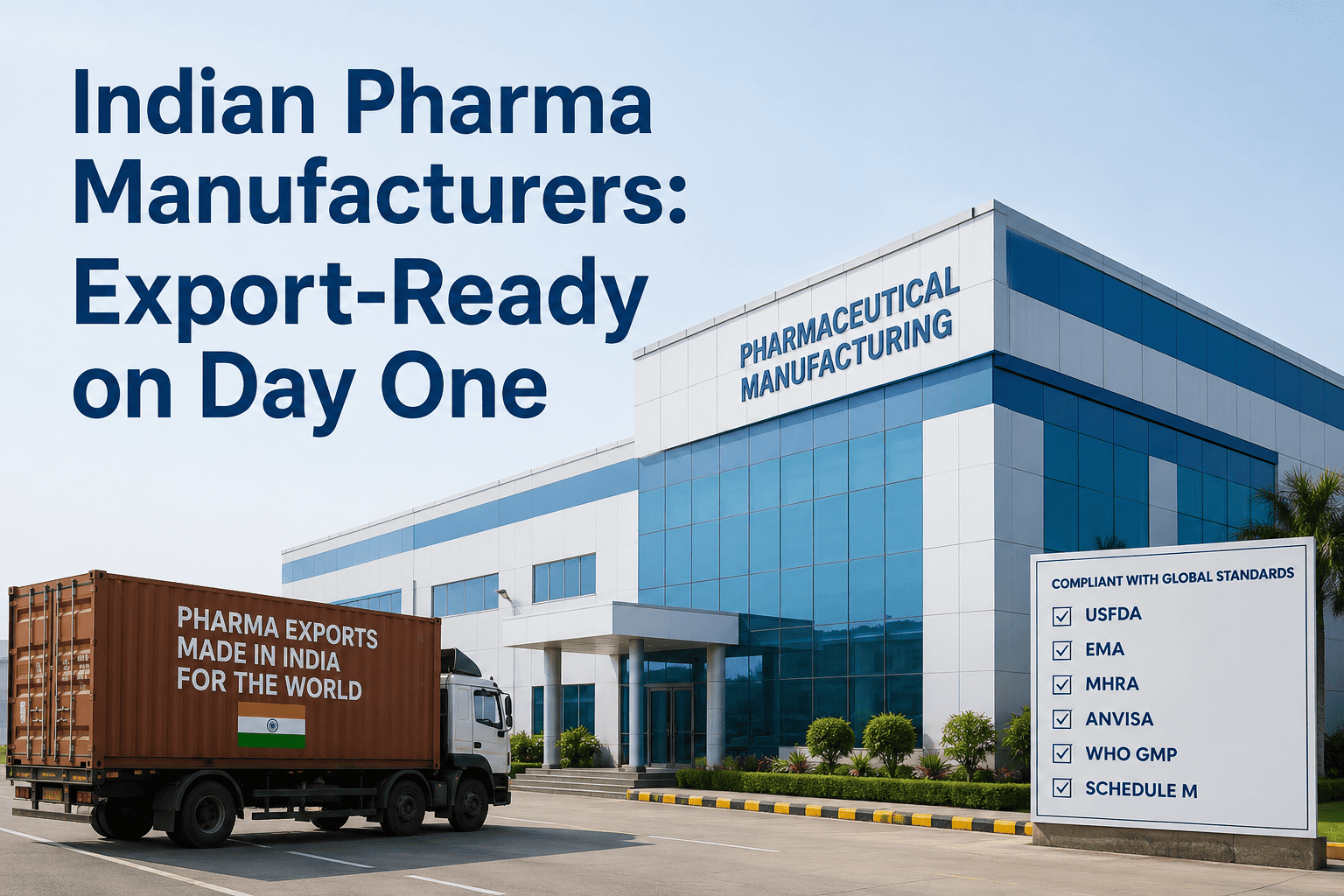
Every year, Indian pharmaceutical manufacturers lose export contracts not because of poor product quality — but because their compliance documentation fails a pre-audit screening in Frankfurt, Washington, or London. The cost is not just a lost tender. It is brand credibility, market re-entry timelines measured in years, and regulatory flags that follow a facility across every global market simultaneously. If your QMS was built for CDSCO alone, you are not export-ready. You are export-exposed.
Is Your Pharma QMS Audit-Ready for USFDA, EMA & MHRA?
Harmonize your compliance posture across all major regulatory bodies — from a single, sovereign platform built for Indian manufacturers scaling globally.
What Non-Compliance Actually Costs Indian Exporters
The financial exposure from a single USFDA Warning Letter or EMA non-conformance report extends far beyond the immediate contract. Leadership teams routinely underestimate the cascading operational and reputational damage that flows from a fragmented QMS.
- Lost export contracts averaging ₹8–40 Cr per facility per year
- Emergency re-validation costs post-audit failure
- Price discounting to retain buyers during compliance remediation
- 18–36 month re-entry timelines for facilities on Import Alert
- Manual SOP reconciliation across USFDA, EMA, MHRA, and ANVISA
- Redundant documentation teams for each regulatory market
- Patient safety incidents traceable to non-harmonized batch records
- Schedule M non-compliance triggering domestic CDSCO action
- WHO GMP certificate suspension blocking all regulated markets
iFactory Export Compliance Suite — What It Delivers
Built specifically for Indian manufacturers targeting multi-region exports, iFactory's Export Compliance Suite collapses parallel documentation workflows into a single audit-ready intelligence layer.
Multi-Region QMS Harmonization
- Single master QMS mapped to USFDA 21 CFR Part 211, EU GMP Annex 11, MHRA guidelines, and Schedule M simultaneously
- Automated gap identification when a regulatory update affects any mapped region
- Zero redundant SOP versions — one source of truth across all markets
Audit-Trail Intelligence
- Immutable, timestamped electronic records satisfying 21 CFR Part 11 requirements
- Automated ALCOA+ data integrity validation on every batch record entry
- Instant audit package generation — USFDA, EMA, or WHO format — on demand
CAPA & Deviation Lifecycle
- End-to-end CAPA workflow from deviation detection to effectiveness check
- Risk-ranked deviation prioritization using ICH Q9 methodology
- Regulator-ready CAPA summaries generated automatically at closure
Supplier & CoA Management
- Centralized approved vendor list with qualification status linked to every batch
- Automated CoA verification against in-house specifications
- Supplier audit scheduling with regulatory deadline tracking across all markets
The Compliance Gap: Where Indian Exporters Lose
The table below illustrates the operational gap between a fragmented legacy QMS and the harmonized iFactory architecture. Every row represents a real audit finding category observed across Indian pharmaceutical export facilities.
| Compliance Area | Legacy Friction | iFactory Optimized Excellence | Regulatory Risk Eliminated |
|---|---|---|---|
| SOP Management | Multiple versions across markets; manual reconciliation | Single harmonized SOP with auto-mapped regulatory references | Critical |
| Batch Record Integrity | Paper-based or hybrid records; ALCOA+ gaps | Electronic batch records with real-time ALCOA+ validation | Critical |
| CAPA Closure Rate | 30–60% open CAPAs at time of audit; no effectiveness checks | Automated escalation; 95%+ on-time closure with linked effectiveness data | Critical |
| Change Control | Siloed change notifications; delayed regulatory impact assessment | Multi-market impact analysis triggered automatically on every change | Major |
| Training Records | Disconnected LMS; no live compliance status per employee | Role-based training matrix with live GMP compliance dashboards | Major |
| Audit Readiness | 6–8 week manual compilation per regulatory body | One-click audit package export in regulator-specific format | Moderate |
Outcomes Across People, Process, and Market Access
QA Staff Productivity
- Eliminate 60–70% of manual documentation hours per audit cycle
- Reduce staff burnout from repetitive cross-market SOP maintenance
- Free QA bandwidth for science-based risk assessment, not paperwork
- Role-based dashboards surface only relevant compliance tasks per user
Manufacturing Throughput
- Reduce batch release cycle times with automated QC review workflows
- Eliminate production holds caused by documentation discrepancies
- Real-time deviation alerts prevent batch failures before they escalate
- Faster change control approvals unlock faster product launches
Export Market Access
- Maintain simultaneous compliance posture for 4+ regulated markets
- Reduce pre-inspection preparation from weeks to hours
- Respond to regulatory queries with traceable, timestamped evidence packages
- Build a defensible audit history that accelerates new market approvals
From Compliance Gap to Export-Ready in 90 Days
Operational Gap Audit
- Benchmark current QMS against USFDA, EMA, MHRA, and Schedule M requirements
- Identify the top 5 citation risks before your next scheduled inspection
Platform Configuration
- Map your existing SOPs and batch record formats into the harmonized QMS architecture
- Configure regulatory profiles for each target export market in parallel
Data Migration & Validation
- Transfer legacy records with full audit trail preservation
- Execute IQ/OQ/PQ validation protocols meeting 21 CFR Part 11 and Annex 11 standards
Live Compliance Operations
- Go live with unified CAPA, change control, and training management workflows
- Real-time compliance dashboards visible to QA, plant heads, and export teams simultaneously
Continuous Audit Readiness
- Automated regulatory update alerts mapped to your active QMS documents
- One-click audit package generation at any point in the compliance cycle
Indian Pharma Export Compliance — What Leaders Ask
Can iFactory handle both Schedule M (revised) and USFDA 21 CFR Part 211 simultaneously?
Yes. The platform maintains a single master QMS with regulatory profiles mapped to each applicable standard. A change to a master SOP automatically flags the impacted regulatory references across Schedule M, 21 CFR Part 211, EU GMP, and MHRA — without manual cross-checking.
How does the platform support 21 CFR Part 11 electronic records compliance?
Every record entry is immutably timestamped with user identity, action type, and system context. Electronic signatures are enforced with role-based access controls. The platform generates a complete audit trail report formatted for USFDA reviewer inspection on demand.
What is the typical implementation timeline for a mid-size Indian export facility?
Most facilities with 200–800 employees achieve full live compliance operations within 60–90 days. The gap audit and regulatory profile configuration phase typically takes 2–3 weeks, followed by data migration, validation, and a structured go-live with dedicated onboarding support.
Does iFactory support ANVISA requirements for Brazilian pharma exports?
Yes. ANVISA RDC 658/2022 and related GMP guidelines are supported within the multi-region compliance framework. Facilities targeting Latin American markets can maintain ANVISA regulatory profiles alongside USFDA, EMA, and WHO GMP profiles from the same platform.
How is sensitive batch and formula data secured on the platform?
iFactory deploys on sovereign cloud infrastructure with AES-256 encryption at rest and in transit. Role-based access ensures that formulation data, batch records, and regulatory submissions are visible only to authorized personnel — with every access event logged in the immutable audit trail.
Make Your Facility Export-Ready on Day One
Stop losing export contracts to preventable compliance gaps. iFactory's Export Compliance Suite gives Indian manufacturers a single, audit-ready platform for USFDA, EMA, MHRA, and ANVISA — simultaneously.