Every day a pharma manufacturer operates without an integrated platform, it bleeds—through failed audits, recall exposure, data integrity gaps, and staff attrition that erodes institutional knowledge. In 2026, the gap between compliant, efficient manufacturers and those still patching legacy workflows is no longer measured in months—it is measured in nine-figure liability events, FDA warning letters, and market share lost to competitors who moved first.
Is Your Pharma Operation Audit-Ready and Revenue-Protected?
iFactory's end-to-end platform closes the compliance, quality, and throughput gaps that cost manufacturers millions every year.
The 2026 Pharma Manufacturer Reality: 20 Challenges You Cannot Ignore
Pharmaceutical manufacturers face an unprecedented convergence of regulatory pressure, supply chain volatility, and digital transformation demands. The cost of inaction is not theoretical—it is auditable, measurable, and career-ending. Below are the 20 critical challenges your leadership team must address this year, and precisely how iFactory's end-to-end platform resolves each one.
Compliance & Data Integrity Risks
21 CFR Part 11 Non-Compliance
- Electronic records lack validated audit trails
- Manual signatures create submission risk
- Remediation costs exceed $2M per inspection cycle
Data Integrity Gaps (ALCOA+)
- Spreadsheet-based records invite human error
- Attributable data is routinely missing from batch records
- Data bridging across disconnected systems creates dark gaps
FDA Warning Letters & 483 Observations
- Repeat observations signal systemic process failure
- Average remediation cost: $3.5M–$7M per warning letter
- Reputational damage accelerates customer churn
Batch Record Errors & Rework
- Paper batch records take 40–80 hrs to complete and review
- Transcription errors trigger costly investigations
- Rework rates inflate cost-of-goods by 12–18%
Serialization & Track-and-Trace Failures
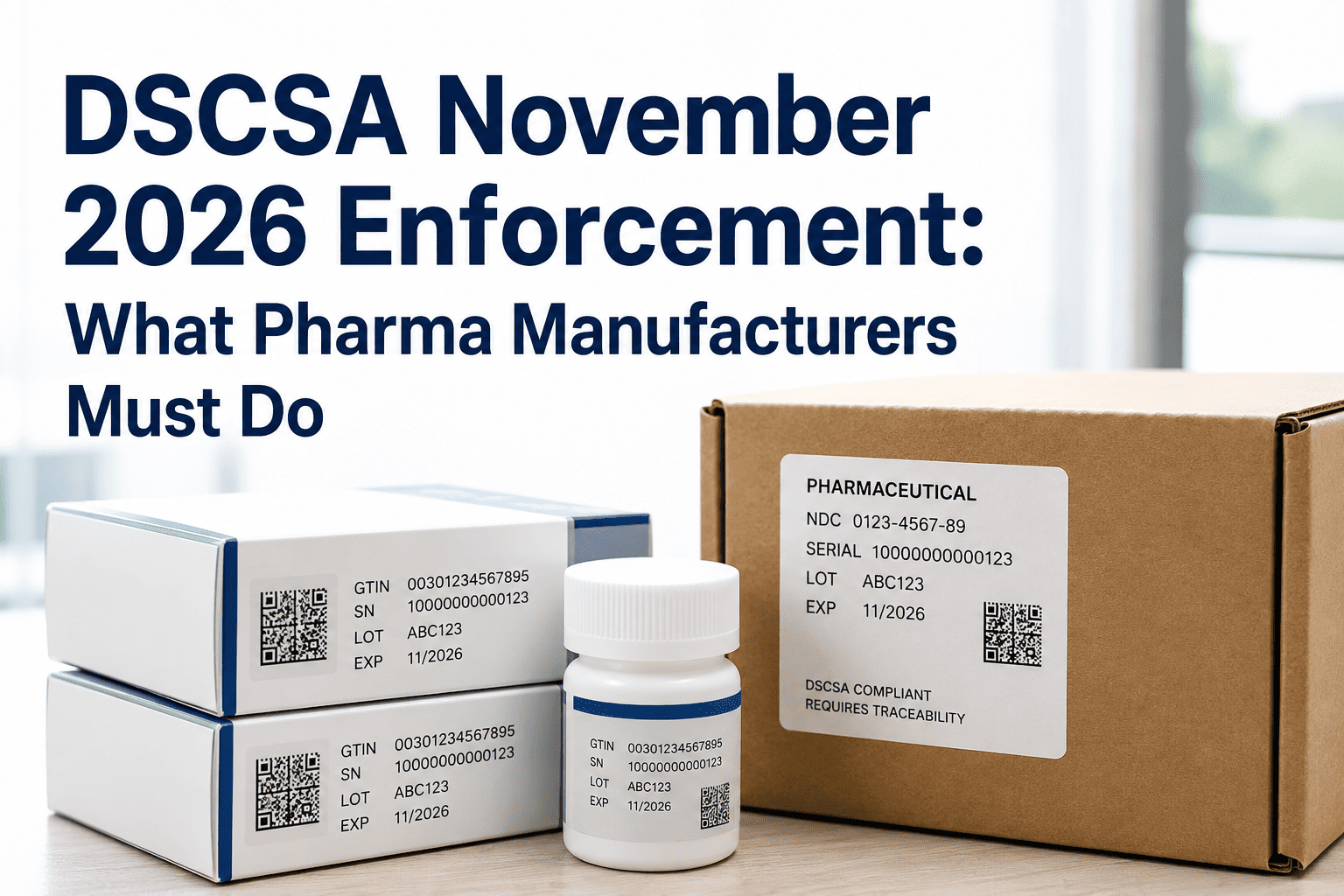
- DSCSA 2026 enforcement demands end-to-end traceability
- Disconnected serialization systems create unit-level blind spots
- Recall scope expands without granular lot genealogy
Supply Chain & Operational Fragility
Drug Shortage & Supply Volatility
- Single-source API suppliers create existential exposure
- Shortage events trigger emergency procurement at 3× cost
- Reactive purchasing destroys margin predictability
Cold Chain Compliance Gaps
- Temperature excursions go undetected during transit
- Manual temperature logs fail regulatory scrutiny
- Product losses from cold chain breaks exceed $35B globally
Equipment OEE Below Benchmark
- Unplanned downtime averages 15–20% in legacy facilities
- Reactive maintenance drives 40% higher MRO spend
- Capacity utilization data is siloed and inaccessible
Vendor & Supplier Qualification Backlogs
- Manual qualification processes delay product launches by months
- Audit cycles require 3–5 FTE weeks per supplier
- Expired qualifications create undetected supply risk
Recall Readiness Deficiencies
- Average recall costs $10M–$600M depending on scope
- Manual lot tracing during a recall takes 72+ hours
- Incomplete distribution records amplify recall scope by 3×
Legacy Friction vs. iFactory Optimized Excellence
| Operational Area | Legacy Friction | iFactory Excellence | Financial Impact |
|---|---|---|---|
| Batch Record Cycle | 40–80 hrs, error-prone | Real-time eBR, auto-reviewed | ↓ 65% Cycle Time |
| Deviation Management | Paper-based, weeks to close | Digital CAPA, SLA-enforced | ↓ 70% Closure Time |
| Audit Preparation | Manual retrieval, 200+ hrs | Instant report generation | ↓ $180K Annual Cost |
| Supplier Qualification | 3–5 FTE weeks per vendor | Automated workflow, 2 days | ↑ 4× Throughput |
| Recall Execution | 72+ hrs, partial tracing | Minutes, complete chain | ↓ 90% Exposure Window |
| OEE Visibility | Siloed, weekly reports | Live dashboards, predictive | ↑ 18% Utilization |
Quality, Workforce & Technology Gaps
CAPA Cycle Inefficiency
- Average CAPA closure time exceeds 90 days in manual systems
- Repeat deviations signal CAPA root cause failure
- Open CAPAs block regulatory submissions and product releases
Staff Burnout & High Attrition
- Quality professionals spend 60% of time on documentation
- Turnover in QA roles averages 22–28% annually
- Institutional knowledge loss creates hidden compliance risk
Training Compliance Lapses
- Expired training records discovered during inspections trigger 483s
- Manual tracking across hundreds of SOPs is unsustainable
- Training gaps on new equipment create safety and quality risk
SOP Version Control Failures
- Obsolete SOPs in active use are among the top 483 observations
- Paper-based revision cycles take weeks and create distribution gaps
- No system-of-record for who acknowledged which version
Technology Fragmentation (ERP/MES/LIMS Silos)
- Average pharma manufacturer runs 7+ disconnected systems
- Manual data bridging between ERP and MES creates errors
- No single pane of glass for cross-functional decision-making
How iFactory Resolves Staff Burnout & Increases Throughput
Operational Throughput
- Automated batch release cuts review time by 65%
- Parallel deviation and CAPA workflows eliminate queuing
- Real-time OEE data drives line scheduling optimization
- Predictive maintenance reduces unplanned downtime by 40%
Staff Wellbeing & Retention
- Administrative automation reduces documentation burden by 55%
- Role-based task queues eliminate coordination friction
- Digital SOPs and training trackers remove manual follow-up
- QA teams shift from reactive firefighting to strategic oversight
Patient Safety & Product Quality
- Real-time deviation detection prevents quality escapes
- Cold chain monitoring eliminates undetected excursions
- Instant mock recall capability reduces patient exposure window
- ALCOA+ data integrity protects every batch from submission risk
Strategic & Financial Risks Demanding Immediate Action
Rising Cost of Goods (COGS)
- Yield losses from undetected process drift erode margins silently
- Rework and scrap rates inflate COGS by 12–18% annually
- No real-time visibility into process parameter deviations
Cybersecurity & Data Sovereignty
- Pharma is the #1 targeted industry for ransomware in 2025–2026
- Non-sovereign cloud storage violates GDPR and 21 CFR standards
- Unencrypted manufacturing data represents national security risk
Slow Product Launch Cycles
- Technology transfer delays cost $1M+ per month in deferred revenue
- Manual validation protocols extend timelines by 30–60 days
- Disconnected scale-up data prevents parallel CMC submissions
Environmental, Health & Safety (EHS) Gaps
- Manual hazard tracking misses near-miss patterns before incidents occur
- EHS incidents during audits trigger facility shutdowns
- ESG reporting requirements are unmet without integrated data
Lack of Predictive Analytics & AI Readiness
- Decisions made on lagging indicators rather than predictive signals
- No structured data foundation to deploy AI/ML models at scale
- Competitors leveraging AI for batch prediction and yield optimization
Close Every Gap. Protect Every Batch. Scale Every Operation.
iFactory's end-to-end platform is the only solution purpose-built to resolve all 20 challenges simultaneously—from CAPA automation to AI-ready analytics.
Frequently Asked Questions — iFactory for Pharma Manufacturers
How quickly can iFactory be deployed in an existing GMP facility?
Most manufacturers achieve go-live within 8–14 weeks for core modules. Our phased onboarding approach prioritizes your highest-risk compliance areas first, delivering immediate audit readiness before full platform rollout is complete.
Does iFactory support both small-molecule and biologics manufacturing?
Yes. The platform is configured for both modalities, with dedicated workflows for biologics cold chain, viral clearance documentation, and the extended deviation management requirements unique to biologic batch processes.
How does iFactory handle multi-site global operations?
iFactory's multi-tenant architecture allows global standardization of SOPs, training matrices, and quality processes while preserving site-specific regulatory configurations. A single dashboard provides cross-site quality KPI visibility for corporate leadership.
What is the validated status of the platform for GxP environments?
iFactory is delivered with a pre-validated GAMP 5 Category 4 software package, including IQ/OQ protocols and a complete validation master plan. This reduces your internal validation effort by up to 70% compared to custom implementations. Book a Demo to review the validation documentation package.
Your Competitors Are Already Closing These Gaps
Every quarter without an integrated platform is a quarter of compounding compliance risk, margin erosion, and talent loss. Start your transformation today.