Your tablet presses are running. Your coating pans are cycling. Your granulators and filling lines are producing — but somewhere between your last PM cycle and your next QC review, a bearing is degrading, a compression force is drifting, and a spray atomization pressure is quietly climbing toward a batch deviation. You will not find out until the investigation is already open. As the executive accountable for production yield, GMP compliance, and capital asset performance across a multi-line pharmaceutical facility, this is not a risk — it is a scheduled financial loss disguised as normal operations. Predictive analytics for pharmaceutical manufacturing changes that equation by moving your entire maintenance posture from reactive to anticipatory: IoT sensors on every critical asset, AI models trained on pharma-specific failure signatures, and a GMP-compliant analytics layer that converts raw sensor streams into auditable, actionable intelligence weeks before a failure event reaches your production floor.
Stop Losing Batches to Equipment Failures You Could Have Predicted
Deploy AI-driven predictive analytics across your tablet presses, coating pans, granulators, and filling lines. Reduce unplanned downtime by up to 45%, protect batch integrity, and generate a 21 CFR Part 11-compliant audit trail — all within a single unified platform built for pharmaceutical-scale operations.
The Financial Architecture of Pharmaceutical Equipment Failure
The commercial pharmaceutical analytics market — valued at $23.28 billion in 2024 — is projected to reach $158 billion by 2035 at a 19% CAGR, driven almost entirely by a single realization: the cost of not knowing is catastrophically higher than the cost of knowing. In a GMP-regulated facility, a single unplanned equipment failure does not stop at lost production hours. It triggers a cascade — deviation investigation, batch hold, potential recall risk, regulatory documentation burden, and the reputational exposure of a quality event that could have been intercepted three weeks earlier by a vibration sensor and a machine learning model. You can schedule a strategic solution session to map your current equipment risk exposure against a predictive analytics deployment architecture tailored to your production line configuration.
Production Yield Protection
AI models detect equipment drift — compression force variance, impeller torque anomaly, spray pressure creep — before deviations reach QC thresholds. Protect batch integrity at the process parameter level, not at the end-of-line review stage.
Regulatory Audit Readiness
Every sensor alert, maintenance trigger, and corrective action is logged in a timestamped, tamper-proof audit trail aligned with 21 CFR Part 11 and EU Annex 11. FDA inspectors receive complete equipment history in minutes — not days of manual record retrieval.
CapEx Lifecycle Optimization
Predictive wear modeling converts equipment health data into replacement probability curves. Capital planning shifts from calendar-based assumptions to data-confirmed asset lifecycles — extending equipment service life and deferring unnecessary capital expenditure.
OEE Scalability Across Facilities
A unified analytics platform aggregates equipment health data across all production lines and facilities into a single executive dashboard. Overall Equipment Effectiveness improves not on one line — but as a measurable, boardroom-reportable operational KPI across the enterprise.
Critical Pharmaceutical Equipment Monitored by IoT Predictive Analytics
Pharmaceutical manufacturing demands a granular, equipment-class-specific approach to sensor deployment. A tablet press failure signature is structurally different from a coating pan anomaly or a lyophilizer vacuum drift — and generic industrial AI models cannot distinguish between them. Purpose-built pharma fault models, pre-trained on pharmaceutical equipment behavioral signatures and fine-tuned on your facility baseline, deliver the accuracy required to act on predictive signals with confidence. Request an operational audit to review which equipment classes in your facility carry the highest unplanned failure cost exposure today.
Tablet Press
Monitors punch and die wear, turret alignment, and compression force variance. Detects mechanical misalignment or pre-punch seizure before tablet weight uniformity is affected.
Coating Pan
Tracks pan rotation speed, inlet air humidity, spray atomization pressure, and product temperature. Prevents coating defects from equipment variability before visual inspection fails batches.
High-Shear Granulator
Monitors impeller torque, motor current draw, and vibration signatures. Detects bearing wear, impeller imbalance, and seal degradation before content uniformity is compromised.
Filling Line
Continuous servo motor health monitoring, fill volume drift detection, and seal integrity trending. Catches filling head misalignment and volumetric variance before a sterility deviation is triggered.
Lyophilizer
Monitors condenser temperature, vacuum levels, and shelf temperature uniformity. Predicts compressor wear and valve failures that can destroy entire parenteral batches mid-cycle.
Bioreactor
Tracks pH, agitation rates, dissolved oxygen, and oxygenation anomalies. Mechanical well-being of agitation systems and filtration units monitored to protect multi-million dollar biologics batches.
Current State vs. Future State: The True Cost of Reactive Maintenance
Leadership teams often assess predictive analytics as a maintenance initiative. It is more accurately a financial risk management decision. The comparison below maps what your operations look like today — and what they look like under an AI-driven predictive analytics infrastructure. FDA warning letters in 2024 showed that over 60% were linked to human-error documentation issues, with individual documentation errors carrying cost exposure of $5,000 to $100,000 each before batch holds and recall risk are factored in. The financial case for transition is not marginal — it is structural. Schedule a Strategic Solution Session to quantify your facility-specific risk exposure and build the business case for your leadership team.
| Operational Dimension | Current State — Reactive / Preventive | Future State — Predictive Analytics | Financial Delta |
|---|---|---|---|
| Equipment Failure Detection | Discovered at breakdown or end-of-line QC | AI detects anomaly 3–5 weeks before failure | Batch loss eliminated |
| Maintenance Scheduling | Calendar-based intervals regardless of condition | Condition-triggered interventions on actual wear | 25–45% maintenance cost reduction |
| GMP Documentation | Manual paper records; high error rate; slow retrieval | Automated, timestamped 21 CFR Part 11 audit trail | 60%+ reduction in documentation risk exposure |
| Batch Deviation Response | Reactive investigation after deviation is recorded | Root cause pre-identified from sensor data history | 50–70% faster CAPA resolution |
| Regulatory Inspection Readiness | Days of manual record gathering under inspection pressure | Complete equipment history generated in minutes | Zero-observation outcomes achievable |
| CapEx Planning | Asset replacement driven by age and schedule assumptions | Replacement timing driven by actual degradation curves | Extended asset life; deferred CapEx |
| Multi-Facility OEE Visibility | Fragmented site-level data; no cross-facility benchmarking | Unified executive dashboard across all production lines | Enterprise-scale OEE governance |
Map Your Equipment Risk Exposure in One Session
Work with our pharmaceutical operations architects to identify your highest-risk equipment classes, estimate your annual unplanned downtime cost, and design a GMP-compliant IoT sensor deployment roadmap for your facility.
How Predictive Analytics Drives Operational Scalability and Risk Mitigation
Pharmaceutical-scale predictive analytics is not a single-point sensor solution. It is a layered intelligence architecture — from edge data capture on the equipment floor, through validated AI models in the analytics layer, to executive-level dashboards that transform equipment health into production continuity assurance. Each operational domain below represents a distinct risk mitigation and scalability lever that compounds in value as the platform matures.
Process Parameter Intelligence
Continuous monitoring of critical process parameters — compression force, pan temperature, granulator torque — creates a real-time deviation detection layer that sits upstream of your QC testing cycle.
GMP Audit Trail Automation
Every maintenance trigger, sensor alert, and corrective action is automatically logged with electronic signatures, timestamps, and data evidence — ready for FDA inspection without manual compilation effort.
Predictive CAPA Generation
When AI models flag anomalies, the platform generates pre-populated CAPA documentation with sensor data evidence, failure probability scores, and recommended intervention windows — cutting investigation time by 50–70%.
Multi-Facility Scalability
The platform aggregates equipment health data from every production line and facility into a unified executive dashboard. Cross-facility OEE benchmarking, failure pattern analysis, and capital planning insights become available at enterprise scale.
Supply Chain Continuity
Predictive failure windows — typically 3–5 weeks — give procurement teams sufficient lead time to source replacement components before an emergency creates expedited purchasing costs and line shutdown exposure.
Workforce Leverage
Maintenance engineers shift from reactive troubleshooting to precision intervention — acting on specific AI-identified failure modes with targeted parts and tools. Fewer technician-hours invested per intervention, with higher first-time fix rates.
Five-Layer Deployment Architecture for Pharma Predictive Analytics
A production-grade pharmaceutical predictive analytics deployment is not a sensor dashboard. It is a five-layer validated architecture — each layer GMP-compliant, each transition point governed by data integrity controls — that converts raw equipment signals into boardroom-level operational intelligence. The platform connects to existing SCADA and DCS infrastructure via OPC-UA, Modbus, and REST API protocols, ingesting process parameters already being measured by your control systems without additional sensors on those data points. Schedule a strategic solution session to map your current infrastructure connectivity against this architecture before deployment begins.
GMP-Validated Sensor Layer
IoT sensors calibrated and validated under GMP requirements — 21 CFR Part 11 and EU Annex 11 compliant. Vibration, motor current, temperature, pressure, and humidity sensors installed without production shutdown. Connects to existing SCADA/DCS via OPC-UA, Modbus, and REST API.
Edge Intelligence Processing
AI fault detection runs at the equipment edge for immediate safety-critical responses, before data is transmitted to the central analytics platform. Equipment-specific AI models pre-trained on pharmaceutical failure signatures — tablet press, coating pan, granulator, filling line — then fine-tuned on your specific baseline during a 2–4 week calibration period.
Centralized Analytics Platform
All sensor streams converge in a centralized, encrypted cloud environment. Long-term predictive modeling, cross-facility benchmarking, and historical wear curve analysis are performed at the platform level, feeding executive OEE dashboards and generating proactive maintenance work orders through a GMP-compliant CMMS integration layer.
Regulatory Documentation Engine
Every AI alert, maintenance action, and equipment history event is captured in a tamper-proof audit trail with electronic signatures and timestamped data evidence. Supports 21 CFR Part 211 Subpart D equipment documentation, EU GMP Chapter 3, and LIMS/MES/ERP integration for complete data continuity across your quality management ecosystem.
Executive Intelligence Dashboard
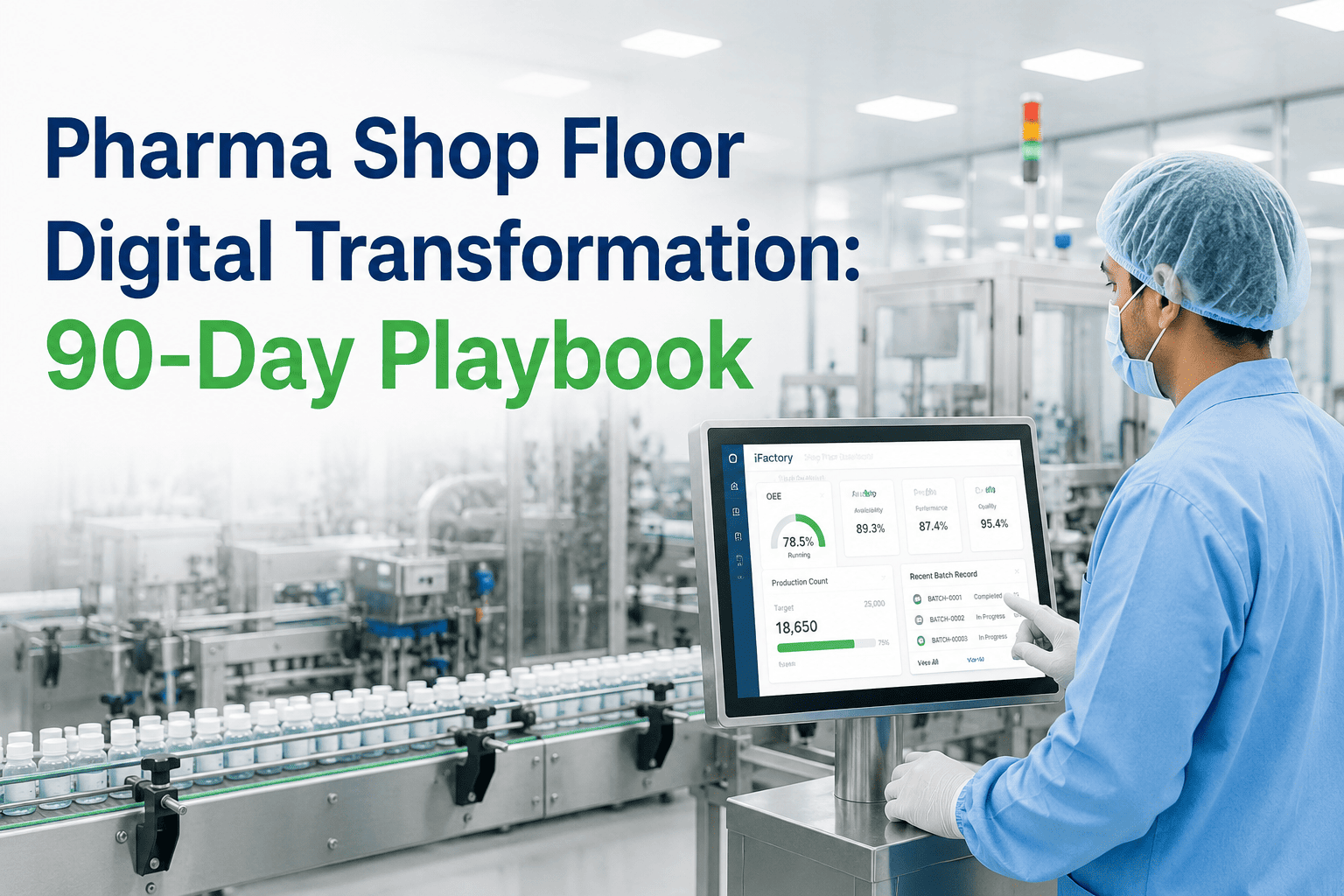
Board-level visibility into plant-wide OEE, equipment risk scores, predicted failure windows, and capital asset health across all facilities. Maintenance KPIs, batch protection rates, and compliance posture displayed as real-time operational metrics — translating maintenance engineering data into C-suite financial language.
Six Operational Risks That Predictive Analytics Directly Eliminates
Pharmaceutical manufacturing carries a risk profile unlike any other industrial vertical. The intersection of GMP compliance obligations, batch-scale financial exposure, and patient safety implications means that equipment failures carry consequences that extend well beyond production hours lost. Each risk category below represents a structural vulnerability in reactive and calendar-based maintenance programs — and a direct target for AI-driven predictive analytics intervention.
Equipment drifting out of validated parameters produces batches with content uniformity failures that survive in-process checks and are only caught at final QC — triggering costly investigations and potential batch write-offs.
Incomplete or manually assembled equipment maintenance records during FDA inspections create 483 observation risk. Automated, GMP-compliant audit trails eliminate the documentation gap that reactive maintenance programs cannot close.
Lyophilizer vacuum pump failures mid-cycle, bioreactor agitation failures, and filling line servo failures during validated sterile runs represent the highest single-event financial exposure in pharma operations — each preventable with predictive monitoring.
Calendar-based PM schedules replace components at fixed intervals regardless of actual wear state. In pharma facilities, over-maintenance also triggers unnecessary revalidation cycles — consuming engineering hours and production time for interventions the equipment did not need.
Equipment performance data siloed in site-level systems prevents corporate engineering teams from identifying failure patterns that are consistent across facilities — pattern intelligence that would allow proactive fleet-wide intervention before a systemic failure event.
Reactive failures require emergency parts sourcing — often at premium cost and with extended lead times on specialty pharmaceutical-grade components. Predictive 3–5 week failure windows convert emergency procurement into planned purchasing at standard rates.
Executives who have mapped these risk categories against their current maintenance infrastructure consistently identify 2–4 active exposure points within a single facility audit. Schedule a Strategic Solution Session to conduct this mapping exercise with our pharmaceutical operations architects and build a prioritized risk mitigation roadmap for your leadership team.
Phased Roadmap to Enterprise Predictive Analytics Maturity
Pharmaceutical predictive analytics does not require a facility-wide shutdown or a multi-year IT transformation to deliver measurable ROI. The deployment roadmap below moves from initial high-priority equipment coverage to full enterprise analytics maturity in four structured phases — each phase independently valuable, each building on validated infrastructure from the prior stage.
High-Risk Equipment Pilot
Deploy IoT sensors on the 3–5 highest-failure-cost assets in one facility. Establish baseline AI models and validate GMP documentation outputs. Measure batch protection rate and downtime reduction against pre-deployment baseline within 90 days.
Full Production Line Coverage
Extend sensor coverage to all critical equipment classes across the pilot facility. Integrate with LIMS, MES, and CMMS platforms. Full 21 CFR Part 11 audit trail operational. CAPA pre-population activated for all predictive alerts generated by the AI layer.
Multi-Facility Rollout
Platform architecture scales to additional facilities using validated sensor configurations and AI models from the pilot site. Cross-facility OEE dashboard activated. Corporate engineering gains visibility into fleet-wide equipment health and failure pattern intelligence.
Predictive CapEx Intelligence
Aggregated historical wear data feeds capital planning models. Asset replacement cycles are driven by predictive degradation curves rather than calendar assumptions. Annual CapEx planning integrates equipment health forecasts as a formal input to the financial planning process.
Request an Operational Audit for Your Production Facility
Work with our pharmaceutical manufacturing architects to map your current equipment risk exposure, identify your highest-priority sensor deployment targets, and build a GMP-validated predictive analytics business case for your leadership team.
Predictive Analytics for Pharmaceutical Manufacturing — Frequently Asked Questions
How do AI models learn pharmaceutical equipment behavior — pharma equipment is very different from generic industrial machinery?
Correct — and generic industrial AI models cannot be applied to pharmaceutical equipment without significant error rates. Our pharma fault models are pre-trained on equipment behavioral signatures from tablet presses, granulators, filling lines, and coating pans, then fine-tuned on your specific equipment baseline during a calibration period of 2–4 weeks. Batch cycles, product changeovers, and CIP/SIP events — which would trigger false positives on an industrial model — are accounted for in the pharma-specific training architecture.
Does sensor installation require a production shutdown or revalidation of the equipment?
Retrofit IoT sensor kits install without production line shutdown. For parameters already being measured by your SCADA or DCS control system — temperatures, pressures, flow rates — data is ingested directly via OPC-UA, Modbus, or REST API without additional hardware. For parameters not currently monitored, such as vibration signatures or motor current draw, sensors can be installed during scheduled PM windows to avoid revalidation obligations.
How does the platform maintain 21 CFR Part 11 and EU Annex 11 compliance for sensor data and AI-generated maintenance decisions?
Every data point, alert, work order, and maintenance action is stored in an immutable audit trail with electronic signatures, access controls, and timestamped data evidence. The AI's recommendation is traceable — including the specific sensor trend that triggered the alert — and the subsequent maintenance intervention is logged against that evidence. This documentation structure directly supports FDA and EMA inspection requests for equipment maintenance records under 21 CFR Part 211 Subpart D and EU GMP Chapter 3. Schedule a Strategic Solution Session to review the full compliance architecture.
What is the expected ROI timeline for a pharmaceutical predictive analytics deployment?
Most facilities achieve measurable ROI within the first 90-day pilot phase through batch loss elimination alone. Over the first year, maintenance cost reductions of 25–45% are typically documented. McKinsey research indicates top pharmaceutical companies using predictive analytics for operational optimization can unlock more than $300 million annually over a 3–5 year horizon. At the enterprise level, the 10-year EBITDA impact of advanced analytics in pharma has been estimated at 45–70% by McKinsey. Schedule an Operational Audit to build a facility-specific ROI model for your leadership team.
Can the platform integrate with our existing LIMS, MES, and ERP systems?
Yes. The platform provides bidirectional integration with major LIMS, MES, and ERP platforms via standard industrial protocols. Equipment health data, maintenance work orders, and compliance documentation sync directly into your existing quality management and production planning workflows — without requiring a separate standalone system or data export process.
How does the platform handle multi-product facilities with frequent product changeovers and equipment reconfigurations?
The AI models account for product changeover events, CIP/SIP cycles, and equipment reconfiguration signatures as expected operational states — not anomalies. Baseline profiles are established per product-equipment combination, and predictive models adjust dynamically when changeover events are logged in the platform. This ensures that the predictive accuracy is maintained across multi-product production schedules without generating false-positive maintenance alerts during transition periods.
Deploy GMP-Compliant Predictive Analytics Across Your Production Lines
Join pharmaceutical manufacturers already protecting batch integrity, reducing unplanned downtime, and achieving zero-observation FDA audit outcomes with AI-driven predictive analytics built for Pharma 4.0.