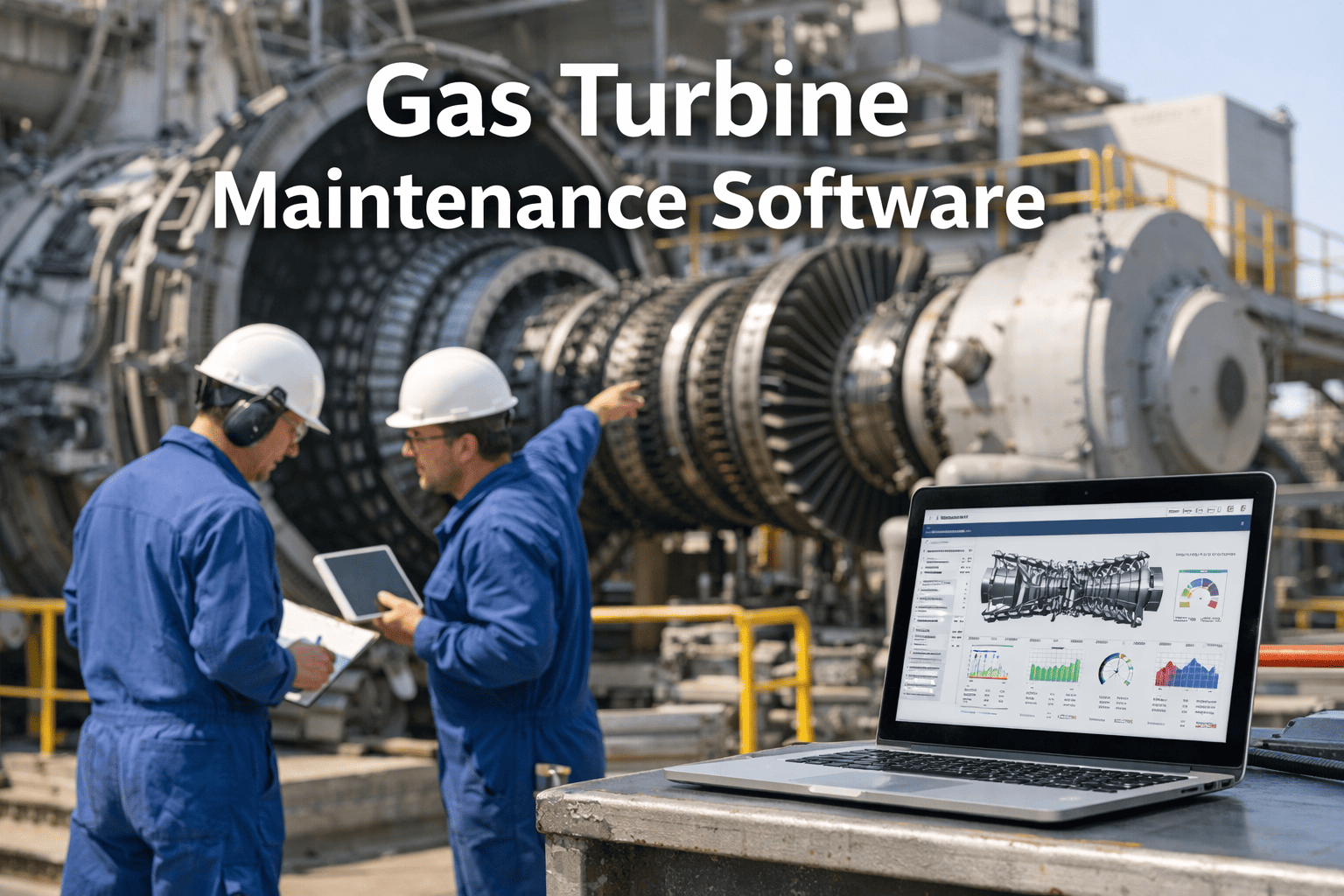
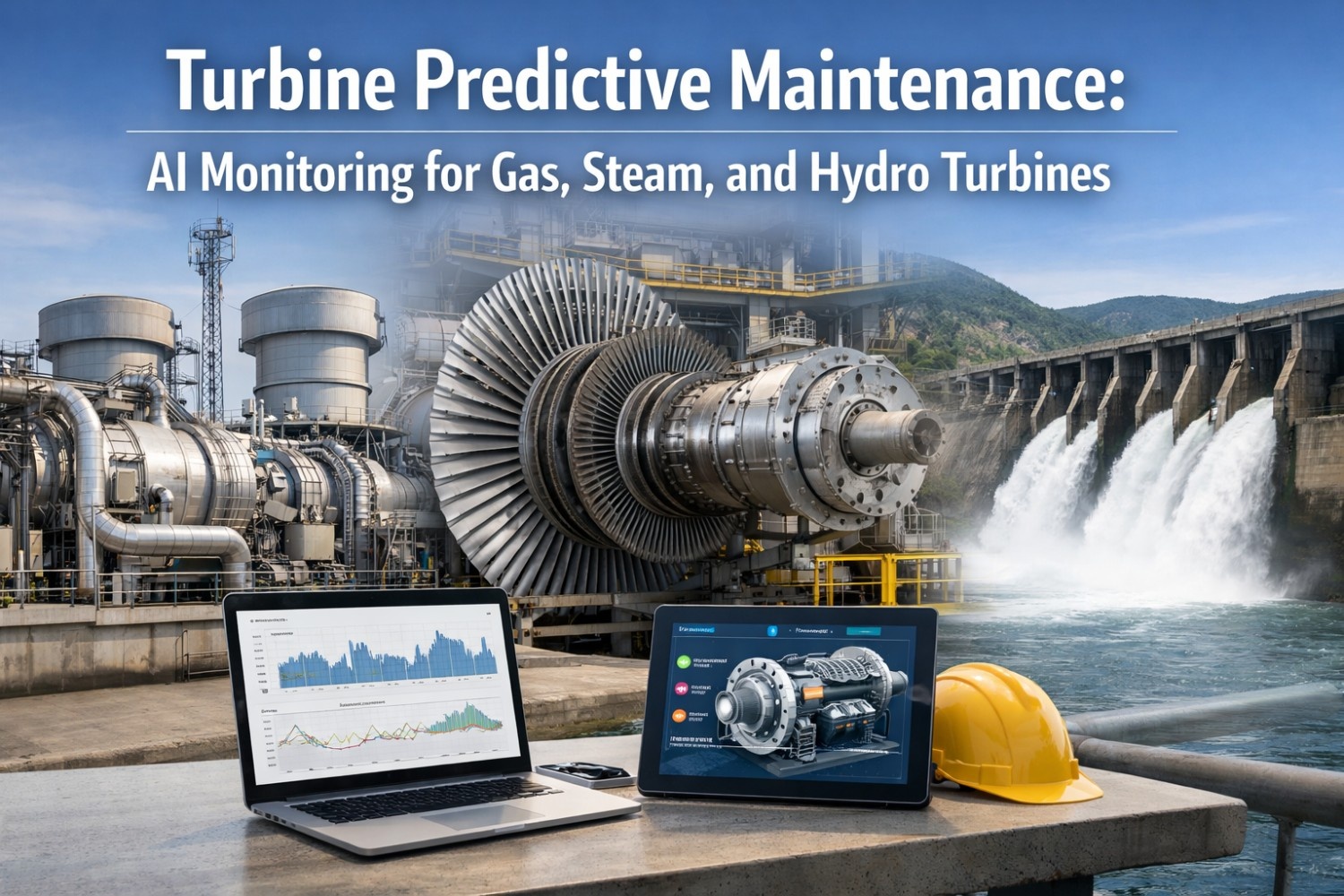
A gas turbine hot section inspection deferred by 2,000 equivalent operating hours beyond the OEM interval risks a $3–8M blade failure event. A compressor wash skipped during a high-demand period degrades heat rate by 1.5–2.5% — costing $200,000–$600,000 per year in excess fuel consumption that nobody notices until the quarterly performance review. Gas turbines operate under a unique maintenance regime where intervention timing is driven by equivalent operating hours, start counts, trip events, and firing temperature exposure — not calendar time. iFactory's gas turbine analytics platform tracks every degradation driver in real time, connects hot section condition data to overhaul scheduling, and optimises compressor wash intervals from actual fouling measurements rather than OEM calendar recommendations. Book a gas turbine analytics assessment for your fleet.
Quick Answer
iFactory tracks gas turbine degradation across three critical zones — hot section (blades, vanes, combustion liners), compressor (fouling, blade erosion, IGV performance), and combustion system (flame dynamics, crossfire tube integrity, fuel nozzle coking). The platform converts equivalent operating hours, start-type counts, trip severity, and firing temperature history into component-level remaining life forecasts — scheduling overhauls, washes, and inspections at the optimal point between too early (wasted interval life) and too late (forced outage risk). Average result: 18% reduction in unplanned gas turbine outages, 2.1% heat rate improvement from optimised wash scheduling.
Three-Zone Turbine Monitoring Architecture
Gas turbine degradation doesn't happen uniformly — it concentrates in three distinct zones, each with different failure modes, degradation drivers, and monitoring requirements. iFactory tracks each zone independently and fuses the data into a unified turbine health assessment.
Components
First-stage blades and vanes, second-stage nozzles, combustion transition pieces, turbine shrouds, wheel space seals
Degradation Drivers
Equivalent operating hours at firing temperature, thermal cycling from start/stop events, trip-induced thermal shock, hot corrosion from fuel contaminants
iFactory Analytics
Blade life consumption tracking per start type (normal, fast, emergency). Remaining hot section interval calculated from weighted EOH + start count + trip severity. Coating life estimation from exhaust temperature spread analysis.
Highest consequence zone — blade liberation risk above $5M per event
Zone 2
Compressor Section
Components
Compressor blades (all stages), inlet guide vanes, variable stator vanes, compressor discharge casing, bleed valves
Degradation Drivers
Airborne particulate fouling, salt and hydrocarbon deposits, blade tip erosion, foreign object damage, IGV actuator wear
iFactory Analytics
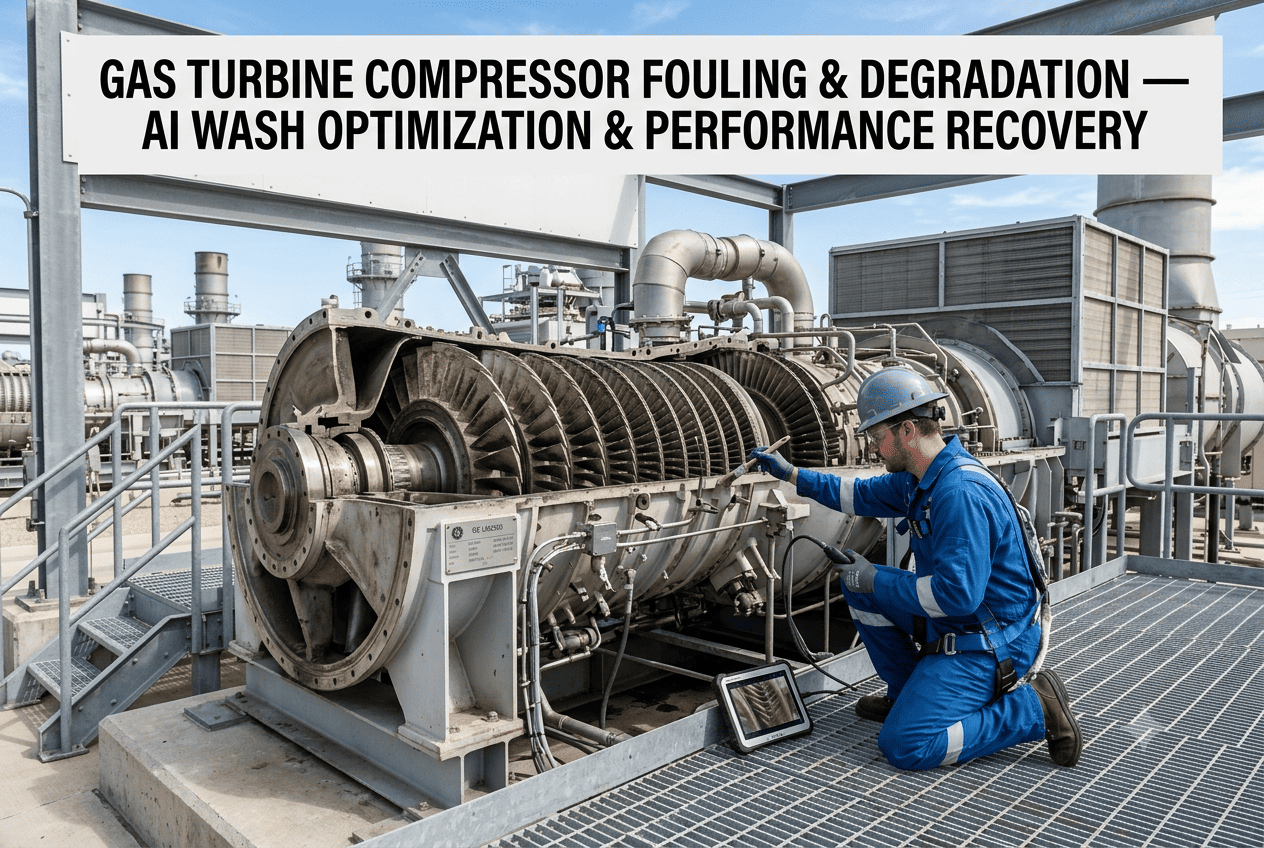
Compressor efficiency trending from pressure ratio and mass flow data. Fouling rate calculation per operating environment. Optimal wash interval from actual degradation rate — not OEM calendar schedule. Post-wash recovery tracking.
Heat rate impact zone — 1.5–2.5% efficiency loss from fouling alone
Components
Combustion liners, fuel nozzles, crossfire tubes, spark plugs, flame detectors, combustion dynamics pressure transducers
Degradation Drivers
Fuel nozzle coking from fuel quality variation, liner cracking from thermal fatigue, crossfire tube wear, combustion dynamics instability (humming/rumble)
iFactory Analytics
Combustion dynamics frequency analysis — detecting humming and rumble modes before they cause hardware damage. Exhaust temperature spread monitoring per combustor can. Fuel nozzle degradation trending from flame temperature profile shifts.
Early warning zone — dynamics instability precedes hardware damage by weeks
Gas Turbine Analytics
Know Exactly Where Your Turbine Stands Between Overhauls — Not Just How Many Hours It Has Run
iFactory tracks hot section life consumption, compressor fouling rate, and combustion system health in real time — scheduling interventions at the optimal point between interval waste and forced outage risk.
18%
Fewer Unplanned Outages
2.1%
Heat Rate Improvement
Gas Turbine Maintenance Failures iFactory Prevents
Each failure below has occurred at operating gas turbine plants — and each is preventable with the right analytics connecting the right data to the right maintenance decision. Talk to an expert about your gas turbine maintenance challenges.
01Hot Section Over-Extension — Blade Liberation
Problem: Overhaul deferred based on calendar EOH without accounting for the severity mix of starts (fast starts consume 3–5x the life of normal starts) and trip events. The turbine runs 2,000 hours past its actual life limit while the OEM interval hasn't technically expired.
iFactory fix: Weighted EOH calculation applies start-type severity factors (normal, fast, peak fire, emergency) and trip impact multipliers to calculate actual hot section life consumed — not just hours elapsed. Overhaul trigger based on real life consumption, not nominal hours.
02Compressor Fouling — Invisible Efficiency Loss
Problem: Compressor washes performed on a fixed calendar schedule (every 500–1,000 hours) regardless of actual fouling rate. In coastal environments, fouling may degrade efficiency in 200 hours; in clean environments, 1,500 hours may be fine. The result: either unnecessary washes that reduce availability or missed washes that waste $200K+ in excess fuel.
iFactory fix: Tracks compressor pressure ratio, mass flow, and efficiency in real time — calculating the actual fouling rate and triggering wash when the cost of continued fouling exceeds the cost of the wash plus lost generation during the wash window.
03Combustion Dynamics — Undetected Until Damage
Problem: Combustion instability (humming or rumble) develops gradually over days or weeks — often masked by normal operational noise. By the time the control system alarms, liner cracking or crossfire tube damage has already occurred, requiring a forced outage for combustion inspection and hardware replacement.
iFactory fix: Continuous combustion dynamics frequency analysis detects amplitude increases in known instability modes (typically 100–500 Hz range) days before they reach alarm thresholds — allowing load reduction or tuning adjustment before hardware damage occurs.
04Exhaust Temperature Spread — Combustor Can Degradation
Problem: Exhaust temperature spread between combustor cans widens gradually as individual fuel nozzles degrade at different rates. A 30F spread that was normal at commissioning grows to 80F over 8,000 hours — but without trending, the shift is invisible until a can exceeds the alarm limit during a high-load event.
iFactory fix: Per-can exhaust temperature trending with statistical process control — detecting spread widening trends and identifying the specific can(s) with degrading fuel nozzles. Nozzle replacement targeted to affected cans only, not a full set replacement.
05Start Count Mismanagement — Wrong Overhaul Interval
Problem: Peaking units with high start counts but low operating hours hit their start-based overhaul interval years before their hours-based interval. Plants focused on EOH miss the start count trigger — particularly when starts include multiple trip events that each count as an additional start equivalent.
iFactory fix: Dual-axis interval tracking — both EOH and factored start count tracked simultaneously. The overhaul is triggered by whichever limit is reached first. Trip events automatically add factored start equivalents based on trip severity (hot, warm, cold).
06Inlet Filter Degradation — Unplanned Compressor Damage
Problem: Inlet filter differential pressure rises gradually as filters load with particulate. A sudden filter media failure or bypass event allows unfiltered air into the compressor — causing blade erosion or FOD that requires a forced outage and compressor blend repair at $500K–$1.5M.
iFactory fix: Inlet filter DP trending with rate-of-change alerting. Sudden DP drops (indicating filter failure or bypass) trigger immediate alarm. Gradual DP rise triggers filter replacement scheduling before the bypass pressure threshold is reached.
Overhaul Interval Optimisation
OEM-recommended overhaul intervals are conservative by design — they assume worst-case operating profiles to protect warranty coverage. iFactory calculates your actual interval consumption rate from your specific operating profile, enabling safe interval extension where data supports it and accelerated scheduling where severity data demands it.
Combustion Inspection (CI)
OEM typical8,000 EOH or 450 starts
iFactory optimisedBased on actual weighted EOH + combustion dynamics health + exhaust spread trending
Typical outcome5–15% interval extension for baseload units; 10–20% earlier for high-start peakers
Hot Gas Path Inspection (HGPI)
OEM typical24,000 EOH or 1,200 starts
iFactory optimisedBased on blade coating life model + exhaust temperature history + start severity profile
Typical outcomeData-justified interval decisions — extending when profile supports it, shortening when trip history demands it
Major Overhaul (MO)
OEM typical48,000 EOH or 2,400 starts
iFactory optimisedBased on full turbine health assessment — hot section + compressor + rotor life + generator condition
Typical outcomeScope optimisation — replacing only components that data shows need replacement, not the full OEM-recommended scope
Platform Capability Comparison — Gas Turbine Analytics
GE APM, Siemens Omnivise, Mitsubishi TOMONI, and generic PI/OSI historian-based monitoring provide turbine performance dashboards. iFactory differentiates on weighted EOH life tracking, combustion dynamics AI, condition-based overhaul interval optimisation, and integration with maintenance work orders and spare parts procurement — capabilities that connect analytics to action. Book a comparison demo.
| Capability |
iFactory |
GE APM |
Siemens Omnivise |
OSIsoft PI |
| Life Tracking & Overhaul |
| Weighted EOH + factored start count |
Real-time, per start type |
GE units only |
Siemens units only |
Manual calculation |
| Condition-based overhaul interval |
Data-justified extension/shortening |
OEM interval only |
OEM interval only |
Not available |
| Multi-OEM fleet support |
GE, Siemens, MHI, Solar |
GE only |
Siemens only |
Vendor agnostic |
| Combustion & Compressor |
| Combustion dynamics AI analysis |
Frequency + amplitude trending |
Basic dynamics monitoring |
Basic dynamics monitoring |
Raw data only |
| Compressor wash optimisation |
Cost-based optimal timing |
Fixed interval |
Fixed interval |
Manual trending |
| Maintenance Integration |
| Analytics to work order automation |
Auto WO + parts trigger |
Alert to CMMS link |
Alert to CMMS link |
Not available |
| Spare parts procurement from RUL |
Auto PO for hot section parts |
Not available |
Not available |
Not available |
Based on publicly available product documentation as of Q1 2025. Verify current capabilities with each vendor before procurement decisions.
Measured Outcomes Across Deployed Gas Turbine Fleets
18%
Reduction in Unplanned GT Outages
2.1%
Heat Rate Improvement From Wash Optimisation
12%
Average Hot Section Interval Extension
$1.8M
Annual Savings Per Turbine From Scope Optimisation
14 days
Earlier Combustion Instability Detection
Multi-OEM
GE, Siemens, MHI, Solar Fleet Support
Turbine Fleet Intelligence
Your OEM Gives You an Interval. iFactory Gives You a Reason to Trust It — Or Change It.
Data-justified overhaul intervals, condition-based wash scheduling, and combustion dynamics AI — turning your gas turbine fleet from calendar-managed to condition-managed.
$1.8M
Savings Per Turbine/Year
From the Field
"We operate six Frame 7FA units across two sites. Before iFactory, overhaul scheduling was based on nominal EOH from the control system — no adjustment for start severity or trip events. iFactory showed us that our peaking units had consumed 30% more hot section life than the nominal hours indicated, because of the fast-start and trip severity profile. We moved the HGPI forward by 4,000 hours on two units — and the borescope inspection confirmed the blades were at exactly the condition iFactory predicted. On the baseload units, iFactory justified extending the CI by 1,200 hours. The net savings across the fleet in the first year was $4.2M in optimised overhaul scope and avoided forced outage risk."
VP of Gas Turbine Operations
1,800 MW Combined Cycle Portfolio — Mid-Atlantic USA
Frequently Asked Questions
QDoes iFactory support both GE and Siemens gas turbines in the same platform?
Yes. iFactory supports multi-OEM gas turbine fleets — GE (Frame 6B, 7E, 7FA, 9E, 9FA, HA series), Siemens (V84, V94, SGT-800, SGT6-5000F, SGT6-8000H), Mitsubishi (M501F/G/J/JAC), and Solar industrial turbines. Each OEM model has specific degradation models, interval calculations, and combustion system analytics.
Discuss your fleet composition in a demo.
QHow does iFactory access gas turbine operating data — does it require OEM system integration?
iFactory connects to the turbine control system (Mark VIe, T3000, NETMATION, etc.) via OPC-UA, Modbus, or historian integration (PI, IP21). No OEM-proprietary system access is required. For plants with existing historian infrastructure, iFactory reads directly from the historian — no additional plant-side instrumentation needed.
QWill using iFactory's interval recommendations affect our OEM warranty or LTSA coverage?
iFactory provides data-justified interval analysis — the decision to extend or shorten an interval remains with your engineering team. For units under LTSA, iFactory's analytics provide the condition data needed to negotiate interval adjustments with the OEM. Many operators use iFactory data to support interval extension requests within their LTSA framework.
Discuss LTSA integration strategies.
QHow quickly does iFactory detect combustion dynamics problems compared to the existing control system?
The turbine control system typically alarms on combustion dynamics at a fixed amplitude threshold — by which point hardware damage may have begun. iFactory analyses the frequency spectrum continuously and detects amplitude trend increases 10–21 days before the control system alarm threshold is reached, allowing operational intervention (load reduction, tuning adjustment) before damage occurs.
Continue Reading
Three-Zone Gas Turbine Analytics — Hot Section Life, Compressor Health, and Combustion Dynamics in One Platform.
iFactory tracks every degradation driver across your gas turbine fleet — weighted EOH, factored start counts, combustion dynamics, compressor fouling, and exhaust temperature spread — producing condition-based overhaul intervals and automated maintenance actions.
Weighted EOH Life Tracking
Combustion Dynamics AI
Compressor Wash Optimisation
Multi-OEM Fleet Support
Overhaul Scope Optimisation