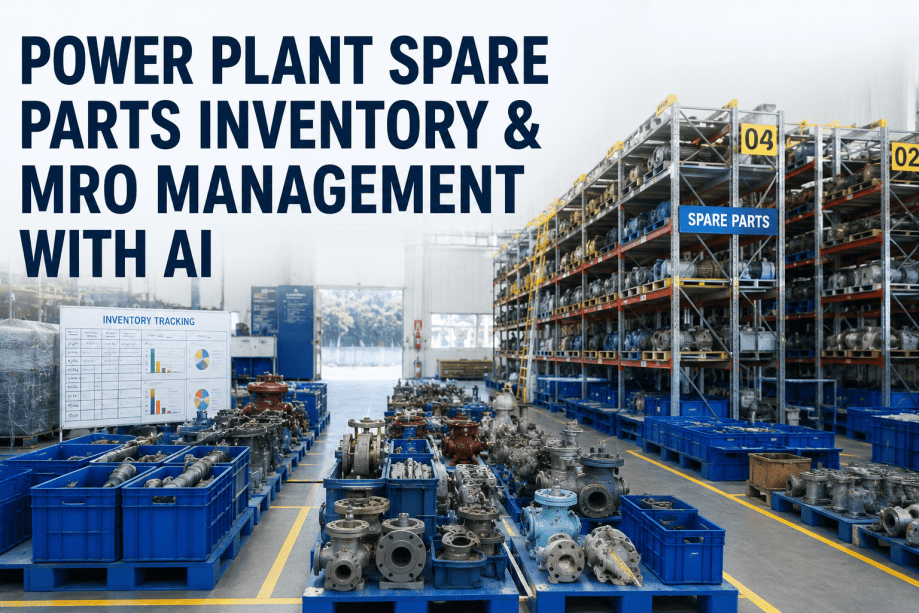
A power plant forced outage costs $50,000–$500,000 per day in lost generation revenue. When the root cause is a missing spare part — a bearing that is out of stock, a seal that takes 14 weeks to procure, a valve actuator that no one knew was the last one in inventory — the financial damage is entirely preventable. Yet most power plants run MRO inventory on a combination of ERP records that haven't been audited in years, tribal knowledge held by experienced technicians, and emergency procurement at 3× standard price. iFactory's spare parts intelligence platform connects component RUL forecasts to procurement timelines, tracks every critical spare from receipt to consumption, and eliminates both the stockout events that cause forced outages and the excess inventory that ties up $2–5M in working capital per plant. Book a free spare parts inventory assessment.
Quick Answer
iFactory links component RUL predictions to spare parts procurement — triggering purchase orders when remaining useful life forecasts require a component before its supplier lead time expires. Real-time inventory tracking, criticality classification, and consumption analytics eliminate both stockout events during shutdowns and excess inventory from over-purchasing. Average result: zero stockout-driven outage extensions, 28% reduction in MRO inventory value.
MRO Inventory Failures iFactory Detects & Prevents
Each card below is a real inventory failure pattern that power plants experience — and that standard ERP inventory management cannot prevent without predictive maintenance integration. Book a demo to see spare parts analytics applied to your plant's critical equipment list.
Critical Spare Stockout — Outage Extension
RULLinked to Lead Time
Problem: A bearing predicted to fail in 45 days has a 12-week supplier lead time — but the ERP shows zero stock and no purchase order exists. Without RUL-to-procurement linkage, this gap is invisible until the bearing fails during operation or the next shutdown finds the part missing.
iFactory solution: Monitors RUL per critical component and compares it to supplier lead time for that specific part number — triggering an automatic purchase order when RUL drops below lead time plus safety buffer, regardless of whether a scheduled PM exists.
PO triggered when RUL crosses lead time threshold
Excess Inventory — Working Capital Tied Up in Obsolete Stock
28%Avg Inventory Reduction
Problem: Power plants accumulate excess inventory through over-purchasing driven by uncertainty — parts that haven't been used in 5+ years, duplicates from different procurement systems, and obsolete stock for retired equipment that no one removed from the approved parts list.
iFactory solution: Analyses consumption history per part number against current equipment population — flagging slow-moving, zero-movement, and obsolete stock with disposition recommendations. Reorder quantities are calculated from actual consumption rate, not from fixed safety stock rules set a decade ago.
Obsolete and excess stock identified — working capital recovered
Shutdown Planning — Wrong Parts Available
ShutdownParts List Auto-Generated
Problem: Planned outages reveal missing critical parts only when the work order is opened and the storeroom is checked — too late to procure within the shutdown window. Emergency expediting at 2–5× standard price adds $50K–$200K to a single shutdown event.
iFactory solution: For every upcoming planned shutdown, iFactory generates a verified parts list — checking current stock levels, pending consumption from other work orders, and supplier lead times — flagging shortfalls 60–90 days before shutdown start with sufficient time for standard procurement.
Parts shortfalls flagged 60–90 days before shutdown
Single-Source Critical Spares — Supply Chain Vulnerability
SupplyRisk Per Part Scored
Problem: OEM-only spare parts with single-source suppliers and 20+ week lead times create catastrophic supply chain risk — a geopolitical event, supplier financial difficulty, or manufacturing disruption can make a critical part unavailable for months, forcing extended outages.
iFactory solution: Scores every critical spare by supply chain risk — single vs multi-source, lead time volatility, OEM vs aftermarket availability, and criticality-to-generation impact — recommending strategic stock levels and alternative supplier qualification for highest-risk combinations.
Supply chain risk scored — strategic stock levels set
No Condition-Linked Reorder — Fixed Safety Stock Rules
DynamicReorder Points
Problem: Fixed safety stock rules set at system implementation don't account for equipment age, changing failure rates, or fleet size changes. A bearing that failed once per year 5 years ago may now fail three times per year as the machine ages — but the reorder point hasn't changed.
iFactory solution: Calculates reorder points dynamically from actual consumption rate per part number per equipment age cohort — updating safety stock requirements as failure rates change with machine condition, fleet composition changes, and seasonal operational patterns.
Reorder points updated from actual failure rates — not static rules
Storeroom Accuracy — Physical vs System Mismatch
Real-TimeStock Accuracy
Problem: ERP inventory records diverge from physical storeroom reality through undocumented withdrawals, incorrect receipts, and parts returned to wrong locations — creating phantom inventory for critical spares that don't exist when the maintenance team needs them.
iFactory solution: Integrates barcode and RFID scanning for every issue, receipt, and transfer transaction — maintaining real-time physical stock accuracy with cycle count scheduling prioritised by part criticality, flagging discrepancies between system and physical count automatically.
Real-time physical accuracy — phantom inventory eliminated
Never Extend a Shutdown Because a Part Is Missing. Never Hold Inventory You Will Never Use.
iFactory links your predictive maintenance RUL forecasts to your MRO procurement cycle — so the right part is always on the shelf when the equipment needs it, and nothing else is.
Critical Spares Classification Framework
iFactory classifies every spare part in your inventory using a three-axis criticality matrix — generation impact, supply chain risk, and consumption rate — to determine the appropriate stock strategy per part number.
Class A — Critical Insurance Spares
High generation impact + long lead time + single source. Held regardless of consumption rate. Stock level set by RUL forecast and lead time.
Turbine rotor, generator stator, transformer, main circuit breaker
Strategy: Hold 1–2 units. Review RUL quarterly. Alternative supplier qualification mandatory.
Class B — Operationally Critical Fast-Movers
High consumption rate + significant generation impact + moderate lead time. Stock level calculated from consumption rate plus safety buffer.
Pump bearings, mechanical seals, valve actuators, relay cards, fan belts
Strategy: Dynamic reorder point. Min/max calculated monthly from actual consumption. Two-source preferred.
Class C — Routine Maintenance Consumables
Low-to-moderate generation impact + predictable consumption + short lead time. Managed by consumption-based replenishment with standard reorder points.
Filter elements, gaskets, O-rings, lubricants, fasteners, contact sets
Strategy: Vendor-managed inventory preferred. Reorder point from 90-day consumption average. Min/max auto-updated.
Class D — Review for Disposal
Zero consumption in 3+ years + equipment retired or upgraded + no scheduled maintenance requirement. Flagged for disposition review.
Parts for retired units, superseded components, duplicates from legacy systems
Strategy: Disposition review — return to supplier, sell as surplus, or write off. Working capital recovery quantified.
iFactory Spare Parts Intelligence Deployment Roadmap
iFactory activates spare parts intelligence in four phases — connecting existing ERP and CMMS data before any new instrumentation or hardware is required.
Phase 1
Inventory Audit & Criticality Classification
Weeks 1–3
iFactory imports your existing ERP parts master, equipment BOM, and work order consumption history — classifying every part by criticality class, calculating current stock vs required stock, and identifying immediate stockout risks for parts with active RUL forecasts.
Deliverable: Criticality-classified inventory + immediate stockout risk report
Phase 2
RUL-to-Procurement Integration
Weeks 3–6
iFactory connects predictive maintenance RUL forecasts to spare parts procurement — linking each critical component to its spare part number, supplier lead time, and current stock. Automatic purchase order triggers activated for Class A and B parts.
Deliverable: RUL-linked PO triggers + supplier lead time database
Phase 3
Real-Time Storeroom & Shutdown Planning
Weeks 6–8
Barcode or RFID scanning deployed for storeroom transactions — issue, receipt, transfer — achieving real-time physical accuracy. Shutdown parts list verification activated: upcoming planned outages checked against current stock, pending consumption, and supplier lead times 60–90 days ahead.
Deliverable: Real-time storeroom accuracy + shutdown parts verification
Phase 4
Dynamic Optimisation & Excess Recovery
Ongoing
Reorder points updated monthly from actual consumption rates per equipment age cohort. Obsolete and excess inventory flagged quarterly with disposition recommendations and working capital recovery value quantified. Monthly MRO performance report tracks inventory turns, stockout events, and procurement savings.
Deliverable: Monthly MRO performance report + excess inventory disposition list
Platform Capability Comparison — Power Plant MRO Inventory
SAP MM, Oracle eAM, Maximo Materials, and generic CMMS inventory modules offer parts master management and reorder point alerts. iFactory differentiates on RUL-to-procurement linkage, criticality-based dynamic safety stock, shutdown parts verification, and supply chain risk scoring — capabilities that require predictive maintenance integration, not standalone inventory management. Book a comparison demo.
| Capability |
iFactory |
SAP MM |
IBM Maximo |
Oracle eAM |
Generic CMMS |
| Predictive Procurement |
| RUL-linked automatic PO trigger |
RUL vs lead time, auto-PO |
Not available |
Manual linkage only |
Not available |
Not available |
| Dynamic reorder points from failure rates |
Monthly update from actual data |
Fixed safety stock only |
Fixed safety stock only |
Fixed safety stock only |
Fixed safety stock only |
| Shutdown parts list verification — 60–90 days ahead |
Auto-verified, shortfalls flagged |
Manual check only |
Manual check only |
Manual check only |
Not available |
| Criticality & Risk |
| A/B/C/D criticality classification |
Auto-classified, quarterly review |
Manual classification |
Manual classification |
Manual classification |
Not available |
| Supply chain risk scoring per part |
Lead time + source + criticality |
Not available |
Not available |
Not available |
Not available |
| Storeroom & Optimisation |
| Real-time physical accuracy — barcode/RFID |
Every transaction, real-time |
Supported |
Supported |
Supported |
Varies |
| Obsolete and excess stock identification |
Auto-flagged with disposal value |
Report-based, manual review |
Report-based, manual review |
Report-based, manual review |
Not available |
Based on publicly available product documentation as of Q1 2025. Verify current capabilities with each vendor before procurement decisions.
Measured Outcomes Across Deployed Plants
Zero
Stockout-Driven Outage Extensions After RUL-PO Integration
28%
Reduction in MRO Inventory Value — Excess & Obsolete Removed
60–90
Days Advance Warning for Shutdown Parts Shortfalls
40%
Reduction in Emergency Procurement Spend Per Year
4 Class
Criticality Framework — Every Part Classified & Managed Appropriately
Real-Time
Physical Storeroom Accuracy — Phantom Inventory Eliminated
Monthly
Dynamic Reorder Point Updates from Actual Failure Rates
$2–5M
Typical Working Capital Recovery Per Plant in Year One
Which Critical Spare in Your Plant Will Be Missing When the Equipment Fails?
iFactory's pre-deployment assessment compares your current inventory against active RUL forecasts and supplier lead times — identifying stockout risks before the next forced outage, and excess inventory ready for disposition.
From the Field
"We extended a planned 12-day outage by 9 days waiting for a boiler feed pump mechanical seal that should have been in stock. The emergency freight and lost generation cost exceeded $800,000. After iFactory, the same pump's bearing RUL triggered a purchase order 11 weeks before the next outage. The part arrived in week 7 and sat on the shelf waiting — exactly as it should. In the first year, we recovered $3.2M in excess inventory and had zero emergency procurement events for Class A or B parts."
VP of Plant Operations
2,400 MW Coal & Combined Cycle Portfolio — Southeast USA
Frequently Asked Questions
QWe already use SAP MM for spare parts — can iFactory integrate with it rather than replace it?
Yes. iFactory integrates with SAP MM, Oracle eAM, and Maximo via API — reading current stock levels and purchase orders while pushing RUL-triggered PO recommendations and criticality classifications back into the ERP. Your procurement team continues working in SAP; iFactory adds the predictive intelligence layer on top.
See SAP integration in a demo.
QHow does iFactory handle insurance spares for long-lead OEM-only items — turbine rotors and transformers?
Class A insurance spares are managed by RUL trajectory and strategic stock policy — not by consumption rate. iFactory tracks the RUL of the installed equipment, monitors the insurance spare's storage condition if sensor data is available, and flags when the spare should be refurbished or when the lead time for a replacement requires immediate procurement action.
QOur plant has 30,000+ part numbers — how long does the initial criticality classification take?
iFactory's classification engine processes the full parts master in 2–3 weeks using equipment BOM data, work order consumption history, and equipment criticality ratings from your CMMS. Approximately 80% of parts are auto-classified; the remaining 20% with ambiguous signals are flagged for engineering review with a classification recommendation.
Book a scoping call for your parts catalogue size.
QCan iFactory manage spare parts across multiple plant sites in a portfolio?
Yes. iFactory provides a portfolio-level inventory view — identifying parts held at one site that could fulfil a stockout risk at another, optimising fleet-wide safety stock levels, and benchmarking storeroom performance across sites. Inter-site transfer recommendations are generated automatically when they reduce portfolio-level stockout risk.
Continue Reading
RUL-Driven Spare Parts Intelligence — The Right Part on the Shelf Before the Equipment Needs It.
iFactory links predictive maintenance forecasts to MRO procurement — eliminating stockout-driven outage extensions, recovering working capital from excess inventory, and verifying shutdown parts availability 60–90 days ahead.
RUL-to-Procurement Linkage
A/B/C/D Criticality Classification
Shutdown Parts Verification
Supply Chain Risk Scoring
SAP / Maximo Integration