A boiler feed pump running with a worn impeller loses 3–4% hydraulic efficiency before any alarm fires — costing $180K–$320K annually in heat rate penalty while the plant runs it to failure. A compressor with a developing valve fault draws 8–12% excess power for weeks before vibration crosses a threshold. A fan with blade erosion degrades boiler efficiency silently. The problem is not that these failure modes are unknown — pump cavitation, bearing wear, lube oil breakdown, valve flutter, and blade erosion are the same failure modes documented in every reliability textbook. The problem is detecting which machine in your fleet of 200+ is exhibiting them today, before the performance loss compounds into a forced outage. iFactory's rotating equipment analytics platform maps every pump, compressor, fan, and turbine auxiliary in your plant to its specific failure modes — and monitors every failure mode signature continuously. Book a free rotating equipment analytics assessment.
Quick Answer
iFactory monitors every rotating machine in your power plant against its specific failure mode library — vibration signatures, lubrication condition, performance curve deviation, and thermal anomalies — delivering fault classification with corrective action guidance, not just raw alarm data. Average result: 45% fewer rotating equipment forced outages, 30% reduction in unnecessary preventive maintenance on healthy machines.
How iFactory Maps and Monitors Every Rotating Equipment Failure Mode
Most condition monitoring tools detect anomalies. iFactory classifies failure modes — telling your engineer whether the vibration signature indicates inner race bearing defect, rotor imbalance, misalignment, or looseness, and what corrective action each requires. Book a demo to see failure mode analytics applied to your rotating equipment fleet.
Vibration Signature Analysis & Fault Classification
12+Fault Classes Per Machine
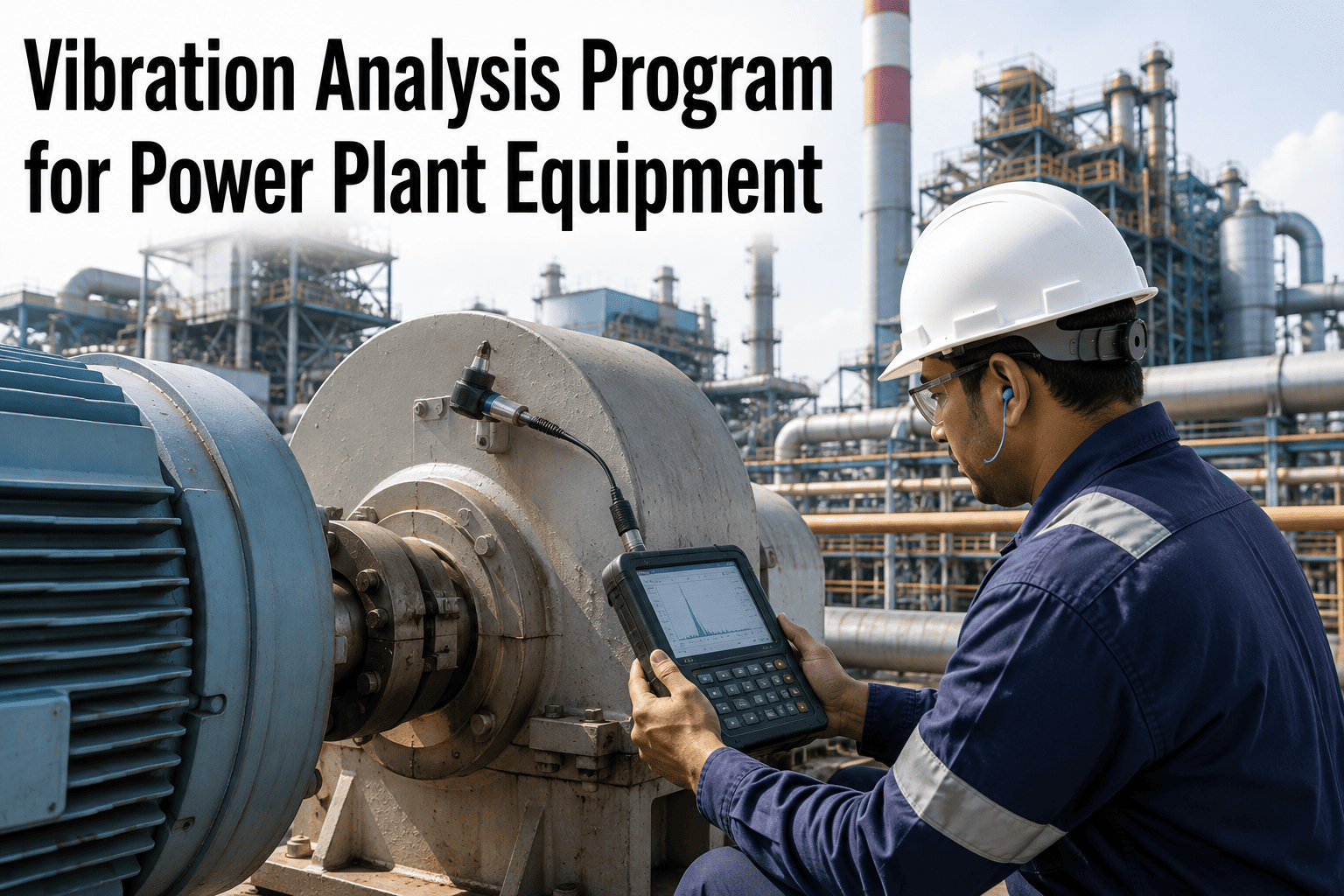
iFactory classifies vibration signals from time-domain, frequency-domain, and envelope analysis — distinguishing bearing inner/outer race defects, rolling element faults, cage wear, rotor imbalance (1× dominant), angular misalignment (2× dominant), parallel misalignment (radial 2×), looseness (sub/super-harmonics), and resonance. Each fault class maps directly to a corrective action — balance, align, replace bearing, tighten fasteners — so technicians arrive prepared, not investigating.
Fault classified to corrective action — technician arrives prepared
Lubrication Health Monitoring & Interval Optimisation
ConditionBased Intervals
Fixed lubrication schedules are one of the largest sources of unnecessary maintenance cost — machines are re-lubricated when the calendar says to, not when the bearing needs it. iFactory monitors lube oil temperature, viscosity deviation, filter differential pressure, particle count, and bearing vibration correlation to determine actual lubrication state. Re-lubrication is triggered by condition, not by schedule — over-lubrication (a leading cause of bearing failure) and under-lubrication both eliminated.
Over-lubrication eliminated — condition-triggered, not calendar-triggered
Pump Performance Curve Tracking
Real-timeCurve vs Actual
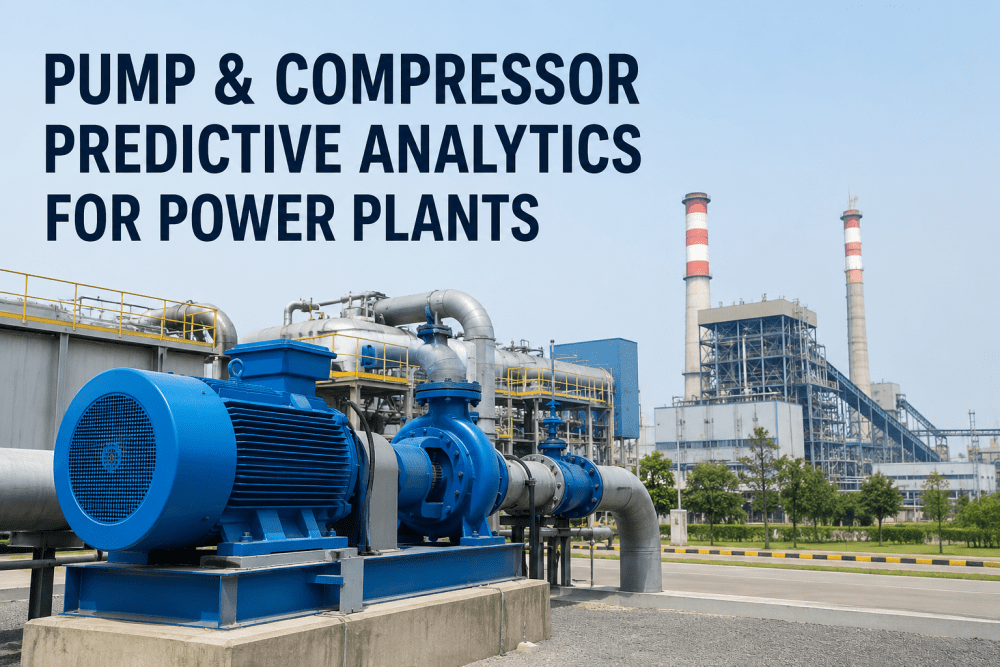
iFactory benchmarks each pump against its design performance curve — comparing actual head, flow, and power draw against the manufacturer curve at every operating point, continuously. Impeller wear shows as reduced head at a given flow; wear ring degradation shows as increased recirculation loss; cavitation shows as head instability. Pump efficiency degradation of 2–3% is detectable weeks before vibration signatures confirm damage — enabling hydraulic rehabilitation before mechanical failure.
2–3% pump efficiency loss detected — weeks before mechanical damage
Compressor Valve & Power Consumption Analytics
8–12%Power Recovery
Compressor valve degradation is one of the most expensive silent failure modes in power generation — a leaking suction or discharge valve increases specific energy consumption by 8–12% while showing no alarm signature until the valve fails mechanically. iFactory detects valve inefficiency from compressor power input vs pressure ratio deviation — a thermodynamic efficiency signature invisible to vibration monitoring alone. Valve replacement is triggered at efficiency threshold, not at mechanical failure.
Valve inefficiency detected from thermodynamics — before mechanical failure
Fan Blade Erosion & Fouling Detection
BladePass Frequency AI
FD and ID fan blade erosion develops silently over months — progressively degrading blade profile, increasing imbalance, and reducing aerodynamic efficiency. iFactory tracks blade pass frequency amplitude trends for erosion progression, monitors imbalance growth from asymmetric blade wear, and detects fouling from increased power draw at a given flow. Blade wash or replacement is scheduled when efficiency data justifies intervention — not on a fixed annual cycle that may be either too early or too late.
Blade erosion progression tracked — wash or replace when data justifies
Failure Mode Library & RUL Per Component
RULPer Bearing, Per Seal
iFactory maintains a failure mode library per machine type — mapping each sensor combination to its detectable failure modes and the RUL calculation model for each. For a boiler feed pump: bearing inner race RUL from BPFI amplitude growth rate; mechanical seal RUL from vibration asymmetry and temperature; impeller RUL from hydraulic efficiency trajectory. Each component has its own RUL estimate driving a separate procurement and maintenance trigger — components replaced when their individual RUL warrants it, not as a unit.
RUL per component — bearing, seal, impeller replaced individually
Stop Running Rotating Equipment to Failure. Stop Maintaining It Before It Needs It.
iFactory connects failure mode libraries to your existing vibration sensors, DCS process data, and CMMS. First fault classifications and RUL estimates within 6 weeks — no new hardware required for most machines.
iFactory vs Competitor Rotating Equipment Analytics Platforms
SKF Enlight, Emerson AMS, ABB Ability, and Azima DLI offer rotating equipment monitoring. iFactory differentiates on failure mode classification depth, lubrication condition intelligence, compressor thermodynamic analytics, and component-level RUL — capabilities that require multi-sensor AI integration, not standalone vibration analysis. Book a demo to compare.
| Capability |
iFactory |
SKF Enlight |
Emerson AMS |
ABB Ability |
Azima DLI |
| Vibration & Fault Classification |
| 12+ fault classes per machine type | AI classified — corrective action guided | Severity levels, limited classification | Severity alerts, analyst review | ABB assets — limited classification | Expert analysis — route-based |
| VSD / variable speed fault normalisation | Speed-normalised continuous | Configurable | Configurable | Limited | Route-based only |
| RUL per component — bearing, seal, impeller | Per component, per machine | Bearing RUL — SKF focus | Asset-level RUL only | Not available | Not available |
| Lubrication & Process Analytics |
| Condition-based lubrication triggers | Oil condition + vibration correlation | Lubrication advisory add-on | Not available | Not available | Not available |
| Pump performance curve deviation tracking | Real-time curve vs actual | Not available | Limited — vibration focus | Not available | Not available |
| Compressor valve efficiency from thermodynamics | Power ratio + pressure delta | Not available | Not available | ABB compressors only | Not available |
| Scale & Infrastructure |
| 200+ machine fleet continuous monitoring | All machines, every cycle | Sensor hardware required | Sensor hardware required | ABB scope limited | Route-based, periodic |
| On-premise — NERC CIP compliant | NVIDIA edge — full | Cloud primary | Cloud primary | Cloud primary | Cloud only |
| Auto CMMS work order on fault detection | 60 sec — pre-classified | API integration | API integration | Limited | Manual reporting |
Based on publicly available product documentation as of Q1 2025. Verify current capabilities with each vendor before procurement decisions.
Our Numbers
12+
Fault Classes Classified Per Machine Type
45%
Fewer Rotating Equipment Forced Outages
30%
PM Cost Reduction — Condition Replaces Schedule
8–12%
Compressor Power Recovered Per Valve Event
72+ hrs
Advance Bearing Failure Warning
Per
Component RUL — Bearing, Seal, Impeller
Zero
Over-Lubrication Events With Condition Triggers
6 wks
To Full Fleet Failure Mode Analytics
Get a Rotating Equipment Failure Mode Assessment — Which Machines Are Running Degraded Right Now?
iFactory's pre-deployment assessment reviews your DCS process data and maintenance history to identify which failure modes are detectable today — before any new hardware is installed.
What Our Clients Say
"We had vibration monitoring on our major pumps and fans — severity-level alerts, nothing more. When an alert fired, our reliability engineer spent 2–3 hours deciding whether it was genuine, what the fault was, and what the corrective action should be. iFactory replaced that process with a fault classification that named the fault type, its severity trajectory, the RUL estimate, and the recommended corrective action — generated automatically within 60 seconds of detection. Our reliability team's investigation time dropped by 70%. More importantly, iFactory detected a boiler feed pump impeller degradation from hydraulic curve deviation 19 days before any vibration signature appeared. We replaced the impeller in a scheduled window. The alternative was a wet failure during peak generation season."
Principal Reliability Engineer
2,200MW Coal and Gas Portfolio — Northern India
Frequently Asked Questions
QHow does iFactory build the failure mode library for our specific machines — do we have to configure it manually?
iFactory's failure mode libraries are pre-built per machine type and class — centrifugal pump, reciprocating compressor, axial fan, and so on — and populated from equipment nameplate data collected during pre-deployment assessment. Bearing defect frequencies, performance curve baselines, and lubrication parameters are calculated from nameplate data, not manual configuration. Site-specific refinement occurs automatically as the AI builds operational baselines in the first 4–6 weeks.
Book a demo to see library configuration for your equipment types.
QCan iFactory's lubrication condition monitoring replace our manual oil sampling programme?
For continuous monitoring between oil samples, iFactory provides higher-frequency condition data than any sampling programme — filter differential pressure, particle count from online sensors, lube oil temperature deviation, and correlated bearing vibration. Manual oil laboratory sampling adds oil chemistry analysis (viscosity, acid number, metal content) that iFactory does not replace. Most plants reduce oil sampling frequency by 50–60% when iFactory is live, targeting samples at machines showing condition deviation rather than on fixed calendar intervals.
QHow does iFactory handle reciprocating compressors differently from centrifugal machines?
Reciprocating compressors have fundamentally different failure mode signatures — valve leakage shows as thermodynamic efficiency deviation, rod packing degradation shows as gas leakage and rod load variation, and cylinder lubrication issues show as metal temperature asymmetry. iFactory maintains a separate failure mode library for reciprocating machines with thermodynamic and mechanical signature integration. Vibration-only platforms miss reciprocating compressor valve and packing failures; iFactory detects them from process parameters.
QWhat is the minimum sensor coverage needed to get useful failure mode analytics from iFactory?
iFactory starts useful analytics from DCS process data alone — temperature, pressure, flow, current, and speed — which enables pump curve tracking, compressor thermodynamic efficiency, and lubrication system monitoring with zero new hardware. Bearing vibration sensors add defect frequency classification. For plants with no vibration sensors, iFactory's pre-deployment assessment identifies which assets most benefit from wireless sensor addition based on failure mode detectability and consequence ranking.
Book a sensor coverage assessment.
Continue Reading
Failure Mode Analytics for Every Pump, Compressor, and Fan — Not Just Alarms. Classification.
iFactory maps every rotating machine to its failure mode library — vibration classification, lubrication condition, performance curve, and thermodynamic efficiency. On-premise. Full fleet analytics in 6 weeks.
12+ Fault Classes Per Machine
Condition-Based Lubrication
Pump Curve Tracking
Compressor Valve Thermodynamics
RUL Per Component