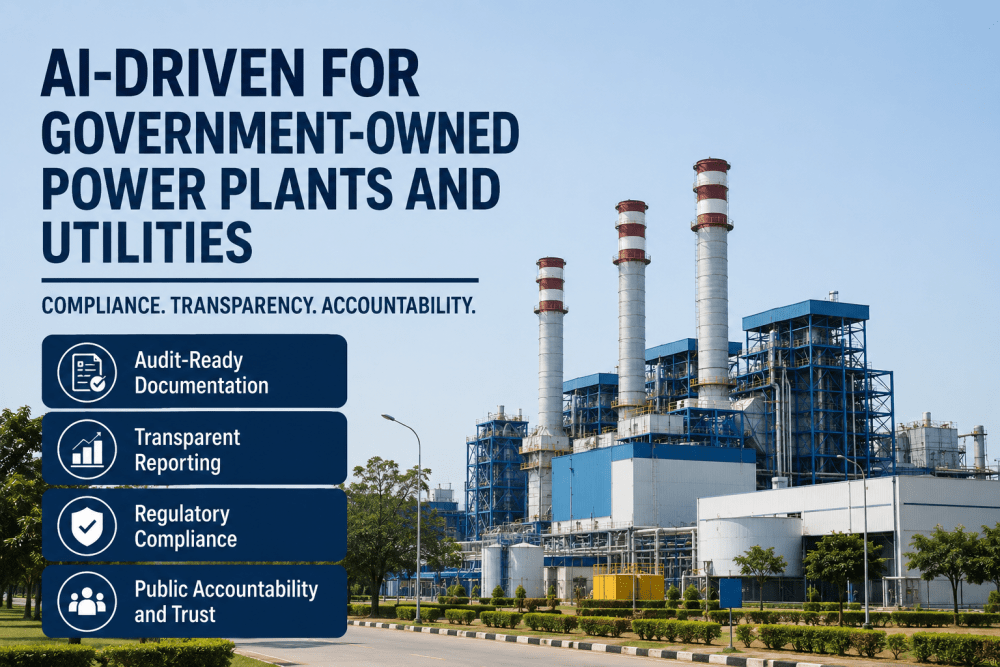
Government-owned power plants and public utilities operate under a compliance and accountability framework that no privately-owned generation asset faces. Every maintenance decision, every procurement action, every equipment failure and every regulatory response is subject to public records requests, legislative audit, inspector general review and in many cases, rate case proceedings before public utility commissions. The challenge is that most government and municipal utility plants are still managing this compliance burden with the same tools — paper work orders, disconnected CMMS systems, manual procurement logs, and spreadsheet-based maintenance tracking — that were never designed to produce the auditable, timestamped, cross-referenced documentation that public accountability requires. The cost of that gap is not just administrative inefficiency. It is audit findings, deferred maintenance that becomes emergency capital expenditure, procurement irregularities that generate inspector general referrals, and regulatory orders that impose compliance timelines on facilities that cannot demonstrate they were managing assets systematically. iFactory's AI-driven analytics platform is purpose-built to close this gap: delivering the real-time asset management, automated compliance documentation, and transparent operational reporting that government and public utility power plants need to operate efficiently, withstand audit, and fulfill the public accountability mandate that comes with public ownership. For an initial conversation about how iFactory applies to your utility's specific regulatory and compliance environment,
Does Your Government-Owned Plant Have the Audit-Ready Documentation That Public Accountability Requires?
iFactory's AI-driven platform delivers automated maintenance records, procurement audit trails, regulatory compliance documentation, and transparent operational reporting — everything government and public utility power plants need to operate efficiently and withstand scrutiny.
Why Government and Public Utility Power Plants Face Compliance Risks That Private Plants Do Not
The compliance environment for a government-owned or municipal utility power plant is fundamentally different from a privately-owned generating asset in four dimensions that have direct operational and financial consequences. Understanding these dimensions is the prerequisite to building the management systems that address them.
Full Audit Exposure
Every maintenance work order, every procurement decision, every contractor engagement, and every equipment failure record is potentially subject to public records requests, legislative oversight committee review, and inspector general investigation — with no equivalent in privately-owned generation.
Regulatory Documentation
Public utility commission rate cases require documented justification for every major maintenance expenditure, capital project, and operating cost increase — documentation that must be produced from management systems, not reconstructed from memory or partial records when a rate case is filed.
Competitive Bid Compliance
Government procurement rules — competitive bidding thresholds, sole-source justification documentation, vendor qualification records, and contract performance tracking — apply to maintenance parts and contractor services in ways that create audit exposure when management systems cannot produce the required records.
Federal Reliability Standards
NERC reliability standards and FERC reporting requirements apply equally to government and private utilities — but government-owned plants face the additional layer of state public utility commission oversight and, in many cases, legislative reporting requirements that create compounding documentation demands.
The Six Compliance Gaps Most Commonly Found in Government-Owned Power Plant Audits
Inspector general reviews, legislative audits, and public utility commission investigations of government-owned power plants consistently identify the same documentation and management system gaps — gaps that iFactory's AI-driven platform is specifically designed to close before they become audit findings.
| Audit Finding Category | Common Root Cause | Regulatory / Accountability Exposure | iFactory Capability |
|---|---|---|---|
| Deferred Maintenance Documentation | No systematic tracking of deferred work orders with rationale and risk assessment | Legislative audit finding; rate case disallowance; NERC standard violation | Automated Deferred Maintenance Tracking |
| Procurement Record Gaps | Parts and contractor purchases not linked to work orders; bid justification not documented | Inspector general referral; procurement irregularity finding; contract audit exposure | Integrated Procurement Audit Trail |
| Corrective Action Response Time | No timestamped record of when deficiencies were identified, escalated, and resolved | NERC compliance violation; regulatory order; rate case adverse finding | Automated Corrective Action Timestamping |
| Asset Condition Documentation | No systematic equipment condition records to justify capital expenditure decisions | Capital budget challenge; rate case disallowance; legislative scrutiny | AI Condition Trending and Capital Justification |
| Contractor Performance Records | No systematic tracking of contractor work quality, schedule adherence, and cost performance | Contract audit exposure; procurement irregularity; public records liability | Contractor Performance Analytics |
| Regulatory Submission Documentation | NERC, EPA, and state regulatory submissions not automatically linked to supporting maintenance records | Regulatory fine; compliance order; reputational and political exposure | Regulatory Submission Support Records |
How iFactory's AI-Driven Platform Addresses the Unique Requirements of Government-Owned Power Plants
iFactory's platform delivers public utility compliance capability across five integrated functional areas — each addressing a specific accountability and operational requirement that distinguishes government-owned generation from private sector asset management. Book a Demo to see how these capabilities apply to your utility's regulatory environment.
Audit-Ready Maintenance Documentation
- Every work order timestamped from creation through completion with full activity log
- Technician sign-off, supervisor approval, and QA review recorded per work order
- Deferred maintenance tracked with documented rationale and risk classification
- Maintenance history exportable in formats accepted by legislative auditors and IG offices
- Asset-level maintenance spend tracked against budget with variance documentation
Procurement Compliance and Bid Documentation
- Parts and contractor purchases linked to originating work orders automatically
- Competitive bid thresholds enforced with automated flagging for sole-source justification
- Vendor qualification records and contract performance history maintained per supplier
- Procurement audit trail exportable per contract, vendor, or date range for audit response
- Emergency procurement records include documented urgency justification and approval chain
NERC and Regulatory Compliance Tracking
- NERC reliability standard compliance activities tracked with automated due-date alerts
- Corrective maintenance actions timestamped from deficiency identification through resolution
- Regulatory submission support records linked to underlying maintenance documentation
- Compliance calendar with configurable alerts for regulatory reporting deadlines
- Evidence package assembly for NERC audit and self-report preparation
Capital Expenditure Justification and Asset Condition Records
- AI condition trending builds documented equipment degradation record before capital request
- Maintenance cost history per asset supports end-of-life versus repair-and-continue decisions
- Capital project tracking with milestone documentation for rate case support
- Asset condition reports exportable for PUC rate case filing and legislative budget presentation
- Risk-ranked equipment list shows which assets are approaching capital investment threshold
Transparent Operational Reporting for Public Accountability
- Executive dashboards showing plant reliability, maintenance spend, and compliance status
- Board and legislative committee reporting packages generated automatically from live data
- Public accountability metrics — availability, reliability, cost per MWh — tracked and reportable
- Contractor performance scorecards for public contract oversight
- Budget vs. actual maintenance cost reporting at asset, system, and plant level
Manual Compliance Management vs. iFactory AI-Driven: What Changes for Government Utilities
The operational and compliance gap between a government utility managing assets manually and one operating with iFactory's AI-driven platform is not a matter of paperwork efficiency — it is the difference between a management system that creates audit risk and one that systematically eliminates it.
- Work orders recorded on paper or in disconnected spreadsheets — incomplete audit trail
- Procurement records not linked to work orders — bid justification reconstructed after the fact
- Deferred maintenance tracked informally — no documented rationale or risk assessment
- NERC compliance activities managed in separate tracking spreadsheets — no integrated record
- Capital expenditure requests based on experience, not documented condition trending data
- Contractor performance tracked informally or not at all — no systematic accountability
- Regulatory submissions prepared from memory — no systematic link to supporting maintenance records
- Board and legislative reporting prepared manually — hours of work per reporting cycle
- Every work order timestamped and fully documented — complete audit trail from request through close
- All procurement linked to originating work orders — bid documentation enforced automatically
- Deferred maintenance tracked with documented rationale and risk classification per asset
- NERC compliance activities integrated in the same platform as maintenance records
- Capital justification supported by AI condition trends and documented maintenance cost history
- Contractor performance scored automatically against cost, schedule, and quality metrics
- Regulatory submissions linked to supporting maintenance records — evidence packages assembled in minutes
- Board and legislative reports generated automatically from live data — no manual compilation
The compounding benefit is in audit response time: a government utility operating on iFactory can respond to an inspector general records request or legislative audit inquiry in hours rather than weeks — because the documentation exists systematically rather than being reconstructed from partial records. Book a Demo to see iFactory's audit trail capabilities demonstrated in a government utility configuration.
What Government Utility Plant Managers and Compliance Officers Say About AI-Driven Asset Management
I spent 19 years as plant manager at a 400 MW municipal coal facility and the last six as a consultant to state and municipal utilities going through legislative audit and PUC rate case proceedings. In almost every engagement, the utilities in the most difficulty are not the ones with the worst maintenance programs — they are the ones with perfectly competent maintenance programs they cannot document adequately. You can have excellent technicians, solid preventive maintenance practices, and responsible procurement decisions, and still receive an inspector general finding because you cannot produce a timestamped record showing that a specific NERC corrective action was opened, assigned, completed, and verified within the required timeframe. Or a rate case panel disallows a capital replacement because the utility cannot produce the maintenance cost history and condition record that justifies the decision. The problem is never the work — it is the documentation of the work. AI-driven asset management platforms that create the audit trail automatically — where every work order, every procurement decision, and every deferred maintenance rationale is timestamped and cross-referenced as a byproduct of normal operations rather than as a separate documentation effort — are not just operational tools for government utilities. They are compliance infrastructure. The utilities that have deployed them go into audit and rate case proceedings with confidence. The ones that have not are perpetually reactive, spending significant management and legal resources responding to findings that a properly documented management system would have prevented entirely.
How Government Utilities Deploy iFactory: A 90-Day Path to Audit-Ready Operations
Government utility deployments follow a structured sequence that prioritizes the highest audit-exposure capabilities first — ensuring that the platform delivers compliance value before any planned audit period, rate case filing, or regulatory reporting deadline.
Days 1–21: Compliance Audit and Documentation Gap Assessment
Map current documentation gaps against your utility's specific audit exposure — NERC compliance records, procurement documentation, deferred maintenance tracking, and capital justification records. Identify the highest-priority documentation gaps and configure iFactory's workflows to address them first. For utilities facing a near-term audit or rate case, this phase prioritizes the documentation infrastructure that creates immediate audit response capability.
Days 22–45: Work Order and Procurement System Integration
Deploy iFactory's CMMS work order workflow across maintenance operations — connecting technician task execution, supervisor approval, parts procurement, and contractor engagement into a single integrated record per work order. Configure procurement bid threshold alerts and sole-source justification workflows that enforce government procurement compliance automatically as maintenance activities occur.
Days 46–70: NERC Compliance Tracking and Regulatory Calendar Integration
Configure iFactory's compliance tracking module for your specific NERC reliability standard obligations — corrective action due dates, evidence requirement templates, and regulatory submission support record linkages. Integrate the compliance calendar with work order scheduling so that NERC-required maintenance activities are automatically prioritized alongside routine operations without requiring separate tracking systems.
Days 71–90: Board Reporting, Executive Dashboards, and Audit Response Templates
Build the executive dashboards and board-level reporting packages that translate iFactory's operational data into the public accountability metrics your utility's leadership, elected officials, and public utility commission need. Configure audit response document templates so that records requests — from inspector general offices, legislative committees, or PUC staff — can be assembled from the platform in hours rather than requiring manual record reconstruction across multiple disconnected systems.
Government Power Plants Are Not Just Managed Facilities — They Are Public Assets That Require Public Accountability Infrastructure
The compliance requirement for a government-owned or public utility power plant is not an administrative burden layered on top of plant operations — it is the fundamental operating obligation of a public asset. Every maintenance decision made at a government-owned plant is a public resource allocation decision. Every procurement action is a government contract action. Every equipment failure is a public service reliability failure. The management systems these plants use are not just operational tools — they are the public accountability infrastructure that determines whether the facility can demonstrate, to any legitimate oversight authority, that public resources are being managed responsibly.
iFactory's AI-driven platform provides that infrastructure. Not as a compliance add-on to an operational system, but as an integrated platform where the audit trail, the procurement documentation, the NERC compliance records, and the capital justification data are created as natural byproducts of normal plant operations — requiring no separate documentation effort and eliminating the gap between how the facility actually operates and what oversight authorities need to verify. Book a Demo to see iFactory configured for a government utility environment and discuss how the platform addresses your specific compliance and accountability requirements.
Build the Audit-Ready Documentation Infrastructure Your Public Utility Needs — Before the Next Audit Asks for It
iFactory's AI-driven platform delivers automated maintenance records, procurement audit trails, NERC compliance tracking, and transparent operational reporting — everything government-owned power plants need to operate efficiently and withstand the public accountability scrutiny that comes with public ownership.
Government Utility Power Plant AI-Driven — Frequently Asked Questions
How does iFactory's procurement documentation capability address government competitive bidding requirements?
iFactory's procurement module is configurable for your utility's specific competitive bidding thresholds — the dollar amounts at which competitive bids, three-quote comparisons, or formal procurement processes are required under state or local government procurement rules. When a parts purchase or contractor engagement approaches the configured threshold, the platform automatically flags it and requires the appropriate documentation — competitive bid records, sole-source justification with approval chain, or emergency procurement documentation — before the purchase can be closed in the system. All procurement records are linked to the originating work order, creating the cross-referenced audit trail that inspector general and legislative audits require. The platform stores vendor qualification records, contract terms, and performance history per supplier — so that a procurement audit can be satisfied from the platform rather than requiring manual record reconstruction across multiple filing systems. Book a Demo to see procurement compliance workflows configured for your utility's procurement rules.
Can iFactory support NERC compliance evidence requirements for government-owned generation facilities?
Yes — iFactory's compliance tracking module supports NERC reliability standard evidence requirements across the applicable standard families: FAC, PRC, MOD, and others as applicable to your facility's functional registration. For each applicable standard, the platform maintains a compliance activity register with due dates, responsible parties, evidence record templates, and status tracking. Corrective maintenance actions required under NERC standards are linked directly to work orders in the CMMS, creating the timestamped documentation chain that NERC audits and self-reports require. When a NERC audit is scheduled or a self-report is required, the evidence package can be assembled from iFactory's compliance module rather than from distributed records across multiple systems — reducing evidence preparation time from weeks to hours and eliminating the documentation gaps that generate NERC findings for facilities with adequate maintenance programs but inadequate record systems.
How does iFactory support public utility commission rate case proceedings for government-owned plants?
Rate case proceedings for government-owned utilities or public power entities require documented justification for maintenance expenditures, capital project decisions, and operating cost levels — documentation that must come from management systems, not from after-the-fact narrative. iFactory builds this documentation continuously as a byproduct of normal operations: maintenance cost history per asset provides the foundation for operation and maintenance cost presentations; AI condition trending and documented repair history support capital replacement justifications; deferred maintenance records with risk classifications document prudent asset management decisions; and contractor performance records support labor and contractor cost justifications. All of this documentation is exportable in formats suitable for regulatory filing and expert witness support. The platform's asset-level cost tracking and condition records are specifically designed to answer the questions that PUC staff and intervenors ask about maintenance prudency — before those questions are asked. Book a Demo to see how iFactory's documentation supports rate case proceedings.
What integrations does iFactory support for government utilities using existing financial and ERP systems?
iFactory integrates with the financial and ERP systems most commonly deployed in government and municipal utility environments: SAP Public Sector, Oracle EBS and Oracle Cloud for Utilities, Tyler Technologies Munis and INCODE, Microsoft Dynamics, and Infor Public Sector. Integration enables maintenance cost actuals from iFactory work orders to flow directly into the utility's financial system for budget tracking and reporting, eliminating manual data re-entry between systems and ensuring that maintenance expenditure records in both systems are consistent for audit purposes. iFactory also integrates with GIS systems common in utility environments (Esri ArcGIS) for asset location and field service dispatch. For utilities using existing CMMS platforms (Maximo, Infor EAM), iFactory's analytics layer can be deployed as an overlay rather than a replacement — adding AI condition analytics and compliance documentation capabilities to existing work order workflows without requiring a full system migration.
How does iFactory handle public records requests for maintenance and operational data?
iFactory's document export and records request capability is designed for the public records environment that government utilities operate in. Records requests can be fulfilled by exporting timestamped work order records, procurement documentation, maintenance history, and compliance tracking records for any asset, date range, work category, or contractor relationship — in PDF, Excel, or CSV formats suitable for records request fulfillment. The platform's role-based access controls ensure that records are complete and unmodified for export, supporting the authenticity requirement for official records production. For utilities receiving frequent public records requests — from journalists, advocacy organizations, or political opponents — iFactory's structured record exports eliminate the risk of incomplete or inconsistent records production that creates legal and reputational exposure. All exported records include complete metadata — creation timestamps, modification history, user identification — that supports legal admissibility in audit, regulatory, or litigation contexts.




.png)