Fuel handling systems at power plants occupy a position similar to compressed air — they are not the primary energy conversion pathway, but they are dependency for everything that is. Natural gas supply headers andfuel oil forwarding systems, distillate storage tanks, fuel filtration trains, and fuel heating equipment collectively determine whether the plant can start, run, and dispatch reliably. At most U.S. generation facilities, the maintenance tracking infrastructure for fuel systems lags significantly behind what the criticality of these systems justifies. Fuel pump service intervals are managed on calendar schedules that do not reflect actual condition. Storage tank inspection records are maintained in paper logs or disconnected spreadsheets that no one reviews until a compliance audit surfaces the gap. Fuel filter differential pressure is trended manually — or not at all — until a fuel supply interruption during a dispatch event reveals what continuous monitoring would have caught weeks earlier.
AI-driven fuel system analytics closes that monitoring gap by bringing the same continuous condition tracking, maintenance scheduling, and compliance documentation that major generation assets receive to the fuel handling equipment that supports them. Fuel pump performance is trended against calibrated baselines. Filter loading rates are tracked and projected against replacement thresholds. Storage tank inspection records are managed in the same platform that tracks work orders, compliance deadlines, and equipment health — so nothing falls through the gap between the maintenance department and the environmental compliance team. For U.S. power plants managing fuel systems under EPA Spill Prevention, Control, and Countermeasure requirements and state environmental regulations, this integrated approach is not just operationally efficient — it is the compliance infrastructure that prevents the penalties and remediation costs that fuel system failures generate when they occur without a monitoring record behind them.
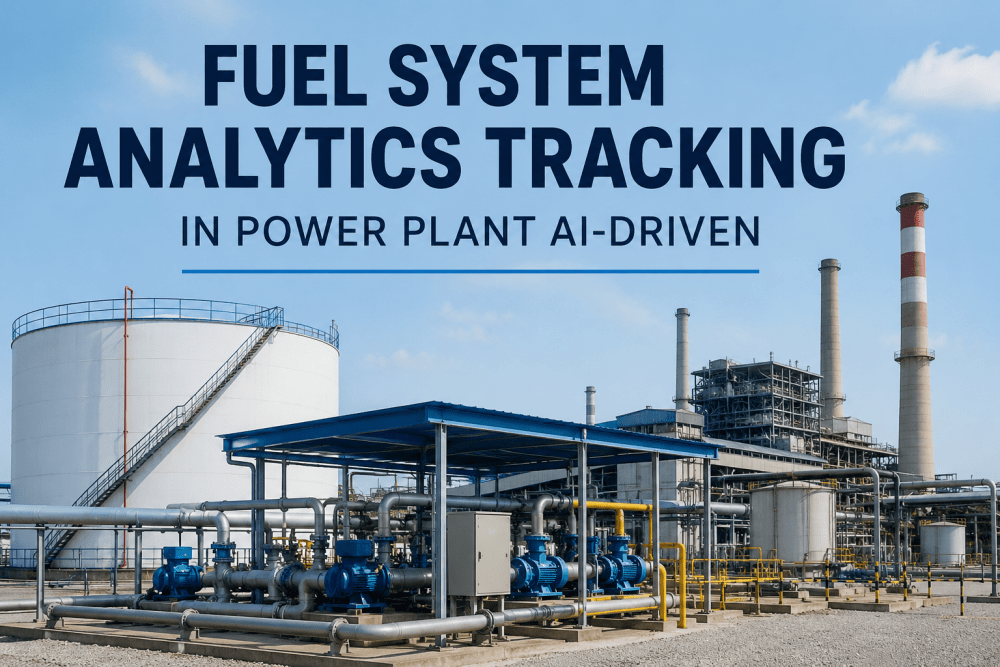
Fuel System Analytics Tracking for Power Plants
Manage fuel pumps, filters, heaters, and storage tanks with scheduled analytics, leak inspection records, and regulatory compliance tracking — all inside one AI-driven platform.
Why Fuel System Maintenance Tracking Falls Through the Gap
The monitoring gap for fuel handling systems at power plants is structural, not accidental. Major generation assets — gas turbines, HRSGs, generators — receive dedicated analytics investment because their forced outage costs are immediately visible and frequently experienced. Fuel handling equipment fails less frequently in isolation, but when it does fail, the consequences cascade into the generation assets that depend on it. A fuel forwarding pump failure that prevents fuel delivery to the turbine during a peak dispatch event produces the same capacity payment losses as a turbine trip — but the fuel pump is managed on a calendar-based PM schedule without continuous condition monitoring.
Siloed Documentation Systems
Fuel pump service records live in the CMMS. Storage tank inspection logs are in paper binders or separate spreadsheets. Environmental compliance deadlines are tracked by a different team. No one system connects all three — so inspection due dates are missed, service history is incomplete, and compliance audits reveal gaps that could have been closed with integrated tracking.
Calendar-Only Maintenance Intervals
Fuel pump service intervals set at equipment commissioning do not account for actual operating hours, cycling frequency, or fuel quality variations that accelerate wear. Units running at peak cycling frequencies may require service at 60% of the standard interval; lightly loaded units may safely extend beyond it. Neither condition is visible in a calendar-based PM schedule.
No Continuous Filter Performance Monitoring
Fuel filter differential pressure is one of the most reliable indicators of filter loading, fuel contamination, and downstream equipment protection status. Without continuous trending, filters are replaced on schedule regardless of loading state — either prematurely, wasting serviceable filter life, or after restriction has already reduced fuel flow to levels that affect combustion performance.
EPA SPCC Documentation Compliance Risk
EPA 40 CFR Part 112 Spill Prevention, Control, and Countermeasure requirements mandate documented inspection records for fuel storage facilities above threshold volumes. Inspection due dates that are tracked manually — or not tracked at all — create the documentation gaps that generate compliance findings, penalty exposure, and remediation obligations that dwarf the cost of the inspection program itself.
Managing fuel system compliance across multiple regulatory frameworks without an integrated tracking system? Book a 30-minute compliance architecture assessment with iFactory's power plant team to see how centralized fuel system tracking closes documentation gaps before they become findings.
What AI-Driven Fuel System Analytics Monitors: Component by Component
Purpose-built fuel system analytics covers every subsystem that contributes to fuel delivery reliability and regulatory compliance — not just the main fuel forwarding pumps. The highest-value monitoring platforms come with pre-built performance models for each fuel system component, correlating multiple signal streams into component-level health scores that update continuously.
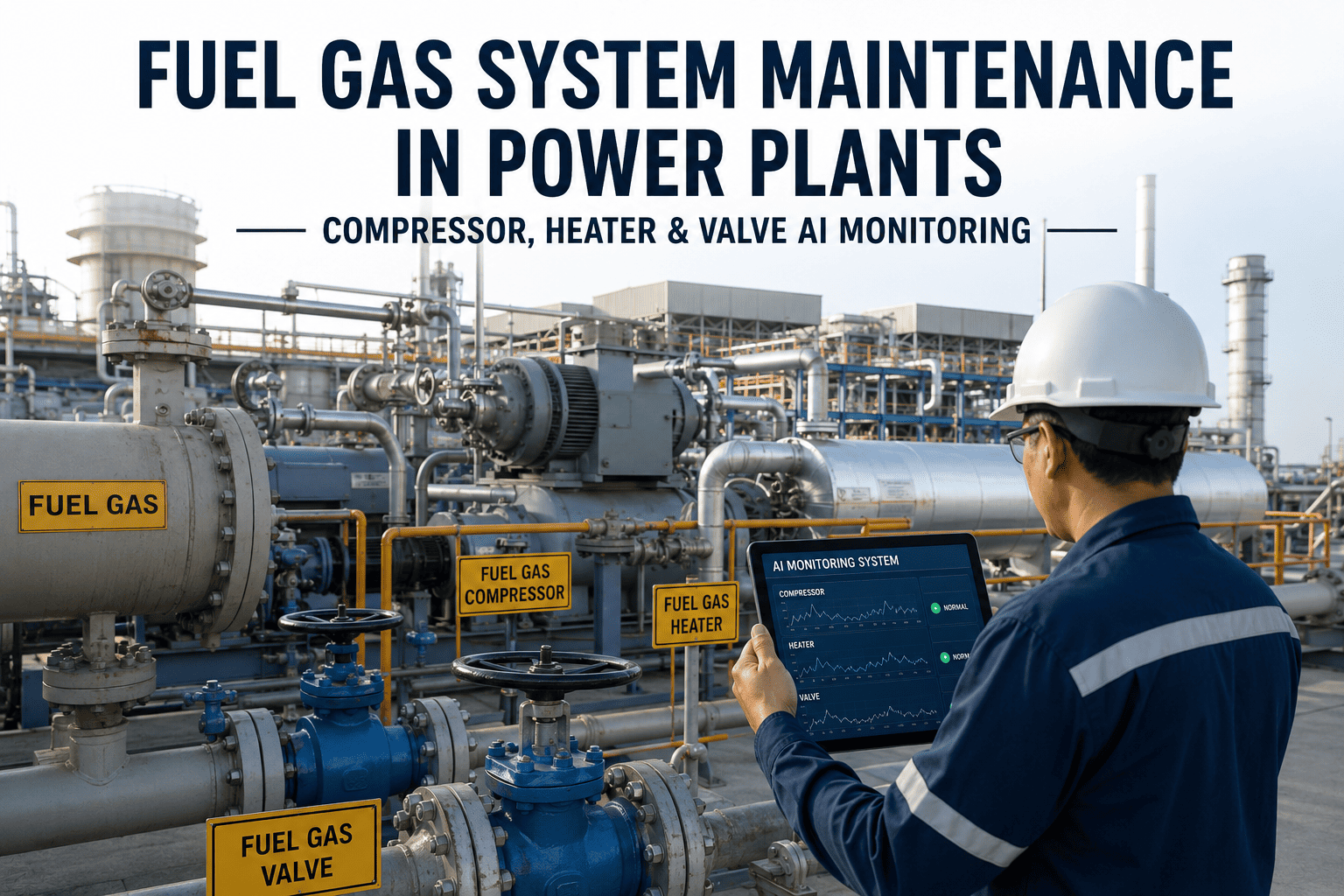
Fuel forwarding pump, boost pump, and transfer pump health is tracked through motor power consumption versus flow output ratios, discharge pressure trending, suction and discharge differential analysis, vibration spectral data on rotating components, and seal condition indicators. AI models establish baseline performance curves calibrated to each pump's rated conditions and continuously measure deviation from those baselines — quantifying efficiency loss, impeller wear, and bearing condition before output falls below the fuel system's minimum delivery requirement during peak load or startup.
Fuel filtration system monitoring tracks differential pressure across each filter element continuously — building a loading rate curve that projects when the element will reach the replacement threshold based on current fuel quality and flow conditions. The platform distinguishes between normal loading progression and accelerated loading from fuel contamination events, generating immediate alerts when contamination-pattern loading is detected so the root cause can be addressed before downstream combustion system damage occurs. Filter life is maximized by condition-based replacement rather than calendar intervals.
For distillate and heavy fuel oil systems, fuel heater performance is critical to maintaining the fuel viscosity required for atomizer performance and combustion efficiency. AI analytics tracks fuel heater outlet temperature relative to the viscosity target at current fuel flow and ambient conditions — detecting heater element degradation, heat exchanger fouling, and steam control valve drift before fuel viscosity falls outside the combustion system's operating specification. Heat exchanger tube fouling is quantified continuously from the relationship between steam consumption and fuel outlet temperature.
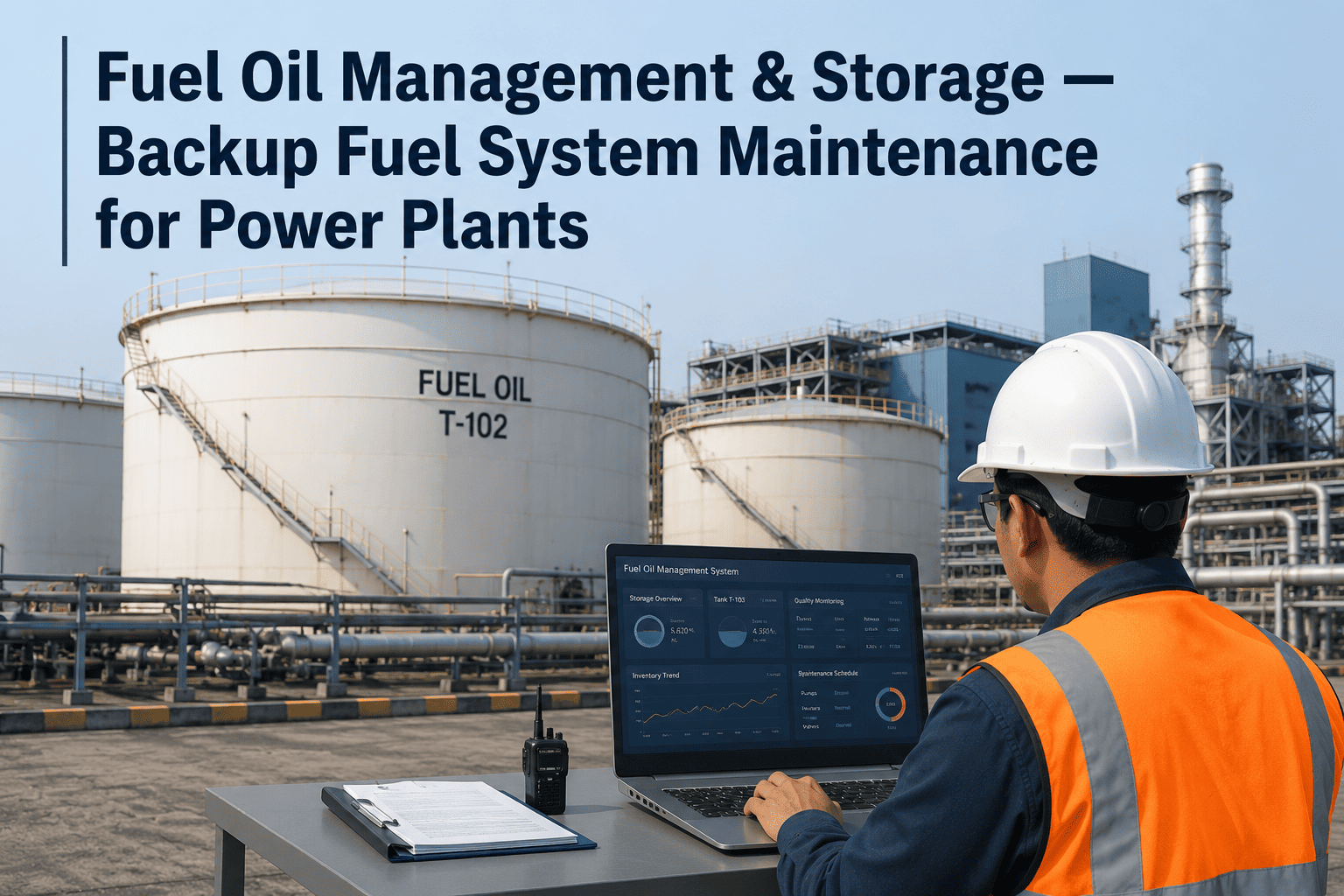
Fuel storage tank management in the AI-driven platform covers both physical condition monitoring and regulatory compliance documentation. Tank level trending identifies consumption and transfer anomalies that may indicate small leaks before they become reportable releases. Inspection due dates under EPA SPCC, state environmental regulations, and insurance requirements are tracked centrally — generating advance notifications before inspection windows close, auto-populating inspection report templates from tank records, and maintaining the complete inspection history that regulators and insurers require in a single auditable record.
Fuel System Regulatory Compliance: What the Platform Tracks Automatically
Fuel system compliance at U.S. power plants spans multiple regulatory frameworks — EPA SPCC requirements, state environmental agency regulations, NFPA 30 flammable liquids standards, and insurance policy inspection requirements. The documentation burden associated with these requirements is substantial and time-sensitive. AI-driven platforms address this burden by tracking every compliance obligation centrally, generating advance alerts before deadlines, and maintaining the auditable inspection record that regulators require during compliance reviews.
EPA SPCC — 40 CFR Part 112
Spill Prevention, Control, and Countermeasure plans require documented visual inspection records for aboveground storage tanks, secondary containment, and transfer equipment. The platform tracks inspection frequency requirements, generates inspection due notifications, and maintains the complete inspection log in a format directly exportable for EPA review.
NFPA 30 Flammable Liquids Storage
NFPA 30 inspection and testing requirements for tanks, piping, valves, and vents are tracked against the plant's installed equipment inventory. Inspection records, hydrostatic test certificates, and valve testing documentation are maintained in the platform alongside maintenance work orders for the same equipment.
Insurance Policy Requirements
Property and liability insurance carriers increasingly require documented fuel system inspection and maintenance programs as conditions of coverage. The platform generates the inspection frequency compliance report and maintenance history summary that underwriters request during annual coverage reviews — with all supporting documentation attached.
State Environmental Agency Requirements
State UST and AST programs impose inspection and reporting requirements that vary by jurisdiction. The platform's compliance library is configurable to each state's regulatory schedule — tracking inspection frequencies, reporting deadlines, and certification renewal dates independently from federal requirements to ensure no state-specific obligation is missed between annual compliance reviews.
Managing fuel system compliance across multiple regulatory frameworks without an integrated tracking system? Book a 30-minute compliance architecture assessment with iFactory's power plant team to see how centralized fuel system tracking closes documentation gaps before they become findings.
Fuel System Analytics Tracking Workflow: From Sensor Data to Compliance Record
The complete value of AI-driven fuel system analytics is realized only when the detection chain — from sensor signal to maintenance action to compliance documentation — is fully automated. The following timeline maps that chain for a power plant managing natural gas supply equipment, fuel oil handling systems, and aboveground storage tanks under EPA SPCC requirements.
All fuel system instrumentation — pump differential pressures, filter dP signals, heater temperatures, tank level transmitters, and motor current signals — is ingested continuously from the plant DCS historian via read-only OPC-UA or PI API connection. Physics-based performance baselines for each component are calculated from operating conditions and continuously updated. Normal variation from ambient temperature changes, fuel specification variations, and load-following cycles is automatically filtered from degradation trending, so only genuine condition changes generate analytical findings.
When a sensor pattern matches a known fuel system failure precursor — accelerating filter dP loading rate, pump efficiency decline curve, heater heat transfer coefficient deterioration — the AI model classifies the specific failure mode and estimates the remaining useful life before the component reaches the operational threshold. A fuel forwarding pump showing a characteristic impeller wear signature receives a condition classification within minutes of the pattern developing — not after a weekly dashboard review cycle. The finding includes the specific sensor data, the failure mode, confidence score, and estimated intervention timing.
High-confidence findings automatically generate draft work orders in the connected CMMS — pre-populated with asset tag, failure mode classification, recommended inspection scope, suggested parts, and financial justification. For fuel system findings, the financial context includes the estimated cost of the failure mode if unaddressed — a filter contamination event that could damage downstream combustion nozzles is expressed as the projected repair cost, not just a filter replacement recommendation. This financial translation connects fuel system condition to the operating margin metric that drives maintenance priority decisions.
The platform tracks every fuel system compliance inspection obligation — SPCC visual inspections, NFPA 30 testing requirements, state environmental agency deadlines, insurance policy inspection requirements — and generates advance notifications 30, 14, and 7 days before each deadline. Inspection assignments are generated as work orders in the CMMS with pre-populated inspection checklists, regulatory citation references, and previous inspection findings attached for reference. The inspection cannot be marked complete without all required documentation fields populated and any identified findings routed for corrective action.
When an inspection work order is completed and signed off, the platform automatically assembles the compliance documentation package — inspection findings, photographs, technician signature, completion timestamp, regulatory citation confirmation, and corrective action status for any identified issues. This package is stored with the asset record in a format directly exportable for EPA SPCC file maintenance, state environmental agency submittals, and insurance underwriter review. No manual assembly of compliance records from multiple systems is required — the complete documentation package exists automatically from the workflow that produced it.
Every confirmed fuel system finding, completed inspection, and maintenance event feeds back into model refinement. After 12 to 18 months of operation, facility-specific fuel system models — calibrated to the specific pump fleet, fuel specification, operating profile, and seasonal demand pattern of the plant — outperform generic fleet models on both detection lead time and false positive rate. Seasonal effects — fuel viscosity changes with ambient temperature, filter loading rates that vary with fuel delivery quality — are learned and normalized automatically, improving the precision of condition-based recommendations without requiring manual model recalibration.
Fuel System KPI Reference: What Gets Measured and What It Means
The following table maps the primary fuel system performance indicators against their measurement definitions, the AI analytics signals used to calculate them, and the operational or compliance consequence if the KPI trends outside the acceptable band. This is the measurement framework that purpose-built fuel system analytics platforms operationalize automatically.
| KPI | Measurement Definition | AI Analytics Source | Alert Threshold | Consequence if Exceeded |
|---|---|---|---|---|
| Pump Hydraulic Efficiency | Actual flow output vs. theoretical output at measured differential pressure and motor power — deviation from baseline efficiency curve | Flow transmitter, pump dP, motor power — ratioed against calibrated baseline model at equivalent load | Greater than 5% deviation from baseline at equivalent conditions | Impeller wear or cavitation indication; increased energy cost; reduced delivery capacity at peak demand |
| Filter Differential Pressure Loading Rate | Rate of dP increase per operating hour — compared to baseline loading rate for current fuel specification and flow | Upstream/downstream pressure transmitters across filter element vs. historical loading curve | Loading rate exceeding 130% of baseline — contamination event indicator | Accelerated filter life consumption; downstream combustion system contamination risk if bypass opens |
| Fuel Heater Heat Transfer Coefficient | Actual heat duty transferred per unit of steam consumption vs. clean-tube design baseline — fouling factor calculation | Fuel inlet/outlet temperature, steam flow meter, steam pressure — referenced against design heat transfer model | Greater than 15% reduction from clean-tube coefficient | Viscosity specification exceedance risk; combustion performance degradation; steam consumption increase |
| Tank Level Consumption Rate | Actual fuel consumption rate vs. expected consumption at current generation output — anomalies indicate leakage or metering error | Tank level transmitter trend vs. metered fuel consumption from generation output data | Greater than 2% deviation from expected consumption rate over 24-hour period | Potential fuel leak; metering error affecting heat rate calculation; SPCC reporting trigger if threshold volume |
| SPCC Inspection Compliance Rate | Percentage of required SPCC visual inspections completed on schedule vs. total required in period — tracked by tank and equipment class | Compliance calendar against completed work order records in CMMS — automated compliance rate calculation | Any inspection overdue beyond 7-day grace window | EPA 40 CFR Part 112 documentation deficiency; $10,000–$37,500/day penalty exposure per violation |
| Pump Motor Current Signature | Motor current draw vs. expected current at measured flow output — deviations indicate mechanical loading changes from impeller condition or bearing wear | Motor current transformer signal vs. flow-corrected baseline current model per pump | Greater than 8% deviation from flow-corrected baseline current | Bearing wear or seal drag indication; increased heat generation; bearing failure risk if unaddressed |
Managing fuel system compliance across multiple regulatory frameworks without an integrated tracking system? Book a 30-minute compliance architecture assessment with iFactory's power plant team to see how centralized fuel system tracking closes documentation gaps before they become findings.
Expert Review: What Reliability Engineers Say About Fuel System Analytics
Fuel handling systems are the most consistently undermonitored asset class I encounter at power generation facilities — and the one where the gap between monitoring investment and failure consequence is most disproportionate. The plants that have experienced a fuel pump failure during a peak dispatch event, or received an EPA SPCC inspection notice on a facility with incomplete inspection records, understand the consequences firsthand. Here are the four things every plant reliability team should know about fuel system analytics before the next audit cycle.
Conclusion
Fuel system analytics at power plants is one of the highest-return monitoring investments available because the gap between current monitoring practice and available capability is so large — and the consequences of that gap so well-documented. Fuel pump failures during peak dispatch events, EPA SPCC compliance findings from incomplete inspection documentation, and filter contamination events that damage downstream combustion equipment are all generated by the same structural problem: fuel system equipment that receives calendar-based maintenance management and siloed compliance tracking rather than continuous condition monitoring and integrated regulatory documentation.
AI-driven fuel system analytics closes that gap by extending to fuel handling equipment the same continuous monitoring, condition-based maintenance scheduling, and automated compliance documentation that major generation assets already receive. The implementation investment is modest — fuel system analytics at most power plants can be operational within four to six weeks of historian connection, using existing instrumentation and requiring no new sensors on most systems. The return is measured against the avoided costs that fuel system failures, compliance penalties, and documentation gaps generate at facilities that continue managing these systems without continuous monitoring support.
Ready to close the fuel system monitoring gap at your plant? Schedule your fuel system analytics assessment with iFactory's power generation team — and get a site-specific ROI estimate based on your equipment inventory and compliance obligations.

.png)