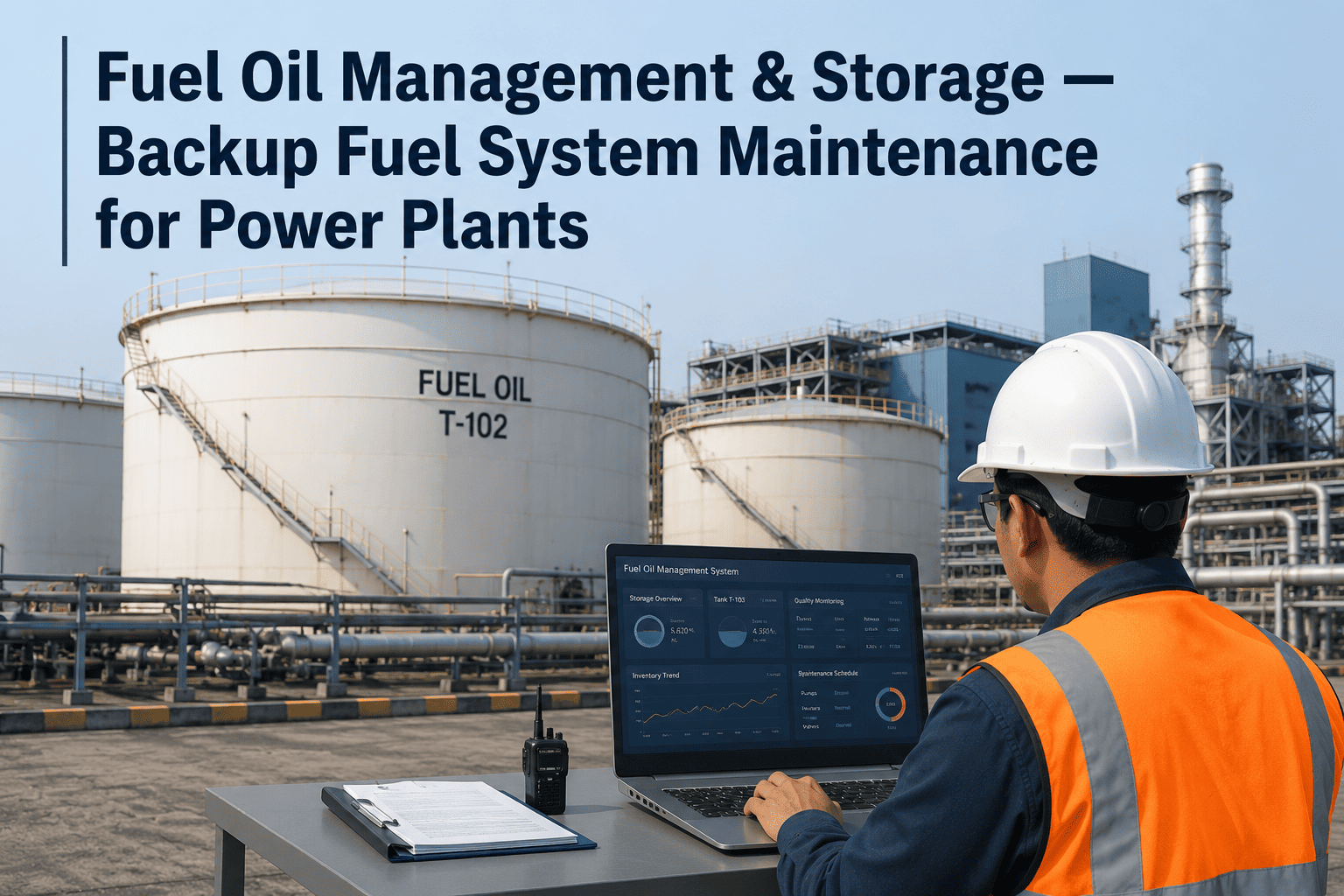
Backup fuel oil sits in a tank for months — sometimes years — waiting for the one moment it has to work: a gas curtailment, a pipeline constraint, an emergency startup at 2 a.m. when the grid operator calls and there is no time to negotiate a spot gas purchase. The problem is that fuel oil does not wait well. Water condenses at the bottom and breeds microbial colonies that produce acids and sludge. Tank walls corrode under coatings that crack without anyone seeing. Filters clog, transfer pumps seize, and fuel nozzles on dual-fuel turbines gum up because nobody ran the system since the last compliance test six months ago. When the call comes, a plant that assumed its backup fuel was ready discovers it is not — and the failure happens at the exact moment the stakes are highest. AI-powered fuel oil management tracks tank condition, fuel quality, and every component in the handling chain continuously, so readiness is a measured fact rather than an assumption — book a demo to see it monitoring a live fuel oil system.
Backup Fuel Systems · AI Monitoring
AI-Powered Fuel Oil Storage, Quality and Handling Readiness for Power Plants
Monitor every tank, every pump, every valve, and every liter of stored fuel oil so your backup system is verified ready every day — not just on the day someone remembers to test it.
30%
of backup fuel systems fail on first call due to degraded fuel or unmaintained equipment
90 Days
typical onset of microbial contamination in diesel storage without active monitoring
24/7
continuous AI readiness verification replacing periodic manual fuel testing
Three Ways a Backup Fuel System Fails When You Need It Most
Most backup fuel failures are not sudden mechanical breakdowns — they are slow degradation processes that accumulate invisibly between test runs. The tank looks fine from the outside. The gauges read full. But the fuel inside and the equipment around it have been quietly deteriorating since the last time anyone checked.
Failure 1
Fuel Degradation
Water condenses inside the tank as temperatures cycle between day and night. Within 90 days, bacteria and fungi colonize the fuel-water interface, producing organic acids that corrode the tank bottom and gelatinous sludge that clogs filters and fuel nozzles. The fuel looks normal from a sight glass — the damage is at the bottom where nobody samples.
Failure 2
Equipment Seizure
Transfer pumps, fuel forwarding skids, and pressure regulators that sit idle for months develop seal dry-out, bearing corrosion, and valve sticking. A pump that tested fine in January may not turn over in July. Dual-fuel turbine fuel nozzles accumulate varnish deposits from residual fuel that polymerizes in the injector passages during long standby periods.
Failure 3
Tank Integrity Loss
Internal coating breakdown exposes bare steel to acidic sludge and condensate, accelerating pitting corrosion on the tank floor — the zone hardest to inspect and most expensive to repair. API 653 requires periodic internal inspection, but between inspections corrosion rates can change dramatically due to fuel chemistry shifts or water ingress that no one monitors.
How Stored Fuel Oil Degrades Over Time
Fuel quality is not static. From the day oil enters the tank, a series of chemical and biological processes begin working against it. Without continuous monitoring, a plant has no way to know where on this degradation curve its stored fuel sits right now.
Day 1-30
Fresh Fuel
Fuel meets all specification limits. Water content minimal. Microbial counts below detection thresholds. Filters pass cleanly.
Month 2-3
Early Warning
Condensation accumulates at tank bottom. Water activity reaches levels that support microbial germination. Oxidation begins altering fuel stability.
Month 4-6
Active Degradation
Microbial colonies established at fuel-water interface. Acid production underway. Filter differential pressure rising. Sludge formation visible in bottom samples.
Month 7-12
Readiness at Risk
Fuel fails filterability tests. Tank floor corrosion accelerating under biofilm. Pump suction strainers clogging. Fuel is unreliable for emergency turbine start without polishing.
A full tank is not the same as a ready tank. AI monitors fuel quality, water content, microbial activity, tank corrosion, and equipment condition continuously — so backup readiness is a live status, not a checkbox that was last updated six months ago.
What AI Monitors Across the Entire Fuel Oil System
The platform connects tank-level sensors, fuel quality instruments, equipment condition monitors, and dual-fuel turbine readiness signals into a single readiness dashboard — replacing scattered manual checks with a live, always-current system status.
Corrosion Tracking
Ultrasonic thickness measurement data from shell and floor plate CMLs feeds into corrosion rate models that calculate remaining life and predict the next API 653 inspection date.
Water Bottom Monitoring
Capacitance probes at the tank floor detect free water accumulation in real time, triggering drain-down alerts before water levels reach the microbial germination threshold.
Coating and Cathodic Protection
Potential surveys and coating condition assessments are tracked as structured inspection records, with degradation trends flagged before corrosion breaks through.
Microbial Contamination
Automated sampling and colony count trending detects bacterial and fungal growth at the fuel-water interface before biomass reaches levels that clog filters or produce corrosive acids.
Fuel Stability and Oxidation
Filterability ratio testing and acid number tracking identify the onset of fuel degradation that makes stored oil unreliable for emergency turbine operation.
Particulate and Sludge Levels
Particle counters at the tank outlet and fuel forwarding skid catch rising contamination levels and trigger fuel polishing or tank cleaning work orders automatically.
Transfer Pumps and Valves
Vibration, temperature, and motor current sensors detect seal dry-out, bearing degradation, and valve sticking on fuel forwarding equipment that sits idle between test runs.
Fuel Treatment Skid
Centrifuge, coalescer, and filter condition monitoring ensures the fuel treatment system is ready to polish stored fuel to turbine-grade cleanliness on demand.
Dual-Fuel Turbine Interface
Fuel nozzle differential pressure, changeover valve position, and fuel oil header temperature are monitored to verify the turbine can transfer from gas to oil without a failed start.
Manual Testing vs. AI-Monitored Fuel Oil Readiness
| Readiness Factor |
Manual Approach |
AI-Monitored |
Impact |
| Fuel quality |
Grab sample sent to lab every 3-6 months |
Continuous water, particulate, and microbial trending |
Degradation caught at onset instead of after damage |
| Tank corrosion |
API 653 inspection at fixed intervals |
CML trending with corrosion rate recalculation after every reading |
Interval extensions where safe, early action where needed |
| Equipment readiness |
Quarterly test run, pass/fail |
Continuous condition monitoring on pumps, valves, and skids |
Seizure and degradation caught between test runs |
| Turbine fuel transfer |
Annual dual-fuel test, typically during planned outage |
Nozzle DP, changeover valve, and header temp monitored live |
Transfer capability verified daily instead of annually |
| Compliance documentation |
Paper logs compiled before audit |
Automatic timestamped records of every test, reading, and alert |
Audit-ready history with no last-minute document assembly |
Turnkey Deployment — Pre-Configured and Shipped Ready
Every fuel oil monitoring deployment ships as a pre-configured NVIDIA AI server bundle with all quality tracking, tank integrity, and equipment monitoring software pre-loaded. Rack it, connect power and Ethernet, integrate with your existing SCADA and historian, and the system begins building a readiness baseline within days.
Weeks 1-2
Site Assessment
Map fuel oil tanks, transfer equipment, treatment skids, dual-fuel turbine interface points, and existing SCADA data feeds. Identify sensor gaps for water detection, vibration, and fuel quality monitoring.
Weeks 3-6
Integration and Calibration
Rack the server, deploy tank sensors and equipment monitors, connect to plant historian and DCS. Calibrate fuel quality baselines and corrosion rate models against historical inspection data and lab results.
Weeks 7-12
Live Monitoring
AI goes live with continuous readiness scoring and alerting. Operator training and 24/7 remote support included. System generates work orders through your existing CMMS when any readiness parameter drifts out of range.
Tank 3 water bottom probe just crossed the 50mm threshold and the quarterly fuel sample is not due for another six weeks. What do I do?
Water in Tank 3 reached 52mm at 06:14 this morning — above the 50mm microbial germination threshold. I have already generated a drain-down work order and flagged a fuel sampling request for microbial colony count. If you approve the drain-down now, the water layer should be below 15mm by end of shift, well before any contamination establishes. I also recommend running the fuel polishing skid for 4 hours to remove any early-stage particulates.
1,000+
Industrial clients
6-12 Wks
Rack to live monitoring
Expert Insight
I have investigated dozens of backup fuel system failures, and the pattern is remarkably consistent: the tank was full, the paperwork said the last test passed, and nobody knew the fuel had been quietly degrading since the last time anyone looked at it. Fuel oil does not fail the way a pump fails — with noise and warning signs. It fails silently. The water accumulates a millimeter at a time, the microbes grow in the dark at the bottom of the tank, and the acids they produce eat through the coating and into the steel where no one is looking. By the time the plant tries to start on oil, the filters are plugged, the nozzles are fouled, and the window to respond to a gas curtailment has already closed. Continuous monitoring is the only way to know your backup fuel is actually ready — not just present.
Elena Vasquez — Fuel Systems Reliability Engineer, 15 years advising power generators on dual-fuel readiness and tank integrity management
Frequently Asked Questions
How does the system detect microbial contamination before it damages the fuel?
The primary early warning signal is water accumulation at the tank bottom — microbes need a fuel-water interface to colonize. Capacitance probes at the tank floor track the water layer depth in real time and trigger alerts when it crosses the germination threshold, typically 40-50mm depending on tank geometry and climate conditions. This triggers an automated drain-down work order before microbial colonies can establish. When supplemented with periodic automated colony count sampling, the system builds a contamination trend over time, catching biological activity at levels far below what would cause filter clogging or acid-driven corrosion. The goal is to keep the environment hostile to microbial growth rather than treating contamination after it has already damaged the fuel and the tank.
Book a demo to see how the water monitoring and microbial trending work on a live tank.
Can this integrate with our existing API 653 tank inspection program?
Yes. The platform is built to complement and extend API 653 programs, not replace them. Every CML (condition monitoring location) on the tank shell and floor is registered as a digital record, carrying its full measurement history, corrosion rate calculation, and remaining life estimate. When new ultrasonic or MFL scan data arrives — whether from an internal inspection, a robotic crawler survey, or a routine external reading — the system recalculates corrosion rates and adjusts the predicted next inspection date automatically. This allows plants to justify interval extensions where corrosion rates support it, and to accelerate inspection where unexpected thinning is detected between scheduled surveys.
Contact support to review how the platform maps to your existing API 653 inspection schedule.
What fuel oil system equipment does the AI monitor?
The system covers every critical component in the fuel oil handling chain: storage tanks (corrosion, water level, fuel quality), transfer pumps (vibration, temperature, motor current, seal condition), fuel treatment skids (centrifuge performance, coalescer differential pressure, filter condition), fuel forwarding systems (header pressure, temperature, flow rate), and the dual-fuel turbine interface (fuel nozzle differential pressure, changeover valve position, purge system status). Wireless sensors can be added to equipment that currently lacks instrumentation, deployed during normal operations with no downtime. The goal is to verify that every component between the tank and the turbine is ready to operate — not just that the tank has fuel in it.
Book a demo to walk through the equipment monitoring architecture for your specific fuel oil system.
How often do backup fuel systems actually fail when called upon?
Industry data and reliability studies indicate that backup fuel systems that are only tested quarterly have a first-call failure rate that is significantly higher than most plant managers assume — driven primarily by fuel degradation, equipment seizure during idle periods, and fuel nozzle fouling on dual-fuel turbines. The failures are rarely catastrophic mechanical breakdowns; they are typically slow degradation processes that accumulate between infrequent manual test runs. Plants that switch from periodic testing to continuous AI monitoring consistently report a substantial reduction in first-call failures because the system catches degradation trends weeks or months before they would have been discovered during the next scheduled test.
Contact support to discuss how continuous monitoring compares to your current fuel oil testing program.
What ROI does AI fuel oil monitoring deliver for a plant that rarely uses its backup fuel?
The ROI for fuel oil monitoring is not measured the same way as production optimization — it is a risk reduction investment, similar to insurance. The value comes from avoided costs: a single failed backup start during a gas curtailment can result in purchased power costs, grid penalties, or lost generation revenue that dwarfs the annual cost of the monitoring system. Beyond emergency readiness, continuous monitoring also reduces fuel polishing and tank cleaning costs by catching water and contamination early, extends tank inspection intervals where corrosion data supports it, and eliminates the labor cost of manual quarterly testing programs. For dual-fuel plants where backup readiness is a regulatory or contractual obligation, the compliance documentation alone — with continuous timestamped records rather than quarterly paper logs — justifies the investment.
Book a demo to build a risk-adjusted ROI case for your specific plant.
A Full Tank Is Not a Ready Tank
Stop assuming your backup fuel system works and start knowing it does — with AI that monitors fuel quality, tank integrity, and equipment readiness every hour of every day.