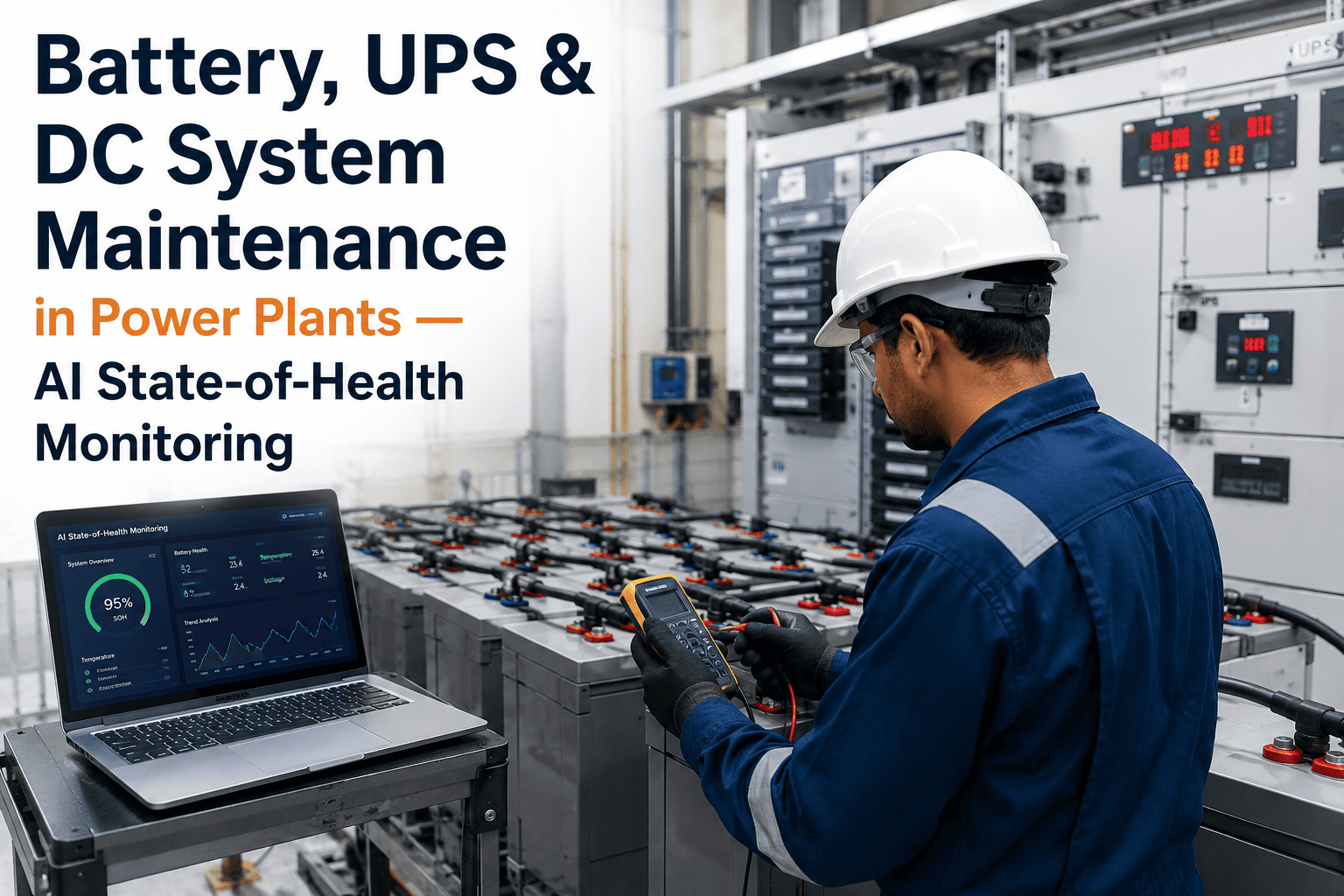
In the high-stakes environment of power generation, the reliability of battery banks, uninterruptible power supply (UPS) systems, and DC distribution networks is not merely an operational preference—it is a non-negotiable imperative for plant safety and grid stability. These systems serve as the last line of defense during a blackout or fault condition, providing critical control power to switchgear, protective relays, and emergency lighting. Yet, traditional maintenance approaches—periodic manual inspections, voltage checks, and impedance tests—are increasingly inadequate for detecting subtle, insidious degradation patterns that precede catastrophic failure. The emergence of artificial intelligence (AI) and machine learning (ML) applied to state-of-health (SoH) analytics is transforming how power plants manage these essential assets, enabling predictive insights that extend battery life, optimize replacement cycles, and virtually eliminate unplanned downtime. This comprehensive guide delves into the technical intricacies of AI-driven battery, UPS, and DC system maintenance, offering plant managers, reliability engineers, and maintenance directors a roadmap to smarter, safer operations. Book a Demo to see how iFactory's predictive analytics platform can revolutionize your plant's backup power strategy.
Transform Your Backup Power Reliability Today
Leverage AI to predict battery failures before they happen. Ensure 100% availability of your critical DC systems.
The Critical Role of Battery, UPS & DC Systems in Power Plants
Battery banks and UPS systems are the silent guardians of a power plant's control and protection infrastructure. They provide uninterrupted DC power to circuit breaker trip coils, supervisory control and data acquisition (SCADA) systems, emergency lighting, and communication networks. A single failure in a station battery can render an entire substation inoperable during a grid disturbance, leading to cascading outages, equipment damage, and safety hazards. According to industry data, approximately 30% of power plant outages are linked to failures in auxiliary systems, with battery-related issues being a leading cause. Traditional maintenance relies on quarterly load tests and monthly voltage readings, but these methods often miss early indicators of cell degradation, such as subtle increases in internal resistance or gradual capacity loss. AI-driven state-of-health monitoring continuously analyzes multiple parameters—voltage, current, temperature, impedance, and charge/discharge cycles—to detect anomalies and predict remaining useful life (RUL) with high accuracy. This proactive approach not only prevents unexpected failures but also optimizes battery replacement schedules, reducing total cost of ownership by up to 25%.
Battery State-of-Health Analytics
AI models analyze historical and real-time data to estimate SoH, detect cell imbalance, and predict end-of-life. Key metrics include internal resistance, open-circuit voltage, and coulombic efficiency. Advanced algorithms can identify specific degradation modes such as sulfation, corrosion, or dry-out, enabling targeted maintenance actions.
UPS System Predictive Maintenance
UPS systems consist of rectifiers, inverters, and static switches, each with failure modes. AI monitors input/output waveforms, capacitor health, and thermal profiles to forecast failures in power electronics. This prevents costly downtime in critical loads like DCS and emergency lighting.
DC Ground Fault Detection & Localization
DC ground faults are notoriously difficult to locate, especially in large distribution networks. AI-driven signature analysis identifies fault patterns and pinpoints the affected feeder or branch, reducing mean time to repair (MTTR) from hours to minutes.
Charger Performance Monitoring
Battery chargers must maintain precise voltage and current profiles to avoid overcharging or undercharging. AI detects anomalies in charger output, such as ripple voltage or drift, and alerts operators before they damage the battery bank.
Evolution of Battery Maintenance: From Reactive to Predictive
Reactive Maintenance (1960s-1990s)
Batteries were run to failure. Maintenance consisted of replacement after a catastrophic event. No monitoring, no diagnostics.
Preventive Maintenance (1990s-2010s)
Introduction of periodic load tests, specific gravity checks, and impedance measurements. Still reactive to calendar-based schedules, not actual condition.
Condition-Based Maintenance (2010s-2020s)
Continuous monitoring of voltage, current, and temperature. Alarms triggered by threshold violations, but limited predictive capability.
AI-Driven Predictive Maintenance (2020s & Beyond)
Machine learning models analyze multi-dimensional data to predict failures weeks in advance. Integration with asset management systems enables automated work orders and optimized replacement planning.
Technical Deep Dive: AI Models for Battery State-of-Health Estimation
Accurate SoH estimation is the cornerstone of predictive battery maintenance. Traditional methods rely on empirical models or equivalent circuit models (ECMs) that require extensive parameterization and calibration. AI-based approaches, particularly deep learning and ensemble methods, offer superior accuracy by learning complex, non-linear relationships from operational data. Convolutional neural networks (CNNs) can process voltage and current waveforms to extract features indicative of degradation. Long short-term memory (LSTM) networks excel at capturing temporal dependencies, making them ideal for predicting capacity fade over time. Gradient boosting machines (GBMs) combine multiple weak learners to produce robust predictions, even with noisy sensor data. These models are trained on historical data from similar battery types and operating conditions, then fine-tuned with plant-specific data to achieve site-level accuracy. The output includes a confidence interval for RUL, enabling maintenance teams to prioritize interventions based on risk. Furthermore, AI can detect cell-to-cell variations within a bank, identifying weak cells that may cause premature failure of the entire string. This granular insight allows for targeted cell replacement rather than full bank replacement, yielding significant cost savings.
Comparison of Battery Chemistry Types & AI Monitoring Suitability
| Chemistry | Application | Degradation Modes | AI Monitoring Effectiveness | Typical Life (Years) |
|---|---|---|---|---|
| Lead-Acid (VLA) | Station battery, emergency lighting | Sulfation, grid corrosion, dry-out | High (impedance tracking) | 15-20 |
| Lead-Acid (VRLA) | UPS, telecom | Thermal runaway, dry-out, sulfation | Very High (voltage/temp) | 5-10 |
| Nickel-Cadmium | Switchgear, control | Memory effect, electrolyte loss | Moderate | 15-25 |
| Lithium-Ion (LFP) | Renewable storage, UPS | Lithium plating, SEI growth | Very High (voltage/current) | 10-15 |
Implement AI-Powered Battery Monitoring in Your Plant
Reduce unplanned downtime and extend battery life with iFactory's advanced analytics platform. Get started today.
Checklist for Implementing AI-Driven Battery & UPS Monitoring
- Audit existing battery banks: document chemistry, age, capacity, and manufacturer.
- Install smart sensors: voltage, current, temperature, and impedance sensors on each cell or string.
- Establish baseline data: collect at least 3 months of historical data for model training.
- Define failure thresholds: set alarm limits for critical parameters (e.g., voltage deviation > 2%).
- Integrate with CMMS: enable automated work order creation when AI predicts a failure.
- Train maintenance staff: ensure team understands AI outputs and recommended actions.
- Review and update models: retrain AI models quarterly with new data to maintain accuracy.
Advanced Techniques: DC Ground Fault Localization Using AI
DC ground faults are among the most challenging issues in power plant electrical systems. They can be intermittent, high-impedance, or occur in inaccessible locations. Traditional methods involve systematic isolation of feeders, which is time-consuming and risks interrupting critical loads. AI-based fault localization uses wavelet transform analysis of transient signals generated by the fault. When a ground fault occurs, it creates a high-frequency transient that propagates through the DC network. By deploying sensors at key nodes and applying machine learning classifiers (e.g., support vector machines or random forests), the system can identify the faulted feeder with over 95% accuracy. This approach reduces MTTR from hours to minutes, minimizing the window of vulnerability. Additionally, AI can differentiate between permanent faults and temporary disturbances, reducing false alarms. The system also provides trending data that reveals incipient faults before they become critical, enabling proactive maintenance.
Predictive Analytics for UPS Capacitors
Aluminum electrolytic capacitors in UPS inverters are prone to aging and failure. AI monitors equivalent series resistance (ESR) and capacitance drift to predict remaining life, allowing proactive replacement during scheduled outages.
Thermal Imaging Integration
Combining thermal camera data with AI analysis detects hot spots in battery connections, charger rectifiers, and DC distribution panels, indicating loose connections or overloaded circuits.
Cybersecurity for Battery Monitoring Systems
As monitoring systems become connected, they introduce cyber risks. AI-driven anomaly detection can identify unauthorized access attempts or data manipulation, ensuring the integrity of critical backup power systems.
Tangible Benefits of AI-Driven Battery & UPS Maintenance
- Reduced Unplanned Downtime: Early warning of failures allows scheduled interventions during low-risk periods.
- Extended Asset Life: Optimized charging and timely replacement of weak cells prolongs overall bank life by 20-30%.
- Lower Maintenance Costs: Condition-based maintenance reduces unnecessary labor and material costs associated with calendar-based schedules.
- Improved Safety: Prevents thermal runaway events and reduces risk of arc flash during maintenance.
- Regulatory Compliance: Detailed audit trails and performance data satisfy NERC, OSHA, and insurance requirements.
Frequently Asked Questions
How does AI improve battery state-of-health monitoring compared to traditional methods?
Traditional methods rely on periodic manual measurements of voltage, specific gravity, and impedance, which provide only snapshots of battery condition and often miss subtle degradation trends. AI continuously analyzes multiple parameters in real time, including voltage, current, temperature, and charge/discharge cycles, using machine learning models to detect patterns that precede failure. This enables early warning of issues such as cell imbalance, sulfation, or thermal runaway, often weeks before they become critical. The result is higher accuracy in predicting remaining useful life and more informed maintenance decisions. For a deeper understanding of how iFactory's platform integrates with existing monitoring systems, contact our support team.
What types of batteries and UPS systems can be monitored with AI?
AI monitoring is compatible with virtually all common battery chemistries used in power plants, including lead-acid (VLA and VRLA), nickel-cadmium, and lithium-ion (LFP, NMC). It also applies to UPS systems of any size or manufacturer, as long as appropriate sensors can be installed. The AI models are trained on data from the specific battery type and operating conditions, ensuring high accuracy. For legacy systems without built-in monitoring, retrofitting with smart sensors is straightforward and cost-effective. To explore compatibility with your specific equipment, book a demo with our engineering team.
How does AI handle DC ground fault detection and localization?
AI-based DC ground fault detection uses high-frequency transient analysis combined with machine learning classifiers. When a ground fault occurs, it generates a transient signal that propagates through the DC network. Sensors at strategic points capture this signal, and the AI system analyzes its characteristics—such as frequency content, amplitude, and time of arrival—to pinpoint the faulted feeder or branch. This method is far more efficient than traditional sequential isolation and can detect high-impedance faults that conventional relays miss. The system also distinguishes between permanent faults and temporary disturbances, reducing false alarms. For more details on implementation, contact our technical support.
What is the typical return on investment (ROI) for implementing AI-driven battery monitoring?
ROI varies based on plant size, battery inventory, and current failure rates, but typical savings include a 25% reduction in battery replacement costs, a 30% decrease in unplanned downtime related to DC systems, and a 20% reduction in maintenance labor. For a mid-sized combined-cycle plant with 10 battery banks, the payback period is usually 12-18 months. These savings come from extended asset life, optimized replacement schedules, and avoidance of costly outages. To calculate a customized ROI for your facility, schedule a consultation with our analytics team.
How does iFactory's platform integrate with existing plant systems like CMMS or SCADA?
iFactory's platform is designed for seamless integration with common plant systems via standard APIs, OPC UA, and Modbus protocols. It can push predictive alerts and recommended actions directly into your CMMS as work orders, and it can pull operational data from SCADA or DCS for enriched analysis. The platform also supports data export to historian databases for long-term trending. Integration is typically completed within a few days with minimal disruption to ongoing operations. For a step-by-step integration guide, visit our support page.
Secure Your Plant's Backup Power Future
Don't wait for a battery failure to compromise your operations. Implement AI-driven monitoring today and gain complete visibility into your critical DC systems.