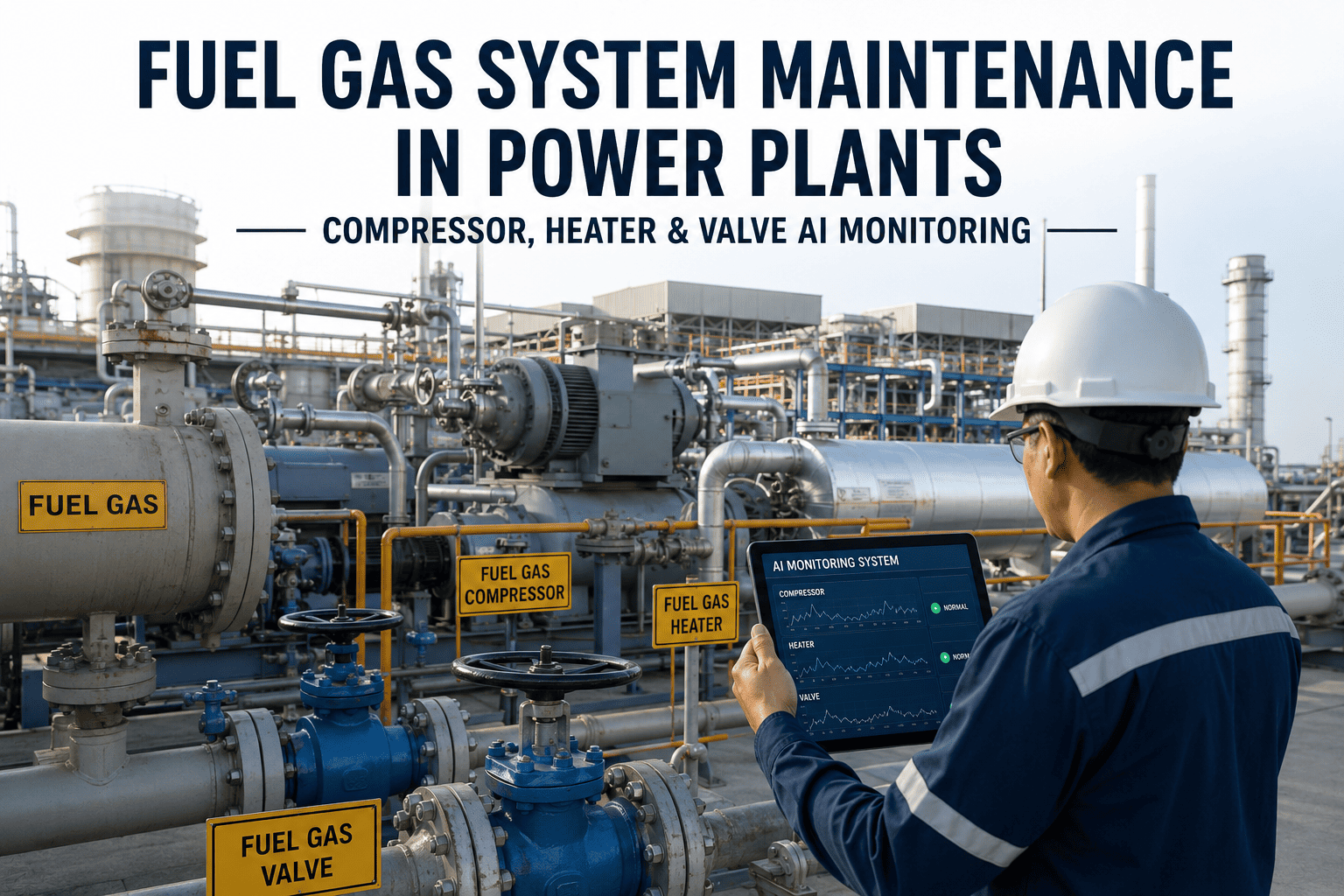
When pipeline gas drops through a pressure-reducing valve on its way to the turbine, it cools sharply enough that moisture and heavy hydrocarbons can condense straight out of the gas stream, and if the fuel gas heater downstream isn't holding enough superheat margin above the dew point that day, liquid carryover reaches the combustor. A fuel gas conditioning skid is a small system with an outsized consequence profile, because it sits between the pipeline and the single most expensive piece of rotating equipment on site, and a missed filter change, a drifting regulator, or an undersized heater doesn't announce itself until the turbine trips. Maintenance managers are typically watching separator liquid levels, coalescing filter differential pressure, heater outlet temperature, and regulator setpoint drift across a skid that runs unattended for weeks between physical inspections. Most of these failure modes develop gradually — a filter loading up, a regulator cycling more than it should, a heater losing heat transfer efficiency — and gradual drift is exactly what gets missed between scheduled walkdowns. iFactory's AI-driven platform tracks fuel gas skid instrumentation continuously, so a fouling filter or a drifting regulator gets flagged while there's still time to schedule the fix. Book a demo to see continuous fuel gas skid monitoring configured for your turbine or boiler fuel train.
AI-Driven · Fuel Gas Systems · Maintenance Reliability
The Fuel Gas Skid Runs Unattended for Weeks. Drift Doesn't Wait for the Next Walkdown.
iFactory tracks separator, filter, heater, and regulator performance across your fuel gas conditioning skid continuously, so a fouling element or a drifting setpoint gets caught before it reaches the combustor.
Skid Reference
The Four Components Doing the Work Between the Pipeline and the Turbine
A conditioning skid is a chain of components, and each one has its own way of failing quietly if it isn't watched continuously.
Stage 1
Inlet Separator
Removes free liquids and particulate before the gas reaches the pressure reduction and heating stages, protecting downstream regulators and filters from slugging.
Stage 2
Pressure Regulation
Reduces pipeline pressure down to the narrow range the turbine or boiler needs, and the pressure drop itself cools the gas through the Joule-Thomson effect.
Stage 3
Fuel Gas Heater
Superheats the gas above its hydrocarbon and water dew point after pressure reduction, preventing condensate from forming on the way to the combustion system.
Stage 4
Coalescing Filtration
Captures submicron liquid droplets and solid particles before final metering, protecting fuel control valves and burner nozzles from plugging or erosion.
Where Drift Hides
Four Failure Modes That Develop Quietly Between Inspections
Filter Loading
Coalescing elements load up gradually with particulate and liquid, and differential pressure across the filter rises steadily long before it hits an alarm threshold that forces a reactive change.
Regulator Drift
A regulator cycling more frequently than its design duty, or drifting off setpoint, can go unnoticed between walkdowns, and deferred regulator maintenance is how a combustor ends up overpressured during a setpoint excursion.
Heater Efficiency Loss
A heater running with reduced heat transfer efficiency may still hit its outlet temperature setpoint most of the time, but its superheat margin above the dew point shrinks, raising the risk of condensate carryover on colder days.
Condensate Accumulation
Any pipe run flatter than its design drain slope will pond condensate during low-flow periods, and that liquid can carry forward in slugs the next time flow increases, well before a scheduled drain check catches it.
Valve Access Deferral
Tight clearances around control valves make routine maintenance harder than it needs to be, and when a valve is difficult to reach, that maintenance tends to get pushed to the next outage rather than done on schedule, which is how a slow drift turns into a deferred repair.
How the Platform Works
From Skid Instrumentation to a Scheduled Fix in Four Steps
1
Continuous Skid Monitoring
Differential pressure, outlet temperature, regulator position, and separator level are pulled from the skid's existing instrumentation continuously.
2
Component Baseline Modeling
Each component is modeled against its own clean, healthy baseline, so a slow rise in filter differential pressure or a shrinking superheat margin is caught as a trend.
3
Dew Point Margin Tracking
Heater performance is tracked against the current gas composition's dew point, not just a fixed outlet temperature setpoint, so shrinking margin is visible before condensation risk rises.
4
Maintenance Alert Before Failure
Maintenance teams get flagged on a fouling filter, a drifting regulator, or a shrinking heater margin while there's still time to schedule the fix around a planned outage window.
Fault Reference
Common Skid Symptoms and What They Usually Point To
| Symptom |
Likely Cause |
Typical Response |
| Rising Filter Differential Pressure |
Coalescing element loading with solids or liquid |
Schedule an element change before it reaches the alarm threshold |
| Regulator Cycling Frequently |
Regulator sized for a different flow range, or internal wear |
Inspect regulator internals, confirm sizing against current flow demand |
| Shrinking Superheat Margin |
Heater fouling or reduced heat transfer efficiency |
Inspect heater elements, confirm setpoint against current gas composition |
| Rising Separator Liquid Level |
Increased liquid loading from upstream pipeline conditions |
Verify drain valve operation, check upstream condensate handling |
Skid Readiness
The Six-Point Fuel Gas Skid Readiness Scorecard
1
Coalescing filter differential pressure is trended continuously against a clean-element baseline
2
Regulator position and cycling frequency are monitored for drift, not just checked at the next walkdown
3
Heater superheat margin is tracked against current gas composition dew point, not a fixed outlet setpoint alone
4
Separator liquid level trends are visible continuously, so condensate loading changes get caught early
5
Maintenance alerts are tied to a trend crossing a threshold, not only to a hard alarm at the failure point
6
Component-level history is tracked over time, so recurring failure patterns on a specific skid become visible
Don't Let a Fouling Filter or a Drifting Regulator Wait for the Next Walkdown.
Continuous differential pressure, temperature, and regulator trend monitoring across your fuel gas conditioning skid, configured for your specific turbine or boiler fuel train.
From the Field
What Changed After a Heater Margin Problem Almost Reached the Turbine
Our fuel gas heater was hitting its outlet temperature setpoint on every reading we checked during walkdowns, so on paper it looked fine for months. What we didn't catch was that its actual superheat margin above the dew point had been shrinking as the heater fouled internally, and it only became a real problem on a cold morning when ambient conditions pushed the dew point up right as our margin was already thin. We caught the condensate carryover risk before it caused a trip, but it was closer than we wanted, and there was no way we would have seen that trend from a monthly walkdown reading alone. Once we had the heater margin trending against actual gas composition instead of just the outlet temperature number, we caught the same kind of fouling starting on our second skid nearly six weeks before it would have become urgent.
— Maintenance Manager, Combined Cycle Power Generation Facility
Conclusion
A Skid That Runs Unattended for Weeks Needs to Be Watched Every Day, Not Every Walkdown
The failure modes that matter most on a fuel gas conditioning skid, filter loading, regulator drift, and shrinking heater margin, almost never happen suddenly. They build gradually between scheduled inspections, which is exactly the window where a continuous monitoring gap turns a maintainable trend into an unplanned trip.
iFactory's AI-driven platform keeps your skid's instrumentation trending continuously, so maintenance teams see the drift while there's still time to schedule the fix around a planned outage instead of reacting to a combustor upset.
Across a fleet of skids, that same continuous view scales into a single priority list, so a maintenance manager overseeing several units doesn't have to reconstruct the picture site by site from separate local readings. Book a demo to see it configured against your fuel gas conditioning skid.
Frequently Asked Questions
Fuel Gas System Maintenance — What Maintenance Managers Ask
Why does superheat margin matter more than just hitting the heater's outlet temperature setpoint?
The outlet temperature setpoint is only meaningful relative to the gas's actual dew point at that moment, and dew point shifts with gas composition and ambient conditions. A heater can be hitting its setpoint reading while its margin above the current dew point has quietly shrunk due to internal fouling, which means the outlet temperature number alone can look fine right up until a colder day or a composition shift pushes the dew point close enough to cause condensation.
Book a demo to see dew point margin tracked against your heater's actual performance.
How early can a fouling coalescing filter typically be caught before it needs an emergency change?
Differential pressure across a coalescing filter tends to rise gradually well before it approaches the alarm threshold that forces a reactive change, so continuous trending typically gives maintenance teams weeks of lead time to schedule the element swap during a planned window. Catching that trend early is the difference between a routine consumable change and an unplanned skid isolation.
Can this monitor multiple fuel gas skids across different units from one view?
Yes. Each skid's instrumentation is modeled against its own baseline, and every unit's condition is visible from one shared view, so a maintenance manager overseeing several turbines or boilers doesn't need to check each skid's local readings separately to know which one needs attention next.
Contact support to discuss connecting multiple skids across your site.
Does this replace the manual walkdown inspection schedule entirely?
No. Physical walkdowns still catch things continuous instrumentation can't, like external corrosion, loose fittings, or unusual sounds, and remain a necessary part of a complete maintenance program. What continuous monitoring adds is visibility into the gradual trends that develop between those walkdowns, so the physical inspection schedule can focus on confirmation and hands-on items rather than being the only way a slow drift ever gets caught. In practice, most teams find the walkdown becomes more useful once the trend data narrows down which component to look at closely, instead of a general inspection that has to cover the whole skid evenly every time.
What instrumentation does a fuel gas skid need before this kind of monitoring can start?
Most fuel gas conditioning skids already include differential pressure, temperature, and pressure instrumentation as part of their standard PLC control panel and safety interlock system. The platform connects to that existing instrumentation rather than requiring a new sensor package in most cases, which means a typical skid can begin generating trend visibility within the early weeks of connection.
Catch the Drift Before the Skid Isolates the Turbine For You.
Continuous filter, regulator, heater, and separator trend monitoring across your fuel gas conditioning skid, configured for your specific turbine or boiler fuel train.