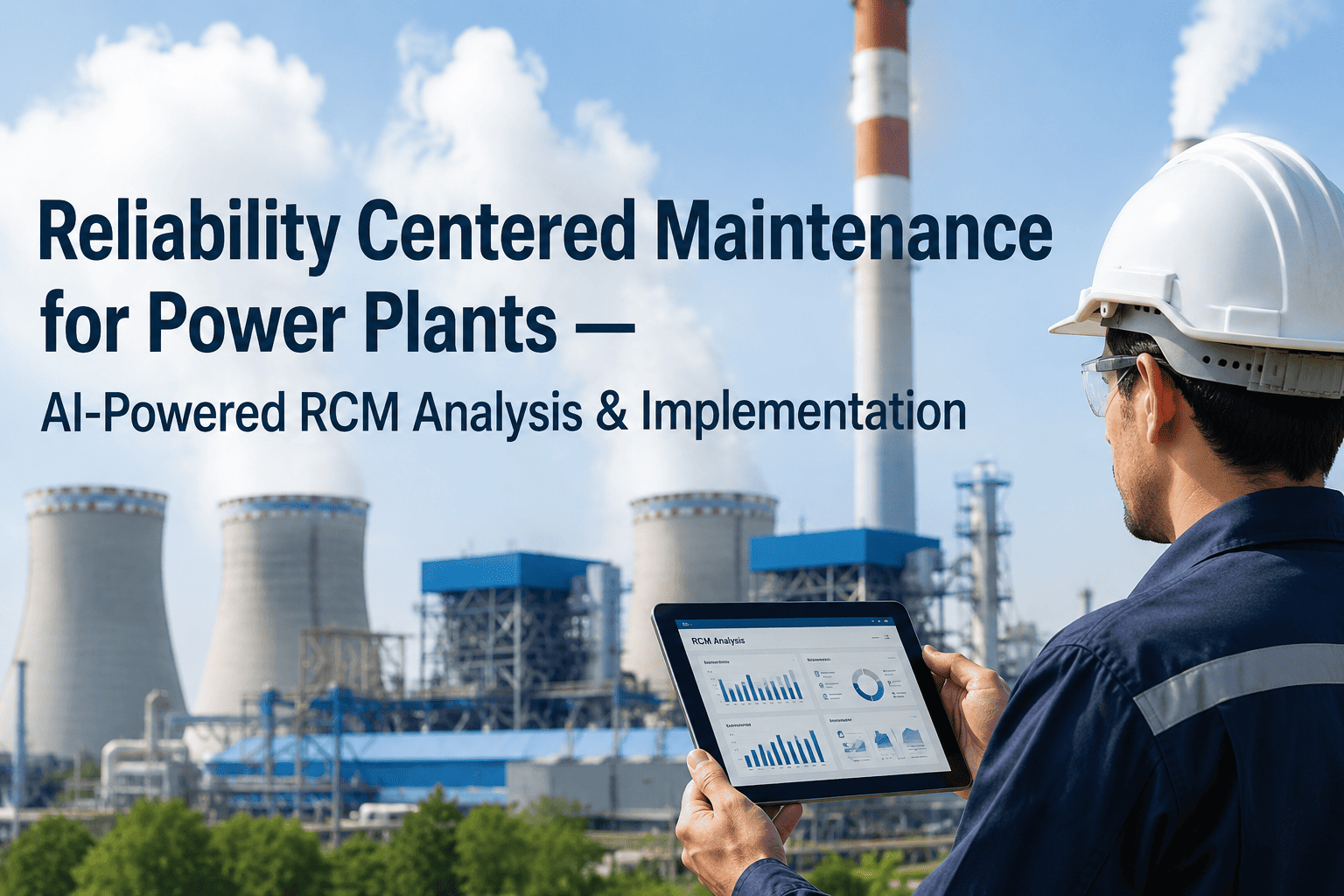
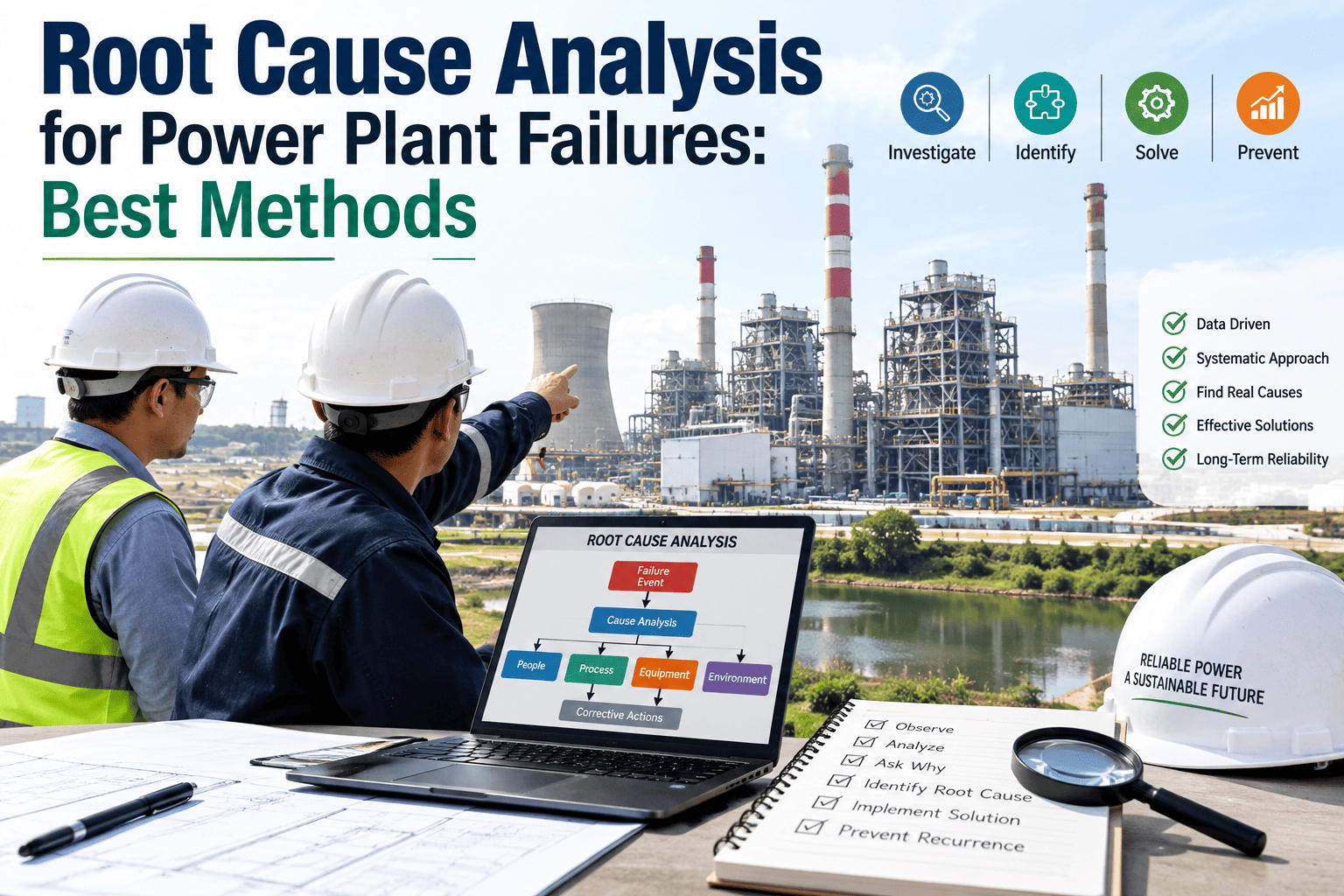
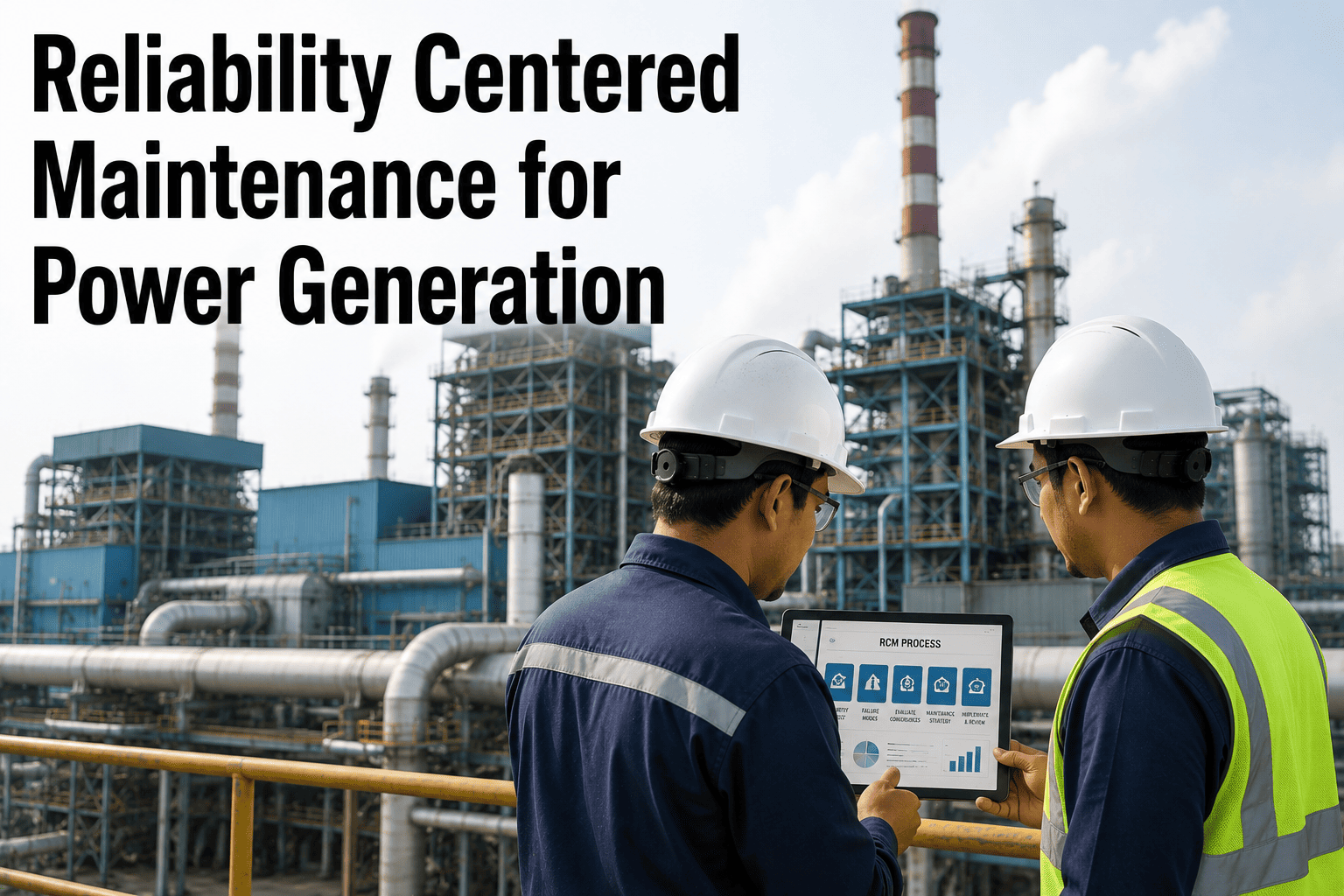
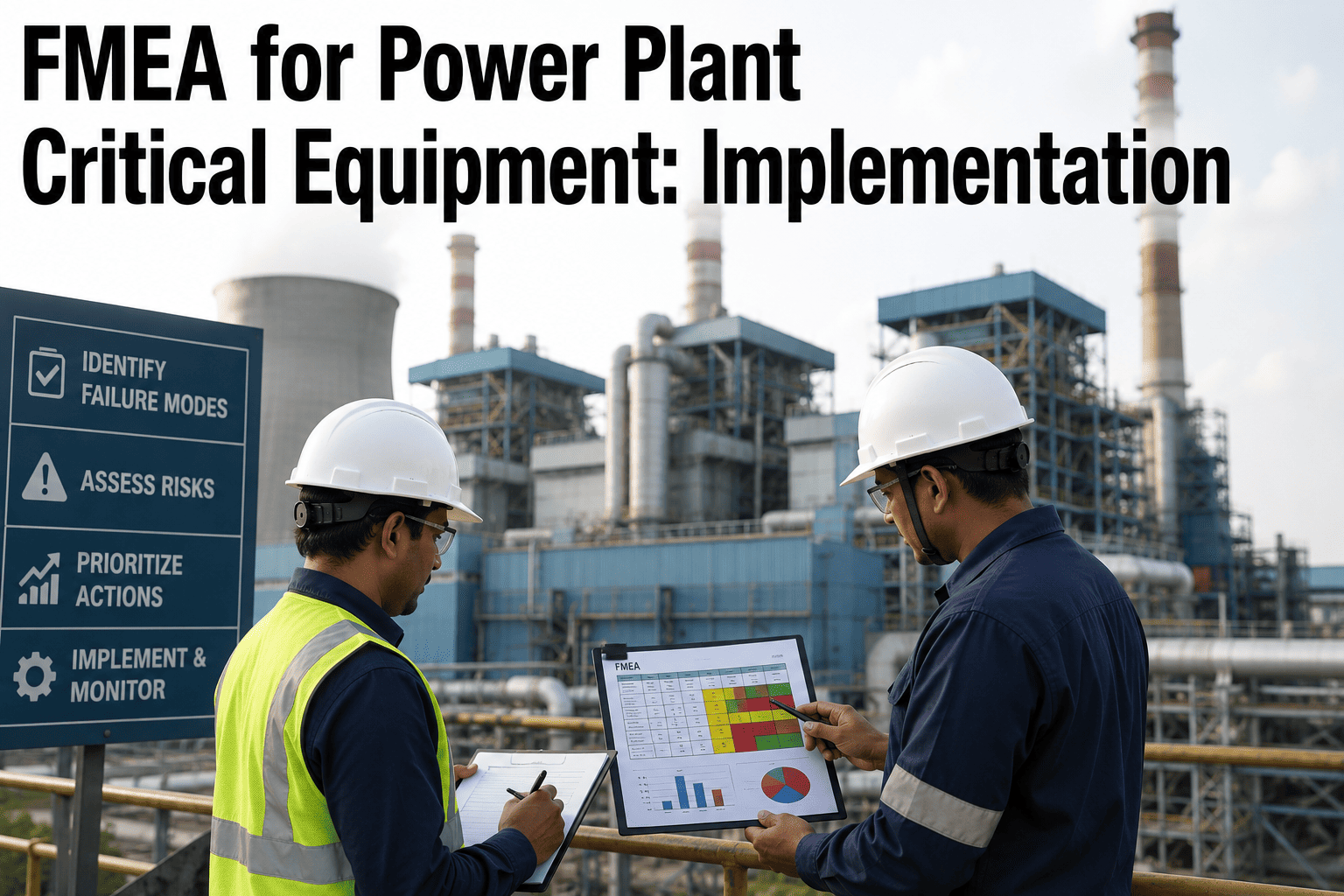
A power plant rarely fails all at once. It fails one bearing, one relay, one gasket at a time, and each small failure traces back to a decision someone made about which maintenance task to run and how often to run it. Most plants inherited those decisions from manufacturer defaults or the habits of engineers who left years ago, and the intervals are rarely revisited even as fuel mix, load cycling, and asset age keep changing. Reliability Centered Maintenance replaces inherited habit with a documented, defensible answer to a harder question — what is this asset actually supposed to do, and what happens the moment it stops. Compliance officers now need that logic on file, not just a schedule, and iFactory's AI builds it directly from your own equipment history — see how an RCM analysis takes shape for your plant.
RCM ANALYSIS · FAILURE MODE INTELLIGENCE · AUDIT-READY DOCUMENTATION
Stop Scheduling Maintenance by Calendar. Start Justifying It by Risk.
iFactory's AI runs the full seven-question RCM methodology against your asset register automatically, classifying failure consequences, selecting the right task for every failure mode, and producing the documented logic your audit binder has been missing.
31%
Fewer unscheduled outages after RCM adoption
65%
Of maintenance budgets still spent reacting, not preventing
75-85%
Task selection accuracy under systematic RCM logic
WHY THE OLD PM CALENDAR IS LOSING GROUND
The Cost of Maintaining Every Asset the Same Way
Time-based preventive maintenance treats a rarely-used standby pump the same as a critical turbine bearing, running both on the same fixed calendar regardless of how differently they actually fail. That approach quietly drains budget from the assets that need attention and wastes labor on the ones that don't.
47%
Higher unplanned downtime reported on critical rotating equipment running purely time-based schedules versus benchmark plants.
2,752 hrs
Typical mean time between failures observed on major rotating assets once condition data replaces guesswork in the interval.
12
Critical subsystems commonly covered in a first-phase RCM rollout across turbine, boiler, and electrical protection groups.
$2.8M
Reported quarterly cost of unplanned equipment failure at a single plant before a documented RCM program was in place.
THE METHODOLOGY
Seven Questions Every Maintenance Task Must Be Able to Answer
RCM was never a software feature — it is a structured line of questioning applied to every asset, one failure mode at a time. iFactory's AI asks these same seven questions against your equipment data automatically, at a scale no engineering team could sustain manually across an entire plant.
01
What is the asset supposed to do, in this plant, right now?
Function is defined against actual current operating context and performance standard, not the generic nameplate rating the manufacturer originally shipped with.
02
In what ways can it fail to perform that function?
Every functional failure is enumerated, including partial degradation that reduces output or efficiency without a full stoppage of the asset.
03
What causes each of those failures to happen?
Failure modes and effects analysis maps the specific mechanical, electrical, or process root causes behind every functional failure identified above.
04
What happens when each failure actually occurs?
Evidence of failure, production impact, and any safety or environmental exposure are documented, since this detail decides the consequence category.
05
Why does that consequence matter to the plant?
Failures are classified as safety and environmental, operational, non-operational, or hidden, and that classification sets the justified level of maintenance effort.
06
What can be done to predict or prevent it?
Condition-based monitoring, scheduled restoration, scheduled discard, or failure-finding inspection are weighed against technical feasibility and worth.
07
What if no suitable preventive task exists at all?
For hidden or safety-critical failures with no viable task, the default becomes redesign or a deliberately defined run-to-failure decision, never a placeholder PM.
CONSEQUENCE CLASSIFICATION
The Same Failure Means Something Different on Every Asset
A bearing failure on a standby fan and a bearing failure on the main feedwater pump are the same failure mode with completely different consequences, and RCM logic is built to tell those two situations apart automatically rather than treating them identically.
Safety and Environmental
Failures that could injure personnel or breach an environmental limit are never left to a fixed calendar; they receive the strictest justified maintenance effort available, condition-based wherever technically possible.
Operational
Failures that reduce output, efficiency, or availability without a safety impact are prioritized by production cost, so effort is spent where lost generation actually hurts the most.
Non-Operational
Failures whose only consequence is repair cost are handled with the least maintenance effort that is still economically justified, freeing budget for assets that carry real risk.
Hidden Failures
Protective devices that only reveal a failure when called upon, such as relays and trip systems, require scheduled failure-finding tasks since no operator would notice otherwise.
Your Failure History Already Contains This Logic
Work order history, protective relay test records, and outage reports already describe how your assets actually fail. iFactory's AI reads that history and builds the consequence-classified RCM logic instead of asking your team to start from a blank worksheet.
TASK SELECTION LOGIC
From Failure Mode to Approved Work Order, in Five Steps
Once a failure mode and its consequence category are known, RCM logic narrows down to a single justified maintenance task rather than leaving the decision to whoever happens to be scheduling that week.
TIME-BASED PM VS RCM-DRIVEN MAINTENANCE
What Actually Changes When Task Selection Becomes Defensible
The difference is not whether maintenance gets done. It is whether every task on the schedule can be traced back to a specific failure mode and a documented reason, which is exactly what an auditor or a new plant manager will eventually ask to see.
| Dimension |
Time-Based PM |
RCM-Driven Maintenance |
| Basis for Interval |
Manufacturer default or calendar habit |
Failure mode, consequence, and condition data |
| Hidden Failures |
Often undetected until called upon |
Covered by scheduled failure-finding tasks |
| Budget Allocation |
Even across all assets regardless of risk |
Weighted toward highest-consequence failure modes |
| Audit Documentation |
Schedule exists, rationale usually does not |
Full function-to-task logic on file for every asset |
| Response to Aging Assets |
Interval rarely revisited as risk changes |
Logic re-scored as condition data updates |
WHERE RCM DELIVERS THE MOST
Four Asset Groups Where Task Selection Errors Cost the Most
Not every asset benefits equally from a full RCM analysis. These four groups consistently carry the highest combination of failure consequence and maintenance cost across power generation plants.
Turbines and Rotating Equipment
Bearing wear, vibration-driven failures, and lubrication breakdown account for a large share of generation losses, and condition-based tasks consistently outperform fixed teardown intervals here.
Boiler and Pressure Systems
Tube leaks, refractory degradation, and safety valve drift carry both safety and production consequences, making consequence-driven task selection especially valuable in this asset class.
Electrical Switchgear and Protection
Relay and breaker failures are frequently hidden until a real fault occurs, which is exactly the category RCM's failure-finding task logic was built to address directly.
Cooling and Auxiliary Systems
Auxiliary equipment is often maintained on the same generic schedule as critical assets despite carrying far lower consequence, wasting labor that RCM reallocates toward higher-risk equipment.
FREQUENTLY ASKED QUESTIONS
What Compliance and Reliability Teams Ask Before Rolling Out RCM
How is RCM different from a standard preventive maintenance program?
Standard preventive maintenance schedules tasks by calendar or run-hours regardless of consequence, while RCM starts from function and failure mode and only assigns a task once it is proven technically feasible and worth doing. That distinction is what separates a maintenance calendar from a documented reliability program that can withstand an audit question.
Book a demo to see the difference applied against your own asset register.
Which assets should we start with when building an RCM program?
Most plants start with the asset groups where failure consequence and maintenance spend are both highest, typically turbines, boiler pressure systems, and protective electrical equipment, before extending the analysis to auxiliary and balance-of-plant equipment. iFactory's AI can rank your own asset register by this exact combination of criteria before you commit resources.
Contact our support team for help prioritizing your first phase.
How long does a full RCM analysis take for a power plant?
A manual RCM study on a single system can take a reliability engineer several weeks of workshops and documentation, which is why most plants never extend it past a handful of critical assets. iFactory's AI compresses this by drawing failure mode and consequence data directly from existing work order and inspection history rather than starting from a blank worksheet for every asset.
Book a demo to see a realistic timeline for your plant's asset count.
Does RCM analysis satisfy NERC and internal audit documentation requirements?
RCM produces exactly the kind of documented, function-to-task rationale that internal and regulatory audits look for, since every maintenance task on the schedule can be traced back to a specific failure mode and consequence classification. This does not replace a compliance program on its own, but it gives your team the underlying evidence auditors typically request.
Contact our support team to review documentation formats used by other plants.
Can RCM logic be maintained and updated as equipment ages or duty cycles change?
Yes, and this is one of the most commonly overlooked steps in manual RCM programs, where the analysis is completed once and then left untouched for years. iFactory's AI re-scores failure consequence and task justification automatically as new condition data, inspection results, and duty cycle changes come in, keeping the logic current instead of stale.
Book a demo to see how the logic updates over time on real equipment data.
Turn Failure History Into a Documented Maintenance Strategy
iFactory's AI runs the full RCM methodology against your existing asset and work order data, classifying consequences, selecting justified tasks, and keeping the logic current as your equipment ages. Book a demo to see it built against your own plant.