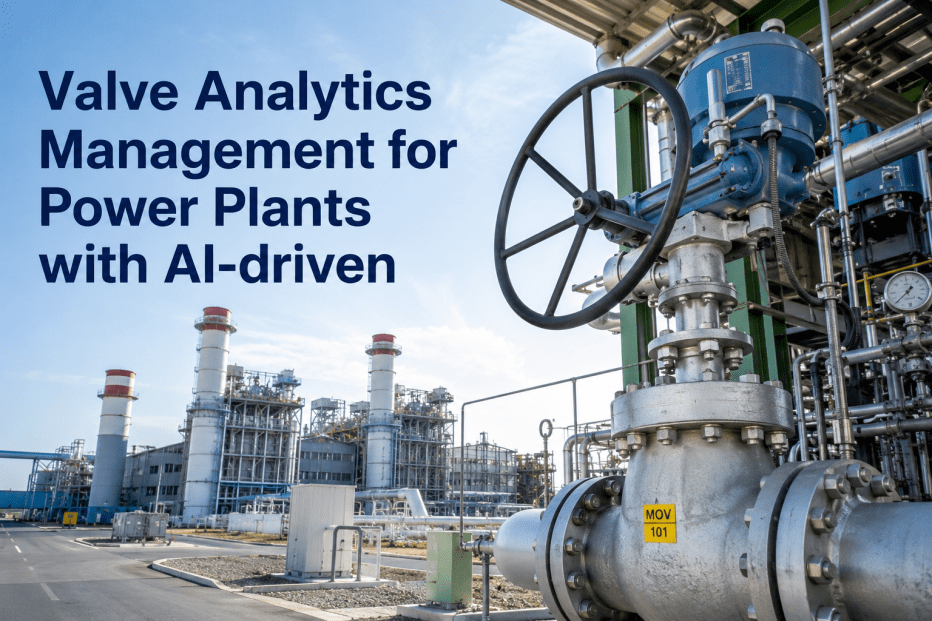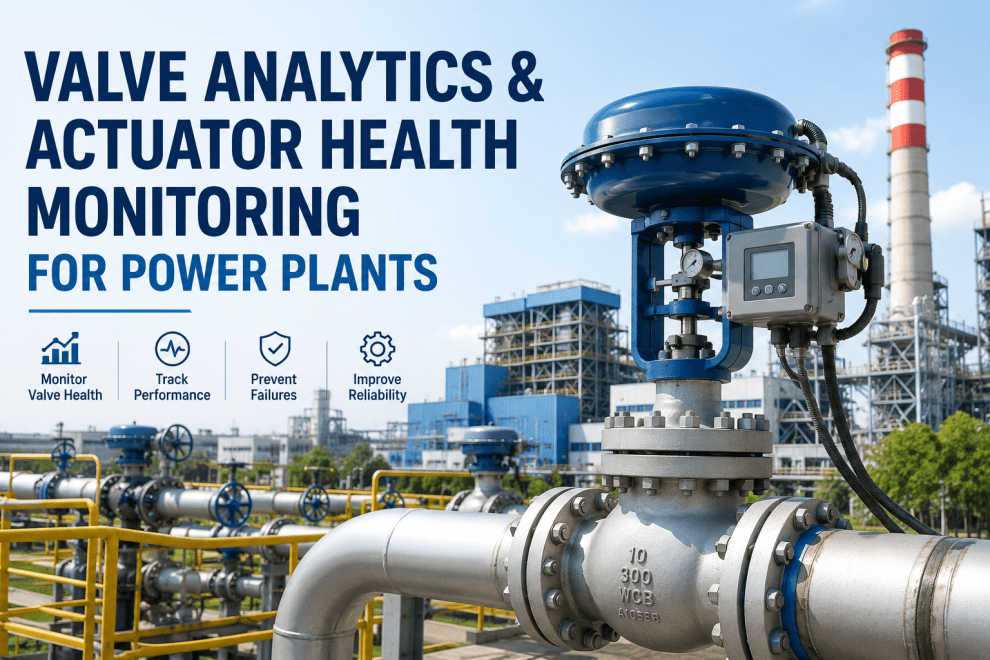
Valve and actuator failures in U.S. power plants do not happen without warning. Power plants that Book a demo of iFactory's valve analytics platform report 62% fewer valve-related unplanned outages and 45% lower emergency valve repair spend within the first year of deployment.
Stop Reacting to Valve Failures. Predict Them 30–90 Days Ahead.
iFactory's AI platform monitors control valves, safety valves, motor-operated valves, and actuators in real time — with valve-specific degradation models that deliver prioritized maintenance actions before failure forces an unplanned outage or safety event.
The Four Valve and Actuator Groups That Drive Power Plant Reliability
Power plants operate hundreds of valves and actuators across the steam cycle, cooling water systems, fuel gas supply, emissions control, and auxiliary systems — each with distinct failure physics, monitoring parameters, and consequence levels. iFactory's valve analytics library covers four high-consequence asset groups that account for the majority of valve-related unplanned events in U.S. power generation.Book a demo
Control Valves
Core Focus: Positioner feedback, stroke time trending, hysteresis measurement, and step response analysis. Control valve degradation is detectable through positioner deviation from setpoint and increasing deadband before it affects process control stability.
Safety & Relief Valves
Core Focus: Seat leakage detection, lift pressure verification, backseat condition monitoring, and pop-test interval tracking. A safety valve that fails to lift at set pressure during an overpressure event creates an immediate personnel and equipment safety exposure.
Motor-Operated Valves
Core Focus: Torque switch calibration drift, limit switch timing, motor current signature analysis, and stem thrust trending. MOV degradation is detectable through increasing torque-to-stroke ratio before the valve fails to fully close or open on demand.
Pneumatic & Hydraulic Actuators
Core Focus: Diaphragm integrity, air consumption rate, positioner response time, and supply pressure degradation. Actuator failure is preceded by measurable changes in stroking speed and supply pressure recovery time that iFactory detects weeks before failure.
Valve Analytics Approaches: Traditional Monitoring vs. AI-Predictive Intelligence
Most power plants monitor valve position through the DCS — open, closed, or intermediate — and schedule maintenance based on operating hours or calendar intervals. This approach misses the degradation signals that precede failure by weeks or months.Book a demo
| Valve Monitoring Parameter | Traditional Approach | iFactory AI Approach | Reliability Impact | Cost Impact |
|---|---|---|---|---|
| Stroke Time | Spot-checked during quarterly exercise | Continuous trending against baseline; deviation alerts at 10%, 20%, 30% increase | Sticking detected before valve fails to stroke fully | Emergency valve replacement avoided; planned during outage |
| Seat Leakage | Detected during shutdown or by downstream temperature observation | Downstream temperature trend + acoustic emission; leak rate quantified and trended | Leak detected at 0.5% of full flow, not 5% | Energy loss and erosion damage contained early |
| Torque / Thrust | Annual torque switch verification | Motor current signature analysis per stroke; torque trend tracked against OEM limits | Torque limit approached with weeks of warning before valve jams | Stem and actuator damage prevented |
| Positioner Response | Calibrated on failure or at annual interval | Step response test results trended; deadband and hysteresis tracked continuously | Positioner drift detected before process oscillation begins | Process variability reduction; spare positioner procurement planned |
| Partial Stroke Test | Manual test at scheduled interval | Automated partial stroke test with full data capture and trend analysis | Safety valve operability verified without full system isolation | Reduced test labor cost; no process interruption |
| Packing / Seal Condition | Visual inspection at overhaul | Stem position vs. actuator pressure ratio trend; packing friction increase detection | Packing degradation detected before external leakage or stem seizure | Packing replacement scheduled; emissions compliance maintained |
What Power Plants Achieve with AI-Driven Valve and Actuator Analytics
The results below represent data from U.S. power plants that have deployed iFactory's valve analytics platform across their critical valve and actuator fleet. These outcomes compound as the AI model learns from each maintenance event and improves detection precision.
Phased Deployment: From Baseline to Predictive Valve Maintenance
Deploying valve analytics across a power plant follows a structured progression that builds data integrity and team confidence. iFactory's implementation team follows a proven three-phase roadmap calibrated to the plant's existing valve monitoring infrastructure. Book a demo to discuss your plant's specific valve fleet configuration and monitoring gaps.
Connectivity & Baseline
Connect to existing valve positioner data streams, DCS historian valve position signals, and partial stroke test records. Establish baseline stroke time, torque, and positioner response for every monitored valve. Integrate CMMS valve work order history for failure mode correlation. Timeline: 6–8 weeks.
Analytics & Prediction
Deploy iFactory valve-specific degradation models: stroke time trend analysis, torque signature classification, seat leakage quantification, and positioner response degradation. Calibrate alert thresholds per valve type and criticality. Automate work order generation for detected deviations. Timeline: 8–12 weeks.Book a demo
Optimization & Automation
Integrate valve analytics with outage planning to schedule interventions during planned windows. Activate automated partial stroke testing for safety valves. Establish ML feedback loop where work order findings improve detection models. Achieve zero unplanned valve-related critical path outages.
Why Valve Analytics Requires AI, Not Better Calibration Schedules
In 28 years of power plant valve engineering — fossil, nuclear, and combined cycle — I have reviewed the root cause analysis reports on more than 200 valve-related forced outages. The pattern is remarkably consistent: the valve that failed was generating detectable signals in the monitoring data for weeks or months before the event. A control valve whose stroke time increased from 12 seconds to 18 seconds over six months was documented in the positioner log but never flagged. A safety valve whose seat leakage increased from undetectable to 2% of rated flow over three operating cycles was visible in the downstream temperature trend but not acted on.Book a demo
Valve Analytics and Actuator Health Monitoring — Frequently Asked Questions
What valve failures cause the most unplanned outages in power plants?
Control valve sticking or positioner failure is the most common cause of valve-related process trips in power plants, accounting for approximately 35% of valve-related forced outages. The second most common is motor-operated valve (MOV) torque switch failure or limit switch drift, which prevents the valve from reaching its required position during critical operations such as turbine steam admission or feedwater isolation. Safety valve failure to re-seat after lifting — while less frequent
How does iFactory's valve analytics differ from the plant's existing DCS valve position monitoring?
The DCS monitors valve position as a binary or analog signal — open, closed, or percentage of travel — for process control purposes. It does not analyze the quality of that position signal or trend it over time against the valve's own performance baseline. iFactory's valve analytics platform ingests the same position signal but adds continuous trend analysis of stroke time, positioner deviation, hysteresis, and step response.
What is the implementation timeline and investment for deploying valve analytics with iFactory?
For a typical 600 MW coal unit or 2x350 MW combined-cycle plant with existing DCS valve position monitoring and a CMMS in place, a full valve analytics deployment runs $65,000 to $130,000 over a 10–16 week implementation. The investment covers data integration from existing valve positioners and DCS historians ($15,000–$35,000), iFactory platform configuration including valve criticality register, stroke time baselines, torque signature libraries, and degradation model setup ($30,000–$60,000)Book a demo
Can iFactory integrate with the plant's existing valve positioner and DCS systems?
Yes. iFactory's valve analytics platform connects to existing valve positioners via HART, Foundation Fieldbus, Profibus PA, and wireless positioner protocols. It integrates with DCS historians including OSIsoft PI, GE Proficy, Siemens, and ABB systems through OPC-UA and API connectors. The platform reads valve performance data from existing sources, applies analytics, and writes maintenance recommendations back to the CMMS without requiring replacement of the plant's existing valve monitoring infrastructure. Book a demo to discuss your plant's specific valve positioner and DCS architecture.
How does AI detect safety valve degradation before catastrophic failure?
Safety valve degradation is detected through three primary signals that iFactory monitors continuously. First, seat leakage is quantified through downstream temperature trend monitoring — a leaking safety valve passes high-temperature fluid past the seat, which creates a measurable temperature rise in the downstream piping that iFactory correlates with valve status and upstream conditions to detect leakage rates as low as 0.5% of rated flow. Second, partial stroke test results are trended over successive tests to detect changes in lift pressure, reseat pressure, and stroke time that indicate mechanical degradation of the spring, disc, or seat surfaces.
The Data Exists. The Analytics Layer Is What Prevents the Valve Failure.
Valve and actuator failures in power plants are not random events. They are the endpoint of a degradation process that generates measurable signals in the monitoring data for weeks or months before the valve fails to stroke, the actuator loses torque, or the safety valve fails to lift. The stroke time trend is in the positioner log. The torque data is in the MOV controller. The seat leakage signal is in the downstream temperature reading. Book a demo to see how your plant's existing valve monitoring data can be converted from a passive log into a predictive reliability asset.
Stop Firefighting Valve Failures. Start Predicting Them with iFactory AI.
iFactory's valve analytics platform delivers the unified intelligence needed to monitor control valves, safety valves, motor-operated valves, and actuators at scale — purpose-built for U.S. power generation reliability programs.